 AI Tools Review Editorial Team
Quick answer:
Suno launched v6, v6-wild and v6-mini on 9 September 2026, its first generation of models trained entirely on licensed music rather than the disputed training data behind earlier Suno models. The deal spans Warner Music Group, BMG and Believe (the Believe partnership announced one day earlier, on 8 September). Suno retired every previous model outright at launch. v6-mini is free for everyone; v6 and v6-wild require a Pro or Premier subscription. Universal Music Group and Sony Music are not part of this deal and remain in active litigation against Suno, with settlement talks reportedly stalled since April 2026.
AI music generation has spent two years defined by a single unresolved question: who gets paid when a model learns from copyrighted recordings without permission? Suno's answer with v6 is not a legal argument — it is a product decision. Retrain from scratch on music its rights holders actually agreed to license, retire everything built on the old, contested data, and let the new models carry the argument that this generation was done properly from day one.
This article draws on Suno's own launch post at suno.com/blog/introducing-v6, contemporaneous reporting from Music Ally, Digital Music News, Variety and Billboard, and Rolling Stone's and Music Business Worldwide's coverage of the underlying Warner Music settlement. Every commercial and legal claim below is attributed to its source.
Suno v6's launch covered alongside the week's other major AI-news stories.
Executive Summary
- Launched 9 September 2026 as three variants: v6 (flagship), v6-wild (experimental) and v6-mini (free), per Suno's own blog post authored by CEO Mikey Shulman.
- Trained "from the ground up" on an entirely new dataset of licensed partner music, user data and Suno's accumulated learnings — explicitly not reusing prior training data.
- Three-way label partnership: Warner Music Group and BMG signed ahead of launch; independent distributor Believe joined on 8 September, one day before v6 shipped.
- Every earlier Suno model was retired at launch — a deliberate clean break rather than an old-and-new-side-by-side rollout.
- Universal Music Group and Sony Music are not part of the deal. Their litigation against Suno continues, with Digital Music News reporting a settlement impasse between Universal and Suno as of April 2026.
- New editing features: plain-language section and lyric edits, cross-track mashups, multimodal input (text, audio, image, video), plus a redesigned Studio 2.0 workspace.
- Safeguards added: audio watermarking and fingerprinting intended to make fraud and platform misuse harder, per Music Ally's reporting.
- Revenue sharing with Warner, BMG and Believe began immediately upon v6's rollout, and Suno says opt-in artist likeness/remix features are planned for later, not included at launch.
From Lawsuits to Licensing Deals
To understand why v6 exists in the form it does, the starting point isn't the model architecture — it's the lawsuits. Major labels sued Suno (and its rival Udio) over training on copyrighted recordings without a licence. Warner Music Group was among the plaintiffs, and according to Music Business Worldwide's reporting on the resolution, Warner and Suno have now signed what both companies call a "first-of-its-kind partnership" that simultaneously settles Warner's lawsuit and establishes an ongoing licensing relationship, intended, in the companies' own words, to "open new frontiers in music creation, interaction, and discovery, while both compensating and protecting artists, songwriters, and the wider creative community." Rolling Stone's coverage adds that artists and songwriters retain control over whether and how their names, images, likenesses, voices and compositions are used in new AI-generated music built on this arrangement.
BMG signed a comparable deal, and Believe joined on 8 September 2026, the day before v6 shipped — giving Suno three named rights-holder partners feeding the licensed dataset v6 was trained on. Tracks created using the partner-licensed model become eligible for distribution through Believe and TuneCore as part of that arrangement, according to Music Ally's reporting.
Three Models: v6, v6-wild, v6-mini
Suno shipped three distinct variants rather than one flagship model, each aimed at a different use case:
| Model | Access | Suno's own description |
|---|---|---|
| v6 | Pro / Premier | "Reliable, precise and consistently delivers polished music" — for when creators know their exact vision |
| v6-wild | Pro / Premier | "Built for exploration" — less predictable, more varied, for "unexpected, textured and ambitious results" |
| v6-mini | Free, all users | "Delivers better, faster results than any free model" |
Descriptions quoted directly from Suno's official launch post, suno.com/blog/introducing-v6.
Splitting a "precise" flagship from a deliberately "less predictable" sibling is a notable design choice: rather than trying to make one model satisfy both the user who wants exactly what they asked for and the user who wants to be surprised, Suno ships both temperaments as named, selectable products.
What v6 Actually Adds
Beyond the underlying training data, Suno's launch post highlights several concrete new editing capabilities. Users can edit a single song section or lyric line in plain language — Music Ally's coverage gives the examples "change the chorus so it's sung by a gospel choir" and combining "the vocals from x, drums from y, and add new lyrics about losing control." Mashups let a track pull elements from several existing songs at once. Multimodal input accepts text, audio, images or video as a starting point, and users can sample, isolate and build beats within one workflow rather than switching tools mid-project.
Suno also introduced audio watermarking and fingerprinting alongside v6, explicitly framed as anti-fraud and anti-misuse infrastructure for distribution platforms rather than a creative feature — a direct response to the kind of provenance and misattribution concerns that dogged the pre-licensing era of AI music.
Taken individually, none of these four capabilities is unprecedented in generative audio; taken together, they mark a shift from "generate a full song from a text prompt and hope it's close enough" toward "generate a draft, then edit it the way you'd edit a real production." Plain-language section edits and mashups in particular target the single biggest complaint about earlier text-to-song tools: that getting one specific detail wrong — the wrong instrument in the bridge, a lyric that doesn't scan — meant regenerating the entire track from scratch and hoping the rest came out just as good a second time. Editing one section in place, without touching the rest, is a materially different creative workflow, closer to how a human producer works in a DAW than to how a single end-to-end generation model has historically operated.
Studio 2.0 and the New Editing Workflow
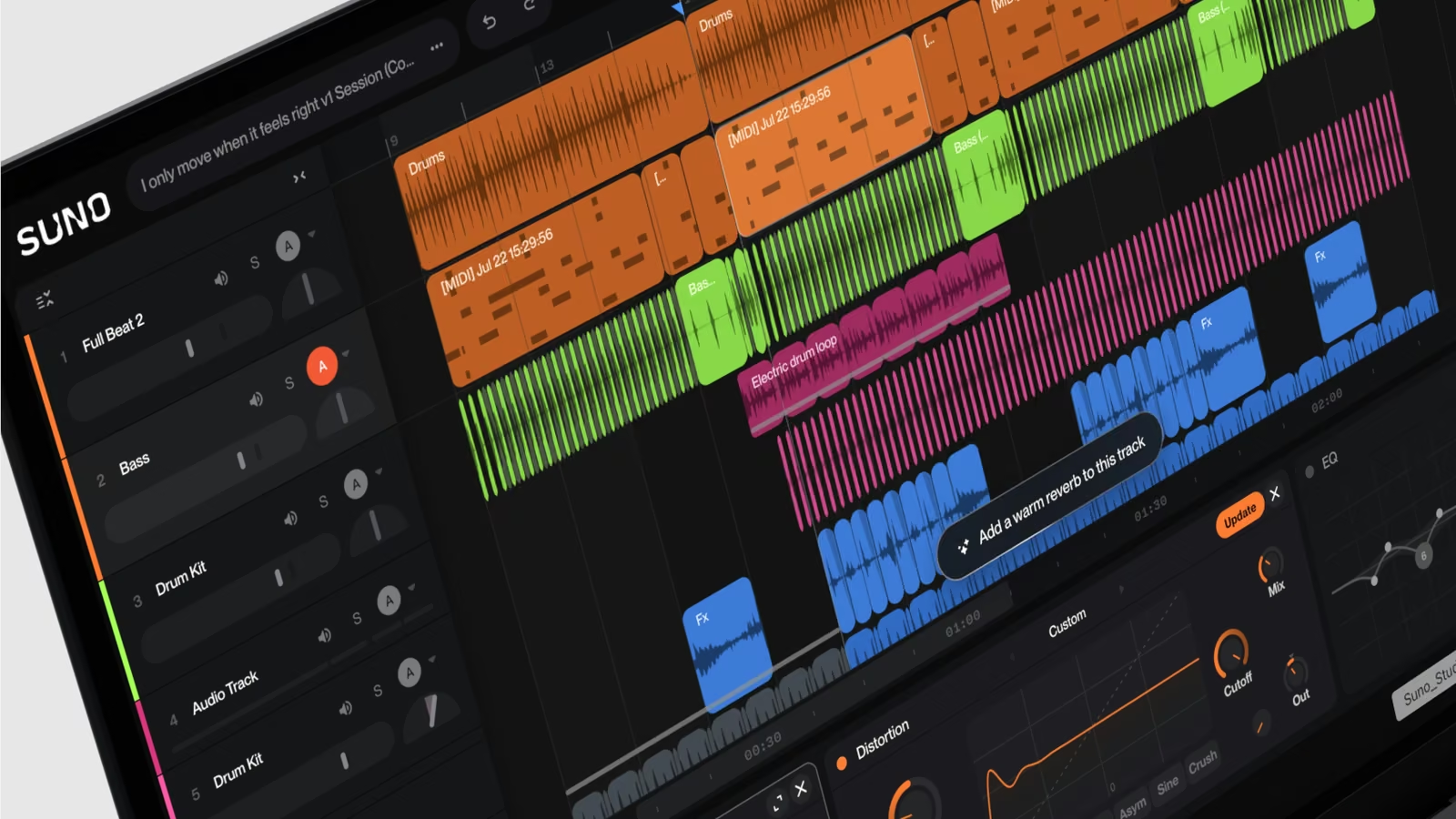
The plain-language editing features ship inside a redesigned workspace Suno calls Studio 2.0: a track-lane editor with drums, bass and audio channels laid out much like a conventional DAW, but with natural-language edit commands available directly inline alongside conventional mixing controls (EQ, distortion, cutoff, mix level).
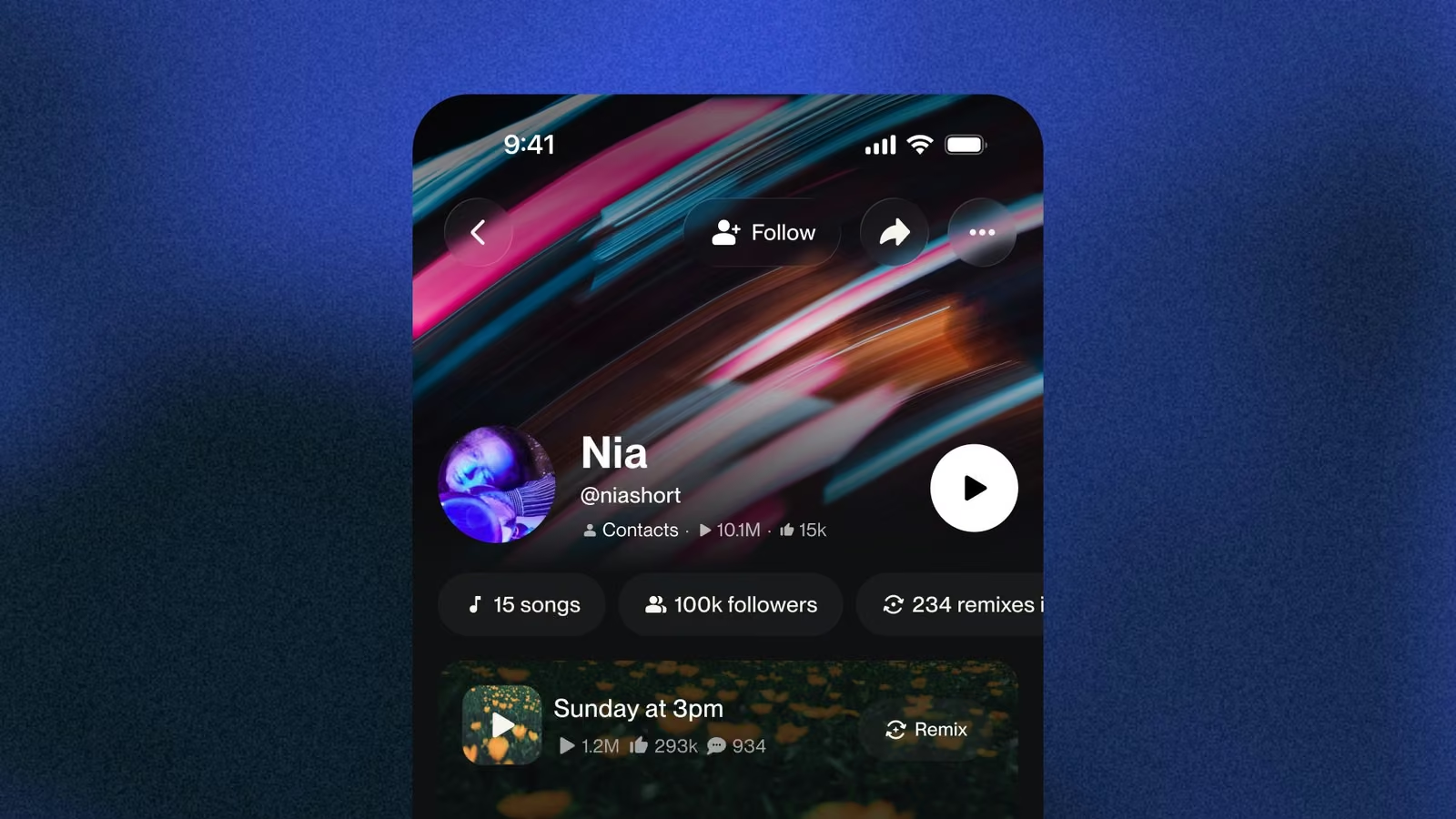
Suno's v6 launch materials also point to social and profile features arriving alongside the model update — public artist-style profiles showing song counts, follower totals and remix counts on generated tracks, positioning individual creators' outputs less like one-off generations and more like an ongoing catalogue with its own audience.
The Labels That Didn't Sign
The licensing story is genuinely partial, not universal, and the site's quality bar requires saying so plainly. Universal Music Group and Sony Music are not part of the v6 licensing arrangement. Digital Music News reported in April 2026 that Universal and Suno had hit a settlement talk impasse, and as of publication their underlying copyright case against Suno has no trial date, per the same reporting.
There is a second, separate legal thread worth knowing about: the American Federation of Musicians has sued Universal Music Group and Warner Music Group directly, not Suno, alleging that the labels licensed recordings featuring its members' performances to Suno and Udio without compensating or crediting the session musicians who actually played on them, according to reporting from Music Business Worldwide and The Hollywood Reporter. That suit is a reminder that even a settled, licensed deal between a label and an AI company doesn't automatically resolve who inside that label's own artist and session-musician roster gets paid for the licensed recordings underneath it.
The Wider AI Music Licensing Race
Suno is not the only AI music company racing to convert lawsuits into licences, and looking at its rival Udio's parallel timeline shows just how uneven this transition has been, label by label. Universal Music Group settled with Udio first, announcing a strategic agreement in late October 2025 that ended UMG's part in the joint UMG/Sony/Warner litigation filed against Udio in June 2024, with a new UMG-licensed Udio platform slated for a 2026 launch and UMG artists able to participate on an opt-in basis. Warner Music Group and Udio then struck their own separate settlement in mid-November 2025. Reported commercial terms from the UMG-Udio arrangement include a per-generation royalty in the $0.002–$0.005 range, rising for outputs that get commercially distributed — one of the few concrete numbers to leak out of any of these AI-music settlements.
Lay that timeline next to Suno's, and the asymmetry is stark: Universal settled with Udio a full year before it managed anything with Suno, and as of publication has still reached no agreement with Suno at all, while Warner went the opposite direction, settling with Suno as part of the v6 launch while its Udio settlement had already landed months earlier. Sony Music, meanwhile, remains in litigation against both companies. The practical upshot for anyone evaluating "licensed AI music" as a category right now is that no single platform is licensed by all three majors simultaneously — Suno has Warner and BMG plus the independent Believe; Udio has Warner and Universal; Sony has settled with neither. Choosing a platform on licensing grounds alone currently means choosing which majors matter most to your specific use case.
Pricing & Revenue Sharing
v6-mini is free for all users. v6 and v6-wild both require a Suno Pro or Premier subscription — Suno's launch materials do not publish new standalone per-model pricing beyond the existing Pro/Premier tier structure. Suno confirmed that revenue sharing with Warner, BMG and Believe began immediately upon v6's rollout, meaning licensed rights holders start receiving a cut of relevant Suno revenue from launch day rather than after some later reconciliation period.
A further opt-in artist experience is planned but not included in the initial v6 release: artists who consent will eventually be able to let their likeness and catalogue be used in remix experiences, with compensation tied to that participation. Suno's Jack Brody is quoted describing this as a future capability, not a day-one feature.
Limitations
- Not a universal licensing settlement. Universal Music Group and Sony Music remain outside the deal and are still litigating against Suno, with talks reportedly stalled since April 2026.
- Every previous Suno project loses its underlying model. Retiring all prior models outright means existing users' established styles and saved workflows built on older Suno models no longer have that exact model available.
- The AFM's suit against Universal and Warner raises an unresolved question about whether session musicians whose past recordings were licensed into this pipeline are being fairly compensated, separate from Suno's own settlements with the labels themselves.
- No new v6-specific pricing tiers. Access is gated by the existing Pro/Premier subscription structure rather than new plans built around what v6 specifically adds.
- Opt-in artist remix features are not live yet — the most direct mechanism for individual artists to participate and be compensated is still a future release, not part of the initial v6 launch.
How It Compares
Suno's own framing positions v6 against its own past self as much as against any competitor: the entire launch narrative is a contrast between the old, contested-data-trained models (all retired) and the new licensed generation. Against other generative media companies covered on this site, the comparison that matters most is process rather than output quality: where Krea Agents is racing to add agentic orchestration on top of dozens of third-party visual models, Suno's v6 story is about retroactively legitimising its training data pipeline for one category, music, before pushing further on features.
Against video generators such as OpenAI's Sora 2 and ByteDance's Seedance 2.0, both of which have faced their own rights and provenance questions around generated likeness and audio, Suno's three-label licensing arrangement is a comparatively concrete, disclosed answer to "where did the training data come from" — even though it only covers roughly two of the major labels, not all of them.
Against its most direct rival, Udio, the comparison is genuinely close to a coin flip depending on which label matters most to a given user: Udio secured Universal a year before Suno managed any deal with the same label, but Suno secured Warner and the independent distributor Believe on a faster timeline than Udio's own Warner settlement fully matured into a shipped product. Neither platform has Sony. For most everyday creators the distinction is academic; for a label-side A&R team or a rights-conscious commercial user deciding where to build a workflow, it's the whole decision.
Who Should Use It
Worth using now if you want a free, no-strings-attached way to generate music (v6-mini), or you're a Pro/Premier subscriber who wants Suno's most capable model with material provenance that's disclosed rather than contested — useful specifically for creators who plan to distribute or monetise output and want to point to a licensed pipeline if asked.
Worth being cautious about if your use case depends on styles or saved projects built on a specific retired earlier Suno model, or if you're watching this space specifically for how the unresolved Universal/Sony litigation and the AFM's musician-compensation suit ultimately get resolved before committing to a long-term commercial workflow on top of it.
The Bottom Line
Suno v6 is less a model upgrade than a governance decision wearing a model upgrade's clothes: retrain everything on licensed data from three named partners, retire everything trained on the old, contested data, and let that clean break carry the argument that this generation of Suno was built the right way. Warner, BMG and Believe now share in Suno's revenue from day one, and the new editing, mashup and multimodal features are genuinely substantial additions on their own merits.
The honest caveat is that "licensed AI music" still means "licensed by some of the majors," not all of them — Universal and Sony remain in litigation with no resolution in sight as of this writing, and a separate suit from the musicians' own union suggests that even settled label deals haven't fully closed the compensation question for the people whose original recordings entered these datasets in the first place.
Suno's own launch post and Music Business Worldwide's coverage of the Warner settlement carry the fullest detail referenced throughout this article.
Last updated: 13 September 2026, four days after v6 launched. This article will be revised if Universal or Sony reach a settlement with Suno, or if opt-in artist remix features ship.
Get the free guide: Claude vs ChatGPT, Gemini & Grok
A 20-page playbook covering everything you need to choose and use the big four AI models in 2026, full cost and feature comparisons, what each is best (and worst) at, and how-tos for images, vectors, building a website, Claude Code and more.