 AI Tools Review Editorial Team
Quick Answer:
To choose an AI model in November 2026, start from the job, not the leaderboard. Claude Fable 5.2 leads the Artificial Analysis Intelligence Index at 64.6, but it costs $26.54 per task. GPT-6.2 Sol scores 57.3 for $1.01 per task, Gemini 4 Hydrogen has the lowest hallucination rate at 8.5, and Kimi K3.1 Pro is the strongest open-weights model at 46.5. Pick two or three candidates, test them on your own work, and re-check monthly.
64.6
Top Intelligence Index score
Claude Fable 5.2, max effort
$1.01
Cost per task for GPT-6.2 Sol
Index 57.3, against $26.54 for Fable 5.2
8.5
Lowest hallucination rate in the top ten
Gemini 4 Hydrogen, lower is better
46.5
Best open-weights score
Kimi K3.1 Pro
Source: Artificial Analysis, via src/data/aa-snapshot.json (index v5.0.1), observed 22/11/2026
How Do You Choose an AI Model in November 2026?
You choose an AI model in November 2026 by matching four numbers to your task: capability, cost per task, reliability and, where it matters, whether the weights are open. The market moved fast this autumn. Claude Fable 5.2 (09/11/2026), GPT-6.2 Astra and GPT-6.2 Sol (17/11/2026) and Gemini 4 Neon (18/11/2026) all launched within ten days, so older advice that names a single "best" model is out of date.
This guide uses our own /benchmarks data, which reads the independent Artificial Analysis leaderboard each day, plus the vendor system cards on each model's tool page. Scores are Artificial Analysis figures at the effort setting shown in the snapshot (for example max for Fable 5.2 and xhigh for Neon), so they are not directly comparable with a vendor's own launch table.
Which AI Models Lead the Benchmarks in November 2026?
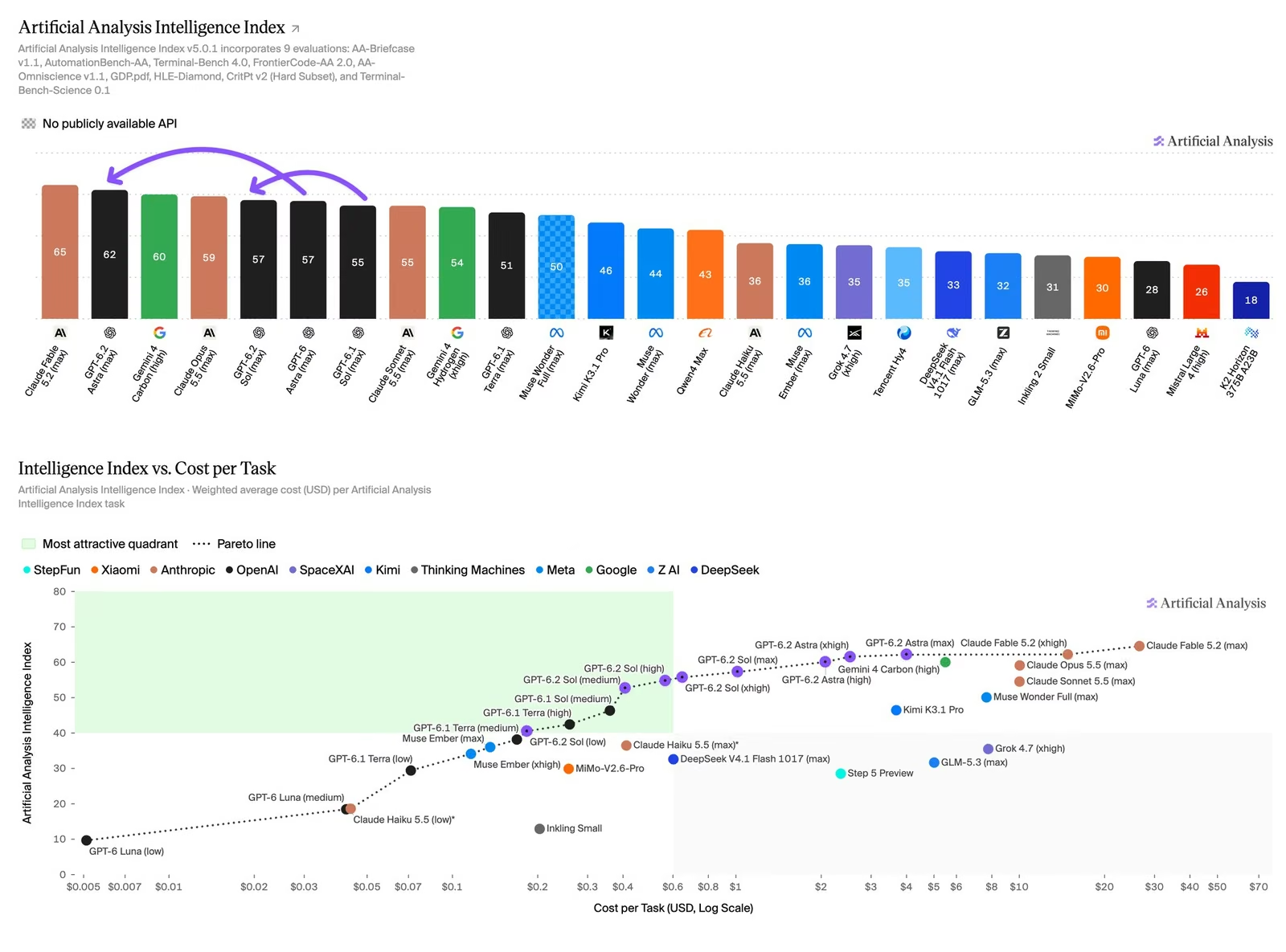
Claude Fable 5.2 leads the Artificial Analysis Intelligence Index at 64.6, ahead of GPT-6.2 Astra at 62.1 and Gemini 4 Neon at 61.4. The top six are separated by only 7.3 points, so cost and reliability usually matter more than rank.
| Model | Maker | Released | Intelligence Index | Coding Index |
|---|---|---|---|---|
| Claude Fable 5.2 | Anthropic | 09/11/2026 | 64.6 | 58.5 |
| GPT-6.2 Astra | OpenAI | 17/11/2026 | 62.1 | 53.5 |
| Gemini 4 Neon | 18/11/2026 | 61.4 | 58.6 | |
| Gemini 4 Carbon | 28/10/2026 | 60.0 | 55.5 | |
| Claude Opus 5.5 | Anthropic | 22/09/2026 | 59.1 | 58.2 |
| GPT-6.2 Sol | OpenAI | 17/11/2026 | 57.3 | 49.8 |
Source: Artificial Analysis, index v5.0.1, observed 22/11/2026. Each model is shown at the effort setting recorded in our snapshot.
Intelligence Index against Coding Index
Six leading models, Artificial Analysis points. Higher is better.
- Intelligence Index
- Coding Index
Claude Fable 5.2
GPT-6.2 Astra
Gemini 4 Neon
Gemini 4 Carbon
Claude Opus 5.5
GPT-6.2 Sol
Show data table
| Benchmark | Intelligence Index | Coding Index |
|---|---|---|
| Claude Fable 5.2 | 64.6 | 58.5 |
| GPT-6.2 Astra | 62.1 | 53.5 |
| Gemini 4 Neon | 61.4 | 58.6 |
| Gemini 4 Carbon | 60.0 | 55.5 |
| Claude Opus 5.5 | 59.1 | 58.2 |
| GPT-6.2 Sol | 57.3 | 49.8 |
Source: Artificial Analysis via /benchmarks snapshot, observed 22/11/2026
How Much Does Each AI Model Cost Per Task?
Cost per task varies by more than 25 times among the top six models: GPT-6.2 Sol costs $1.01 per task and Claude Fable 5.2 costs $26.54. Artificial Analysis measures this as the price of completing its coding-agent tasks, so it includes how many tokens each model spends, not only the list price.
List price alone misleads. GPT-6.2 Astra and Fable 5.2 both list at $8 per million input tokens and $40 per million output tokens, yet Astra used about 41,029 tokens per task against 273,776 for Fable 5.2. That is why Astra's measured cost is $4.00 against $26.54.
| Model | Input per 1M tokens | Output per 1M tokens | Cost per task | Tokens per task |
|---|---|---|---|---|
| Claude Fable 5.2 | $8 | $40 | $26.54 | 273,776 |
| GPT-6.2 Astra | $8 | $40 | $4.00 | 41,029 |
| Gemini 4 Neon | $3 | $15 | $6.44 | 141,631 |
| Gemini 4 Carbon | $4 | $20 | $7.76 | n/a |
| Claude Opus 5.5 | $4 | $20 | $10.04 | n/a |
| GPT-6.2 Sol | $2 | $10 | $1.01 | n/a |
Source: Artificial Analysis via /benchmarks snapshot, observed 22/11/2026. The snapshot gives token counts only for some models, shown as n/a otherwise.
Artificial Analysis cost per task
US dollars per task at each model's recorded effort setting. Lower is better.
Claude Fable 5.2
Claude Opus 5.5
Claude Sonnet 5.5
Gemini 4 Carbon
Gemini 4 Neon
GPT-6.2 Astra
GPT-6.2 Sol
GPT-6.1 Terra
Show data table
| Benchmark | Cost per task |
|---|---|
| Claude Fable 5.2 | $26.54 |
| Claude Opus 5.5 | $10.04 |
| Claude Sonnet 5.5 | $10.02 |
| Gemini 4 Carbon | $7.76 |
| Gemini 4 Neon | $6.44 |
| GPT-6.2 Astra | $4.00 |
| GPT-6.2 Sol | $1.01 |
| GPT-6.1 Terra | $0.96 |
Source: Artificial Analysis via /benchmarks snapshot, observed 22/11/2026
Which AI Model Is Best for Coding?
Gemini 4 Neon, Claude Fable 5.2 and Claude Opus 5.5 are effectively tied for coding on the Artificial Analysis Coding Index, at 58.6, 58.5 and 58.2. Claude Sonnet 5.5 follows at 56.3 and costs $10.02 per task, close to Opus 5.5's $10.04.
On Terminal-Bench 4.0 the order changes. Gemini 4 Carbon scores 65.2, GPT-6.2 Astra 64.1, and Gemini 4 Neon and Claude Sonnet 5.5 both 63.6, while Claude Fable 5.2 scores 59.6. On FrontierCode 2.0 Fable 5.2 leads at 48.8, then Opus 5.5 at 46.4 and Astra at 45.4. Coding results depend on the harness, which Artificial Analysis records as Claude Code for the Claude models, Codex for OpenAI and Antigravity CLI for Gemini 4 Neon. Test on your own repository before committing.
For model-specific detail see our reviews of Gemini 4 Neon and Claude Fable 5.2 against Opus 5.5, or the Claude Sonnet 5.5 tool page.
Which AI Model Hallucinates Least?
Gemini 4 Hydrogen has the lowest hallucination rate among the leading models at 8.5, followed by Gemini 4 Carbon at 11.4 and Gemini 4 Neon at 14.4. Claude Fable 5.2 (59.3) and GPT-6.2 Astra (59.1) are far higher, and Claude Opus 5.5 is at 50.3. Lower is better on this measure.
The trade-off is real. The two highest-scoring models on the Intelligence Index have the two highest hallucination rates in this group, so a strong score does not mean the model admits when it does not know. If you use a model for research, legal or medical drafting, or anything where a confident wrong answer is costly, weigh this measure heavily and check the sources. Meta's Muse Wonder Full also scores a low 17.6.
Read the Gemini 4 Hydrogen and Gemini 4 Carbon tool pages for the vendor's own figures.
Which Open-Weights AI Model Is Best?
Kimi K3.1 Pro is the strongest open-weights model in our snapshot, scoring 46.5 on the Artificial Analysis Intelligence Index with a coding score of 48.6, at $2 per million input tokens and $10 per million output tokens. That is 18.1 points below Claude Fable 5.2, so open weights still trail the closed frontier, though they give you control over hosting and data.
| Open-weights model | Maker | Intelligence Index | Input / output per 1M |
|---|---|---|---|
| Kimi K3.1 Pro | Kimi | 46.5 | $2 / $10 |
| Tencent Hy4 | Tencent | 34.6 | $0.834 / $2.501 |
| DeepSeek V4.1 Flash 1017 | DeepSeek | 32.6 | $0.3 / $1.2 |
| GLM-5.3 | Z AI | 31.7 | $1.4 / $4.4 |
| Mistral Large 4 | Mistral | 26.1 | $0.7 / $2.1 |
Source: Artificial Analysis via /benchmarks snapshot, observed 22/11/2026.
How Do You Check an AI Model Is Safe to Use?
You check an AI model's safety by reading the vendor's system card, which lists the safety level, the findings and the benchmark results the vendor ran itself. Every model tool page on this site now shows a system-card section drawn from that document, with the source link and the date we last checked it.
For example, OpenAI's card for GPT-6.2 Astra rates it Critical for Cybersecurity and High for AI Self-Improvement, while Anthropic's card for Fable 5.2 says Claude Mythos 5.2, its more permissive sibling, is restricted to vetted organisations. Our explainer What Is a System Card? shows how to read one. If you are building an agent that runs unattended, also read What Is an Always-On AI Agent?
What Is a Simple Process for Choosing an AI Model?
A simple process for choosing an AI model has five steps, which are our own recommendation rather than a vendor method.
- Name the task. Coding, research, drafting and agent work reward different models, as the coding and hallucination sections above show.
- Set a budget per task. Use cost per task, not list price, because token use differs several-fold between models.
- Shortlist two or three models from /benchmarks, covering one premium option and one cheaper option.
- Test them on 10 to 20 of your own real tasks. Public benchmarks do not use your data, your prompts or your tools.
- Re-check monthly. The leaderboard changed this month and will again.
If you want one default, GPT-6.2 Sol is the cheapest model in the top six at $1.01 per task and 57.3 on the index. Move up to Gemini 4 Neon or Claude Opus 5.5 when quality matters more than cost, and to Claude Fable 5.2 only where the top score justifies $26.54 per task.
Sources
- Artificial Analysis leaderboard (index v5.0.1), stored in our /benchmarks snapshot, observed 22/11/2026.
- Vendor system cards and launch posts summarised on each model's tool page.