 AI Tools Review Editorial Team
Quick Answer:
Gemini 4 Neon, released on 18/11/2026, is Google's mid-tier Gemini 4 model for coding and complex reasoning. It scores 61 on the Artificial Analysis Intelligence Index at its xhigh thinking level, which places it third overall behind Claude Fable 5.2 (65) and GPT-6.2 Astra (62) and ahead of Gemini 4 Carbon (60), Claude Opus 5.5 (59) and GPT-6.2 Sol (57). It costs £2.28 ($3) per million input tokens and £11.40 ($15) per million output tokens, has a 1 million-token context window and four thinking levels, and is available in the paid Gemini API, the Gemini app and Google Antigravity for AI Pro and Ultra subscribers. Most of the benchmark table is vendor-reported, and the full safety report is not yet published.
Google has now shipped four Gemini 4 models in about seven weeks. Neon is the one that makes the line-up awkward for its siblings: it is cheaper than Carbon, it edges Carbon on the most-cited independent index, and it has already replaced Argon in the Gemini app. This review checks every headline claim against Google's announcement, the model card, the API pricing page and the independent leaderboards, and sets out where Neon leads, where it does not, and what is still unknown.
61
AA Intelligence Index (xhigh)
Third overall; 60 at default high
$3 / $15
Per million tokens in / out
About £2.28 / £11.40
1M
Token context window
64K default output
$6.44
AA cost per task (xhigh)
About £4.89; Opus 5.5 is $10.04
Source: Artificial Analysis leaderboard and Google AI Studio pricing page, fetched 19/11/2026
WorldofAI runs Gemini 4 Neon through coding, frontend, computer-use and SVG tests on the creator's own benchmark tool. Creator testing, not independently verified.
Executive Summary
- What it is: a Gemini 4 model that Google says is "built for complex coding, analytical reasoning, and production-grade enterprise workflows". The model card states it is adapted from Gemini 4 Carbon.
- Headline score: 61 on the Artificial Analysis Intelligence Index v5.0.1 at xhigh thinking, third of all models. We confirmed this on the Artificial Analysis leaderboard on 19/11/2026.
- Price: £2.28 ($3) input and £11.40 ($15) output per million tokens, flat across the 1 million-token window, with cached input at £0.11 ($0.15). No free API tier.
- Where it leads: Vals Index (second, 70.87%), Zapier AutomationBench (56.3%), Terminal-Bench Science (70.5%), HLE-Diamond (71.3%) and long-context GraphWalks (95.2%), according to Google's table.
- Where it does not: Claude Opus 5.5 is ahead on Terminal-Bench 4.1 and FrontierCode 2.0, GPT-6.2 Sol is ahead on Chartography, and Claude Fable 5.2 and GPT-6.2 Astra both outscore it on Artificial Analysis. Google's table leaves both of those models out.
- Safety: Google reports a 0.09% misaligned action rate, a 99.2% agent honesty pass rate and a 0.0% attack success rate on Gray Swan's indirect prompt injection benchmark. The model card carries forward Argon's frontier risk determinations, including that the critical capability levels for biological and cyber uplift "cannot be ruled out". The full Safety and Security Report is listed as coming soon.
- Access: paid Gemini API in Google AI Studio and Android Studio, Gemini for business, the Gemini app and Google Antigravity for paid AI Pro and Ultra subscribers.
What Is Gemini 4 Neon?
Gemini 4 Neon is a multimodal large language model from Google DeepMind, released on 18/11/2026, that is positioned between the flagship Gemini 4 Carbon and the fast Gemini 4 Hydrogen. It was announced by Koray Kavukcuoglu, SVP of Google DeepMind and Google's Chief AI Architect, with the summary that it brings "frontier-level intelligence with fast end-to-end task completion across complex software engineering, knowledge work, and science workflows".
The reports from creators that prompted this article were broadly accurate on the basics. The 1 million-token context window, the four thinking levels, the Antigravity integration and the third-place ranking on the Artificial Analysis Intelligence Index are all confirmed by Google's post, the model card and Artificial Analysis itself. The claim in some video titles that Neon "beats GPT-6.2" needs a qualifier: it beats GPT-6.2 Sol on that index, not GPT-6.2 Astra.
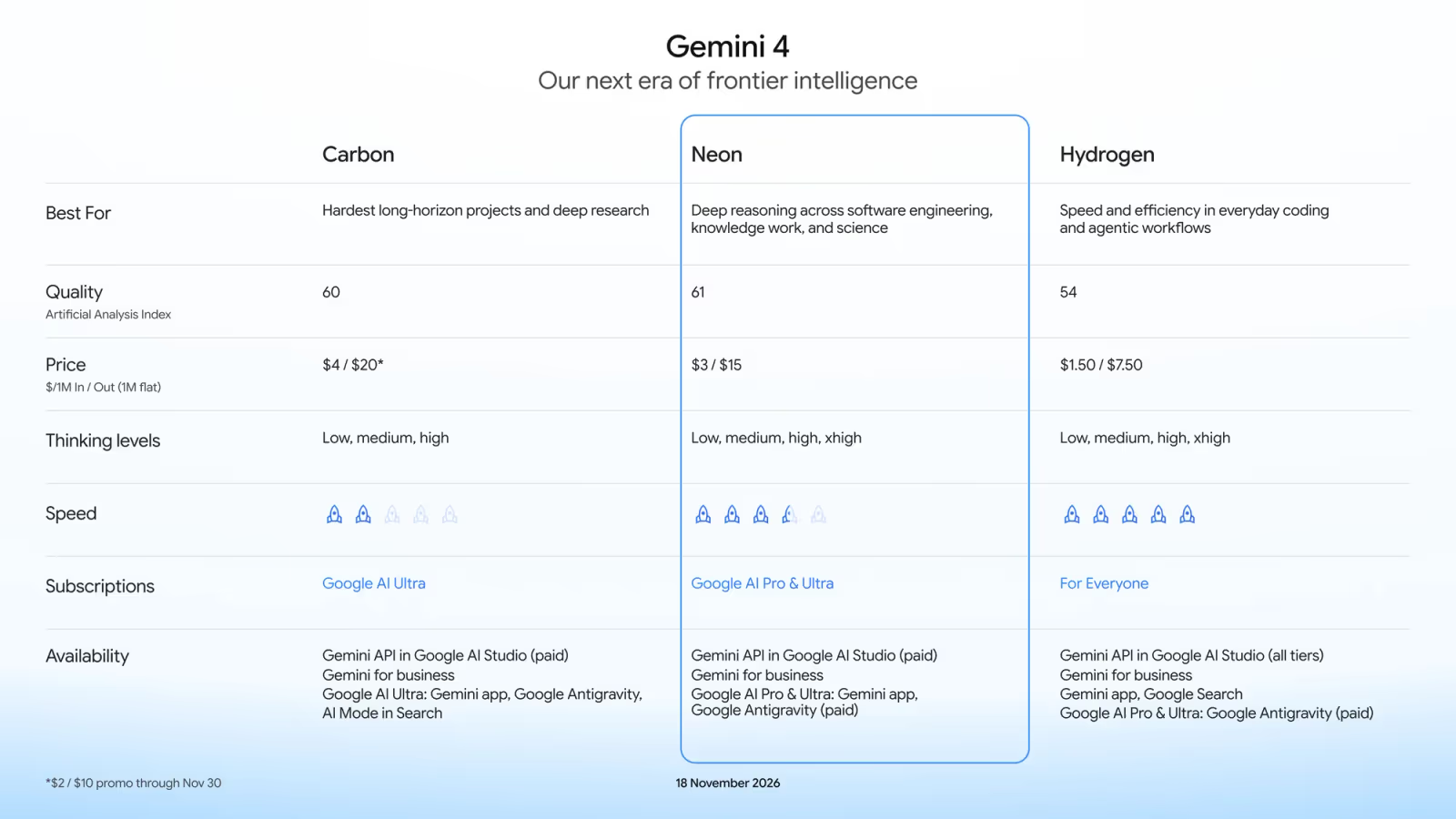
Google's one-line positioning is worth quoting because it defines the product: "While Carbon tackles your hardest, long-horizon projects and Hydrogen handles fast everyday execution, Neon balances depth and efficiency."
How Does Neon Differ From Argon, Carbon and Hydrogen?
The Gemini 4 family has arrived at speed. As we reported at the time, Gemini 4 Argon was announced on 30/09/2026 and reached paying developers on 13/10/2026. Carbon followed and became generally available to paid users on 10/11/2026, and Gemini 4 Hydrogen arrived on 12/11/2026. Neon landed six days after that. TestingCatalog counts it as the fourth model Google has released in about seven weeks.
Neon vs Carbon
Neon is derived from Carbon. The model card says so directly ("Gemini 4 Neon is adapted from Gemini 4 Carbon") and refers readers to the Carbon card for architecture, training data and hardware. Google does not say how the adaptation was done, and it does not publish parameter counts for either model. What it does publish is the outcome: Neon scores one point higher than Carbon on the Artificial Analysis index (61 at xhigh against 60 at Carbon's top level, high), adds a fourth thinking level that Carbon lacks, and is priced 25% below Carbon's standard rate. Carbon remains Google's recommendation for the "hardest long-horizon projects and deep research", and Google lists it in AI Mode in Search for Ultra subscribers.
Neon vs Hydrogen
Hydrogen is the cheaper, faster option at half Neon's token price, with a free tier in AI Studio and access for every Gemini app user. Neon is seven points ahead of it on Artificial Analysis (61 against 54, both at xhigh). The two share the same four thinking levels and the same 1 million-token window. In Antigravity they are designed to work together, with Neon planning and Hydrogen executing, which we cover below.
Neon vs Argon
Argon is the model Neon most obviously displaces. It scores 50 on Artificial Analysis, costs the same as Carbon, and no longer appears in Google's family graphic. 9to5Google reports that Neon replaces Argon in the Gemini app, and Digital Trends confirmed the same change in the app's model picker, where Neon now sits under "Deeper analysis". Argon is still listed on the API pricing page. Google has not announced a retirement date for it, so treat any claim that Argon is being withdrawn from the API as unconfirmed.
| Model | Google's stated role | AA Index (top level) | API price in / out per 1M | Thinking levels |
|---|---|---|---|---|
| Gemini 4 Carbon | Hardest long-horizon projects and deep research | 60 (high) | $4 / $20 from 01/12/2026 ($2 / $10 promo until 30/11/2026) | Low, medium, high |
| Gemini 4 Neon | Deep reasoning across software engineering, knowledge work and science | 61 (xhigh) | $3 / $15 | Low, medium, high, xhigh |
| Gemini 4 Hydrogen | Speed and efficiency in everyday coding and agentic workflows | 54 (xhigh) | $1.50 / $7.50 | Low, medium, high, xhigh |
| Gemini 4 Argon | Not shown in Google's current family graphic | 50 (high) | $4 / $20 from 01/12/2026 ($2 / $10 promo until 30/11/2026) | Not restated at Neon launch |
Sources: Google family graphic (18/11/2026), Google AI Studio pricing page and Artificial Analysis leaderboard, both fetched 19/11/2026.
Specs, Context Window and Thinking Levels
| Specification | Gemini 4 Neon |
|---|---|
| Release date | 18/11/2026 |
| API model ID | gemini-4-neon |
| Base model | Adapted from Gemini 4 Carbon |
| Inputs | Text, images, audio and video |
| Context window | 1 million tokens, combined input and output |
| Output limit | Up to 64K tokens by default (synchronous); up to 1M via background long decode |
| Thinking levels | Low, medium, high (default), xhigh |
| Knowledge cutoff | March 2026 |
| Standard price | £2.28 ($3) input, £11.40 ($15) output, £0.11 ($0.15) cached input per million tokens |
| Free API tier | No |
| Distribution | Gemini app, Gemini API, Google AI Studio, Gemini for business, Google Antigravity |
Sources: Gemini 4 Neon model card (November 2026) and Google AI Studio pricing page.
What do the four thinking levels change?
A thinking level is a setting that controls how many reasoning tokens a model spends before it answers, trading speed and cost for accuracy. Neon has four: low, medium, high and xhigh. High is the default. Google says the levels "scale steadily, letting teams dial intelligence and token spend to what each workload needs".
Artificial Analysis measured all four, and the numbers show where the value sits.
| Thinking level | AA Intelligence Index | Avg time per task | Time to first answer token | Output tokens across the index |
|---|---|---|---|---|
| Low | 44 | 3.7 min | 13.9 s | 28.3M |
| Medium | 55 | 8.3 min | 20.1 s | 62.9M |
| High (default) | 60 | 14.8 min | 40.6 s | 123M |
| Xhigh | 61 | 21.5 min | 56.5 s | 283M |
Source: Artificial Analysis, Gemini 4 Neon model page, fetched 19/11/2026.
Two things stand out. First, the jump from low to medium is worth 11 index points and the jump from medium to high another five, so low is a genuinely different quality tier and should be reserved for simple work. Second, xhigh buys one extra point over high while generating about 2.3 times as many output tokens and taking roughly 45% longer per task. The headline score of 61 is an xhigh score. The setting most people will actually run, high, scores 60, level with Carbon.
Artificial Analysis lists Neon's output speed at about 110 tokens per second. VentureBeat, citing the same source, puts Carbon at 59 tokens per second at high, which would make Neon roughly 1.9 times faster on raw output. Hydrogen is faster again.
Benchmarks: What Google Published
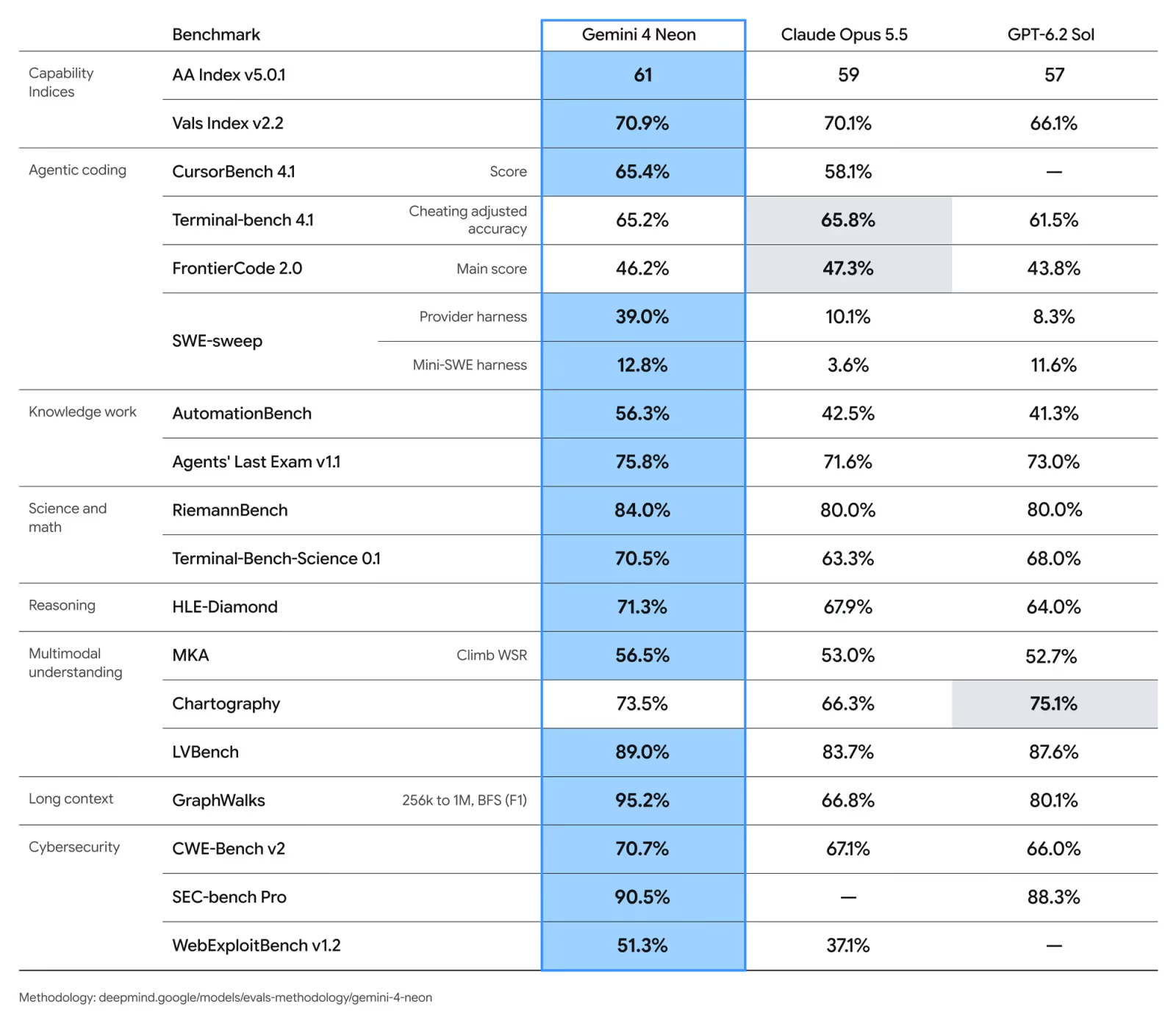
Google's launch table compares Neon with two rivals only: Claude Opus 5.5 and GPT-6.2 Sol. Neon is first in 16 of the 19 rows.
Gemini 4 Neon vs Claude Opus 5.5 vs GPT-6.2 Sol
Selected rows from Google's launch table, score in %. Higher is better.
- Gemini 4 Neon
- Claude Opus 5.5
- GPT-6.2 Sol
Terminal-Bench 4.1
FrontierCode 2.0
AutomationBench
Agents' Last Exam v1.1
Terminal-Bench Science 0.1
HLE-Diamond
Chartography
GraphWalks (256k to 1M)
Show data table
| Benchmark | Gemini 4 Neon | Claude Opus 5.5 | GPT-6.2 Sol |
|---|---|---|---|
| Terminal-Bench 4.1 | 65.2% | 65.8% | 61.5% |
| FrontierCode 2.0 | 46.2% | 47.3% | 43.8% |
| AutomationBench | 56.3% | 42.5% | 41.3% |
| Agents' Last Exam v1.1 | 75.8% | 71.6% | 73% |
| Terminal-Bench Science 0.1 | 70.5% | 63.3% | 68% |
| HLE-Diamond | 71.3% | 67.9% | 64% |
| Chartography | 73.5% | 66.3% | 75.1% |
| GraphWalks (256k to 1M) | 95.2% | 66.8% | 80.1% |
Source: Google, Introducing Gemini 4 Neon, 18/11/2026. Non-Gemini figures are mostly vendor self-reported; see methodology notes below.
Agentic coding
The coding picture is closer than the table's colouring suggests. On Terminal-Bench 4.1, Opus 5.5 leads Neon by 0.6 points (65.8% against 65.2%). On Cognition's FrontierCode 2.0, Opus leads by 1.1 points (47.3% against 46.2%), and Neon's figure there was run at high thinking, not xhigh. Neon leads on CursorBench 4.1 (65.4% against 58.1% for Opus, with no Sol figure) and Google says it ranks first on the Artificial Analysis Coding Agent Index with 58.6. We could not read that index's table directly, so the 58.6 figure is Google's citation of it.
The row that needs the most care is SWE-sweep. Neon scores 12.8% on the neutral mini-SWE harness, against 11.6% for Sol and 3.6% for Opus 5.5, and then 39.0% in the "provider harness" row, against 10.1% and 8.3%. Google's methodology document explains why: Neon ran in the Antigravity CLI, Opus in Claude Code and Sol in Codex, and the Antigravity CLI "includes a default tool that allows for sub-agents that fan out across the codebase, which is particularly suited to bug finding tasks like SWE-sweep". All of these results are self-computed by Google. The 39.0% figure is therefore a measure of Neon plus Antigravity's sub-agent tooling, not of the model alone. Google says as much in its post, describing the result as "showing what the Antigravity harness unlocks".
Knowledge work
This is where Neon's lead is widest. On Zapier's AutomationBench it scores 56.3% against 42.5% for Opus 5.5 and 41.3% for Sol, figures Google sources from the public leaderboard. Google also reports first place on Vals AI's Legal Research Bench and Tax Agent Bench, first place on most Surge AI benchmarks covering finance, accounting and spreadsheet modelling, and first place on Andon Labs' Vending-Bench 2, a long-horizon simulation of running a business, with a final balance of $16,843 in simulated money. On Agents' Last Exam v1.1 it scores 75.8%, which Google describes as "on par with leading models". That figure was self-computed by Google in the Antigravity CLI with a five-hour window.
Science, maths and reasoning
Neon posts 84.0% on RiemannBench (Opus and Sol both 80.0%), 70.5% on Terminal-Bench Science 0.1 and 71.3% on HLE-Diamond. The Terminal-Bench Science score was self-computed and averaged over five attempts per task; the HLE-Diamond score comes from the Artificial Analysis leaderboard.
Multimodal and long context
On the Multimodal Knowledge Agent test Neon scores 56.5% against 53.0% and 52.7%, and on the LVBench video benchmark 89.0% against 83.7% and 87.6%. On Chartography, which tests reading dense professional charts, GPT-6.2 Sol leads with 75.1% to Neon's 73.5%. The LVBench comparison is not like-for-like: Google gave Gemini one frame per second, Sol 500 frames and Opus 600 frames "due to API limitations".
The largest single gap in the table is GraphWalks at 256,000 to 1 million tokens of context, where Neon scores 95.2% against 80.1% for Sol and 66.8% for Opus. It is self-computed by Google on 200 problems, so it deserves independent replication.
How should you read this table?
Three caveats come straight from Google's own methodology notes. First, "all the results for non-Gemini models are sourced from providers' self-reported numbers unless otherwise mentioned", so settings and harnesses differ across columns. Second, the comparison set is Opus 5.5 and Sol. Anthropic's Claude Fable 5.2 and OpenAI's GPT-6.2 Astra, both of which outscore Neon on Artificial Analysis, are absent. Google's framing is that those are "larger, slower models", which is fair on price but still a choice. Third, the cybersecurity rows were run with safety filters off, which is not how the public model behaves.
Is Neon Really Third on Artificial Analysis?
Yes. The Artificial Analysis Intelligence Index is an independent composite score, currently version 5.0.1, built from nine evaluations including Terminal-Bench 4.0, FrontierCode-AA 2.0, AutomationBench-AA, AA-Omniscience and HLE-Diamond. When we fetched the leaderboard on 19/11/2026 it read as follows.
| Rank | Model (effort) | AA Index | Cost per task | Time per task | Vals Index v2.2 |
|---|---|---|---|---|---|
| 1 | Claude Fable 5.2 (max) | 65 | $26.54 | 41.8 min | 71.31% |
| 2 | GPT-6.2 Astra (max) | 62 | $4.00 | 13.9 min | 67.66% |
| 3 | Gemini 4 Neon (xhigh) | 61 | $6.44 | 21.5 min | 70.87% |
| 4 | Gemini 4 Carbon (high) | 60 | $7.76 | 37.1 min | 70.45% |
| 5 | Claude Opus 5.5 (max) | 59 | $10.04 | 25.2 min | 70.14% |
| 6 | GPT-6.2 Sol (max) | 57 | $1.01 | 8.7 min | 66.06% |
| 7 | Claude Sonnet 5.5 (max) | 55 | $10.02 | 32.7 min | 70.85% |
| 8 | Gemini 4 Hydrogen (xhigh) | 54 | $3.16 | 15.3 min | 68.49% |
| 10 | Gemini 4 Argon (high) | 50 | $4.97 | 29.7 min | 69.39% |
Sources: Artificial Analysis leaderboard and Vals AI Vals Index, both fetched 19/11/2026. Cost and time are Artificial Analysis averages per Intelligence Index task.
Neon's cost per task at xhigh is £4.89 ($6.44). That is 17% below Carbon, 36% below Opus 5.5 and 76% below Fable 5.2. It is also 61% above GPT-6.2 Astra, which scores one point higher, and more than six times GPT-6.2 Sol, which scores four points lower. Google's statement that Neon at xhigh costs "36%+ less per task than competing models at their highest setting" matches the Opus 5.5 figure exactly, but on these numbers it does not hold against either GPT-6.2 model.
Artificial Analysis Intelligence Index: score vs cost per task
Each point is a thinking or reasoning-effort level. Up and to the left is better.
- Gemini 4 Neon
- Claude Opus 5.5
- GPT-6.2 Sol
Show data table
| Model | Setting | AA Intelligence Index | Cost per task |
|---|---|---|---|
| Gemini 4 Neon | Low | ~44 | ~$0.72 |
| Gemini 4 Neon | Med | ~55 | ~$1.9 |
| Gemini 4 Neon | High | ~60 | ~$3.7 |
| Gemini 4 Neon | Xhigh | 61 | $6.4 |
| Claude Opus 5.5 | - | ~35 | ~$0.95 |
| Claude Opus 5.5 | - | ~48 | ~$2.5 |
| Claude Opus 5.5 | - | ~52 | ~$3.5 |
| Claude Opus 5.5 | - | ~57 | ~$6.0 |
| Claude Opus 5.5 | Max | 59 | $10 |
| GPT-6.2 Sol | - | ~40 | ~$0.15 |
| GPT-6.2 Sol | - | ~53 | ~$0.38 |
| GPT-6.2 Sol | - | ~55 | ~$0.52 |
| GPT-6.2 Sol | - | ~56 | ~$0.62 |
| GPT-6.2 Sol | Max | 57 | $1.0 |
Source: Top-effort points from the Artificial Analysis leaderboard, 19/11/2026; lower-effort points read from Google's AA Index v5.0.1 chart (approximate)
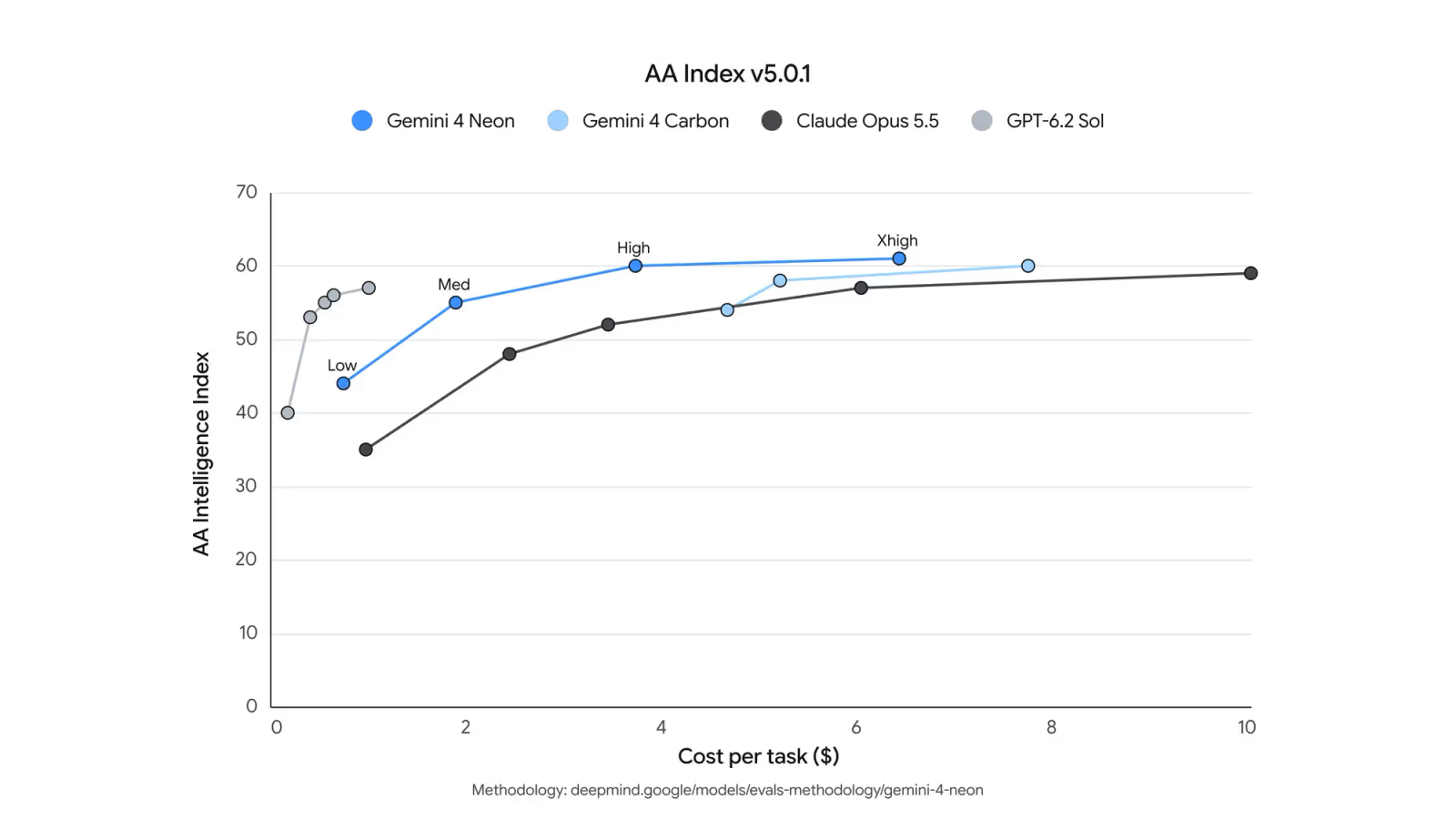
The sweep makes Neon's case better than the single headline number does. At every cost level it sits above Opus 5.5, and at medium (about $1.90 a task on Google's chart) it scores 55, level with Claude Sonnet 5.5 at maximum effort. It also shows Neon's weak flank: GPT-6.2 Sol reaches 57 for about a dollar a task. Buyers choosing purely on index points per pound should look at GPT-6.2 Sol first.
One of Google's cost claims we could not fully reconcile. The post says that at high, Neon has "a 32% lower cost per task than Carbon". Artificial Analysis publishes a per-task cost for Neon only at xhigh, where the gap to Carbon is 17%, a point VentureBeat also makes. Google's own chart appears to put Neon at high somewhere near $3.70 a task, which against Carbon's $7.76 would be a bigger saving than 32%. Google does not state which Carbon setting it used for the comparison. The direction is clear; the exact percentage is not.
Vals Index and Agent Arena
On the Vals Index v2.2, Neon is second with 70.87%, 0.44 points behind Fable 5.2 at 71.31%. Vals measures Neon at £5.62 ($7.40) per test against £13.63 ($17.94) for Fable 5.2 and £18.83 ($24.77) for Opus 5.5. The top five models on that index sit within 1.2 points of each other, so the cost column separates them more than the accuracy column does.
Google also says Neon debuted second on Arena's new Agent Arena Index with a score of 1336 across more than 4,200 real-world agent sessions, and second for steerability, which Arena defines as adapting cleanly to a user's mid-task corrections. We could not load Arena's leaderboard to confirm the ranking ourselves. TestingCatalog reports a median cost of $2.82 per task on that index, 53% below Opus 5.5; that figure comes from one outlet.
Cost per task on two independent indices
US dollars per task at each model's top effort setting. Lower is better.
- Gemini 4 Neon
- Claude Opus 5.5
- GPT-6.2 Sol
Artificial Analysis Intelligence Index
Vals Index v2.2 (cost per test)
Show data table
| Benchmark | Gemini 4 Neon | Claude Opus 5.5 | GPT-6.2 Sol |
|---|---|---|---|
| Artificial Analysis Intelligence Index | $6.44 | $10.04 | $1.01 |
| Vals Index v2.2 (cost per test) | $7.40 | $24.77 | $3.18 |
Source: Artificial Analysis leaderboard and Vals AI, fetched 19/11/2026
Neon in Google Antigravity
Google Antigravity is Google's agentic development environment, available as a desktop app, a CLI and IDE extensions. Neon is rolling out there for paid AI Pro and Ultra subscribers, according to the Antigravity blog, and two features matter.
Orchestrator pairs a planning model with an executing model in a single session. With this release Neon can act as the planner and Hydrogen as the executor: Neon handles architecture and complex reasoning, Hydrogen handles routine edits, package updates and test runs, and if Hydrogen gets stuck it hands back to Neon to repair the plan. When Orchestrator launched with Hydrogen it paired Carbon with Hydrogen, as we covered in our Hydrogen review. Google gives no quota or success-rate figures for the Neon pairing.
/swarm fans a task out to parallel sub-agents. Google's launch demos lean on it heavily: a Blender scene of a lab bench, a 3D recreation of Alan Turing's 1936 study at King's College, Cambridge, and a 100,000-cell Google Sheet that renders an image with more than 500,000 formulas. Google also shows a first-person WebGL2 ski simulator that it says Neon wrote from scratch in 10,200 lines of custom shader code. These are demos selected by Google. For background on the pattern, see our explainers on agent swarms and Antigravity dynamic workflows.
Google also says Neon recorded its "lowest fabrication rate yet in internal Google Antigravity testing". No rate is given, so the claim cannot be compared with other vendors.
Neon for Cyber and the Fairwind Program
Google is releasing a separate configuration, Gemini 4 Neon for cyber, to vetted defenders through its Fairwind Program "in the coming days". The Fairwind Program is Google's limited-access scheme that gives trusted security teams early or less restricted access to frontier models. It is not part of standard API or subscription access.
The published numbers cover the code-hardening lifecycle. On SEC-bench Pro, which tests finding vulnerabilities, Neon scores 90.5% against 88.3% for GPT-6.2 Sol and 88.2% for Carbon, at what Google says is roughly half the cost per challenge. On Collinear's CWE-bench v2, which tests patching, it reaches 70.7% against 67.1% for Opus 5.5 and 66.0% for Sol. On WebExploitBench v1.2, a black-box penetration test across 15 web application targets with 277 vulnerabilities, it scores 51.26% against 37.1% for Opus 5.5. On AutoBaxBench, which grades whether generated backends are both functional and secure, Google reports 76% on the hard tier, and its chart shows 74% for Carbon and 68% for both Claude Opus 5.5 and Claude Fable 5.2.
These are strong results, with conditions attached. The cyber evaluations were run with safety filters off. SEC-bench Pro and ExploitGym were self-computed by Google in an Antigravity harness, with competitor numbers taken from their system cards. WebExploitBench was self-evaluated and then validated by AgentCyberRange. CWE-bench v2 comes from the public leaderboard and is the most independent of the four.
Wes Roth on the Neon launch and the pace of Google's Gemini 4 releases, with Carbon, Hydrogen and Neon arriving within weeks of each other.
Safety: What the Model Card Says
Neon's safety documentation is thinner than its benchmark documentation, and readers should know that before relying on it. The model card runs to nine pages, most of which defer to the Carbon card, and it states that "the full Safety & Security Report for Gemini 4 Neon will be available in the coming days". As of 19/11/2026 that report has not been published.
Frontier Safety Framework determinations
Google did not run a full set of critical capability evaluations on Neon. Instead it ran a Material Capability Change assessment against Gemini 4 Argon, the last model to get the full treatment. The card says Neon "showed an increase in general capability under our MCC assessment compared with Gemini 4 Argon, however this falls below our MCC threshold", so Argon's determinations are carried forward:
- Biological uplift: critical capability level "cannot be ruled out". Mitigations deployed.
- Cybersecurity uplift: critical capability level "cannot be ruled out". Mitigations deployed.
- Chemical, radiological and nuclear uplift: tracked capability level not reached.
- Harmful manipulation: critical capability level not reached.
- Loss of control, stealth and situational awareness: tracked capability level "cannot be ruled out". Baseline AI control and model security mitigations apply.
- Loss of control, ML R&D acceleration and automation: critical capability levels not reached.
It is notable that a model which outscores Argon by 11 points on Artificial Analysis, and which Google markets as state of the art on several offensive-security benchmarks, falls under the threshold for a fresh assessment. The explanation may be that the more capable Carbon has already been assessed separately, but the card measures the change against Argon and the report that would show the working is not yet out.
Alignment and agent behaviour
The announcement carries the behavioural data. Google reports a 0.09% misaligned action rate on its agentic safety suite and a 99.2% pass rate on its agent honesty evaluation. Neon matched Carbon with 0.0% cheating on Terminal-Bench 4.0 and took shortcuts on 2.45% of tasks in Google's coding cheating evaluation, which Google says is the lowest of any Gemini 4 model. Against Carbon, it reduced under-service by 43% to 56% and overreach by 15% to 35%, depending on effort level. All of these are internal Google evaluations.
Google also says alert rates from its chain-of-thought and action misalignment monitor stayed below Carbon's baseline during internal coding use, and that the same monitor runs on Neon in external products. The monitor is part of the Gemini 4 safety and security stack that Google described on 13/10/2026: input screening by smaller models, activation probes that read the model's internal signals for cyber or biological threat content, and continuous monitoring that can cut an agent off mid-task.
Refusals and content safety
Over-refusal is a real cost for security and science users, and Google gives two figures: Neon refused 1.98% of tasks on Terminal-Bench 4.0 and 0% on Terminal-Bench Science. The model card's automated content safety results, measured against Hydrogen, are mostly flat: text-to-text safety unchanged, multilingual safety down 0.40 percentage points, image-to-text safety up 1.90 points, refusal tone up 1.25 points and unjustified refusals down 3.00 points. Google says all the content safety differences are within confidence intervals.
Prompt injection
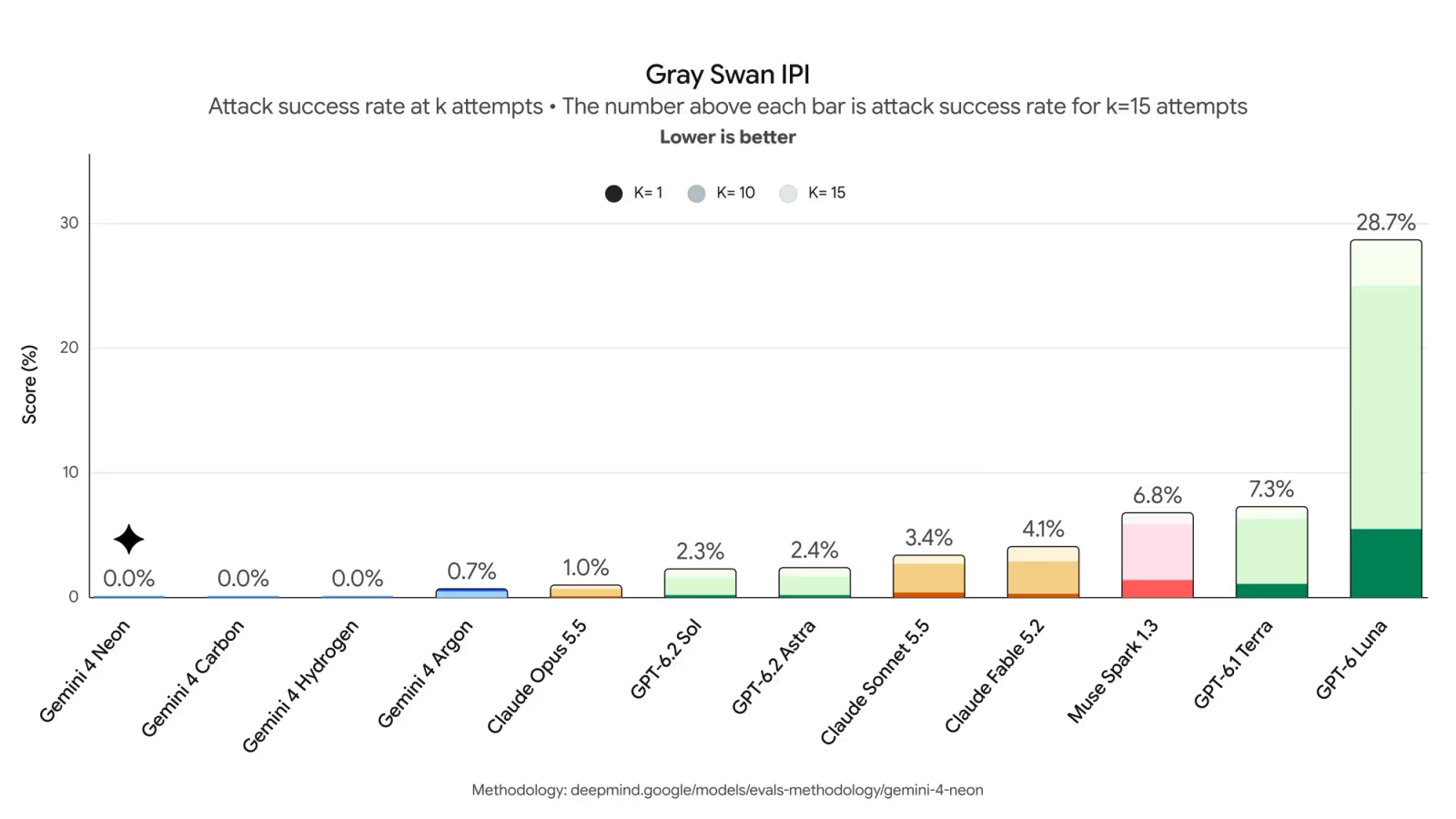
Indirect prompt injection is an attack in which malicious instructions are hidden in a web page, email, document or code that an agent reads while doing its job. On Gray Swan's benchmark, which uses 1,810 curated attacks from its public red-teaming competitions, Neon recorded a 0.0% attack success rate across 15 attempts. Google's chart shows Carbon and Hydrogen also on 0.0%, Argon on 0.7%, Claude Opus 5.5 on 1.0%, GPT-6.2 Sol on 2.3%, GPT-6.2 Astra on 2.4% and Claude Fable 5.2 on 4.1%. The evaluation was run by Gray Swan, which makes it one of the more credible numbers in the launch. Two qualifiers apply: Neon's result is "with real-time safeguards at its highest thinking level", and the attacks date from the first two quarters of 2026, so they do not include anything written specifically against Neon.
How Much Does Gemini 4 Neon Cost?
Sterling figures in this article use $1 = £0.76, the mid-market rate on 19/11/2026. Google bills in US dollars, so the sterling amounts are indicative.
| Gemini API tier | Input per 1M tokens | Output per 1M tokens (incl. thinking) | Cached input per 1M |
|---|---|---|---|
| Standard | £2.28 ($3.00) | £11.40 ($15.00) | £0.11 ($0.15) |
| Batch | £1.14 ($1.50) | £5.70 ($7.50) | £0.06 ($0.075) |
| Flex | £1.14 ($1.50) | £5.70 ($7.50) | £0.06 ($0.075) |
| Priority | £4.10 ($5.40) | £20.52 ($27.00) | £0.21 ($0.27) |
Source: Google AI Studio pricing page, fetched 19/11/2026.
Four details are easy to miss. There is no free API tier for Neon, unlike Hydrogen. The price is flat across the whole 1 million-token window, with no long-context surcharge. Thinking tokens are billed as output, so moving from high to xhigh raises the bill even though the list price is unchanged. And caching is implicit only: the 95% cached-input discount applies automatically when Google detects a repeated prefix, and explicit cache control is not supported. Grounding with Google Search is free for the first 5,000 requests a month, shared across Gemini models, then £10.64 ($14) per 1,000 requests.
Unlike Carbon and Argon, Neon has no introductory discount. Until 30/11/2026 Carbon is actually cheaper than Neon at $2 / $10; from 01/12/2026 it doubles to $4 / $20 and Neon becomes the cheaper of the two by 25%. Anyone benchmarking this month should cost their workload at the December rates.
For subscribers, Neon is included in Google AI Pro and Ultra in the Gemini app and in Antigravity. Google has not published usage limits for Neon on either plan. 9to5Google reports that the app's model picker now offers Auto, Hydrogen for "Everyday help", Neon for "Deeper analysis" and Carbon for "Code & complex work". Digital Trends also lists Vertex AI availability for verified enterprise customers; Google's announcement and model card do not mention Vertex AI, so we treat that as unconfirmed.
Neon vs Claude Opus 5.5, Fable 5.2 and GPT-6.2
| Model | List price in / out per 1M | AA Index | AA cost per task | Gray Swan IPI (15 attempts) |
|---|---|---|---|---|
| Gemini 4 Neon | £2.28 / £11.40 ($3 / $15) | 61 | £4.89 ($6.44) | 0.0% |
| Claude Opus 5.5 | £3.04 / £15.20 ($4 / $20) | 59 | £7.63 ($10.04) | 1.0% |
| Claude Fable 5.2 | £6.08 / £30.40 ($8 / $40) | 65 | £20.17 ($26.54) | 4.1% |
| GPT-6.2 Astra | £6.08 / £30.40 ($8 / $40) up to 272K input | 62 | £3.04 ($4.00) | 2.4% |
| GPT-6.2 Sol | £1.52 / £7.60 ($2 / $10) up to 272K input | 57 | £0.77 ($1.01) | 2.3% |
Sources: Google AI Studio, Anthropic and OpenAI pricing pages; Artificial Analysis leaderboard; Gray Swan results as published by Google. All fetched 19/11/2026.
Neon vs Claude Opus 5.5
This is the comparison Google built the launch around, and Neon comes out ahead on most of it. It is 25% cheaper per token, 36% cheaper per Artificial Analysis task, two points higher on that index and 0.7 points higher on Vals at less than a third of the cost per test. Claude Opus 5.5 keeps a narrow lead on Terminal-Bench 4.1 and FrontierCode 2.0, which are the two benchmarks closest to day-to-day agentic coding, and the margins either way are small enough that harness and prompt choices will matter more than the model. Teams already on Opus 5.5 have no benchmark reason to rush; teams choosing fresh have a cost reason to trial Neon.
Neon vs Claude Fable 5.2
Fable 5.2 is the stronger model on both independent indices, four points ahead on Artificial Analysis and 0.44 points ahead on Vals. It also costs roughly four times as much per Artificial Analysis task (£20.17 against £4.89) and takes about twice as long. Neon does better on the Gray Swan injection test. This is a price-performance decision, and our Fable 5.2 vs Opus 5.5 comparison sets out when Fable's extra capability is worth paying for.
Neon vs GPT-6.2 Astra and Sol
OpenAI's pair brackets Neon. Astra scores one point higher on Artificial Analysis and, despite a list price more than twice Neon's, costs less per task there (£3.04 against £4.89) which implies it gets through the suite on far fewer tokens. Sol scores four points lower for about a sixth of Neon's per-task cost. On Vals the order reverses: Neon's 70.87% is ahead of Astra's 67.66% and Sol's 66.06%. Neon's clearest structural advantages are flat pricing across the full 1 million-token window, where both GPT-6.2 models move to a higher rate above 272,000 input tokens, and native audio and video input. We compare the two OpenAI models with Anthropic's flagship in GPT-6.2 Astra vs Claude Fable 5.2.
What the Creator Videos Claim
Two videos from channels we track prompted this review. Neither has a published transcript we could check line by line, so we rely on their titles and descriptions and attribute anything beyond that to the creators.
WorldofAI describes Neon as ranking third on the Artificial Analysis Intelligence Index with a 1 million-token context window, four thinking levels and Antigravity integration. All of that checks out. The video title says Neon "beats Opus 5.5 & GPT-6.2", which is accurate for Opus 5.5 and GPT-6.2 Sol on that index and inaccurate for GPT-6.2 Astra. The hands-on segments listed in the description, including a first-person shooter clone, computer use, SVG generation and a Minecraft-style demo, were run on the creator's own benchmarking tool. They are one person's tests and we have not reproduced them. Google's model card says computer use was among the areas evaluated, but no computer-use benchmark appears in the published table.
Wes Roth focuses on cadence, noting in his description that "Gemini 4 Carbon had barely rolled out before Hydrogen showed up" and asking how long Neon will last before the next model. That concern is reasonable. Argon went from launch to being dropped from the Gemini app picker in about seven weeks.
Limitations and Open Questions
- No full safety report yet. The model card points to a Safety and Security Report that is still "coming soon", and the frontier risk determinations are carried over from Argon instead of being measured afresh.
- Vendor-reported comparisons. Competitor numbers in Google's table are mostly self-reported by those vendors under their own settings, and several of Neon's numbers are self-computed in Google's Antigravity harness.
- Selective comparison set. Claude Fable 5.2 and GPT-6.2 Astra, the two models ahead of Neon on Artificial Analysis, are left out of the main table and the cost chart.
- The headline is an xhigh number. The default high level scores 60, and xhigh costs far more tokens for one extra point.
- Not the cheapest per task. Both GPT-6.2 models complete the Artificial Analysis suite for less.
- Speed is relative. Neon is quicker than Carbon, Opus 5.5 and Fable 5.2 per task on Artificial Analysis, but slower than both GPT-6.2 models, and it waits about 40 seconds before its first answer token at the default level.
- Standard model limits apply. The card lists hallucinations and jailbreak resistance as known limitations, and the knowledge cutoff is March 2026.
- No published subscriber limits. Google has not said how many Neon requests AI Pro or Ultra subscribers get in the Gemini app or Antigravity.
- No hands-on results from us yet. This review is based on primary documents and independent leaderboards published within a day of launch, not on our own testing.
Who Should Use It
- Teams on Gemini 4 Carbon or Argon for general coding and analysis: test Neon now. It matches or beats both on the independent indices, and from 01/12/2026 it will be 25% cheaper per token than either.
- Antigravity users: the Neon and Hydrogen Orchestrator pairing is the obvious thing to try, and the SWE-sweep result suggests the harness adds a great deal for bug-finding work.
- Long-document and multimodal pipelines: flat pricing to 1 million tokens, audio and video input, and the GraphWalks result make Neon a strong candidate. Validate the long-context claim on your own data.
- Agents that read untrusted content: the Gray Swan result is the best published among current frontier models, though no result of 0.0% on a fixed attack set means a model cannot be injected.
- Cost-first, high-volume workloads: price up GPT-6.2 Sol and Gemini 4 Hydrogen before committing. Both are materially cheaper per task.
- The hardest research-grade problems: Claude Fable 5.2 and GPT-6.2 Astra still score higher overall. If you use Cursor or another multi-model tool, running the same task on two models is the quickest way to find out whether that gap matters for your work.
The Bottom Line
Gemini 4 Neon is the most sensible default in Google's line-up today. The core claims hold up when checked: third on Artificial Analysis, second on Vals, a real 1 million-token window at a flat price, and a per-task cost well under Claude Opus 5.5. It has effectively made Argon redundant and, for most work, it gives little reason to pay for Carbon after the promotional price ends.
The caveats are about framing. Google compared Neon with the rivals it beats and left out the two it does not, its most eye-catching coding number depends on its own harness, and its claim to be cheaper than competitors at top effort is true of Anthropic's models and not of OpenAI's. The safety evidence published so far is encouraging on agent behaviour and prompt injection, but the full report is still outstanding and the frontier risk assessment was inherited from an older, weaker model. We will update this review when the Safety and Security Report appears and when more independent testing is available. For how these scores fit the wider field, see our frontier AI benchmarks guide.
Last updated: 19/11/2026. Prices are published in US dollars; sterling conversions are approximate at $1 = £0.76 (mid-market rate, 19/11/2026). Leaderboard positions were checked on 19/11/2026 and can change.
Sources
- Google: Introducing Gemini 4 Neon (18/11/2026)
- Google DeepMind: Gemini 4 Neon model card (November 2026)
- Google DeepMind: Gemini 4 Neon model evaluation methodology
- Google AI Studio: Gemini API pricing
- Google Antigravity: Gemini 4 Neon in Google Antigravity
- Google: Gemini 4 safety and security stack (13/10/2026)
- Artificial Analysis: model leaderboard and Gemini 4 Neon model page
- Vals AI: Vals Index v2.2
- Anthropic: Claude API pricing
- OpenAI: API pricing
- VentureBeat: Google launches Gemini 4 Neon
- 9to5Google: Google launches Gemini 4 Neon
- Digital Trends: Google releases Gemini 4 Neon
- TestingCatalog: Google launches Gemini 4 Neon