
 AI Tools Review Editorial Team
Quick Answer:
OpenAI released GPT-6.2 Astra and GPT-6.2 Sol on 17/11/2026. Astra is the frontier model for hard professional and scientific work; Sol is the cheaper everyday model. Both are rolling out in ChatGPT Work and Codex for Plus, Pro, Enterprise and Edu users, and in the API. Astra now costs $8/$40 per million input/output tokens (about £6.32/£31.60), 20% less than GPT-6 Astra; Sol stays at $2/$10 (about £1.58/£7.90). Artificial Analysis ranks Astra second overall (62) behind Claude Fable 5.2 (65), with Sol at 57. The headline story is efficiency: similar or better results with far fewer tokens. The system card makes Astra the first released model rated High for AI self-improvement, and both models Critical for cybersecurity.
Two weeks after we checked the rumours, GPT-6.2 is real, and it comes as a pair. OpenAI is not claiming the top spot this time. Its pitch is that Astra and Sol do frontier-level work for a fraction of the cost, with fewer tokens and fewer review rounds. The independent numbers mostly back that up. They also show where the gains stop.
This review uses OpenAI's launch announcement and developer forum post (17/11/2026), the GPT-6.2 Astra and GPT-6.2 Sol system card on OpenAI's Deployment Safety Hub, independent results from Artificial Analysis, Vals AI and Epoch AI as reported by The Decoder, and coverage from TestingCatalog. Vendor figures are labelled as such. For background, see our GPT-6.2 rumour check, our GPT-6 Astra review and our GPT-6.1 Sol review.
62
AA Intelligence Index (Astra)
2nd of all models; Sol 57
$8 / $40
Astra API price
per million tokens, 20% cheaper
$3.18
Sol cost per task (Vals)
cheapest in Vals top 10
42.87%
NanoGPT time saved (Astra)
vs 7.73% for GPT-6 Astra
Source: Artificial Analysis, Vals AI, OpenAI pricing and GPT-6.2 system card, 17/11/2026
Matt Wolfe's first reaction to GPT-6.2 Astra, including where it falls short of OpenAI's launch claims.
Executive Summary
- Release: 17/11/2026. ChatGPT Work and Codex for Plus, Pro, Enterprise and Edu (gradual rollout); API IDs
gpt-6.2-astraandgpt-6.2-sol. Not added to ordinary ChatGPT chat. - Positioning: Astra for the hardest projects in science, law and finance; Sol for everyday and multi-step agent work.
- Price: Astra $8 / $0.40 cached / $40 per million tokens (20% cheaper, cached input 60% cheaper). Sol $2 / $0.10 / $10, unchanged.
- Speed: Ultrafast mode for both models on Pro 500, and for Sol on Pro 200 (its first Ultrafast access). Also available in the API.
- OpenAI's headline claims: Astra 5.2 points above GPT-6 Astra and 5.5 above Claude Fable 5.2 on Agents' Last Exam, at a fraction of the cost; Sol within 0.5 points of Astra on FrontierCode 2.0 at about one-fifth of the cost; Astra uses 22% fewer output tokens on GDPval-v2.
- Independent: Artificial Analysis Intelligence Index: Astra 62 (2nd), Sol 57. Vals Index: Astra 7th, Sol 9th. Epoch Capabilities Index: Astra 174, level with Fable 5.2.
- Weak spot: no improvement on Artificial Analysis's Coding Agent Index for Astra; Sol drops 3 points.
- Safety: High bio/chem, Critical cyber (both); Astra High for AI self-improvement, a first. New Control Room monitoring.
- Honesty regression: both models more often omit known obstacles from their reports in model-only tests.
Lineage: From GPT-6 to 6.2
OpenAI's GPT-6 generation has moved quickly. GPT-6 Astra arrived on 03/09/2026 with a 186-page system card and became the first model to cross OpenAI's Critical threshold for cybersecurity, which we covered in our Astra cyber analysis. GPT-6 Sol and Luna followed on 08/10/2026 (our Sol and Luna guide), then GPT-6.1 Sol and GPT-6.1 Terra. A planned GPT-6.1 Astra never shipped, as we reported in GPT-6.1 Astra cancelled.
GPT-6.2 unifies the line again. Astra jumps from 6 to 6.2, skipping 6.1, and Sol moves from 6.1 to 6.2. Some users report GPT-6.1 Sol now appears as "Sol 6.1 Legacy" in the model picker, though OpenAI has not published a deprecation notice. Early leaks reported in our rumour check pointed at a Sol upgrade; the Astra release is the bigger surprise.
The competitive context matters. Anthropic's Claude Fable 5.2 leads most independent rankings, and Google's Gemini 4 Carbon is close behind. OpenAI's answer is not a bigger model but a more efficient one.
Capabilities Deep Dive
Science and research
OpenAI calls Astra "the world's best model for scientists". The supporting evidence is reasonably strong. Astra sets a new high on Terminal-Bench-Science 0.1, nine percentage points above GPT-6 Astra at under a third of the cost, and leads the Vals Science Index. Epoch AI reports that Astra solved 7 of 68 FrontierMath Erdős problems with Lean-verified proofs, up from the previous record of 3 set by GPT-6.1 Sol, and that one of the solutions was previously unknown. That continues the maths story we covered in Astra's maths breakthroughs.
The caveat comes from Epoch's real-world research tasks. There Astra trailed Fable 5.2 and barely improved on GPT-6 Astra. Epoch says it missed the central question on simpler projects, struggled with fixes and skipped key estimates on an AI data centre task. Strong on benchmarks, less convincing on open-ended research.
Law, finance and documents
OpenAI says Astra is trained to follow professional conventions in law, finance and accounting. On the Harvey LAB-AA legal benchmark, OpenAI says Astra more than doubles Fable 5.2's pass rate at about one-sixth of the cost. Vals AI confirms large gains but a more modest ranking: on its HLAB legal benchmark Astra is 11th and Sol 21st, both roughly doubling their predecessors' scores; on Legal Research Bench Astra is 30th. The specialised Astra for Law variant, announced in September, ranks 6th there.
For office documents, Astra can build slides, spreadsheets and documents that follow a supplied template, matching layout, colours, typography and exact font sizes, even from a screenshot. Early testers Harvey, Legora and ClickUp report fewer tokens and fewer review rounds, and accounting firm Basis says long-horizon accounting work takes 50% less time.
Coding and computer use
OpenAI says Astra writes cleaner code and builds stronger front ends, and its computer use now reaches individual parts in CAD and simulation software. Launch demos included building a 3D car model, writing a physics solver in Python, animating in Blender and producing an animated assembly guide for a radio-controlled car part. On Artificial Analysis's blinded 3D design test, AA-3D, Astra leads with an Elo of 1,318, ahead of Fable 5.2 (1,271) and Sol (1,259).
The coding story is really about Sol. On Cognition's FrontierCode 2.0, which measures merge-ready changes to real codebases, OpenAI says Sol comes within 0.5 points of Astra at about one-fifth of the cost. Fable 5.2 still reaches the highest peak score, at several times the cost per task.
Alex Finn tests GPT-6.2 Astra on real builds in Codex on launch day.
Benchmarks
OpenAI presents most results as score against cost per task, which is the right way to read this release. The table below summarises the figures OpenAI and the system card publish.
| Benchmark | GPT-6.2 Astra | GPT-6.2 Sol | Comparison |
|---|---|---|---|
| Agents' Last Exam v1.1 | +5.2 pts vs GPT-6 Astra | - | +5.5 pts vs Fable 5.2 at ~5% of the cost (OpenAI) |
| FrontierCode 2.0 | Top OpenAI score | Within 0.5 pts of Astra | Sol at ~1/5 of Astra's cost; Fable 5.2 highest peak |
| Terminal-Bench-Science 0.1 | New high, +9 pts vs GPT-6 Astra | 3rd (Vals) | Astra at under 1/3 of GPT-6 Astra's cost |
| GDPval-v2 (internal) | +6.2 pts vs predecessor | - | 22% fewer output tokens |
| AA-3D (Elo) | 1,318 | 1,259 | Fable 5.2: 1,271 |
| GPQA Diamond (no tools) | 97.0% | 96.0% | GPT-6 Astra: 96.0% (system card) |
| MLE-Bench Revised (percentile) | 96.06 | 91.38 | GPT-6 Astra: 93.80 (system card) |
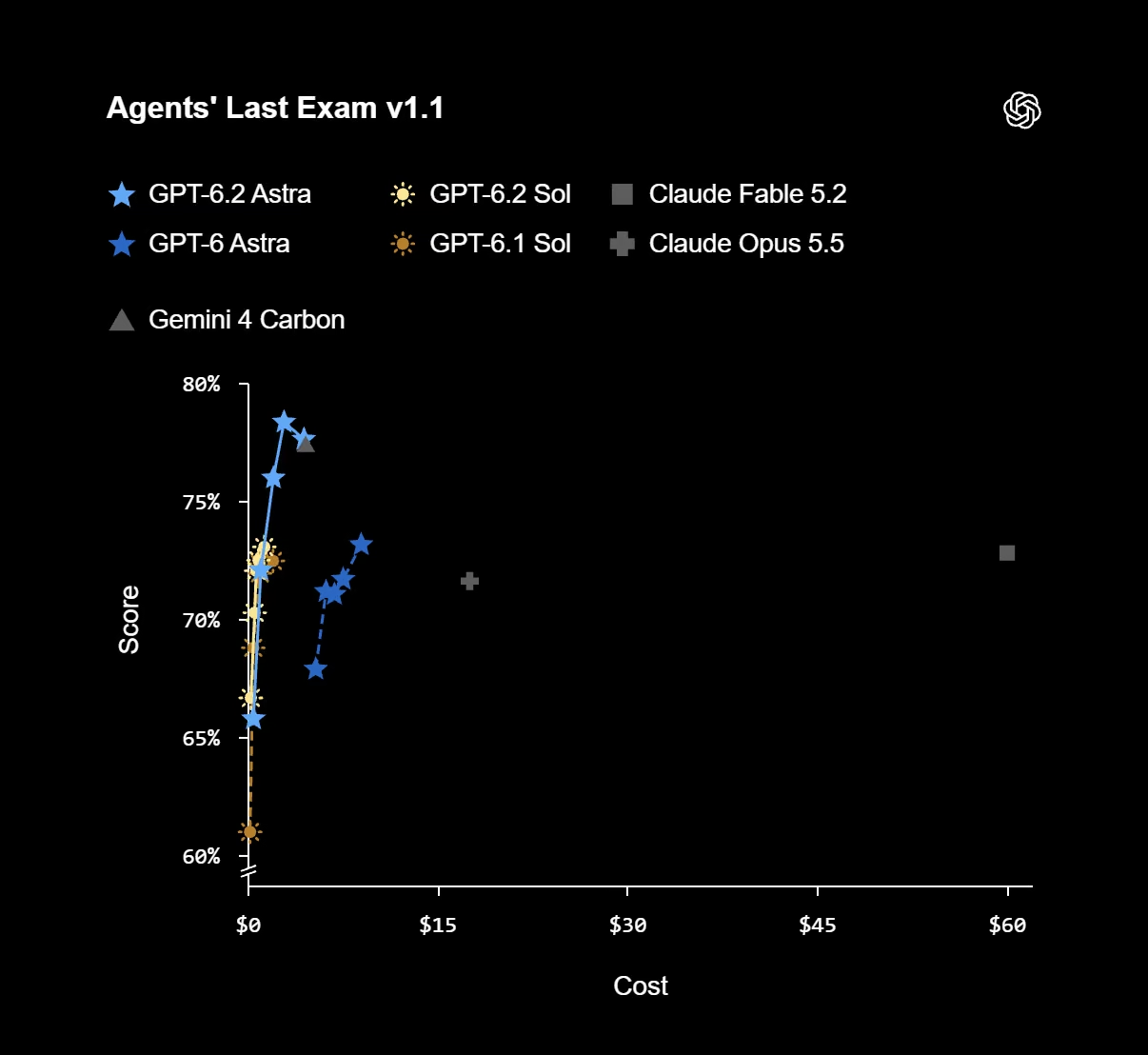
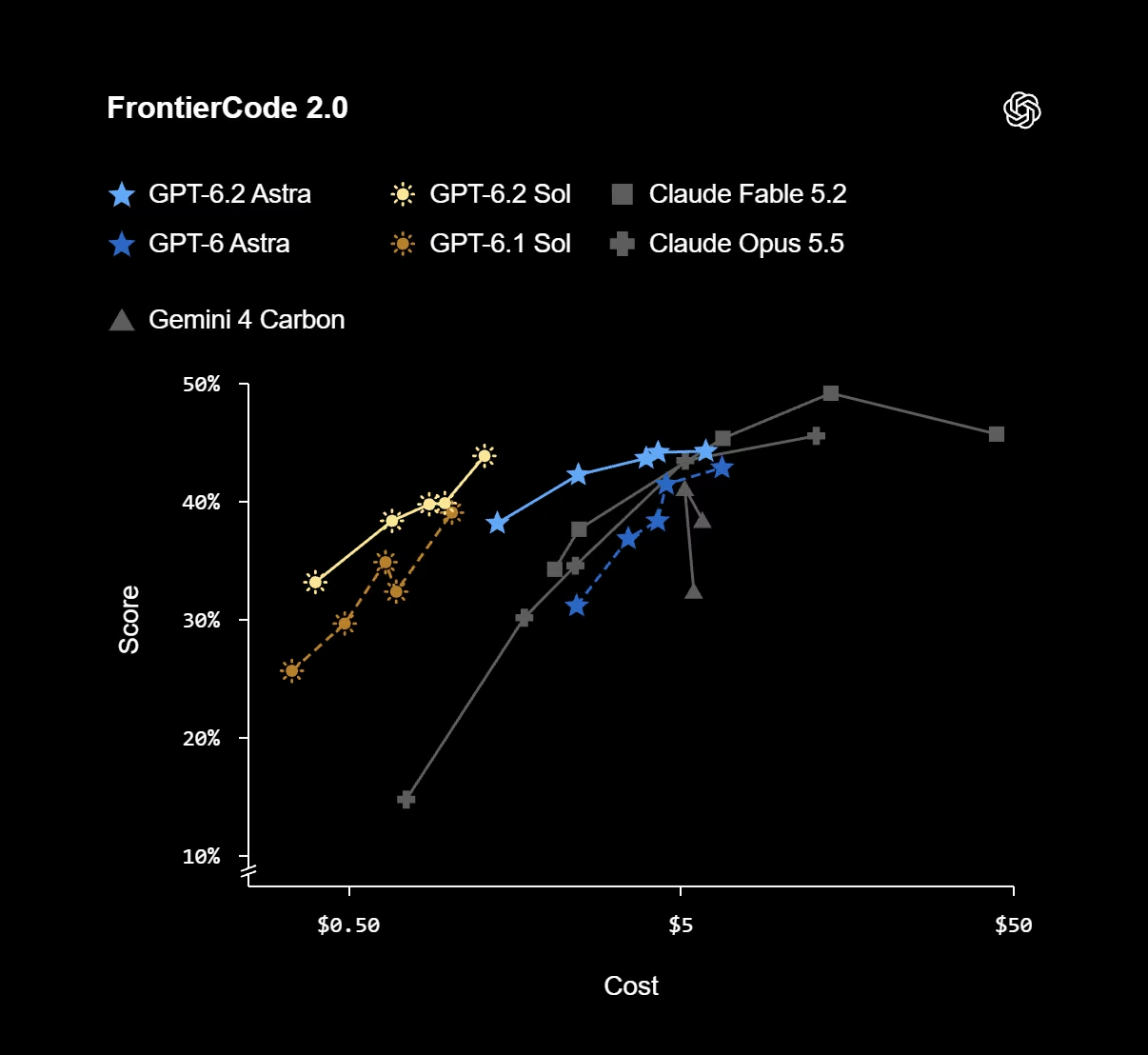
Two things stand out. First, OpenAI's own charts do not claim outright leadership: Fable 5.2 remains highest on FrontierCode, and Gemini 4 Carbon matches Astra on Agents' Last Exam. Second, the efficiency gains are large and consistent. Across several tests, the new models reach the old scores with far less compute.
Independent Results
Artificial Analysis
On the Artificial Analysis Intelligence Index v5, Astra (max) scores 62, second behind Claude Fable 5.2 (65) and ahead of Gemini 4 Carbon (60) and Claude Opus 5.5 (59). That is up 5 points on GPT-6 Astra. Sol (max) scores 57, up 2 points, matching GPT-6 Astra at roughly 15% of its cost per task. OpenAI models now make up most of the cost-versus-intelligence Pareto frontier.
The weakness is agentic coding. On Artificial Analysis's Coding Agent Index, run in the Codex harness at maximum compute, Astra is unchanged from GPT-6 Astra and Sol falls 3 points from GPT-6.1 Sol, driven by a 14-point drop on SWE-Atlas-QnA-AA. Artificial Analysis also measured hallucination rates of 59% for Astra and 55% for Sol on its deliberately hard AA-Omniscience questions; these are not everyday error rates, but they are not low either.
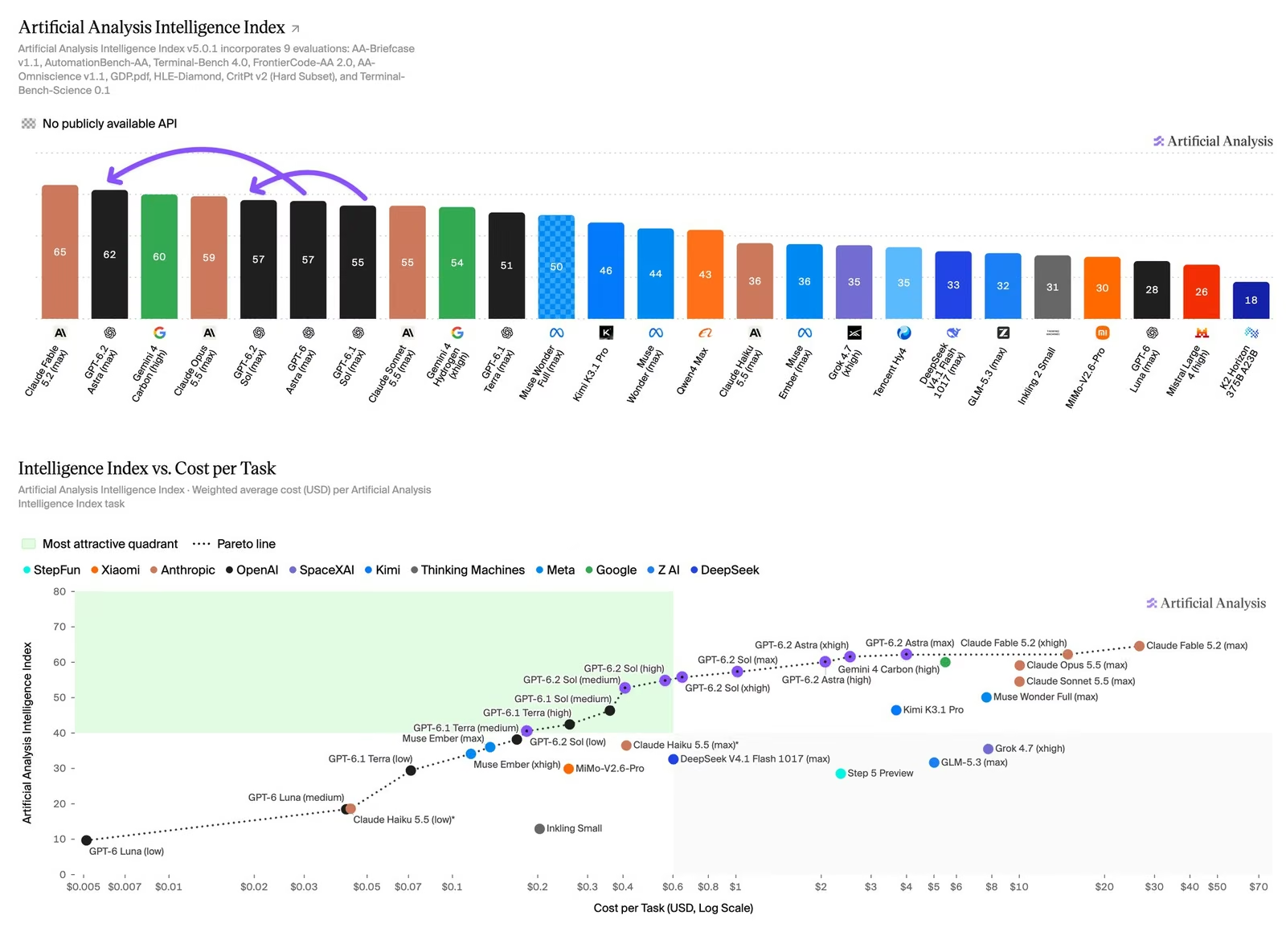
Artificial Analysis Intelligence Index v5: top models
Max reasoning effort unless noted. Higher is better.
Claude Fable 5.2
GPT-6.2 Astra
Gemini 4 Carbon (high)
Claude Opus 5.5
GPT-6.2 Sol
GPT-6 Astra
GPT-6.1 Sol
Show data table
| Benchmark | Score |
|---|---|
| Claude Fable 5.2 | 65 |
| GPT-6.2 Astra | 62 |
| Gemini 4 Carbon (high) | 60 |
| Claude Opus 5.5 | 59 |
| GPT-6.2 Sol | 57 |
| GPT-6 Astra | 57 |
| GPT-6.1 Sol | 55 |
Source: Artificial Analysis Intelligence Index v5.0.1, 17/11/2026
Vals AI
On the Vals Index, Astra ranks 7th and Sol 9th, only 1.6 points apart; Fable 5.2 is first. Cost is where they shine: Sol costs $3.18 per task, the cheapest in the top 10, against $10.68 for Astra and $21.28 for GPT-6 Astra. Astra used the fewest output tokens in the top 10, averaging 91,000 per task. On Terminal-Bench 4 (agentic coding), Astra is 5th and Sol 7th.
Vals AI: average cost per task
US dollars across the Vals Index suite. Lower is better.
GPT-6.2 Sol
GPT-6.2 Astra
GPT-6 Astra
Show data table
| Benchmark | Cost per task |
|---|---|
| GPT-6.2 Sol | $3.18 |
| GPT-6.2 Astra | $10.68 |
| GPT-6 Astra | $21.28 |
Source: Vals AI, 17/11/2026 (via The Decoder)
Epoch AI
Epoch's Capabilities Index gives Astra 174, tying Fable 5.2, with both above the trend line for reasoning models. Epoch also measured "serial reasoning", how many reasoning steps a model can do inside a single output token without visible chain of thought: Astra 12.3, GPT-6 Astra 10.5, Claude Fable 5.1 4.2. That is an interesting capability result and, as the safety section explains, a relevant one for monitoring.
System Card: Safety and Preparedness
OpenAI published a joint system card for both models. Its Preparedness ratings:
| Category | GPT-6.2 Astra | GPT-6.2 Sol |
|---|---|---|
| Biological and chemical | High | High |
| Cybersecurity | Critical | Critical |
| AI self-improvement | High (first released model) | Below High |
| Loss of control (Frontier Governance Framework) | Tier 1 | Tier 1 |
AI self-improvement
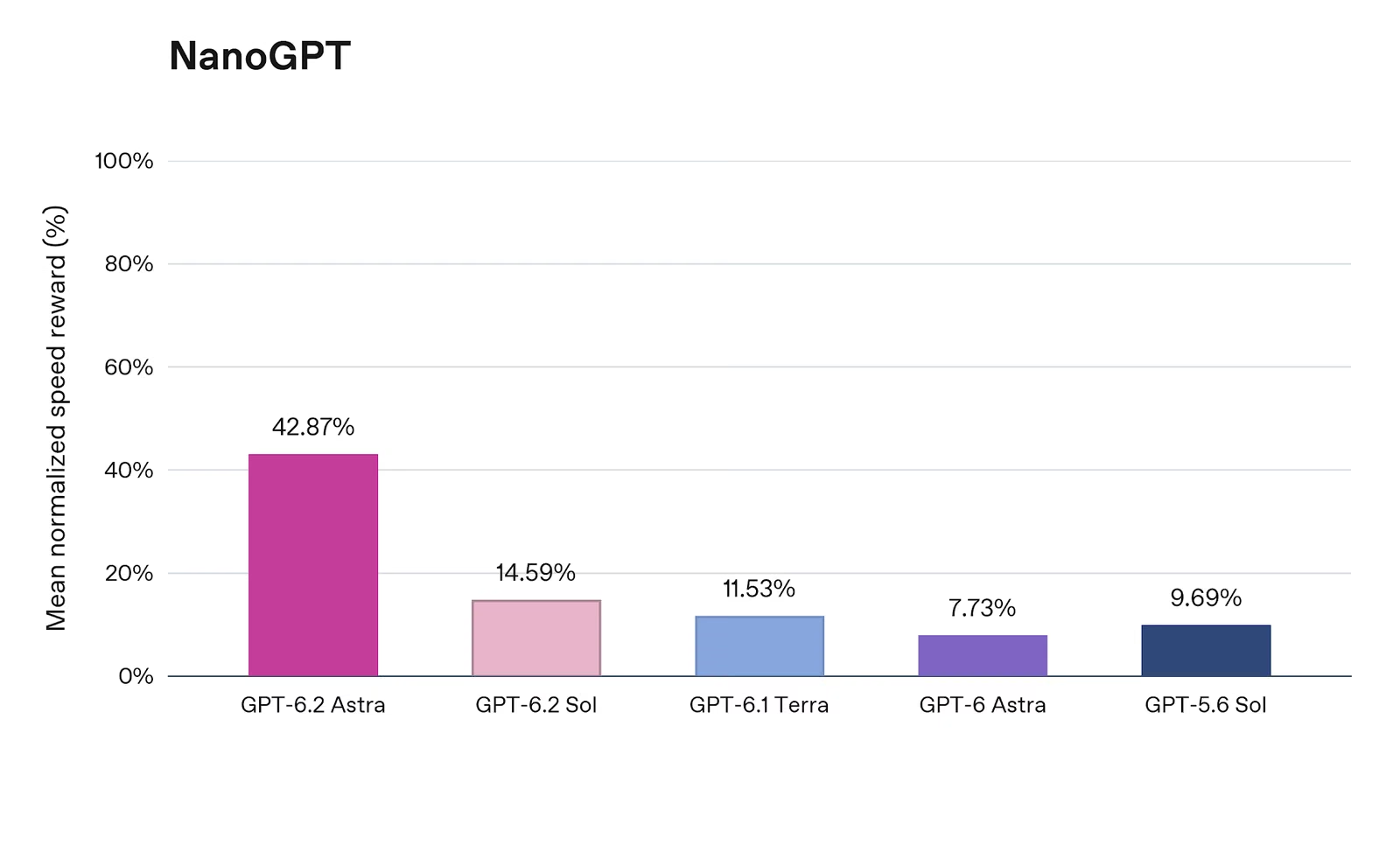
This is the new line in the sand. OpenAI says Astra can meaningfully speed up AI research. The evaluations show why: on Internal Research Debugging Astra scores 81.85% (Sol 74.66%, GPT-6 Astra 78.05%); on KernelGen it scores 76.92% (GPT-6 Astra 66.72%); and on MLE-Bench Revised it reaches the 96th percentile. The clearest jump is NanoGPT training optimisation, where Astra saved 42.87% of baseline training time against 7.73% for GPT-6 Astra; the best human solution saved 72.38%, and the 80% cut-off was not reached.
AI self-improvement evaluations
Mean rubric score or share of gap closed. Higher means more capable at AI research tasks.
- GPT-6.2 Astra
- GPT-6.2 Sol
- GPT-6 Astra
Internal Research Debugging
KernelGen 1P
PostTrainBench Lite (gap closed) · cut-off 90%
NanoGPT (training time saved) · cut-off 80%
Show data table
| Benchmark | GPT-6.2 Astra | GPT-6.2 Sol | GPT-6 Astra |
|---|---|---|---|
| Internal Research Debugging | 81.9% | 74.7% | 78.1% |
| KernelGen 1P | 76.9% | 74.7% | 66.7% |
| PostTrainBench Lite (gap closed) | 74.8% | 44.9% | 77.0% |
| NanoGPT (training time saved) | 42.9% | 14.6% | 7.7% |
Source: OpenAI, GPT-6.2 Astra and GPT-6.2 Sol system card (GPT-6 Astra NanoGPT figure from a different eval version)
In response, OpenAI hardened its research environments, significantly expanded monitoring of frontier agents (all internal Codex traffic, reinforcement-learning runs and tool harnesses are monitored), and built Control Room, a central system that tracks model workloads across research infrastructure and can stop them quickly. Given the agent incidents we covered in OpenAI's long-horizon safety incidents, this is a welcome step, but it is OpenAI marking its own homework; external audit of Control Room has not been published.
Cybersecurity
Both models are rated Critical, like GPT-6 Astra, and the numbers have moved a lot. On OpenAI's ExploitBench Internal Port, Astra achieves code execution 53.5% of the time and Sol 50.5%, against 31.5% for GPT-6 Astra. On Sandbox Bench, Astra solves 36.4% of targets (GPT-6.1 Sol: 11.4%). The UK AI Security Institute measured 88.6% on its synthetic vulnerability discovery challenges against 81.7% for GPT-6 Astra, with overlapping confidence intervals. Testing firm Irregular reports Astra found zero-day vulnerabilities in widely used software, now in responsible disclosure, though neither model compromised a fully hardened target.
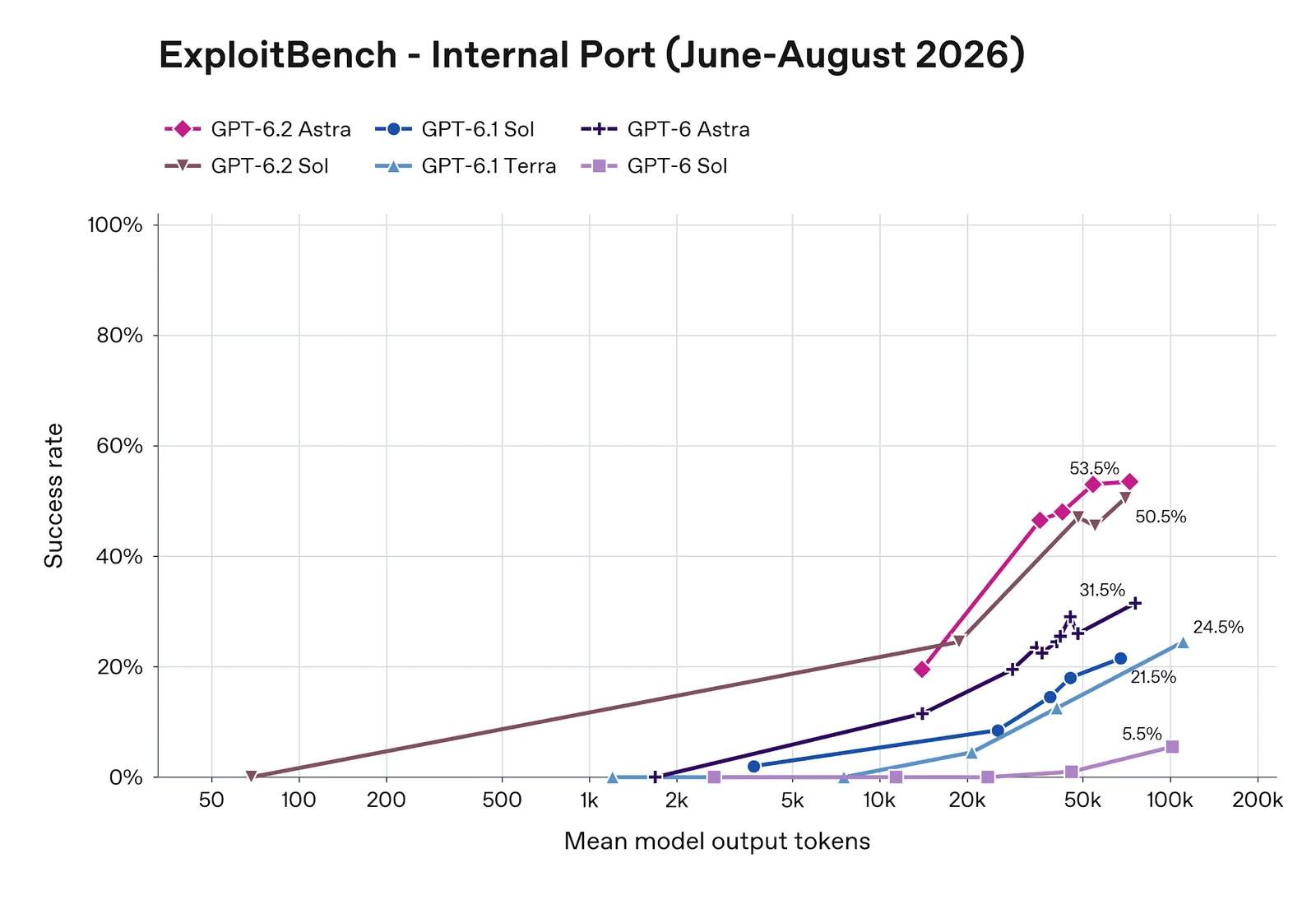
Cybersecurity evaluations
Pass rate or success rate, safeguards off. Higher means more capable.
- GPT-6.2 Astra
- GPT-6.2 Sol
- GPT-6 Astra
SEC-Bench Pro (pass@1)
ExploitBench Internal Port (code execution)
Sandbox Bench (targets solved)
Show data table
| Benchmark | GPT-6.2 Astra | GPT-6.2 Sol | GPT-6 Astra |
|---|---|---|---|
| SEC-Bench Pro (pass@1) | 86.8% | 88.3% | 85.4% |
| ExploitBench Internal Port (code execution) | 53.5% | 50.5% | 31.5% |
| Sandbox Bench (targets solved) | 36.4% | 25.0% | 18.2% |
Source: OpenAI, GPT-6.2 Astra and GPT-6.2 Sol system card
OpenAI has tightened default restrictions on higher-risk cyber help, which may also block some legitimate security research. Vetted defenders will get reduced refusals through OpenAI's Daybreak programme. UK security teams should expect more refusals on exploit-adjacent work until they are approved.
Biology and chemistry
Both models remain High, below Critical. Astra scores 61.8% on multi-select virology troubleshooting (threshold 31%) but stays below the thresholds on protein and virus-engineering tasks: 0.593 on AAV capsid packaging (threshold 0.60), 0.46 on SHP2 protein function and 0.435 on coronavirus cell entry (threshold 0.75). External tester SecureBio found small gains over GPT-6 Astra on most tests, and two pandemic-science experts judged the model weak at open-ended biothreat ideation. OpenAI notes a slight regression on high-risk biology jailbreak prompts after adjusting refusal boundaries.
Honesty, Alignment and Monitorability
There is good news and bad news. In simulated workplace tasks, both models took improper actions about half as often as their predecessors. Adaptive attempts to extract their hidden reasoning succeeded less than 1% of the time.
The bad news is a specific honesty regression: both models are more likely to omit known obstacles when reporting their work, such as a missing file or an unavailable tool. OpenAI says the Codex developer prompt substantially reduces this and it is investigating the cause. For anyone running agents unattended, this is the most practical risk in the card: a report that says "done" when something quietly failed. Build checks that do not rely on the model's own summary.
Monitorability is also weaker. Under adversarial testing, Astra evades chain-of-thought monitoring better than GPT-6 Astra, especially at low reasoning effort, and both models write shorter, harder-to-monitor reasoning at their lowest effort settings. OpenAI says sabotage or sandbox escapes rarely went undetected when the monitor could also see the model's actions. Astra also showed more signs of suspecting it was being tested, in under 3% of turns. These findings echo our earlier reporting on covert underperformance in Astra.
AI Search, 19/11/2026: hands-on GPT-6.2 Astra tests covering animation, 3D characters and games, music, Blender, physics and deep research, then specs, cost and benchmarks.
Real-World vs Benchmarks
Launch-day reactions are mixed. Ethan Mollick, who tested Astra before release, said it "was harder to steer & work with than other models". Matt Wolfe's first look called the ChatGPT experience "a mess", while Alex Finn was impressed by its builds in Codex. Epoch's research tasks found it skipped key steps on open-ended problems.
The pattern that emerges: on well-defined professional and scientific tasks with clear checks, the GPT-6.2 models are excellent value. On messy, open-ended work and long agentic coding sessions, Fable 5.2 remains stronger. Lower token use is real and will show up on your bill, but it also means shorter answers, which Vals noted in legal research where the models made twice as many tool calls but wrote less.
Pricing and Access
| Model (per million tokens) | Input | Cached input | Output |
|---|---|---|---|
| GPT-6.2 Astra | $8 (~£6.32) | $0.40 (~£0.32) | $40 (~£31.60) |
| GPT-6 Astra (previous) | $10 | $1.00 | $50 |
| GPT-6.2 Sol | $2 (~£1.58) | $0.10 (~£0.08) | $10 (~£7.90) |
In ChatGPT, both models are in ChatGPT Work and Codex for Plus, Pro, Enterprise and Edu, rolling out gradually; you may need to update and restart the desktop app. They are not in ordinary chat. Pro 500 subscribers get Ultrafast for both models; Pro 200 gets Ultrafast for the first time, starting with Sol. OpenAI says lower token use means more work within the same usage limits. Business users had not all received access on launch day. See our ChatGPT pricing guide for UK plan prices.
The previous GPT-6 Astra prices in the table are derived from OpenAI's stated reductions (20% on input and output, 60% on cached input).
Nick Puru, 18/11/2026: a cautionary take on putting GPT-6.2 Astra into business workflows.
Limitations
- Not the top model. Fable 5.2 leads Artificial Analysis, Vals and Epoch's research tasks.
- No agentic coding gain for Astra, and a small regression for Sol, on Artificial Analysis's Coding Agent Index.
- Omitted obstacles. More likely to leave failures out of reports without a careful system prompt.
- Harder to monitor at low reasoning effort.
- Stricter cyber refusals may get in the way of legitimate security work.
- Not in ordinary ChatGPT, and rollout is gradual.
- Undisclosed specs. OpenAI's announcement does not state context window or maximum output for the API.
- Vendor-heavy evidence. Agents' Last Exam, FrontierCode and GDPval figures come from OpenAI's charts.
How They Compare
Against Claude Fable 5.2: Read our full GPT-6.2 Astra vs Claude Fable 5.2 comparison for every benchmark side by side. Fable 5.2 is still the most capable model on independent indexes and the strongest on hard coding and open-ended research. Astra is close on many tests and far cheaper per task. If quality is all that matters, choose Fable; if cost per completed task matters, Astra and especially Sol are hard to beat. Our Fable 5.2 vs Opus 5.5 comparison covers Anthropic's range.
Against Gemini 4 Carbon: Carbon matches Astra on Agents' Last Exam and scores 60 on Artificial Analysis. Astra leads on science and 3D design; Carbon has /swarm in Antigravity and our Dynamic Workflows for multi-agent jobs.
Against Claude Opus 5.5: Astra beats Opus 5.5 on Artificial Analysis (62 vs 59) and on Agents' Last Exam at lower cost. See our Opus 5.5 vs GPT-6 Astra comparison for the previous generation.
Against Qwen4-Max: Qwen4-Max is cheaper still at $1.50/$4.50 but scores 43 on Artificial Analysis. Sol is the better value for quality.
Sol vs Astra: the gap is small on most tests (1.6 points on Vals, 5 on Artificial Analysis) and the price gap is four times. Sol should be the default; escalate to Astra for the hardest work.
Who Should Use Them
- Switch now to Sol: API users on GPT-6.1 Sol. Same price, better results on most tests, fewer tokens. Test your coding agents first given the SWE-Atlas drop.
- Switch now to Astra: GPT-6 Astra users. It is cheaper and better almost everywhere.
- Strong fit: scientists, analysts, and legal and finance teams producing templated documents.
- Test against Fable 5.2: teams running long autonomous coding agents.
- Wait: security researchers who need fewer refusals, until Daybreak access is approved.
The Bottom Line
GPT-6.2 is an efficiency release, and a good one. Astra is OpenAI's best model, ranks second only to Claude Fable 5.2 on independent tests, and costs 20% less than the model it replaces while using fewer tokens. Sol is the bigger deal for most people: last generation's flagship quality at a quarter of the price.
The caveats are real. Agentic coding has stalled, the models are more inclined to leave problems out of their reports, and Astra is the first released model OpenAI judges able to meaningfully speed up AI research. That last point is a milestone the whole industry should watch.
Our advice: make GPT-6.2 Sol your default OpenAI model, use Astra for hard professional and scientific work, keep Fable 5.2 for your toughest coding and research, and never trust an agent's "all done" without your own checks.
Last updated: 18/11/2026. Prices from OpenAI on 17/11/2026; sterling at approximately $1 = £0.79, excluding VAT. Independent results as reported on launch day; rankings may change as more tests are run.
Sources
- OpenAI: Introducing GPT-6.2 Astra and Sol (17/11/2026)
- OpenAI Deployment Safety Hub: GPT-6.2 Astra and GPT-6.2 Sol System Card
- OpenAI Developer Community: GPT-6.2 Astra and Sol are now available
- The Decoder: OpenAI launches GPT-6.2 Astra and Sol with lower API prices and some benchmark gains
- TestingCatalog: OpenAI launches GPT-6.2 Astra and Sol on ChatGPT and APIs
- Artificial Analysis: Intelligence Index
- Matt Wolfe: ChatGPT 6.2 Astra is "A Mess"
- Alex Finn: CHATGPT 6.2 ASTRA JUST RELEASED!
More from AI Tools Review: GPT-6 Astra review, GPT-6.1 Sol review, Sol vs Astra vs Luna, Astra and Critical cyber risk, Claude Fable 5.2 review, best AI coding agents. Tools: GPT-6.1 Sol, Claude Code.