 AI Tools Review Editorial Team
Quick Answer:
A system card is the report an AI developer publishes with a model, setting out its capabilities, the vendor's own benchmark scores, the safety tests it ran and the risk level it assigned. Anthropic, OpenAI and Google all published one for their November 2026 flagships. It is the most detailed first-party source on a model, but it is written by the vendor, so read it alongside independent results.
36
Model-card records on this site
One JSON file per model
244
Pages in the Claude Opus 4.8 system card
Published 28/05/2026
3
Labs covered in this article
Anthropic, OpenAI and Google
17/11/2026
GPT-6.2 Astra system card date
Rated Critical for Cybersecurity
Source: Site model-cards data (src/data/model-cards), checked 22/11/2026
What Is a System Card?
A system card is a document an AI developer publishes alongside a model that explains what the model can do, how it was tested and what risks the developer found. It is the vendor's own account of the model, usually released on the same day as the launch post, and it is the place where safety ratings, refusal behaviour and detailed benchmark tables appear.
The idea matters more each year because the models are getting more capable and the documents are getting longer. Anthropic's system card for Claude Opus 4.8 runs to 244 pages. We have followed the format since the early Claude releases, including our deep dives on the Claude 3 Opus system card and the Claude 3.5 Sonnet system card.
What Does a System Card Contain?
A system card typically contains four things: a description of the model, the vendor's benchmark results, safety evaluations and a risk rating under the vendor's own framework. The detail varies, but our model-card records capture the same fields for every model so they can be compared.
- Documents: the system card, model card or technical report, with its URL and publication date.
- Vendor-reported benchmarks: category, benchmark name, score, unit and the setting used, such as "adaptive thinking at max effort, averaged over five trials".
- Safety level and key findings: the rating under the lab's framework and short findings such as prompt-injection robustness or cyber capability.
- Pricing and context window, where the vendor states them.
The benchmark setting matters. A score at max effort is not comparable with a score at default effort, which is why every row on our tool pages names its setting.
What Do Recent System Cards Say?
The latest cards from Anthropic, OpenAI and Google each reach a different safety conclusion, using each lab's own framework and terminology. The table summarises the records on our tool pages.
| Model | Document | Published | Safety conclusion |
|---|---|---|---|
| Claude Fable 5.2 | Claude Fable 5.2 and Claude Mythos 5.2 System Card | 09/11/2026 | CB-1 protections applied, CB-2 not crossed; AI R&D threshold not met |
| GPT-6.2 Astra | GPT-6.2 Astra and GPT-6.2 Sol System Card | 17/11/2026 | Biological and Chemical High, Cybersecurity Critical, AI Self-Improvement High |
| Gemini 4 Neon | Gemini 4 Neon Model Card and evaluation methodology | November 2026 | Below the Material Capability Change threshold; earlier Argon determinations carried forward |
| Claude Opus 5.5 | Claude Opus 5.5 System Card | 22/09/2026 | CB-1 treated as met, CB-2 not crossed |
| Claude Sonnet 5.5 | Claude Sonnet 5.5 System Card | 28/09/2026 | CB-1 and Autonomy-1 treated as met; CB-2 and Autonomy-2 not crossed |
Source: vendor documents as recorded in our model-cards data, last checked 22/11/2026.
OpenAI's card for GPT-6.2 Astra is notable because Astra is the first externally released OpenAI model to meet the High threshold for AI Self-Improvement, and the card records Critical for Cybersecurity, with ExploitBench Internal Port code execution reaching 53.5% against 31.5% for GPT-6 Astra. Anthropic's card for Fable 5.2 reports that Claude Mythos 5.2 has the strongest cyber capabilities of any Anthropic model released, yet still sits in the lower capability category of its framework. Our review covers Claude Fable 5.2 and Mythos 5.2 in more depth.
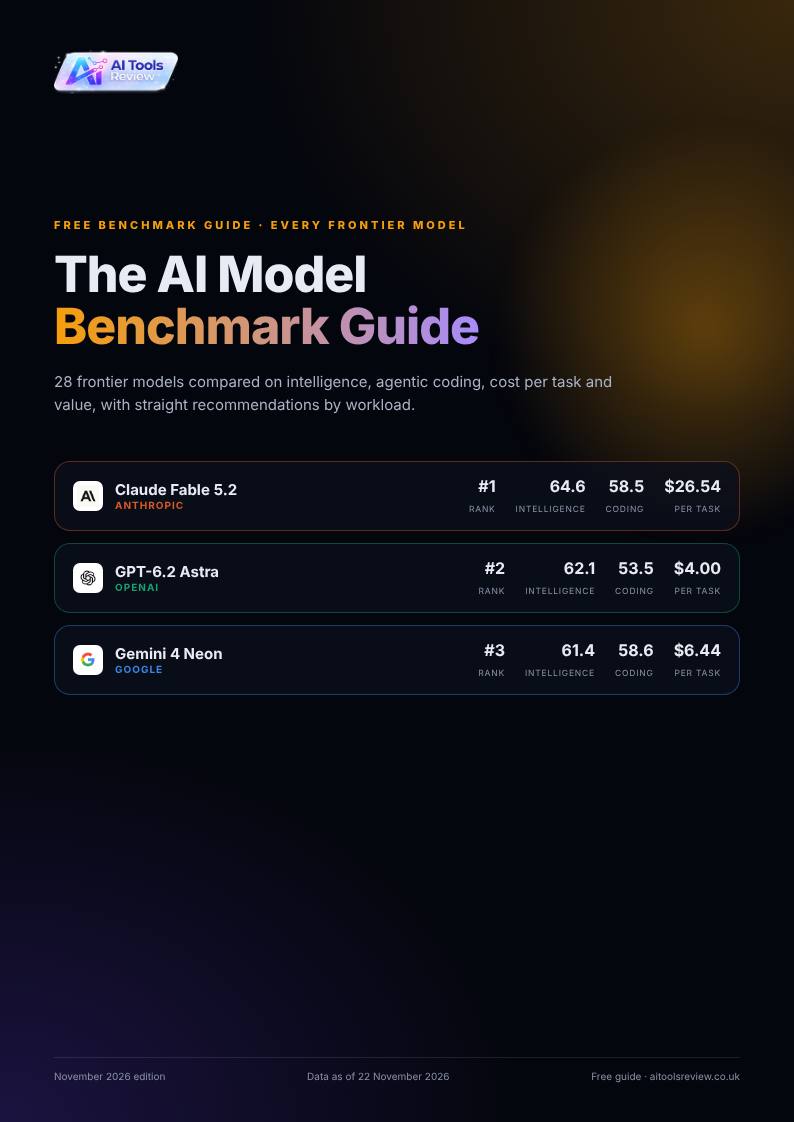
Get the free guide: The AI Model Benchmark Guide
Every frontier model compared on intelligence, coding, cost per task and value, with straight recommendations. November 2026 edition. Updated 22/11/2026.
How Is a System Card Different From a Model Card?
A system card and a model card cover much the same ground, and the name mostly reflects the lab. Anthropic and OpenAI publish system cards. Google DeepMind published a model card for Gemini 4 Neon, plus a separate technical page describing its evaluation approach, methodology and results.
The practical difference is scope. A system card often describes the model as deployed, including safeguards and behaviour in products, while a model card tends to be shorter and more standardised. When you research a model, collect every document the vendor lists: the system or model card, the launch post and any technical report. Our records keep all of them, each with its own link and date.
How Far Can You Trust a System Card?
You can trust a system card as an accurate record of what the vendor tested, but not as an independent verdict, because the vendor chooses the benchmarks, settings and comparisons. Three details from recent cards show why.
- Google's Gemini 4 Neon card describes comparisons where non-Gemini figures are mostly the providers' self-reported numbers, and the model leads on most rows but trails Claude Opus 5.5 on Terminal-Bench 4.1 and FrontierCode 2.0.
- OpenAI's launch post shows most capability scores only in charts, so the exact figures come from the system card tables.
- Anthropic's Fable 5.2 card records that the model falls back to Opus 4.8 more often than recent models in prompt-injection scenarios, which gives a higher attack success rate, though it is among the most robust when it answers itself.
Cross-check with independent data. Our /benchmarks page reads the Artificial Analysis leaderboard daily, where Claude Fable 5.2 scores 64.6, GPT-6.2 Astra 62.1 and Gemini 4 Neon 61.4. If a vendor number and an independent number disagree, the gap is worth understanding before you choose a model. Our guide How to Choose an AI Model in November 2026 shows how to combine them.
How Do You Read a System Card?
You read a system card by going to the summary, then the safety rating, then the benchmark settings, and ignoring the rest until you need it. A 244-page document is a reference, not a read-through. This order is our recommendation, not a vendor standard.
- Read the vendor's summary and safety level. It tells you whether any risk threshold was crossed.
- Check the effort setting behind each benchmark number before you compare models.
- Look at the comparison rows. Note which competitor figures are self-reported.
- Read the findings on the risks that match your use, such as prompt injection for agents or cyber capability for security teams.
- Note the date. Vendors revise cards. The Claude Opus 4.8 card, for example, carries a changelog dated 3 June 2026.
Where Can You See System Cards on AI Tools Review?
Every model tool page on AI Tools Review now has a system-card benchmarks section, so you can see the vendor's numbers next to the independent Artificial Analysis data. Each record names its source document and marks whether we verified it from the official document or from one of our own articles that cites it.
Open a tool page such as Claude Fable 5.2, GPT-6.2 Astra or Gemini 4 Neon to see it. We copy figures from the vendor document only and leave out anything that is not published. System cards are also becoming relevant to agent builders: see What Is an Always-On AI Agent? for why permissions and safeguards matter when a model runs unattended.