
 AI Tools Review Editorial Team
Note: Clawdbot has been rebranded to Moltbot (January 2026). This article uses both names interchangeably.
For the rebrand story and security warnings, see: What is Moltbot?
In January 2026, a series of viral Twitter threads claimed that a UK-based micro-SaaS had achieved the impossible: Zero Human Employees. The business, purportedly managed entirely by a locally-hosted Clawdbot instance, handled everything from server maintenance to customer billing and marketing copy.
This wasn't just another automation story; it was a glimpse into the "Post-Staff" economy. But as the hype reached a fever pitch, skeptics began to ask: mapping a bot to a terminal is one thing, but can an AI agent truly hold the keys to a corporate kingdom?
In this deep dive, we examine the Architecture of Autonomy, the legal minefields of UK company law, and why the most successful "Zero-Employee" companies are actually high-powered partnerships between one human and a swarm of specialized agents.
Origins of the Zero-Employee Story
Overnight sensation
When Clawdbot’s GitHub repository burst onto social media, its popularity skyrocketed. An article from 36Kr (a Chinese tech publication) noted that the assistant gained more than 20,000 GitHub stars in a single day, with developers across Silicon Valley expressing astonishment. The piece described Clawdbot as a “Claude with hands” because it combines the language understanding of large models with the ability to act on a user’s computer.
The article emphasised that the system can think, remember and act; it runs on personal devices and can be controlled through WhatsApp, Telegram, iMessage and other chat apps. This combination of autonomy and accessibility fuelled speculation about a new breed of business powered entirely by AI.
The first zero-employee company?
The “zero-employee company” story appears to have originated from a series of blog posts and social media discussions. Enthusiasts posited that a single person could register a company, deploy Clawdbot to manage operations and step back entirely. The idea gained momentum when some users reported using the agent to handle tasks such as scheduling, email triage, customer enquiries and even coding small features.
In one widely shared example, a developer claimed that Clawdbot completed the tedious work of organising electronic files in 10 seconds, a task that previously took an hour. While these anecdotes illustrate the assistant’s productivity, they do not constitute a fully autonomous enterprise.
Separating hype from reality
Clawdbot’s strengths lie in automation and persistence. It can write code, run scripts and interface with third-party services. However, the assistant still relies on human oversight and external LLMs for decision making. It lacks strategic judgment and cannot assume legal responsibility. Businesses cannot simply hand over control to an AI without incurring significant legal and ethical risks. In practice, the “zero-employee” label refers to the idea of minimal staffing, where human operators supervise the agent rather than perform every task themselves.
How Clawdbot Supports Lean Business Models
Round-the-clock operations
Clawdbot runs continuously and can perform tasks at any time of day, making it ideal for international businesses that operate across time zones. For example, a UK-based e-commerce owner could ask Clawdbot to monitor orders, send invoices and update inventory while they sleep. The assistant’s persistent memory enables it to maintain context over long periods, meaning it can pick up tasks where it left off without repeated instruction.
Multichannel communication
Because Clawdbot integrates with multiple messaging platforms, it can act as a central communications hub. Customers might send queries via WhatsApp or email, while team members contact the agent through Slack. The gateway aggregates these messages and routes them to the appropriate tools. This consolidation simplifies customer service and allows a small team, or even a single person, to manage multiple channels.
Tooling and automation
The breadth of Clawdbot’s tool ecosystem makes it suitable for tasks ranging from data entry to DevOps. It can interact with APIs, manage spreadsheets, deploy code and generate reports. The optional Lobster workflow shell allows complex multi-step processes to run with explicit approval checkpoints (discussed in detail in the Lobster article). Such automation reduces manual labour, enabling entrepreneurs to focus on strategic work.
The Architecture of an Autonomous Department
A "Zero-Employee" business isn't run by one giant bot; it's run by a Swarm. Modern Clawdbot (Moltbot) users are moving toward a modular architecture where different "Skills" represent different business functions.
The Ops Agent
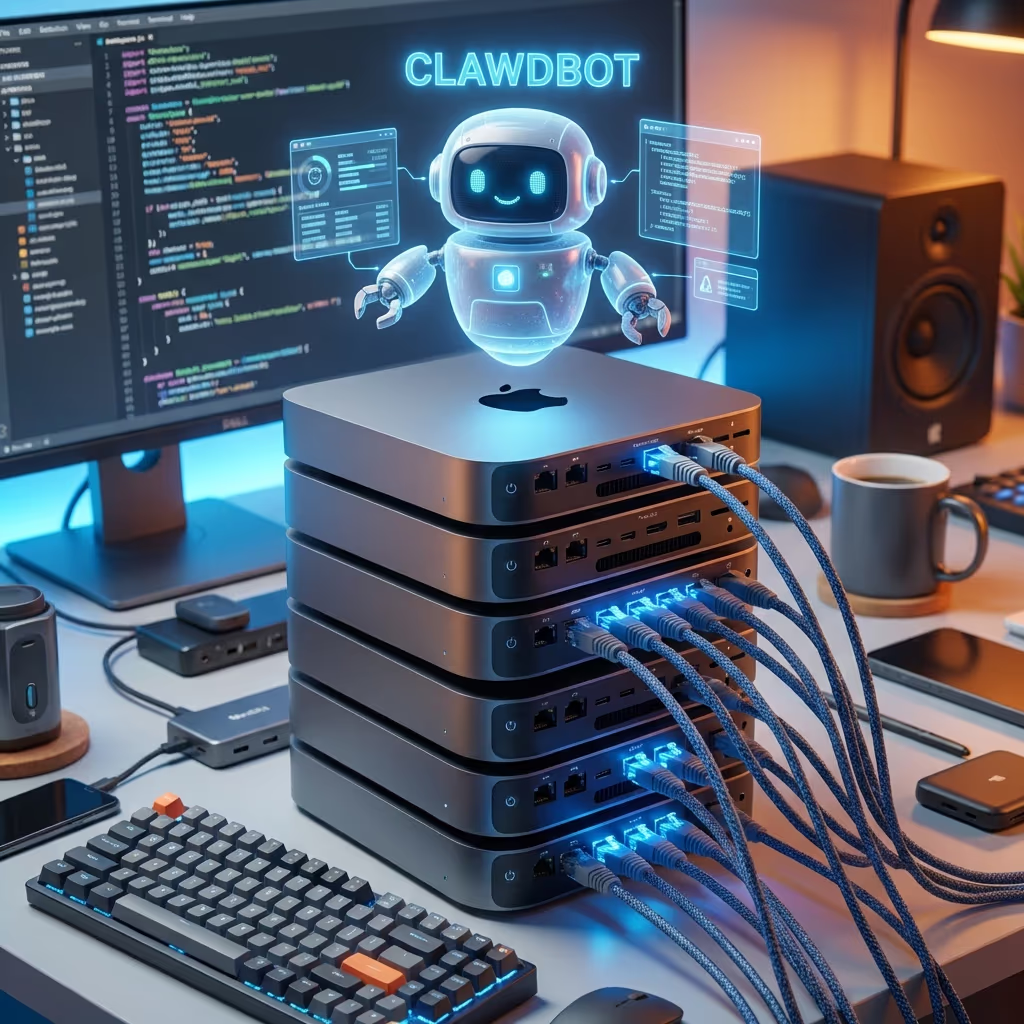
Monitors server health, handles backup rotations, and auto-scales infrastructure. This agent has "Full Hands" access to the Mac Mini nodes.
The Front-Office Agent
Interfaces with customers via WhatsApp and Email. It uses Bayesian memory to remember previous interactions and sentiment, drafting responses for human approval.
The Productivity Multiplier
Data from early 2026 suggests that a single founder with a well-configured agent swarm can mirror the output of a traditional 12-person agency. The bottleneck is no longer execution; it is the founder's ability to review and approve the agentic workstream.
Example Business Scenarios
A freelance web designer in London could use Clawdbot to draft proposals, manage client communications and deploy website updates. The agent could summarise client requirements, generate invoices and coordinate with hosting providers.
A YouTuber or blogger might ask Clawdbot to transcribe videos, schedule social media posts and monitor analytics. The assistant can summarise feedback, respond to comments (subject to approval) and alert the creator when engagement spikes.
A small shop selling niche products could utilise Clawdbot to process orders, respond to customer queries, reorder inventory when stock is low and coordinate shipping. By connecting to payment gateways and shipping APIs, the agent automates operations that previously required staff.
Legal and Ethical Considerations
Legal Reality Check: The 'Director Problem'
While the technical possibilities are dizzying, the legal framework is lagging. In the UK, the Companies Act 2006 is very clear: a company must have a human director.
The Liability Trap
If an autonomous agent makes a financial commitment, enters a contract, or commits a tort (like copyright infringement), the Human Director is personally liable for oversight failures. You cannot sue a Mac Mini.
Data protection and privacy (UK GDPR)
Businesses using Clawdbot must comply with the UK General Data Protection Regulation (UK GDPR). Processing personal data through an AI agent requires lawful basis, transparent policies and mechanisms for data subject rights. The agent’s persistent memory means it stores conversation histories and potentially sensitive information. As the SOCRadar article warns, exposed Clawdbot control interfaces reveal API keys, tokens and conversation logs. This can result in serious data breaches. Companies should encrypt storage, restrict access and regularly audit configurations.
Security and prompt injection risks
Misconfigured deployments can allow unauthorised users to access or control the agent. Attackers may send prompt injections that manipulate the LLM into leaking secrets or performing harmful actions. Businesses must implement IP whitelisting, enforce authentication and review AI outputs before execution.
Ethical implications
Delegating tasks to an AI raises ethical questions about accountability, bias and transparency. If Clawdbot sends a customer email that causes confusion or harm, who is responsible? Without oversight, the agent could repeat inaccuracies from its LLM, leading to misinformation. Businesses should ensure that a human reviews important communications and decisions.
Opportunities and Challenges
Benefits
- Cost savings: Automating tasks reduces labour expenses. Small businesses might replace several part-time roles with Clawdbot, freeing budget for growth.
- Scalability: An AI assistant can handle many tasks simultaneously, scaling with demand without requiring proportional increases in staff.
- Consistency: Clawdbot performs tasks consistently and does not suffer fatigue. It remembers instructions precisely and follows procedures accurately.
Challenges
- Technical complexity: Deploying and maintaining Clawdbot requires technical skills. Entrepreneurs without a computing background may struggle to configure the gateway securely.
- Reliance on external models: The assistant’s intelligence comes from LLMs hosted by providers like OpenAI and Anthropic. Changes in pricing, availability or terms of use can impact operations.
- Legal liability: A company cannot delegate legal accountability to an AI. Human directors remain responsible for compliance.
UK Perspective: Innovation within Regulation
The UK Government is actively exploring AI regulation through consultation papers and sector-specific guidelines. Innovators in London’s tech ecosystem should stay informed about forthcoming rules governing autonomous agents. The UK GDPR and Data Protection Act already impose strict obligations on data controllers; using Clawdbot does not exempt a business from these laws. For entrepreneurs, the promise of lean operations must be balanced with compliance, security and ethical considerations.
Cost Breakdown: Traditional vs AI-Augmented
The most compelling argument for the "Zero Employee" (or at least "One Human") model is financial. Here is a breakdown of annual operating costs for a typical micro-SaaS or content business in the UK.
| Expense Category | Traditional Small Team (3 Staff) | Moltbot-Augmented (1 Human) |
|---|---|---|
| Salaries (Junior Ops/Support/Dev) | £90,000+ | £0 |
| Software/SaaS Tools | £3,000 (Simultaneous Seats) | £500 (Single Seats) |
| AI Infrastructure (API Costs) | £200 (Copilot seats) | £1,200 (Heavy API Usage) |
| Office/Equipment | £5,000 | £0 (Home Office) |
| Estimated Annual Total | £98,200+ | £1,700 |
Conclusion
Clawdbot’s rise has sparked bold claims about the future of work. The idea of a zero-employee company makes for a compelling headline but oversimplifies the reality. While the assistant can automate many tasks and enable lean operations, it does not eliminate the need for human oversight, legal accountability or security measures.
Businesses considering deploying Clawdbot should view it as a powerful tool rather than a replacement for human judgment. Those willing to invest in proper configuration, governance and oversight can benefit from round-the-clock automation and improved productivity. As the technology matures, we may see more companies augment their teams with AI agents, but the era of truly “zero-employee” enterprises remains largely speculative.
The next article explores Lobster, the workflow shell that powers Clawdbot’s multi-step automations and ensures safety through explicit approvals.