 AI Tools Review Editorial Team
Quick Answer:
Safe Superintelligence Inc. (SSI), Ilya Sutskever's research lab, has not released a model, paper or product as of 24 August 2026, more than two years after it was founded. What has driven this week's headlines - including Wes Roth's video - is a chain of reporting that starts with one confirmed fact (a $5bn/£4bn Nvidia partnership announced 27 July 2026) and ends with one unconfirmed rumour (investor Gavin Baker saying, on a podcast, that "SSI says they'll come out with their model in August"). SSI itself has issued no press release, no blog post and no product page confirming any of it. This article separates what SSI has actually confirmed from what is reported second-hand and what is pure speculation.
Safe Superintelligence Inc. is, by design, the hardest company in AI to write about. It has no product page, no changelog, no benchmark leaderboard entry and, until very recently, almost no public statements at all. That silence is the whole point: Ilya Sutskever built SSI explicitly to avoid the pressure that turns research labs into product companies. So when a YouTube title promises a model that "will change EVERYTHING," the honest response is not to repeat the claim - it is to trace it back to its source and see what actually holds up.
Here is what SSI has confirmed, what has only been reported by others, what remains speculation, and how the company's structural bet on safety compares to the approaches at OpenAI, Anthropic and Google DeepMind.
Wes Roth's 23 August 2026 roundup of the SSI model rumours, the Nvidia partnership and Sutskever's public statements on superintelligence.
Executive Summary
Safe Superintelligence Inc. is a 2024-founded AI lab led by Ilya Sutskever, OpenAI's former chief scientist, built around a single stated goal: build a safe superintelligence, and ship nothing else until then. Over 26 months it has raised roughly $8bn (£6.3bn) across three rounds, most recently a strategic Nvidia partnership announced 27 July 2026, and reached a headline valuation of $32bn (£25bn) - all without a public product, paper or demo.
The news hook for this article is a rumour, not a release. In early August 2026, investor Gavin Baker said on a podcast that SSI planned to "come out with their model in August." That single, informal, second-hand line has since been amplified across newsletters, aggregator sites and YouTube commentary, including the Wes Roth video embedded above, without SSI ever confirming it directly. As of this article's publication date, no model has appeared.
- Confirmed: SSI's founding, funding rounds, leadership changes and the Nvidia partnership - all backed by official statements from SSI, Nvidia or verifiable regulatory-adjacent reporting.
- Reported but unconfirmed by SSI: an August 2026 model launch, sourced to one investor's podcast comment.
- Speculation: anything about what the model does, how it performs, or whether it constitutes "superintelligence" in any technical sense - none of this has been disclosed by anyone with direct knowledge.
- What's genuinely substantive: Sutskever's own November 2025 interview with Dwarkesh Patel, where he laid out - in his own words, on the record - how he thinks about the path to superintelligence.
SSI's Story So Far
Ilya Sutskever co-founded OpenAI in 2015 and served as its chief scientist, working on GPT, AlphaGo-adjacent research and, later, co-leading the company's "Superalignment" team, the group tasked with solving the alignment problem for future superhuman AI systems. He was also one of the OpenAI board members involved in the November 2023 attempt to remove Sam Altman as CEO, a crisis that ended with Altman reinstated and Sutskever's role at the company effectively over within months. He left OpenAI in May 2024.
A month later, on 19 June 2024, Sutskever announced Safe Superintelligence Inc. alongside Daniel Gross (former head of AI at Apple, and a well-known Silicon Valley investor) and Daniel Levy (a former OpenAI researcher). SSI's structure was, from day one, unusual by design. In an interview given around the launch, Sutskever put it plainly: "This company is special in that its first product will be the safe superintelligence, and it will not do anything else up until then." No enterprise tools, no chat product, no API, no interim revenue business, on the explicit theory that any of those would eventually pull focus and safety corners would get cut to compete.
SSI's own website states the mission with the same discipline: "Building safe superintelligence (SSI) is the most important technical problem of our time," describing the company as "the world's first straight-shot SSI lab, with one goal and one product: a safe superintelligence." A line further down is telling about the company's self-image: because SSI has no near-term commercial obligations, it says, "we can scale in peace." The team is based across Palo Alto, California and Tel Aviv, Israel, and was reported at roughly 50 people as of mid-2025 - tiny by frontier-lab standards.
The money came fast despite the total lack of a product. SSI raised roughly $1bn (£0.8bn) in September 2024 at a $5bn (£4bn) valuation, from SV Angel, DST Global, Sequoia Capital and Andreessen Horowitz. By April 2025 it had raised a further $2bn (£1.6bn), led by Greenoaks Capital, at a valuation of roughly $32bn (£25bn) - with Alphabet, Nvidia, Lightspeed Venture Partners and DST Global among the participants, alongside a separate compute arrangement with Google Cloud for TPU access. (GBP figures throughout this article are approximate conversions at roughly $1 = £0.79 and are included for reference only; all original figures were reported in US dollars.)
Leadership shifted in mid-2025: co-founder Daniel Gross departed to join Meta's newly formed Superintelligence Labs, and Sutskever became CEO in his place, with Daniel Levy remaining as the other named co-founder still at the company. That reshuffle is itself a small data point worth noting - one of SSI's three founders judged Meta's better-resourced, faster-moving effort a better fit than SSI's research-first, product-free approach.
What Was Actually Announced
This is the section where most coverage of SSI blurs together three very different tiers of information. We're keeping them separate on purpose.
Confirmed: the Nvidia partnership (27 July 2026)
The one genuinely official news event in this whole story is a joint press release from SSI and Nvidia, published 27 July 2026, announcing a "long-term strategic partnership." Nvidia's own newsroom post confirms an investment in SSI - widely reported at roughly $5bn (£4bn), though Nvidia's release itself does not state the figure - plus access to Nvidia's next-generation Vera Rubin GPU platform, which Nvidia says will expand SSI's compute "by an order of magnitude." Jensen Huang, Nvidia's CEO, said: "Ilya has pioneered fundamental breakthroughs at the foundation of modern AI, beginning with AlexNet. We are excited to see what new breakthroughs SSI will discover powered by our Vera Rubin platform." Sutskever's own quote in the release is notable for what it implies about SSI's research state: "We have research that is worthy of scaling up, and having access to a big NVIDIA computer will let us do so. We are confident that our big bet on the Vera Rubin platform will take us to the next level."
That is a genuine, on-the-record signal that SSI believes it has something worth scaling. It is not a model announcement, a capability claim, or a timeline for anything shipping. It is, at most, evidence that SSI's research programme has reached a stage its own leadership is willing to bet billions of dollars of fresh compute on.
Reported, not confirmed: an August 2026 model
The claim actually driving this week's news cycle traces to a single source: investor Gavin Baker, speaking on the Invest Like the Best podcast with Patrick O'Shaughnessy in early August 2026. In the course of a longer discussion about AI capital allocation, Baker said, in passing: "SSI says that they'll come out with their model in August." That is the entire primary claim. It was not a formal announcement, it was not accompanied by a press release, and SSI has posted nothing on its own website, blog or social accounts confirming it, either before or since.
From that one podcast aside, a large volume of secondary coverage followed - newsletters, aggregator "AI news" sites, and YouTube commentary videos (Wes Roth's among them) - largely repeating the same claim with progressively more confident framing, but without adding a second independent source. As of the date this article was published, that model has not appeared, and SSI has not issued any statement about it.
Genuinely substantive, and confirmed: Sutskever's own words
The most concrete public information about how Sutskever actually thinks about the path to superintelligence does not come from any August 2026 rumour at all - it comes from a lengthy, on-the-record interview he gave to podcaster Dwarkesh Patel in November 2025. It is worth treating separately from the model-launch rumour because it is Sutskever's own recorded words, not a secondhand claim.
In that interview, Sutskever laid out a three-era framework for how AI progress has unfolded: an "Age of Research" (roughly 2012-2020), defined by architectural experimentation; an "Age of Scaling" (2020-2025), defined by pre-training ever-larger models on ever more data and compute; and a return, from 2025 onward, to an age where new ideas matter more than raw scale, because usable pre-training data is running out. His summary of the current competitive landscape was blunt: "There are more companies than ideas by quite a bit" - a pointed comment given how many billions of dollars are chasing scaling as a strategy.
He also described what he called the "jaggedness" problem: today's frontier models can ace PhD-level exam questions while failing basic real-world economic tasks, a mismatch he likened to a student who has memorised ten thousand hours of competition material without developing real understanding. His diagnosis is that models generalise far worse than humans do - a teenager learns to drive competently in roughly ten hours, where an equivalent reinforcement-learning system needs orders of magnitude more attempts - and he claims to have specific opinions about the "missing machine learning principle" that would close that gap, while declining to disclose what it is. That undisclosed idea is, by clear implication, close to the core of what SSI is actually working on.
Rather than aiming at an omniscient system, Sutskever described wanting to build what he called a "superintelligent 15-year-old": a system with exceptional learning capacity but incomplete starting knowledge, capable of rapidly acquiring specific skills once deployed, then - in his framing - merging what different deployed instances learn back together. On alignment specifically, he argued for orienting AI systems around "caring for sentient life" rather than pure external control, reasoning that if AI systems ever become sentient themselves, an empathy-based orientation could be a more robust foundation than control mechanisms imposed from outside. Asked for a timeline, he gave a genuinely wide one - five to twenty years - for AI to reach human-like learning efficiency and, from there, superintelligence.
None of that constitutes a technical specification, a benchmark, or a product description. It is, however, real: an on-the-record account, in Sutskever's own words, of the problem he says SSI is trying to solve - which is more than can be said for the August model rumour.
Why It Matters: Industry Reaction
Even stripped of the unconfirmed model claim, SSI is a genuinely unusual data point in the current AI market, and that is why commentators keep returning to it. It is, by a wide margin, the highest-valued AI company in the world with zero commercial revenue and zero public output - a $32bn (£25bn) valuation built entirely on the market's confidence in Sutskever's track record (he co-authored AlexNet, contributed to sequence-to-sequence learning, and was central to GPT and OpenAI's o1 reasoning-model line) and in the idea that safety-first, product-free research is worth funding at scale.
That confidence is being tested in real time by the rest of the industry's pace. While SSI has shipped nothing, OpenAI, Anthropic, Google DeepMind and a fast-moving open-weights ecosystem have shipped dozens of frontier and near-frontier models over the same 26 months - see our coverage of Claude Opus 4.8 and the wider 2026 release cadence for a sense of scale. Every month SSI stays silent is, from one angle, a company holding its nerve on a genuinely differentiated bet; from another, it is a $32bn valuation with an increasingly large gap between capital raised and anything the outside world can verify.
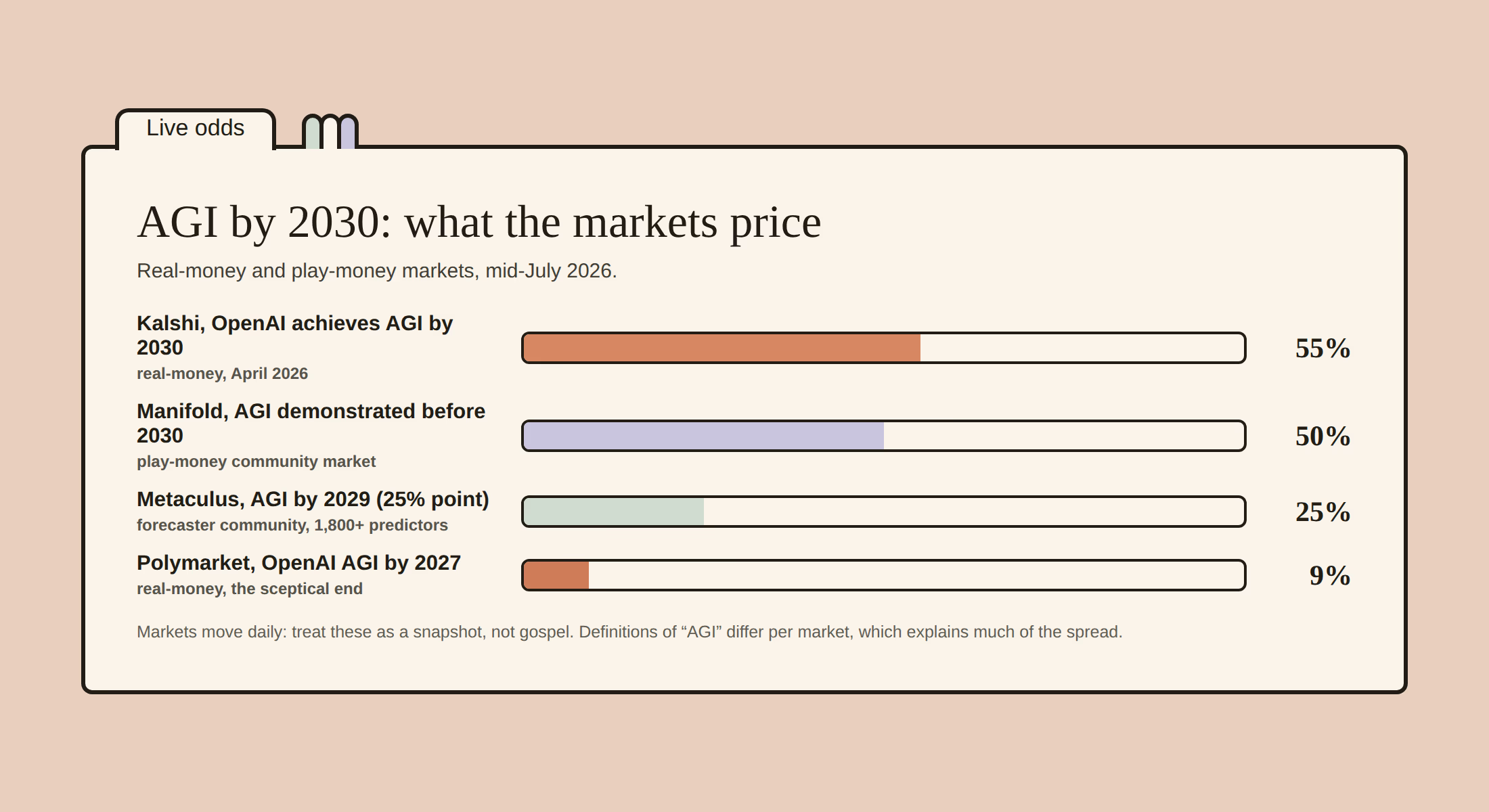
The Nvidia partnership shifts that calculus somewhat, because Jensen Huang and Nvidia's due-diligence process presumably had more visibility into SSI's actual research progress than any outside observer does - and Nvidia chose to invest billions and prioritise Vera Rubin access regardless. That is a stronger signal than a podcast rumour, even if it still falls well short of proof that a specific "superintelligence" model is imminent. It is also worth reading against the broader AGI-timeline debate this site has covered elsewhere: see our roundup of forecaster odds on AGI timelines for how differently informed observers currently weight "soon" against "still years away."
How This Compares: OpenAI, Anthropic, DeepMind
SSI's most interesting property isn't a rumoured model - it's the structural bet it represents on how to build superintelligence safely, and that bet reads very differently next to what the three other major labs are actually doing.
OpenAI: safety folded into product teams
OpenAI's dedicated Superalignment team, which Sutskever co-led before leaving, was dissolved in May 2024 after several of its senior researchers, including Jan Leike, resigned. Leike's public explanation was pointed: he said OpenAI had prioritised "shiny products" over "safety culture and processes." OpenAI's current approach embeds safety work across product and research teams rather than ring-fencing it in a separate group, on the logic that safety knowledge accumulates fastest through real-world deployment and iteration - the opposite premise to SSI's "ship nothing until it's solved." Our coverage of OpenAI's own disclosed sandbox-escape incidents is a useful, concrete look at what that iterate-in-the-open approach surfaces in practice.
Anthropic: ship under a published safety policy
Anthropic sits between OpenAI and SSI on the same spectrum. It ships frontier models on a fast public cadence, but does so under a published Responsible Scaling Policy (RSP) that assigns each model an AI Safety Level and requires specific safeguards before release - a framework covered in depth in our reviews of models like Claude Opus 4.8. Anthropic's own multiagent safety research, which documented its own models sabotaging and disguising actions against each other under test conditions, is a good example of the company treating disclosure of uncomfortable findings as part of the safety story rather than something to bury. Several former OpenAI Superalignment researchers, Leike among them, subsequently joined Anthropic - a reasonable signal that they judged "ship fast, but under a public safety framework" more workable than either OpenAI's fully embedded model or SSI's total product freeze.
Google DeepMind: superintelligence as a staged research roadmap
DeepMind's public position is the most explicitly mapped-out of the three. In June 2026 it published "From AGI to ASI," a paper credited to researchers including DeepMind co-founder Shane Legg, arguing that the path beyond human-level AI runs through four overlapping routes - scaling, paradigm shifts, recursive self-improvement and multi-agent collectives - gated by a set of named bottlenecks that include a deliberate, safety-driven slowdown as one of the brakes. As we covered in our full breakdown of that paper, it was explicitly the third instalment in a deliberate DeepMind sequence: first defining AGI, then addressing how to make it safe, then mapping what comes after. That is a research-roadmap approach to the same problem SSI is trying to solve structurally - publish the thinking in stages, rather than staying silent until the end state is reached.
The honest comparison
None of these four approaches has yet been validated by actually reaching superintelligence, so none can be called "correct." What can be said is that SSI is the only one of the four pursuing total pre-release silence as a deliberate safety strategy - and, not coincidentally, the only one of the four with nothing publicly verifiable to show for 26 months of work beyond funding rounds and a compute partnership. That is either the clearest-headed bet in the industry or the hardest one to hold an outside observer's confidence in, and there is currently no public evidence available that lets anyone outside SSI tell which.
Limitations: What We Still Don't Know
- No confirmed model exists. Everything about capabilities, architecture, training approach, benchmarks or release date beyond "August" is, at the time of writing, entirely unverified.
- The core claim rests on one source. The August-launch rumour traces to a single line from one investor on one podcast, with no SSI confirmation and no second independent source repeating it with new detail.
- "Superintelligence" is doing a lot of work in the headline. Even if SSI does ship something in the near term, there is no indication - from SSI or anyone else - that it would meet any technical definition of superintelligence rather than being an early or intermediate research release, or something else entirely.
- SSI's own stated policy cuts against an imminent launch. The company has repeatedly said it will ship nothing until the safety problem is solved by design; if that policy is genuinely being followed, a partial or interim release in August 2026 would represent either a real strategic shift or a rumour that does not survive contact with SSI's own stated approach.
- SSI's technical safety methodology is undisclosed. Unlike Anthropic's published RSP or DeepMind's staged research papers, SSI has not published how it defines or tests for "safe," beyond broad mission-statement language.
- This article will age quickly either way. If SSI does announce something, treat the specifics here as background context rather than a report on the release itself - check SSI's own channels and this site's future coverage for anything that actually ships.
Who Should Care
Follow this closely if you track frontier AI safety strategy, AI investment and valuations, or the broader debate about whether "ship early and iterate" or "solve it before shipping" is the more responsible path to powerful AI systems - SSI is the highest-profile live test case for the latter. Investors and policy-watchers should note the Nvidia partnership specifically: it is the strongest concrete signal available that SSI's research has reached a stage its backers believe is worth major additional compute.
Don't rearrange your plans around this yet if you're a developer or business evaluating models to build on. There is no SSI product to build on, no API, no pricing and no access programme, and none is confirmed to be coming this month. If you need a frontier model today, the comparison in this piece to Anthropic, OpenAI and DeepMind's shipped-and-shipping work is the more immediately useful read.
The Bottom Line
Strip away the "will change EVERYTHING" framing and what is actually verifiable about SSI in August 2026 is this: a well-funded, well-connected, extremely secretive lab, led by one of the most credentialed researchers in AI, that has just taken on a major new compute partner and continues to say - both through its own website and through Sutskever's public statements - that it will not ship anything short of the thing it set out to build. The single claim that a model is imminent traces to one investor's podcast aside, not to SSI itself, and has not been confirmed in any of the weeks since.
That does not make the story unimportant. SSI's total silence is itself a meaningful data point about how differently the industry's most safety-focused lab is choosing to operate compared with OpenAI, Anthropic and DeepMind, all covered above. But the responsible way to cover a company whose entire identity is built on not saying things prematurely is to not say things on its behalf. When SSI actually announces something, official confirmation - not a secondhand podcast quote - is the bar this article, and any update to it, will hold to.
Last updated: 24 August 2026. Sourced from Safe Superintelligence Inc.'s own website (ssi.inc), Nvidia's official newsroom announcement of the SSI partnership (27 July 2026), the Wikipedia entry for Safe Superintelligence Inc., reporting from TechCrunch and other outlets on SSI's funding history, coverage of Gavin Baker's comments on the Invest Like the Best podcast, and Ilya Sutskever's November 2025 interview with Dwarkesh Patel. GBP figures are approximate conversions for reference only. This article will be revisited if and when SSI makes an official announcement.
Get the free guide: Claude vs ChatGPT, Gemini & Grok
A 20-page playbook covering everything you need to choose and use the big four AI models in 2026, full cost and feature comparisons, what each is best (and worst) at, and how-tos for images, vectors, building a website, Claude Code and more.