
 AI Tools Review Editorial Team
Quick answer:
Ling 3.0 Tiny is a 7.9-billion-parameter Mixture-of-Experts model from InclusionAI, Ant Group's AI research division, released on 6 August 2026. It activates only around 1.3 billion parameters per token, ships with a native 256K-token context window, switchable Thinking and Instant reasoning modes, native function calling, and prompt caching. Independent evaluator Artificial Analysis scores it 25 on its Intelligence Index, ranking 6th of 56 models in its size class against a class median of 8. It is free to use today on OpenRouter and Vercel AI Gateway through roughly 13-14 August 2026, after which list pricing lands around $0.06 input / $0.18 output per million tokens. Open weights have been promised but not yet delivered, unlike its larger sibling Ling-3.0-flash, which already shipped MIT-licensed weights on Hugging Face.
While most of the Chinese open-weight race this summer has been a contest of who can cram the most parameters into a single checkpoint, Ant Group's InclusionAI team went the opposite direction on 6 August 2026. Ling 3.0 Tiny is not trying to out-benchmark Claude Fable 5 or GPT-5.6 Sol. At 7.9 billion total parameters and roughly 1.3 billion active per token, it is small enough to run on a single consumer GPU, and InclusionAI is pitching it squarely at agents, local inference, and workflows where cost per token matters more than raw intelligence-index score.
This article separates what InclusionAI has actually confirmed from what remains a vendor demo, walks through the independent Artificial Analysis benchmark data that exists for it, places it in the lineage of Ant Group's Ling, Ring and Ming model families, and weighs it honestly against the small-model competition it is actually likely to be chosen over, models like Gemini 3.5 Flash-Lite and Liquid AI's LFM2.5, rather than the trillion-parameter flagships it was never built to fight.
Note: this analysis draws on InclusionAI's own launch announcement thread from its @AntLingAGI account, independent benchmark and pricing data from Artificial Analysis's Ling 3.0 Tiny model page, Vercel's official AI Gateway changelog post, OpenRouter's and Krater's model listings, InclusionAI's public GitHub repository and Hugging Face organisation for architecture and lineage context, and press coverage of the closely related Ling-3.0-flash release (KuCoin, DigitalApplied, Businesswire). Figures for Ling-3.0-tiny's own architecture ratios and individual per-benchmark scores were not published at the time of writing; where a number could not be independently verified, that is stated explicitly rather than estimated. Prices are billed in US dollars.
Julian Goldie SEO's hands-on walkthrough of Ling 3.0 Tiny's Mixture-of-Experts architecture, benchmark scores, and agentic tool use shortly after release.
Summary
- Released 6 August 2026 by InclusionAI, Ant Group's AI research division, also known as Ant Bailing.
- 7.9 billion total parameters, roughly 1.3 billion active per token, a sparse Mixture-of-Experts design built for low inference cost rather than raw scale.
- 256K native context window (262,144 tokens on the commercial API listings), with a maximum output of 32,768 tokens.
- Switchable Thinking and Instant modes, native function calling, and prompt caching, aimed squarely at agentic and tool-using workloads.
- Independently scored by Artificial Analysis at 25 on its Intelligence Index, 6th of 56 models in its class, well above the class median of 8, but individual per-benchmark scores have not been published.
- Free to use today on OpenRouter and Vercel AI Gateway, through roughly 13-14 August 2026 depending on the platform, after which list pricing lands near $0.06 input / $0.18 output per million tokens.
- Not yet open-sourced. InclusionAI has said weights are coming, but as of publication nothing has appeared on Hugging Face or ModelScope, unlike its larger sibling Ling-3.0-flash, which shipped MIT-licensed weights on 26 July 2026.
- Flagged as slow and verbose by Artificial Analysis relative to its class: a 2.46-second time-to-first-token against a 1.01-second median, and roughly 3.3x the output-token volume of the median model in its evaluation suite.
From Ling-lite to Ling 3.0: the lineage
InclusionAI is the AI research arm of Ant Group, the fintech company best known as the operator of Alipay. Its open-weight model work is organised into three families: Ling, standard Mixture-of-Experts language models; Ring, reasoning-optimised variants built on the same hybrid architecture; and Ming, multimodal models spanning speech, audio and vision. The Ling line stretches back to Ling-lite (16.8B total, 2.75B active) and Ling-plus (290B total, 28.8B active), through trillion-parameter flagships including Ling-1T and the Ring-2.5-1T and Ring-2.6-1T reasoning models, the last of which achieved gold-medal-standard scores on IMO 2025 (35/42) according to Ant Group's own published results.

The immediate run-up to Ling 3.0 Tiny is a story of shrinking active-parameter counts generation over generation. Ling-2.6-flash, released in May 2026, carried 104 billion total parameters with 7.4 billion active, using a 1-MLA-per-7-Lightning-Linear attention layout. Ling-3.0-flash followed on 23-26 July 2026 at 124 billion total parameters but only 5.1 billion active, a roughly 31% drop in active compute despite total parameters growing by about 19%, achieved through a native hybrid-linear attention design InclusionAI describes as a 5:1 stacking of Kimi Delta Attention (KDA) and Multi-head Latent Attention (MLA) layers. InclusionAI's own launch claim for Ling-3.0-flash was that it "matches or beats" the team's 1-trillion-parameter flagship on most benchmarks shown, while using one eighth of the total and one twelfth of the active parameters. That model shipped as real, downloadable weights: MIT-licensed BF16 (roughly 255GB) and FP8 (roughly 128GB) checkpoints on Hugging Face and ModelScope, deployable via vLLM or SGLang.
Ling 3.0 Tiny, announced less than two weeks later on 6 August 2026, pushes the same generational trend a step further: down to 7.9 billion total parameters and roughly 1.3 billion active, small enough that InclusionAI demonstrated it running fully offline with no cloud dependency, including a demo integrating it with obsidian-cli to retrieve, organise and generate content from local text repositories. Where Ling-3.0-flash is pitched at production-scale agent infrastructure, Ling 3.0 Tiny is pitched at the opposite end of the deployment spectrum: mobile-device and browser UI control, cost-efficient automation, and local-first workflows where a model needs to be cheap and fast rather than maximally capable.
Architecture and training
What InclusionAI has confirmed about Ling 3.0 Tiny itself is narrower than what it has confirmed for the Ling 3.0 generation as a whole. It is a sparse Mixture-of-Experts model: 7.9 billion parameters total, with roughly 1.3 billion activated for any given token, a ratio of about 1-in-6. It supports a native 256K-token context window (listed as 262,144 tokens on commercial API endpoints), a maximum output of 32,768 tokens, and ships with two operating modes, a default-on "Thinking" mode that spends additional tokens reasoning before answering, and an "Instant" mode that responds directly. The model is text-in, text-out only; unlike some competitors in its price tier, it does not accept image, audio or video input.
The Ling 3.0 generation as a whole is built on what InclusionAI calls a native hybrid-linear attention architecture, introduced from the start of pretraining rather than retrofitted afterward: alternating layers of Kimi Delta Attention, a linear-attention mechanism whose lineage traces to Moonshot AI's research, and Multi-head Latent Attention, a periodic full-attention layer with a compressed key-value representation, combined with 1/64 sparse expert activation to keep MoE compute efficient. InclusionAI has confirmed this stacking ratio (5 KDA layers to 1 MLA layer) specifically for Ling-3.0-flash; whether Ling 3.0 Tiny uses the identical ratio at its much smaller scale has not been independently confirmed, and no model card or technical report for Ling-3.0-tiny specifically had been published at the time of writing.
That absence of a dedicated model card is the single biggest gap in InclusionAI's disclosure for this release. There is no published training-data description, no confirmed number of experts or router design specific to the Tiny checkpoint, and no independently reproducible detail on how its active-parameter ratio was chosen relative to its larger siblings. What is verifiable is behavioural: independent evaluation from Artificial Analysis (covered in full below) confirms the model performs meaningfully above the median for its size and price class, and its context window and output-length limits are consistently reported the same way across OpenRouter, Vercel AI Gateway, Novita AI and Krater's listings, which is a reasonable, if indirect, confirmation that those specific figures are accurate.
Capabilities deep dive
Hybrid reasoning: Thinking vs Instant mode
Ling 3.0 Tiny ships with two switchable response modes rather than a single fixed behaviour. Thinking mode is enabled by default and has the model spend extra tokens on intermediate reasoning before producing a final answer, the pattern InclusionAI expects for maths, multi-step planning and agentic tool sequences. Instant mode skips that reasoning pass for latency-sensitive, low-complexity requests. This is the same design pattern several other 2026-era model families have converged on (a single checkpoint that can be dialled between fast and deliberate), and it is a genuinely useful lever for a model this small, where the cost of always reasoning would otherwise erode the point of using a cheap, low-active-parameter model in the first place.
Native function calling and prompt caching
Function calling is built into the model natively rather than bolted on through prompt engineering, and prompt caching is supported for repeated context, both standard requirements for anyone building multi-step agents or tool-using pipelines on top of it. Combined with the 256K context window, this is the part of the spec sheet that most directly targets agent-framework developers: enough context to hold a long tool-call history or a sizeable local document, at an active-parameter count small enough to serve cheaply and, per InclusionAI's own demonstration, entirely offline.
Local-first and on-device positioning
InclusionAI's launch thread leaned heavily on local deployment as the model's differentiator: fully local inference with no cloud dependency, an integration with obsidian-cli for retrieving, organising and generating content from local text repositories, and demonstrations of browser and mobile UI control intended to show cost-efficient automation running close to the device rather than through a hosted API. These are vendor demonstrations, not independently reproduced benchmarks, and should be read as illustrations of intended use cases rather than verified capability claims. They are, however, consistent with the model's core trade-off: a 1.3B active-parameter model is realistically the kind of thing that can run on a single consumer GPU or a capable laptop, which a 100B+-active-parameter frontier model simply cannot.
Agentic UI and workflow automation
Beyond the local-document use case, InclusionAI also demonstrated the model handling routine business-automation tasks, cited examples include automated community-member re-engagement messaging and instruction-following for repetitive workflow tasks. As with the local-inference demos, these are vendor-narrated capability showcases rather than benchmarked results, and the honest read is that they illustrate intended positioning (a cheap, tool-using, always-available agent backend) more than they prove out-of-the-box reliability at any particular task.
Benchmarks: what is actually verified
Unlike several recent Chinese flagship launches, InclusionAI did not publish its own detailed benchmark table for Ling 3.0 Tiny at release. The most substantive independent evidence available comes from Artificial Analysis, which evaluates every model it lists on an identical suite and reports a single aggregate Intelligence Index alongside class-relative rankings.
| Metric (Artificial Analysis) | Ling 3.0 Tiny |
|---|---|
| Intelligence Index | 25 (class rank 6 of 56; class median 8) |
| Context window | 262,144 tokens |
| Output speed | 154.1 tokens/second (rank 15 of 56; median ~148 t/s) |
| Time to first token | 2.46 seconds (median 1.01s) |
| Output verbosity | ~210M tokens generated across eval suite (median 63M); rank 16 of 56, flagged "very verbose" |
| Evaluation cost | $0.00 (free promotional pricing at time of testing) |
The Intelligence Index of 25 is built from nine underlying assessments: GDPval-AA v2, τ³-Banking, Terminal-Bench v2.1, SciCode, Humanity's Last Exam, GPQA Diamond, CritPt, AA-Omniscience and AA-LCR. Artificial Analysis's public model page reports the composite score and the model's rank within its size-and-price class rather than a breakdown of each individual assessment, so it is not possible to say from public data alone which specific benchmarks it is strongest or weakest on. A rank of 6th out of 56 models, well clear of the class median of 8, is a genuinely strong result for a model with only 1.3 billion active parameters, but it should be read as a relative, class-adjusted score rather than a claim of competing with frontier-scale models on absolute capability.
The two figures worth weighing against that headline number are speed and verbosity. A 2.46-second time-to-first-token is more than double the 1.01-second class median, a meaningful latency cost for anything interactive. And Artificial Analysis's own evaluation run generated roughly 210 million output tokens for Ling 3.0 Tiny against a 63-million-token class median, a verbosity difference of over 3x. Because output tokens are the more expensive side of most per-token pricing, and because Thinking mode is enabled by default, a model that talks three times as much per task can erode much of the benefit of a low headline price once it moves off the current free-promotion window.
No third-party evaluator beyond Artificial Analysis had published independent Ling 3.0 Tiny benchmark numbers at the time of writing, and InclusionAI itself has not released a self-reported benchmark table comparable to what it published for Ling-3.0-flash. Readers should treat the Intelligence Index figure as the best currently available independent signal, not as a settled, comprehensive capability profile.
Real-world context and competitive landscape
Ling 3.0 Tiny arrives during a summer of near-constant Chinese open-weight releases, but it is not really competing in the same race as Kimi K3, Qwen 3.8 Max, DeepSeek V4 Pro or GLM 5.2, all of which are trillion-or-hundreds-of-billions-parameter models chasing frontier-adjacent scores. Ling 3.0 Tiny's more direct competitive set is the small, efficient-inference tier: Google's Gemini 3.5 Flash-Lite, and open-weight efficiency plays like Liquid AI's LFM2.5 series, models built to be cheap and fast rather than to top a leaderboard.
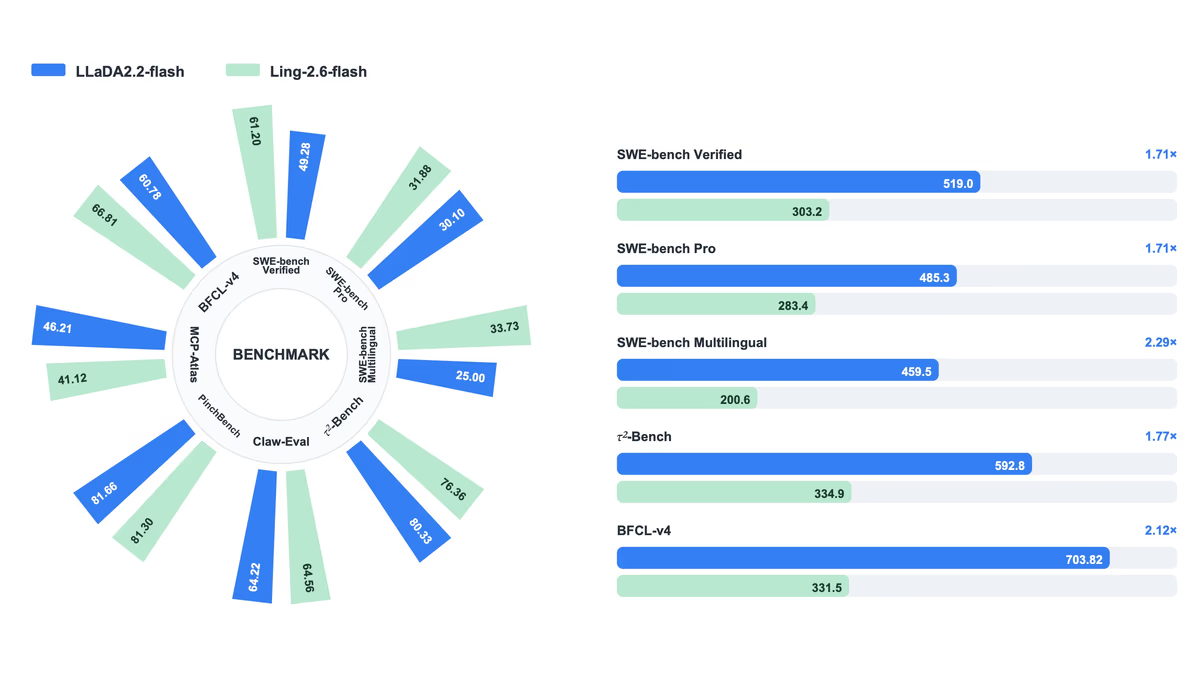
Within Ant Group's own portfolio, the more relevant sibling comparison is LLaDA2.2-Flash, InclusionAI's 100-billion-parameter open-source diffusion language model released in late July 2026, which pursues a similar efficiency-over-scale philosophy through a completely different architecture (diffusion-based generation with Levenshtein Editing rather than Mixture-of-Experts autoregression). Between LLaDA2.2-Flash, Ling-3.0-flash and now Ling 3.0 Tiny, InclusionAI has shipped three distinct efficiency-focused releases in under two weeks, a clear signal that Ant Group's AI strategy in mid-2026 is oriented as much toward serving cost and deployability as toward chasing benchmark supremacy.
That positioning also explains the promotional distribution strategy. Rather than a single announcement, Ling 3.0 Tiny went out simultaneously through OpenRouter and Vercel AI Gateway (both hosted via Novita AI), the same pattern InclusionAI used for Ling-3.0-flash's free trial period in late July, and one increasingly common among Chinese labs seeking fast developer adoption: give the model away for a week or two on the platforms developers already use, then convert to metered pricing once usage habits form. Community discussion around the release, visible in InclusionAI's own launch thread and early third-party comparisons, focused less on raw capability and more on the practical question of whether a 1.3B-active-parameter model can reliably power real agentic workflows, tool use, UI control, local retrieval, at a cost low enough to make it a genuine alternative to metered frontier APIs for high-volume, lower-complexity tasks.
Pricing and availability
| Rate (per 1M tokens) | Price |
|---|---|
| Input (launch promo) | $0.00 (free through approx. 13-14 August 2026) |
| Output (launch promo) | $0.00 (free through approx. 13-14 August 2026) |
| Input (post-promo, third-party listing) | ~$0.06 |
| Output (post-promo, third-party listing) | ~$0.18 |
| Cached input (post-promo, third-party listing) | ~$0.01 |
Ling 3.0 Tiny is free to use today. Vercel's own AI Gateway changelog states the free window runs through 8:00am PT on 14 August 2026, hosted via Novita AI, under the model ID inclusionai/ling-3.0-tiny-free; after that it switches to the metered ID inclusionai/ling-3.0-tiny. OpenRouter lists the same free tier as inclusionai/ling-3.0-tiny:free, with some third-party trackers citing an end date of 13 August rather than 14 August, a small discrepancy between platforms that is worth noting rather than resolving into a false precision. Vercel's AI Gateway passes through provider pricing directly, charging no platform markup and no additional gateway fee.
The post-promotional pricing figures above, roughly $0.06 input and $0.18 output per million tokens, with cached input around $0.01, come from third-party pricing pages (OpenRouter and Vercel's own gateway listings) rather than a standalone InclusionAI price sheet, since InclusionAI has not published its own direct-API pricing for Ling 3.0 Tiny. At that rate it would sit well below Gemini 3.5 Flash-Lite's $0.30 input / $2.50 output, though the verbosity flagged by Artificial Analysis (roughly 3.3x the output-token volume of the class median) means the effective per-task cost gap is narrower than the headline per-token numbers alone would suggest.
Beyond OpenRouter and Vercel AI Gateway, Ling 3.0 Tiny is also listed on Novita AI directly and on aggregator platforms including Krater.ai. No self-hosting path exists yet: weights have not been published, so every current access route is a hosted API call rather than a local deployment, somewhat at odds with InclusionAI's own local-inference demonstrations at launch.
Limitations
Ling 3.0 Tiny is a genuinely interesting small-model release, but a fair number of open questions and real weaknesses remain, worth weighing before routing a production workload to it.
- No weights yet. InclusionAI has said open-sourcing is coming, but as of 9 August 2026 nothing has appeared on Hugging Face or ModelScope, so every InclusionAI-hosted local-inference demo is currently not reproducible by third parties on their own hardware.
- No detailed model card or technical report. The exact expert-routing design, training data mix, and confirmation of whether it shares Ling-3.0-flash's 5:1 KDA:MLA attention ratio have not been published for the Tiny checkpoint specifically.
- Individual benchmark scores are not public. Artificial Analysis reports only an aggregate Intelligence Index and class ranking, not per-benchmark results, limiting how precisely its strengths and weaknesses can be characterised.
- Slower time-to-first-token than its class median, 2.46 seconds against a 1.01-second median, which matters for latency-sensitive interactive use.
- Flagged as very verbose, generating roughly 3.3x the output-token volume of the median model in its class during Artificial Analysis's evaluation, which will meaningfully affect real-world cost once the free promotional pricing ends.
- Text-only. No image, audio, or video input, a real gap against comparably priced multimodal competitors like Gemini 3.5 Flash-Lite.
- Free-tier end date is inconsistent across platforms, cited as 13 August by some trackers and confirmed as 14 August, 8am PT, on Vercel's own changelog; anyone budgeting around the promotion should check the specific platform they intend to use.
None of this means the underlying model is weak for its size, the independent Artificial Analysis Intelligence Index ranking is a real, third-party-verified signal that it performs well above its class median. It means the surrounding evidence base, model card, reproducible weights, per-benchmark transparency, is thinner than what accompanied several of the larger Chinese releases this summer, and thinner than InclusionAI provided for Ling-3.0-flash just two weeks earlier.
How Ling 3.0 Tiny compares
Against Gemini 3.5 Flash-Lite, Ling 3.0 Tiny trails clearly on Artificial Analysis's Intelligence Index (25 vs 36) and loses on nearly every other axis that matters for production use: Gemini offers a 1-million-token context window against Ling's 256K, 64K max output against 32K, roughly 490 tokens per second against Ling's 154.1, and full multimodal input where Ling is text-only. Ling 3.0 Tiny's only real advantages are price, free today and roughly $0.06/$0.18 per million tokens once metered, against Gemini's $0.30/$2.50, and a marginally longer context window in its default free tier than some competing free offerings.
Against Liquid AI's LFM2.5-2.6B-Base, the comparison is less direct because the two ship on almost opposite distribution models. LFM2.5 is a dense 2.69-billion-parameter model with zero published evaluations for its base checkpoint and no hosted inference provider at all, a download-only artefact released under the LFM Open License v1.0, which caps commercial use at $10 million in annual revenue. Ling 3.0 Tiny, by contrast, is a live, testable API today with an independent third-party benchmark score already attached, even though its own weights are not yet downloadable. For a team deciding today, Ling 3.0 Tiny is simply easier to evaluate; for a team that specifically needs to self-host under a permissive licence right now, LFM2.5 is the only one of the two that currently offers that path.
Against its own sibling, LLaDA2.2-Flash, and the larger Ling-3.0-flash, Ling 3.0 Tiny is the smallest and cheapest of InclusionAI's three recent efficiency-tier releases, but also the one with the least public technical detail: LLaDA2.2-Flash and Ling-3.0-flash both shipped with published weights and more complete disclosure, while Ling 3.0 Tiny's weights and full model card remain outstanding. For the full scored picture across frontier and mid-tier models, see our live Benchmarks page, which we will update as more independent scores for Ling 3.0 Tiny become available.
Who should use it, and who should wait
Worth trying now: developers building agentic or tool-calling workflows who want to test a genuinely cheap, well-above-median-for-its-class small model while it is free; anyone prototyping local-first or on-device use cases who wants to evaluate the model's behaviour ahead of an eventual open-weight release; and teams whose task volume is high but per-task complexity is modest, where Ling 3.0 Tiny's low headline price (even after the free promotion ends) is likely to beat a frontier model's cost by a wide margin, provided its verbosity is accounted for in that calculation.
Better to wait: anyone who needs multimodal input today, where it simply does not compete with Gemini 3.5 Flash-Lite; anyone who needs to self-host immediately rather than call a hosted API, since weights are not yet public; latency-sensitive interactive applications, given its above-median time-to-first-token; and anyone who wants a full model card and independently reproduced per-benchmark scores before committing, neither of which currently exists for this specific checkpoint.
The bottom line
Ling 3.0 Tiny is a genuinely useful data point in the small-model race, not because it beats anything on raw capability, but because it is one of the few sub-2-billion-active-parameter models with an actual independent benchmark score attached to it: 25 on Artificial Analysis's Intelligence Index, sixth of 56 in its class, a real result rather than a vendor claim. InclusionAI's own launch material leaned on local inference and agentic UI control demos that remain unverified by anyone outside the company, and the absence of a published model card or open weights, especially so soon after the more fully disclosed Ling-3.0-flash release, is a legitimate gap worth watching rather than ignoring.
The more durable story is Ant Group's pattern, not any single model: three efficiency-focused InclusionAI releases (LLaDA2.2-Flash, Ling-3.0-flash, and now Ling 3.0 Tiny) in under two weeks, each trading scale for lower active-parameter compute, and each landing amid a Chinese open-weight cycle that has otherwise been dominated by ever-larger flagship announcements. Whether Ling 3.0 Tiny's weights actually ship, and whether its benchmark lead over the class median survives once the free-tier crowds move on to metered pricing, are the two questions worth revisiting once InclusionAI provides more evidence.
InclusionAI's own launch announcement thread, Artificial Analysis's independent Ling 3.0 Tiny benchmark page, and Vercel's official AI Gateway changelog provide the underlying detail referenced throughout this article.
Last updated: 9 August 2026, three days after Ling 3.0 Tiny's release, based on InclusionAI's launch thread, Artificial Analysis's independent benchmark data, and Vercel and OpenRouter's official listings. This article will be revised once InclusionAI publishes a full model card, open weights, or InclusionAI's own benchmark table for this specific checkpoint.
Get the free guide: Claude vs ChatGPT, Gemini & Grok
A 20-page playbook covering everything you need to choose and use the big four AI models in 2026, full cost and feature comparisons, what each is best (and worst) at, and how-tos for images, vectors, building a website, Claude Code and more.