 AI Tools Review Editorial Team
Quick answer:
NVIDIA Isaac Lab 3.0 is the generally available release of NVIDIA's open-source framework for training robot policies in simulation. Announced at GTC Berlin on 21 October 2026 (the GitHub v3.0.0 tag is dated 20 October), it offers one task API across the Newton and PhysX physics engines and several renderers, can run without the full Isaac Sim stack, and adds the LEAPP tool for exporting trained policies. It targets Isaac Sim 6.2, Python 3.12 and PyTorch 2.11, and is a breaking upgrade from 2.x.
Most coverage of robotics this autumn is about the machines: humanoids on factory floors, robot butlers, record-breaking IPOs. Almost none of it is about the software that teaches those machines to move. Isaac Lab is that software, and version 3.0 is the biggest rewrite of it so far.
This article draws on NVIDIA's GTC Berlin press release, the official v3.0.0 release notes on GitHub and NVIDIA's own Hugging Face walkthrough of training a small walking robot. It separates what those primary sources confirm from what the creator coverage adds, and it flags the places where the documentation disagrees with itself.
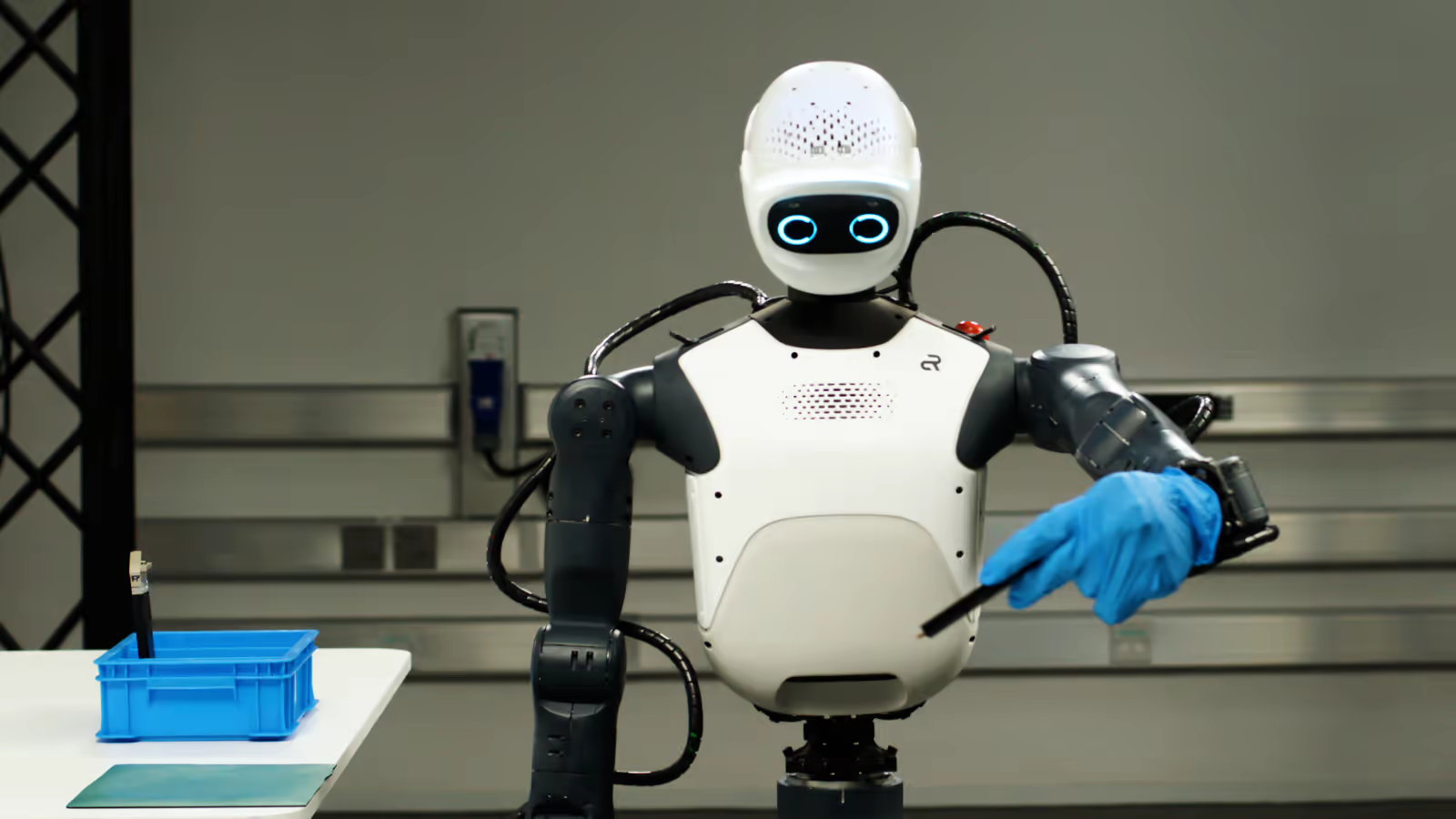
Julian Goldie's quick overview of the Isaac Lab 3.0 release and what it means for robot training.
Executive Summary
Isaac Lab is an open-source framework for reinforcement learning and imitation learning on robots. You describe a robot, a task and a reward; the framework runs thousands of simulated copies in parallel on a GPU, and a learning algorithm discovers a control policy. The result is a small neural network that you then copy onto a real robot.
Version 3.0 changes the foundations. According to the official release notes, it provides one task API across multiple physics, rendering and visualisation backends, kit-less execution, Warp-native data paths and a unified workflow from install through training, evaluation and deployment. In plain terms: you are no longer locked to a single simulator, and you no longer need the heavyweight Isaac Sim application just to start training.
- Three physics options: Newton (using MuJoCo-Warp, VBD and MPM solvers), OVPhysX, and the full Isaac Sim PhysX stack.
- Three renderer options: the Newton renderer, OVRTX and Isaac Sim RTX, chosen independently of physics.
- A unified command line: isaaclab train and isaaclab play, with six reinforcement-learning libraries supported.
- LEAPP policy export for moving a trained policy toward real hardware, now accepting camera and deformable inputs.
- A strict migration burden: quaternion order, actuator naming, task configuration and launch APIs all changed from 2.x.
NVIDIA announced general availability alongside a wider Isaac platform update at GTC Berlin on 21 October 2026, including Isaac OS and a reference humanoid. We cover those below, but the headline for working roboticists is the framework itself. If you read our coverage of the Unitree Superman robot and its record Shanghai IPO, you saw the commercial side of robotics; Isaac Lab is the engineering side.
Lineage: From Isaac Gym to Isaac Lab 3.0
To see why 3.0 matters you need the lineage. Early GPU-parallel robot learning arrived with Isaac Gym, which showed that you could train a walking policy in minutes by simulating thousands of robots at once. Isaac Lab grew out of that work and was built on top of Isaac Sim and the Omniverse Kit application framework, which gave it high-quality rendering, sensors and a rich asset pipeline.
That design had a cost. Kit is a large application. Installing it, version-matching it and running it on servers or in continuous integration was awkward, and every task was tied to the PhysX physics engine that ships inside it. Researchers who wanted a different solver, or who simply wanted a light install on a laptop, had to work around the framework rather than with it.
Isaac Lab 3.0 is NVIDIA's answer. The release notes describe Isaac Sim as now optional, and describe a modular architecture in which assets, sensors, scenes and environments are backend-neutral and dispatch to whichever implementation you select. The project's own agent-skills list even includes a migration helper for people coming from Isaac Gym, a reminder that the framework still carries users from three generations of tooling.
The release also reflects a change in who NVIDIA expects to use the framework. The release notes list repository-owned agent skills such as isaaclab-migrating-2x-to-3x and isaaclab-selecting-backends. That is a quiet but telling detail: the project expects coding agents to help with migrations, which suits a codebase with this many breaking changes.
Architecture: One Task API, Many Backends
The central idea in 3.0 is separation of concerns. Physics, rendering and visualisation are three independent choices, selected with short identifiers.
| Layer | Selector values (from the v3.0.0 notes) | What it gives you |
|---|---|---|
| Physics | newton_mjwarp, ovphysx, isaacsim_physx | Newton MuJoCo-Warp solver, standalone PhysX, or full Isaac Sim PhysX |
| Renderer | newton_renderer, ovrtx, isaacsim_rtx | Warp camera rendering, standalone RTX rendering, or full Isaac Sim RTX |
| Visualiser | newton_gl, newton_rtx, viser, rerun, kit | Desktop OpenGL, experimental RTX, browser viewers, or the Kit viewport |
This is more than a convenience. If a policy works under two different physics engines, that is evidence it has learned something about the robot and not merely exploited a quirk of one simulator. The release notes include PhysX-to-Newton policy-transfer guidance for exactly this kind of sim-to-sim check.
Newton: Warp-native physics
Newton is the default path. It is built on NVIDIA Warp and offers several solvers: MuJoCo-Warp for articulated rigid bodies, VBD for deformables, MPM for particles and materials such as liquids, coupled solvers that combine them, and an experimental solver called Kamino. Supporting rigid bodies, deformables and particles in one framework matters for tasks like cable insertion or pouring, which the release notes illustrate with demonstration animations.
OV libraries and Isaac Sim
For teams that need PhysX or RTX rendering without the full application, NVIDIA ships OVPhysX and OVRTX as standalone libraries, installed through an optional extra. The full Isaac Sim stack, with its ROS bridge, XR support, livestreaming and Kit tooling, remains available through a separate extra for those who want it.
Warp-native data and zero-copy tensors
A smaller but important change is the ProxyArray type, which gives zero-copy access to the same data as either a Warp array or a PyTorch tensor. Combined with fused GPU kernels, lazy buffers, cached views and CUDA graph support, this targets the unglamorous bottleneck of robot learning: moving data between simulator and learner without copying it.
The architecture also changes how you install. The recommended path uses uv, Python 3.12 and a pinned dependency set, which we list in the requirements section below.
Kit-less Training: What It Means in Practice
Kit-less execution is probably the single most practical change. According to the release notes, you can now run Newton physics, Newton Warp camera rendering and a Newton OpenGL visualiser without Kit at all, with browser visualisation through Viser and Rerun. The documented quick start is three lines: clone the v3.0.0 tag, then run uv run isaaclab train with the RSL-RL library, the Isaac-Cartpole task, the newton_gl visualiser and the newton_mjwarp physics selector.
Why does that matter? Because the cost of trying a robot-learning idea falls sharply. A cartpole task is a toy, but the same command structure drives larger tasks. Teams running training on cloud GPUs, in containers or in CI no longer need to carry a full simulator application for every job. The notes also describe Windows wheel installs, Linux aarch64 and DGX Spark support, and RTX multi-GPU training on PyTorch 2.11 and CUDA 13.
The project even ships 17 interactive demos that run Newton locally in the browser using WebAssembly on the CPU, with no install. They cover MPM material response, a domino cascade, Unitree G1 velocity control and a Franka drawer-opening task. For anyone evaluating the framework, that is the fastest way to see what the physics can do.
A caution: kit-less does not mean feature-complete. Newton RTX visualisation is described as experimental, and some Isaac Sim capabilities such as the ROS bridge and XR still live in the full stack. Choose backends according to what your task needs, not according to what is newest.
The Training Workflow and Supported Libraries
The unified command line is the glue. isaaclab train and isaaclab play replace the backend-specific train.py and play.py scripts of earlier releases. The --checkpoint option accepts latest, best, pretrained or an explicit path, and the same interface works across six reinforcement-learning libraries: RSL-RL, RL-Games, skrl (PyTorch or JAX), Stable-Baselines3, RLinf and TorchRL.
Other workflow additions listed in the notes include automatic Weights and Biases checkpoint resolution, mixed-precision and torch.compile support in RSL-RL, time-ordered observation histories with configurable delay, video capture for zero or random agents, and an environment browser that lists tasks and their presets. The uv run command auto-syncs the environment, and downstream task packages are discovered through entry points, so a research group can keep its tasks in its own repository and still use the standard CLI.
On sensing, 3.0 provides backend-neutral frame-transformer, IMU, position-velocity-acceleration, joint-wrench and ray-caster sensors, with explicit contracts for total, normal, friction, filtered and aggregate contact forces. Deformable objects are supported as surfaces or volumes, and visual materials and material randomisation are backend-neutral.
For teleoperation and data collection, the notes describe Isaac Capture through an isaaclab_teleop package, with pipeline retargeting, CloudXR streaming and MCAP record and replay. That is the entry point for imitation learning, where a human demonstrates a task and the robot learns from the recording.
Sim-to-Real: The Microduck Walkthrough
Frameworks are easy to describe and hard to judge. NVIDIA's Hugging Face walkthrough of training a small bipedal robot called Microduck is the most concrete evidence of the full pipeline, so it deserves a careful read.
The steps are: install uv and clone Isaac Lab, verify the tasks with the list_envs command, train a rough-terrain walking task with RSL-RL using 4,096 parallel environments and a preset called backlash, evaluate the policy, export it, copy it to the robot and load it with the robot's control tool. Playback writes both a TorchScript file and an ONNX file, and the ONNX file is what runs on the robot.
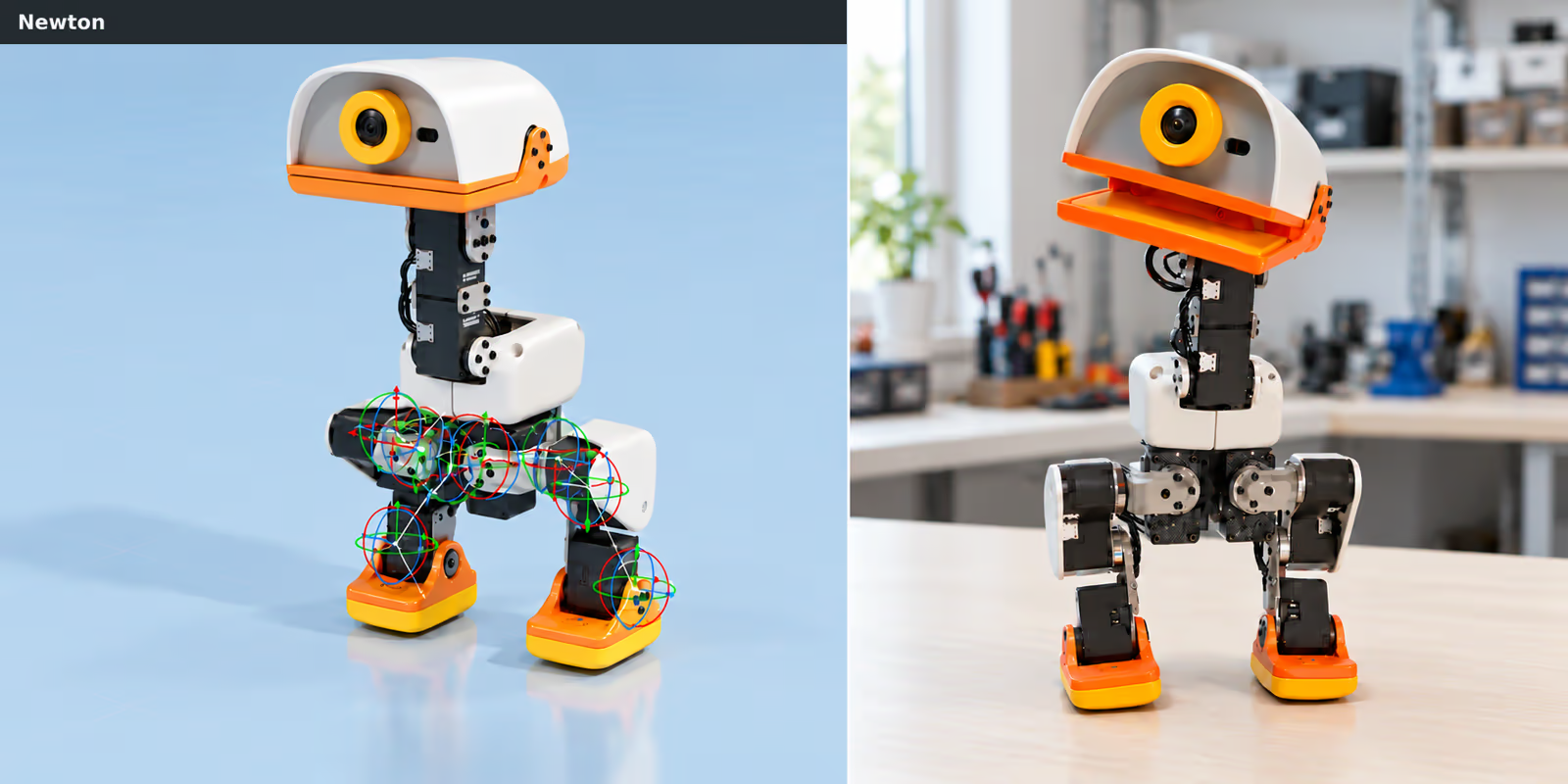
The realism comes from the simulation setup. The walkthrough uses Newton with the MuJoCo-Warp solver and Newton-based servo models, plus a backlash preset that models servo firmware, motor limits, friction and delay. It then randomises mass and centre of mass, ground friction, joint inertia, encoder offsets, battery voltage and sag, command latency, per-joint backlash, terrain and external pushes. This is classic domain randomisation: if the policy survives a wide spread of imperfect worlds, the real world is more likely to be one of them.
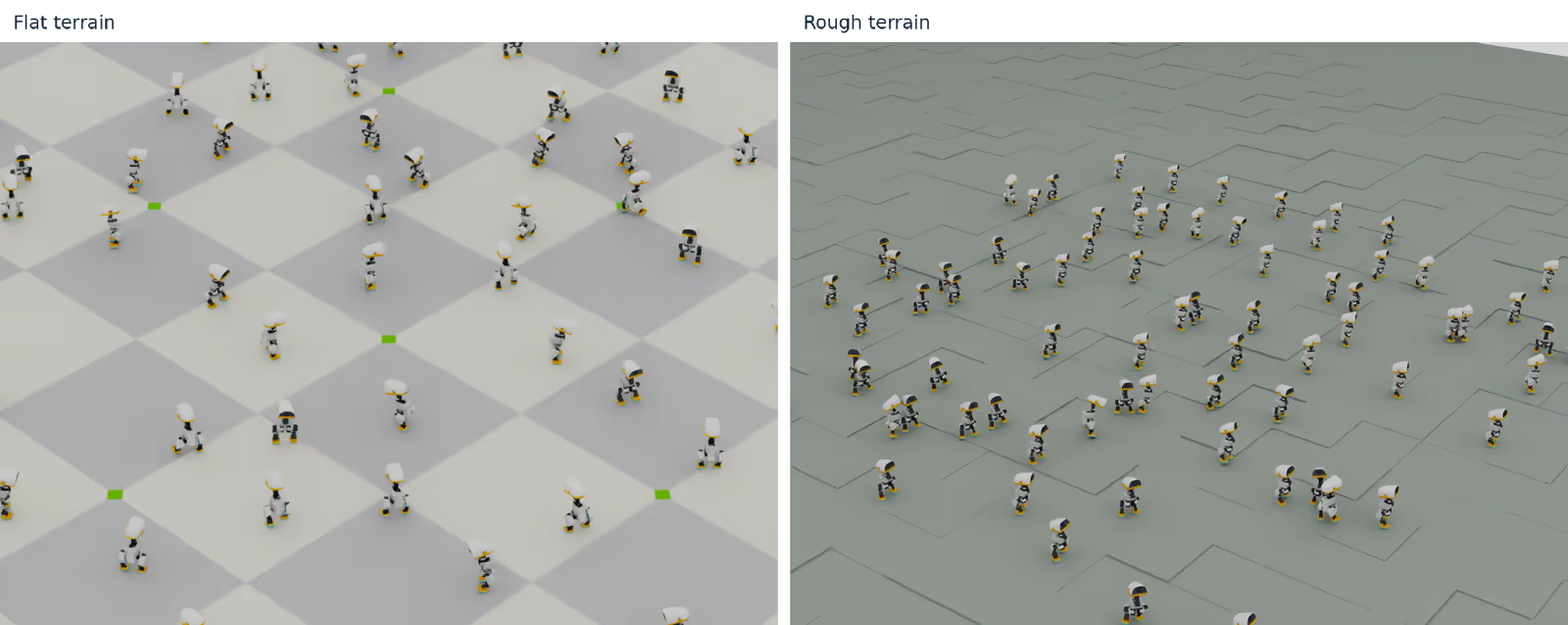
The numbers NVIDIA gives are specific. The walkthrough reports up to 1.25 million simulation steps per second with rough terrain and backlash enabled, mentions distributed training across 16 GPUs as an option, and notes that the policy takes 61 observation values in and produces 14 joint-position outputs. The Microduck Arena, a community leaderboard, enforces the same 61 observations, 14 actions and a maximum model size of 64 MiB.
On results, NVIDIA says the simulated robots walk across uneven block terrain, and that the physical Microduck walks and turns on a carpeted office floor and recovers its footing after being knocked over. What the walkthrough does not provide is any quantitative sim-to-real metric such as success rates, error against simulation or energy use. Treat it as a demonstration that the pipeline works end to end, not as a benchmark.
One practical warning from the walkthrough applies to every deployment: keep observation order, normalisation and action scaling identical between training and the robot, and test with the robot supported on a stand before letting it walk.
LEAPP and Deployment Tooling
The release notes list LEAPP policy export, now with camera and deformable inputs, as part of the deployment story. The idea, as described in creator summaries of the release, is to bundle a policy's compute graph and metadata so a policy trained in simulation can move to hardware with less glue code. We could not find LEAPP discussed in NVIDIA's Microduck walkthrough, which exports directly to ONNX, so we cannot say how widely it is used in practice yet.
The sensible reading is that LEAPP is NVIDIA's route to standardising exports across robots, while ONNX remains the common format for small robots such as Microduck. If you are deploying today, check the LEAPP documentation for your specific robot before committing to it.
Alongside export, the notes mention PhysX-to-Newton policy-transfer guidance and agent skills for sim-to-sim transfer. Sim-to-sim checking is a cheap way to catch overfitting before you risk hardware.
The Wider Isaac Platform: Isaac OS and the Reference Humanoid
Isaac Lab 3.0 was one part of an announcement NVIDIA made at GTC Berlin on 21 October 2026. The press release describes several other components.
- Isaac OS: an open-source runtime built on NVIDIA Holoscan that connects AI, sensors, controls and robot hardware for deterministic, real-time performance from simulation to physical robots. NVIDIA gave no release date.
- Agile ONE SN: a full-stack reference humanoid from Agile Robots built on Isaac GR00T and Jetson Thor. It is 1.40 m tall, weighs 40 kg, has 31 degrees of freedom and carries 3 kg per arm. Availability is early 2027.
- Jetson Thor: quoted at 2,070 FP4 teraflops with 128 GB of unified memory.
- SimReady Central Library: over 2,000 simulation-ready assets on Hugging Face.
- Human 1M Dataset: human activity data with synchronised three-view video and 3D hand tracking, with full access limited to Cosmos Coalition partners.
- Halos: a safety platform on IGX Thor, with no availability date given.
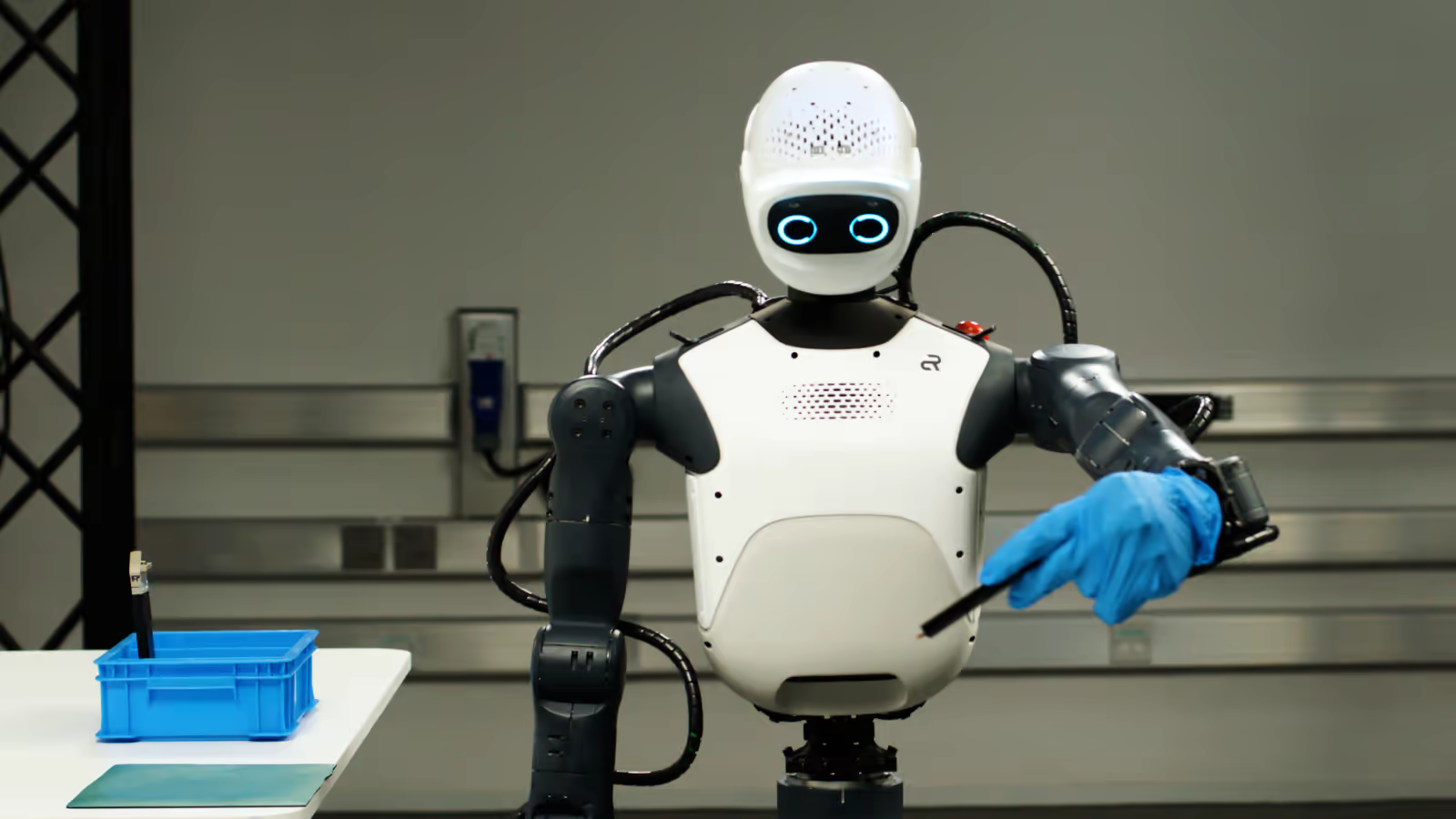
NVIDIA lists robot-learning workflow support from 1X, Agile Robots, Humanoid, Maven Robotics, Mentee, MicroAGI, Rhoda, Sereact and Skild AI, and Halos integration from Agile Robots, Agility, Dexory, FORT Robotics and KION. Jensen Huang is quoted saying that the ChatGPT moment for robotics is fast approaching. That is a forecast, not a measurement, and the announcement contains no benchmark to back it.
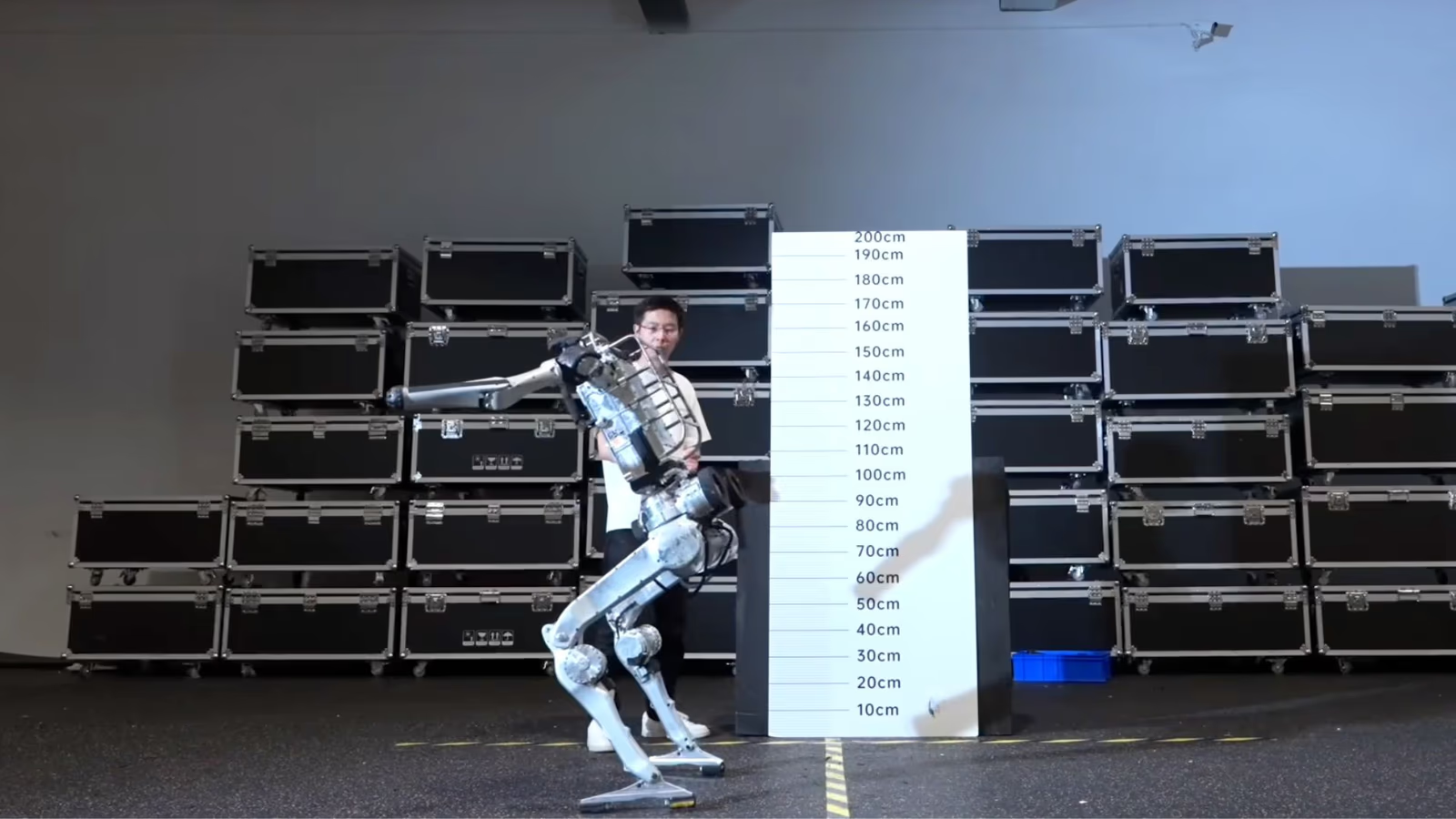
For the wider market picture, see our look at Unitree Superman robot and its record Shanghai IPO and our explainer on World Labs Atlas, which covers real-to-sim robotics from the world-model side.
Requirements, Version Pins and Migration Pain
The v3.0.0 notes pin a precise stack, and you should match it rather than improvise.
| Component | Version |
|---|---|
| Isaac Sim | 6.2 |
| Python | 3.12 |
| PyTorch / CUDA | 2.11 / 13.0 |
| NVIDIA Warp | 1.17 |
| Newton | 1.6.1 |
| RSL-RL | 5.5.1 |
| OVRTX / OVStage / OVPhysX | 0.5.1 / 0.2.1 / 0.6.4 |
| Kit-less OpenUSD | 26.08 (usd-exchange 3.0.1) |
Anyone moving from 2.x should expect real work. The notes list these as the key breaking areas: quaternions change from (w, x, y, z) to (x, y, z, w), so the identity becomes (0, 0, 0, 1); asset data returns ProxyArray objects that you access through .torch or .warp; actuator and limit parameters are renamed; the old 2.x IMU becomes a PVA sensor; the AppLauncher is replaced by launch_simulation; Hydra task helpers are replaced by resolve_task_config; and the camera observation helper mdp.image is replaced by separate RGB, depth, normals and segmentation terms. The URDF and MJCF importers were rewritten, and the --headless flag no longer disables visualisers.
Version drift is a second trap. Earlier early-access and beta builds targeted Isaac Sim 6.1 and Newton 1.5.2, so check your pins before you upgrade. One more inconsistency: the GitHub release and NVIDIA's news release call 3.0 generally available, while a page in NVIDIA's documentation still described a beta when we checked. The GitHub tag and the press release are the more authoritative signals, and the docs page appears to be stale, but verify against the release you install.
A final note on the Stable-Baselines3 wrapper: unbounded continuous action spaces now default to the range minus 1 to 1, where the early-access build used minus 100 to 100. A silent change like that can alter training behaviour, so set the bounds explicitly if you are porting experiments.
How It Compares: Isaac Lab, MuJoCo and the Rest
Isaac Lab is not alone. MuJoCo and its GPU variants, Genesis, ManiSkill and others all target fast robot learning. The honest comparison is about ecosystem rather than a single score.
Isaac Lab's strengths are its integration with NVIDIA hardware and software, a large library of robots and tasks, support for several RL libraries and now backend choice. It is also unusual in letting you swap physics engines under one task definition. MuJoCo-Warp is itself one of its Newton solvers, so the line between the projects is blurring rather than hardening.
Its weaknesses are the platform's weight and its breaking-change history. Even with kit-less execution, you are buying into an NVIDIA GPU ecosystem, and migrations between major versions have been costly. If your robot is a research arm and your team is small, a lighter simulator may get you to a result faster. If you work with NVIDIA's humanoid stack, Jetson hardware or GR00T models, Isaac Lab is the path of least resistance.
We have not run head-to-head benchmarks, and no source we found publishes a neutral comparison of 3.0 against alternatives, so we make no throughput claims beyond the figures NVIDIA published for Microduck.
Who Should Use Isaac Lab 3.0
- Robotics researchers who want to compare physics engines under one task definition.
- Teams with CI or cloud pipelines that were held back by the weight of the old install.
- Educators and hobbyists, who can try the browser demos and the Microduck walkthrough with modest hardware.
- Companies building on NVIDIA's humanoid and Jetson stack.
- Not ideal: teams mid-project on 2.x with deadlines, who should budget migration time before upgrading.
If you are in the last group, read the migration guide and use the project's migration agent skill on a branch before committing.
The Bottom Line
Isaac Lab 3.0 is a serious infrastructure release. It makes robot learning lighter to install, lets you choose your physics and rendering, and documents an end-to-end path from simulation to a small real robot. The evidence for that path is NVIDIA's own Microduck walkthrough, which is encouraging but unquantified.
What remains unproven is how well the pieces such as LEAPP, Isaac OS and the reference humanoid work together outside NVIDIA's partners, and whether the 3.0 migration cost is worth it for existing projects. Isaac OS and Halos have no dates; the humanoid ships in early 2027.
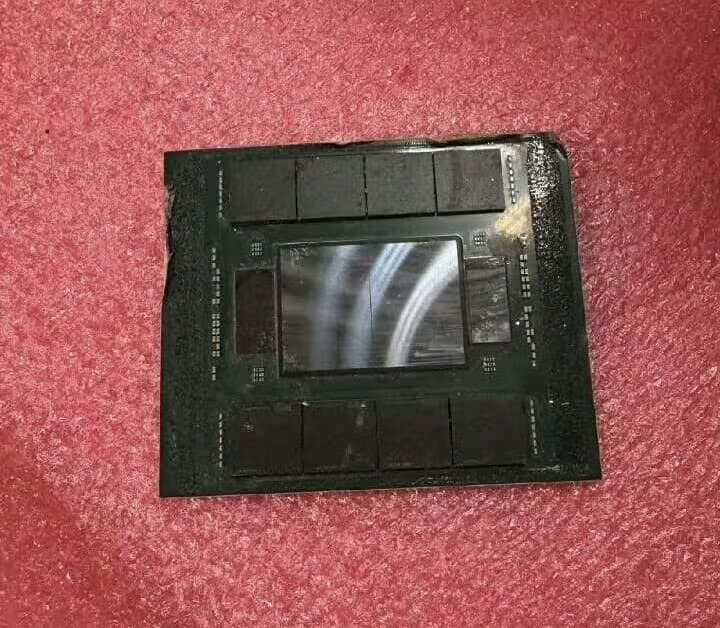
For broader context on the AI hardware race that powers all of this, see our analysis of China's AI chip race. We will update this article as independent benchmarks and migration reports appear.
Last updated: 26 October 2026. Sources: NVIDIA GTC Berlin press release (21 October 2026), the Isaac Lab v3.0.0 release notes on GitHub, NVIDIA's Microduck and Isaac Lab 3.0 walkthrough on Hugging Face, and the Julian Goldie SEO video above. Version pins and availability may change.
Get the free guide: Claude vs ChatGPT, Gemini & Grok
A 20-page playbook covering everything you need to choose and use the big four AI models in 2026, full cost and feature comparisons, what each is best (and worst) at, and how-tos for images, vectors, building a website, Claude Code and more.