 AI Tools Review Editorial Team
Quick Answer:
Unitree, the Hangzhou-based robotics maker, unveiled an experimental humanoid called "Superman" on 17-18 August 2026, claiming a 2-metre standing high jump and a 12.66 m/s top speed (about 45.6km/h) on 0.85-metre legs, built in "just over three months." It has no hands and no independent test protocol has been published, so treat the figures as an unverified company claim, not a certified record. Days later, on 19 August 2026, Unitree listed on Shanghai's STAR Market, raising roughly 6.1 billion yuan (about $905 million / £670 million) at 150.80 yuan a share, a listing multiple outlets say was oversubscribed more than 8,000 times by retail investors, a STAR Market record, with shares surging anywhere from roughly 460% to 629% on debut depending on which outlet, and which moment of the trading session, you read. Unitree is, unusually for a humanoid-robot maker, already profitable.
Two stories collided in China in the space of a single week in August 2026. First, a robotics company showed the world a machine it says can out-sprint an Olympic gold medallist and out-jump any human being alive. Then, days later, that same company opened trading on a Chinese stock exchange and posted one of the most dramatic debut share-price moves anyone has seen this year.
Both stories are genuinely remarkable. Neither is quite as simple as the headlines make it sound. Here is what Unitree actually announced, what independently verifiable financial reporting says about the IPO, and where the honest gaps are between demonstration footage and demonstrated fact.
AI Revolution X covers the Superman reveal alongside the Shanghai IPO and the same week's humanoid firefighting trials in Beijing.
Executive Summary
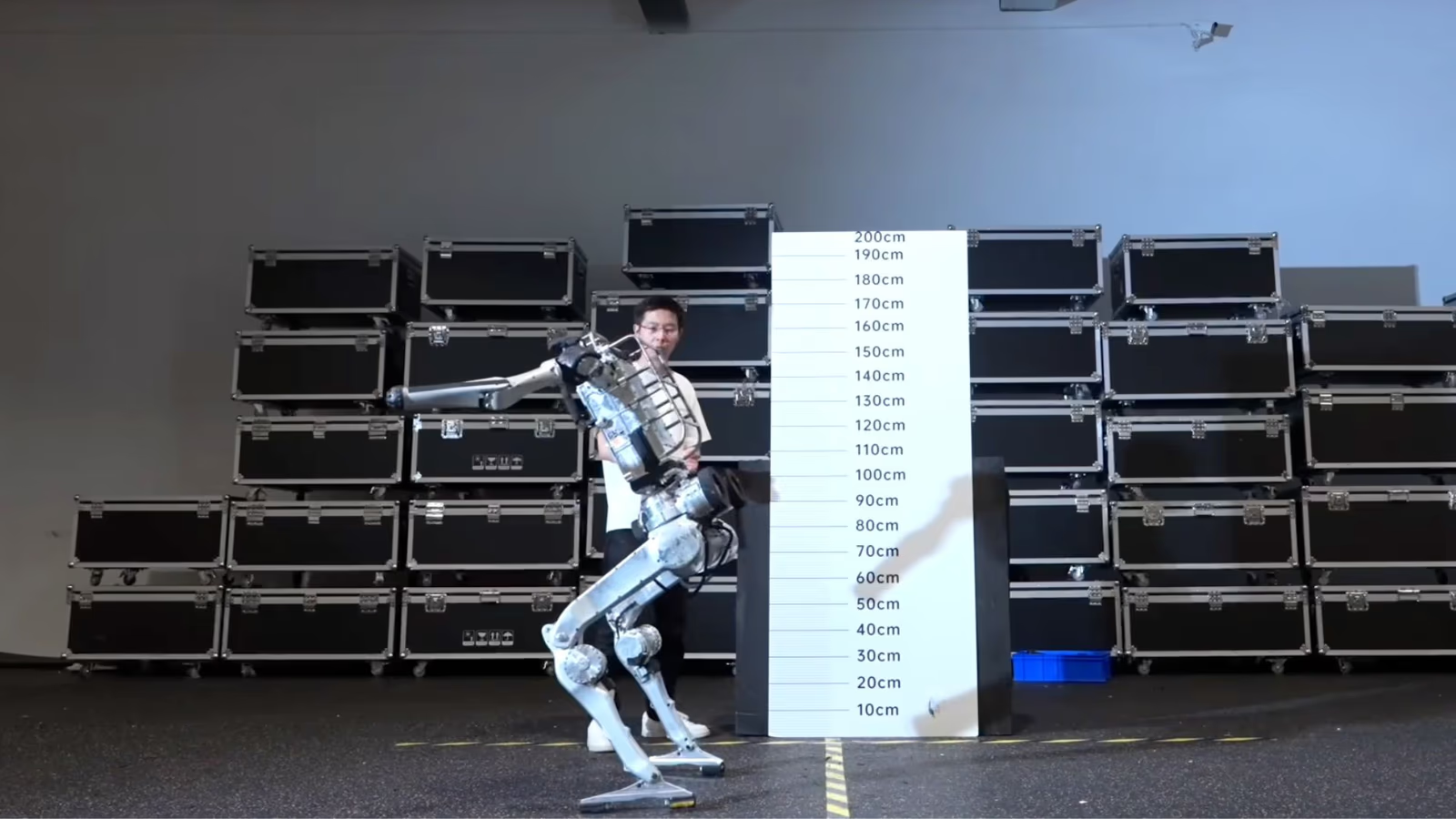
Unitree Robotics posted a 30-second demonstration video to its official X account on 17-18 August 2026 showing a new, unnamed-until-now humanoid prototype it calls "Superman." The company's own claims: a standing high jump of 2 metres and a top running speed of 12.66 metres per second, achieved on legs measuring 0.85 metres, developed in a build cycle the company describes as "just over three months." The robot has no hands, a deliberate design choice Unitree made to maximise locomotion performance rather than general-purpose usefulness. No outside body has independently verified the figures, and neither Unitree nor any outlet covering the reveal has published details of the test surface, payload, or how repeatable the run was.
Two days later, on 19 August 2026, Unitree began trading on Shanghai's STAR Market (officially the Sci-Tech Innovation Board), becoming the first general-purpose humanoid robot maker to list on a mainland Chinese exchange. The company priced its offering at 150.80 yuan a share, raising approximately 6.1 billion yuan, comfortably above its original 4.2 billion yuan target, and multiple outlets reported retail demand exceeding 8,000 times the shares on offer, a STAR Market record. Shares then moved dramatically on debut day, though exactly how dramatically depends on which outlet and which measurement point you trust, a discrepancy this piece addresses directly rather than picking a single flattering number.
- Superman's headline claims: 2m standing jump, 12.66 m/s top speed, 0.85m legs, built in roughly three months. Company claim, not independently verified.
- The IPO: ~6.1 billion yuan (~$905m) raised on Shanghai's STAR Market, 19 August 2026, at 150.80 yuan/share, valuing Unitree at roughly 61 billion yuan (~$9bn) pre-debut.
- The debut: retail oversubscription reported at 8,000x+ (a STAR Market record); share-price gains on the day reported anywhere from ~460% to ~629% depending on outlet and timing.
- The company: founded 2016 by Wang Xingxing, profitable, ~1.7bn yuan 2025 revenue, roughly 18,000 robots delivered by July 2026.
- The caveat that matters most: Superman is an experimental locomotion demo with no hands and no published verification protocol, not a shipping product.
What Unitree Announced
Unitree's official X (formerly Twitter) account, @UnitreeRobotics, posted the Superman reveal with the caption: "Unitree New Robot Preview: 'Superman' Breaking the Limits of Humanity. Standing high jump 2m, top speed 12.66 m/s (0.85m leg length). Surpassing the standing high jump and running speed records of all humans around the world." The company added that the machine had "only been in development for" just over three months, and that "significant room for improvement" remains, an admission that this is very much a work-in-progress prototype rather than a finished platform.
Put in context: 12.66 m/s works out to roughly 45.6 kilometres per hour, or about 28.3mph. Reuters, whose report on the reveal is credited by at least one tracked creator covering this story, and outlets including Interesting Engineering and Tech Times all covered the claim within a day of the post going live, several of them independently flagging the same concern: no test protocol has been published. That means there is no confirmed detail on the running surface, whether the robot carried any payload, how many attempts were made before this result, or whether the figure represents a sustained speed or a brief peak reading, all standard disclosures for any claimed athletic record.
The Usain Bolt comparison is the headline hook, and it is worth being precise about which of Bolt's numbers it actually beats. Bolt's 100m world record, set in Berlin in 2009, was 9.58 seconds, which works out to an average speed across the full race of about 10.44 m/s. Superman's claimed 12.66 m/s beats that average comfortably. But Bolt's race also contained a much faster peak instantaneous speed, commonly cited at around 12.42 m/s during his fastest split, and Superman's figure only narrowly clears that number. Tech Times explicitly called out this framing, noting that Bolt's number came from a fully ratified 100-metre competition run under international timing standards, while Superman's is "a peak reading from company-supervised footage of an experimental prototype," a materially different kind of evidence.
The 2-metre standing jump claim is reported by Interesting Engineering as surpassing recognised human standing-jump records, though as with the speed figure, the exact jump was captured on Unitree's own footage rather than measured under any independent athletics-style protocol.
Superman has no hands. Unitree built it purely to push the limits of bipedal locomotion; without hands or grippers, the robot cannot manipulate objects and is not, at this stage, a general-purpose product. This is consistent with how Unitree has historically used flashy locomotion demos, its H1 humanoid, for instance, became known for standing backflips well before it did anything commercially useful, but it is also exactly the kind of context that gets lost when a 30-second clip travels faster than the caveats attached to it.
The Shanghai IPO
On 19 August 2026, Unitree began trading on the Shanghai Stock Exchange's STAR Market, the tech-focused board often compared to Nasdaq, becoming the first general-purpose humanoid robot manufacturer to list on a mainland Chinese exchange. The company priced its offering at 150.80 yuan a share, selling roughly 40.45 million shares, about 10% of its post-offering share capital, to raise approximately 6.1 billion yuan (about $905 million, or roughly £670 million at recent exchange rates). That comfortably beat Unitree's original target of around 4.2 billion yuan, and priced the company at roughly 61 billion yuan (about $9 billion) ahead of its first day of trading.
Retail demand was extraordinary by any measure, though the exact multiple reported has itself shifted over time. Reports closer to and around the listing date, including CNBC, Forbes and Yahoo Finance, put the final retail oversubscription at more than 8,000 times the shares on offer, described as a STAR Market record. An earlier Bloomberg report on 10 August 2026, however, had put subscription at around 5,526 times. It is not fully clear from available reporting whether this reflects an earlier snapshot of a demand figure that kept climbing as the listing approached, different subscription tranches, or a later correction; this article notes the discrepancy rather than silently choosing the more dramatic number.
Cornerstone and strategic placements reportedly went to a notable set of Chinese tech names: DeepSeek, Tencent's Qishan Investment vehicle, and PetroChina's Kunlun Capital, according to Forbes reporting, with DeepSeek's stake alone reported at around 140.8 million yuan. That lineup signals how directly China's AI and state-linked capital sees humanoid robotics as an extension of the same platform bet already under way in large language models and domestic chips, a dynamic covered in more depth in our piece on China's AI chip race.
Trading-day performance is where reported figures diverge most, and it is worth laying them out plainly rather than picking one. Multiple outlets, including a Reuters-sourced report and Caixin Global's own headline, put shares opening around 1,100 yuan, a gain of roughly 629% over the 150.80 yuan offer price. CNBC's own headline instead reported the stock "pops 542%" on debut. Other coverage cited a closing price nearer 845 yuan, which would put the day's net gain closer to 460% against the offer price. None of these figures are wrong exactly, they most likely describe different moments in the same trading session (the opening print, an intraday peak, and the eventual close), but not every outlet was explicit about which moment its headline number referred to, and this piece is not going to quietly average them into a single tidy figure it cannot verify. What is consistent across every outlet is the direction and rough scale: a debut gain in the hundreds of per cent, one of the largest STAR Market first-day moves in 2026.
The scale of that debut pop pushed Unitree's market capitalisation as high as roughly $66 billion intraday by some reporting, up sharply from its roughly $9 billion offer-price valuation, and pushed founder Wang Xingxing's personal net worth to an estimated $16 billion on debut day, according to Forbes, making him, by that outlet's account, China's first humanoid-robotics billionaire.
Company Background
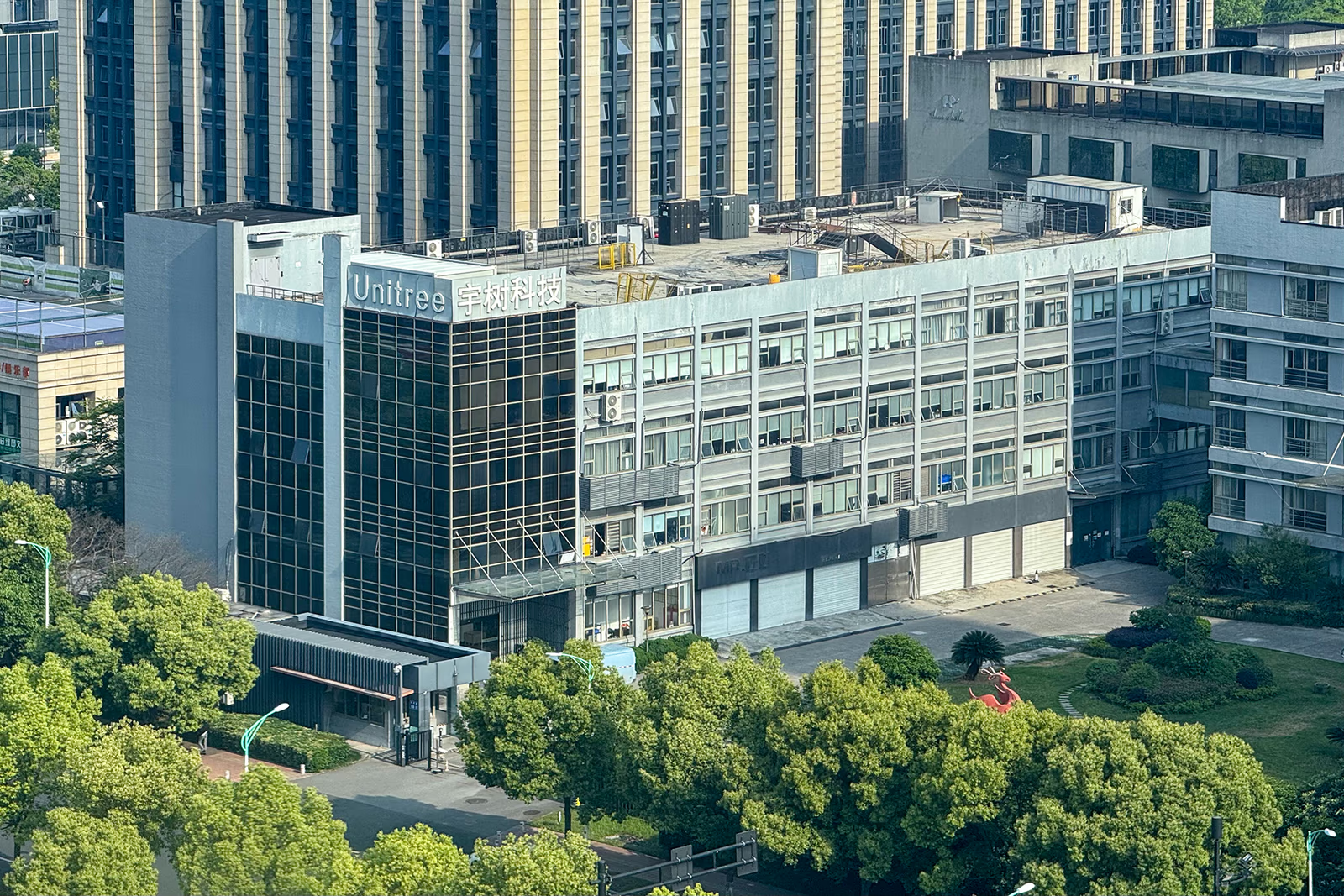
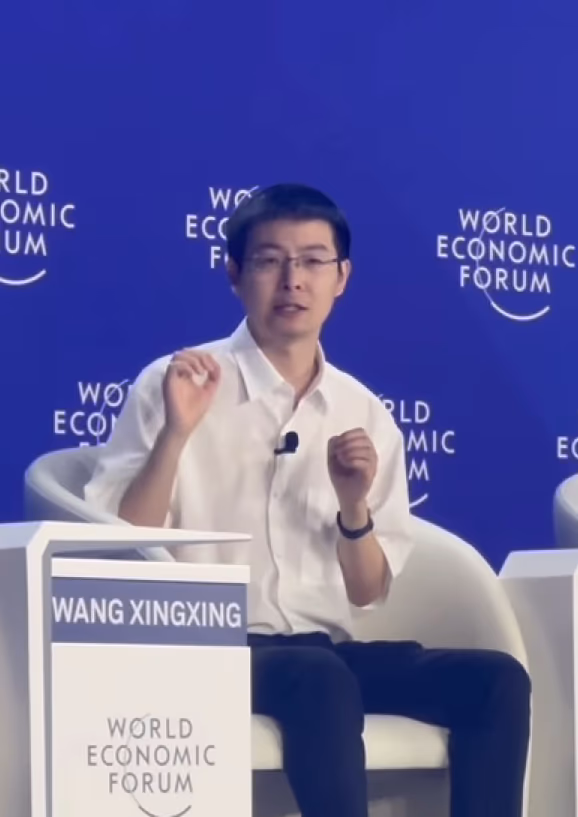
Unitree was founded on 26 August 2016 in Hangzhou by Wang Xingxing, then a recent graduate (BEng, Zhejiang Sci-Tech University; MEng, Shanghai University) who had built a four-legged robotic prototype nicknamed "XDog" during his studies. After a brief, roughly two-month stint at dronemaker DJI, he founded Unitree with about 2 million yuan in angel funding, registering the company in a 50 square-metre office in Hangzhou's Binjiang District.
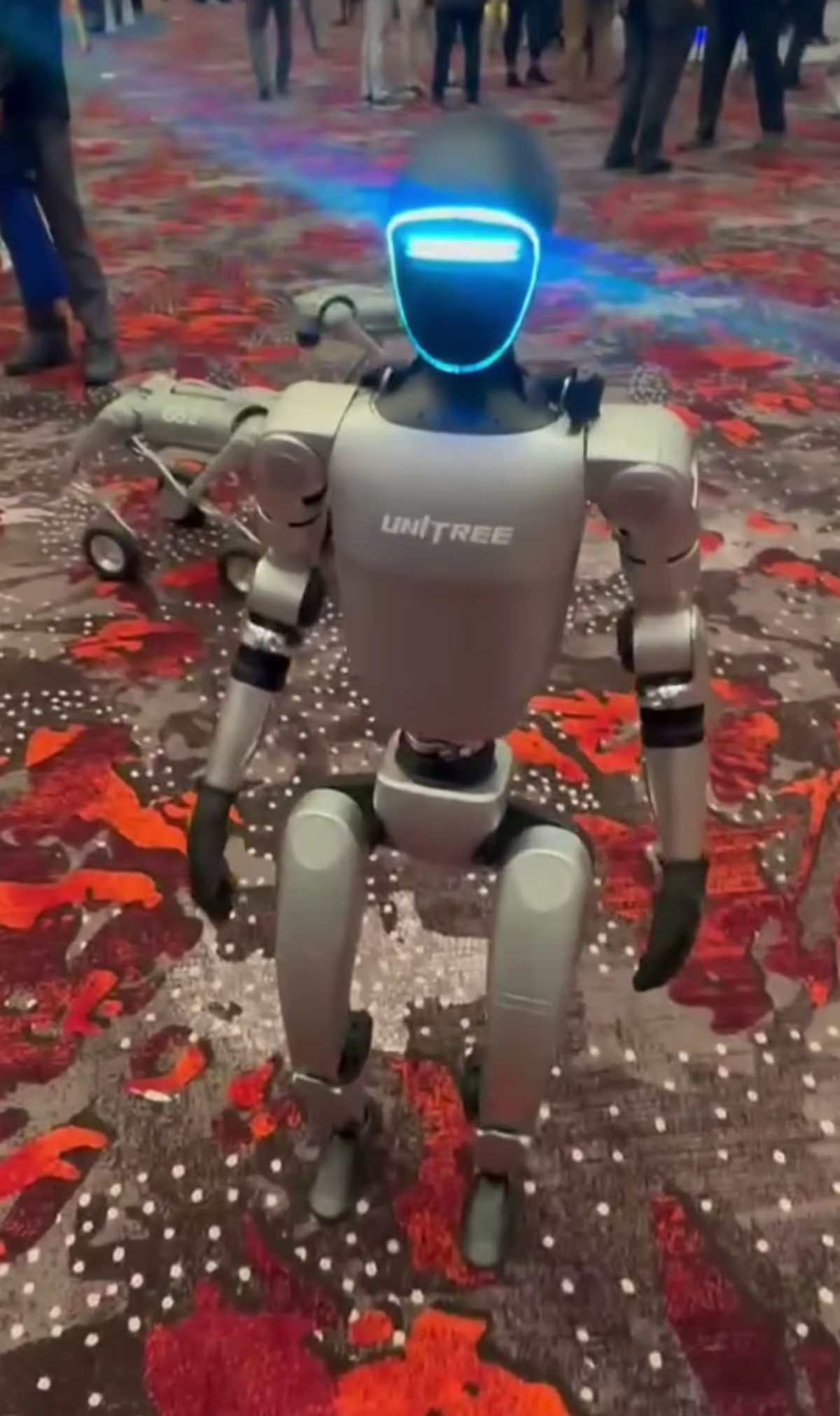
The company built its early business on quadruped ("robot dog") platforms, where Unitree and fellow Chinese maker Deep Robotics now dominate the global commercial market, reportedly holding more than 60% of it between them. Unitree's first full-sized humanoid, the H1, launched in 2023 and became known for demonstrating a standing backflip and, at launch, a running speed record of 3.3 m/s, later improved to a reported 10.1 m/s by an updated H1 configuration in April 2026, itself a useful benchmark for just how large a jump Superman's claimed 12.66 m/s represents over Unitree's own prior public record. The G1, launched 13 May 2024, is a smaller, roughly 127cm-tall, 35kg "AI avatar" humanoid that launched at approximately $16,000, a price aggressive enough to undercut most Western humanoid competitors by a wide margin and to become, by unit volume, one of the best-selling humanoid robots in the world.
Financially, Unitree is a genuine outlier in humanoid robotics: it is profitable. Forbes reported 2025 revenue of approximately 1.7 billion yuan (roughly $235 million), with gross margins near 60% and net margins in the mid-teens percent, figures more typical of a mature hardware business than an early-stage robotics start-up. On deliveries, the picture needs a little care: Washington Post reporting cited Unitree having produced roughly 18,000 robots in total by July 2026 (a figure that most likely spans its quadrupeds and humanoids combined), while Tech Times separately reported Unitree shipped approximately 5,900 humanoid robots specifically in the first half of 2026 alone, describing that as around 31% of the global humanoid market. Both figures are plausible and not necessarily contradictory, they are simply measuring different things (all robots vs humanoids only), and this piece keeps them separate rather than merging them into one number.
Why This Matters
Unitree's IPO is the clearest signal yet that Chinese capital markets are ready to treat humanoid robotics as an investable, standalone sector rather than a research curiosity bolted onto an industrial conglomerate. A STAR Market listing that draws 5,000-8,000-times retail oversubscription and cornerstone commitments from names like DeepSeek and Tencent is not just enthusiasm for one company's robots, it is a bet that China's broader industrial-policy push into robotics, much like the domestic chip-substitution drive covered in our China AI chip race piece, has moved from subsidy and mandate into something public markets will now price on its own.
It also lands at a moment when the gap between flashy locomotion demos and reliable real-world deployment is under unusually direct scrutiny inside China itself. Days before the Superman reveal, the second World Humanoid Robot Games (WHRG) held a firefighting final in Beijing on 16 August 2026, at a real fire brigade site rather than a controlled indoor mock-up, according to Global Times. Robots were given 30 minutes to identify two simulated hazardous substances, shut off three valves, and locate and extinguish a fire. Of the 23 teams entered in the category, only three robots completed the full course; rain, changing lighting and outdoor conditions reportedly disrupted the visual recognition and manipulation systems several teams relied on. A representative from one competing team, UniX AI, put it plainly: "Rain and lighting conditions can affect the robot, and actual situations are often different from what we simulate in the laboratory." A Tiangong team representative offered a more optimistic framing of the same gap: "Every real-world failure is valuable data that helps humanoid robots toward practical application."
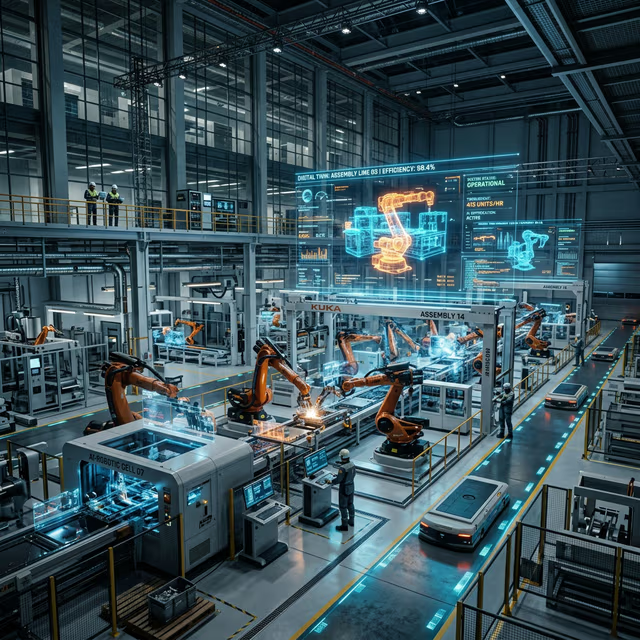
That contrast, a 45.6km/h sprinting demo with no hands celebrated in the same news cycle as a firefighting drill where most competitors failed to finish, is the honest state of humanoid robotics in mid-2026: genuinely fast-moving hardware progress on narrow, controlled tasks, alongside a persistent and well-documented reliability gap once robots leave the lab. Both things are true at once, and neither cancels the other out. For a broader look at how AI is reshaping physical industry beyond humanoids specifically, our Industrial AI Revolution piece covers digital twins and autonomous robotics in manufacturing more widely.
Limitations & Scepticism
- No independent verification of Superman's figures: the 2m jump and 12.66 m/s speed come from a company-supervised demonstration video, not a ratified athletic record, a lab test, or third-party measurement. No published test protocol covers surface, payload or repeatability.
- No hands, no manipulation: Superman is a locomotion-only prototype. It cannot pick anything up, open a door, or perform any task beyond running and jumping, and is not a general-purpose product on any published roadmap.
- The Usain Bolt comparison is doing more work than it should: Superman's 12.66 m/s beats Bolt's average 100m race speed comfortably but only narrowly exceeds his ratified peak instantaneous speed of around 12.42 m/s, and the two figures were measured under entirely different conditions.
- The timing invites scepticism on its own terms: a headline-grabbing capability demo landing two days before one of the most anticipated tech IPOs of the year is, as Tech Times put it, "a familiar pattern," and readers should weigh that context alongside the numbers themselves.
- Financial reporting on the IPO debut is genuinely inconsistent across otherwise reliable outlets: reported share-price gains range from roughly 460% to roughly 629% depending on source and which point in the trading day is measured; this piece has laid out each figure with its source rather than resolving the discrepancy for you.
- Real-world reliability lags demo footage: the same week's WHRG firefighting final, where only 3 of 23 competing teams finished the course, is a useful counterweight to any assumption that fast, viral locomotion clips translate directly into dependable field performance.
How It Compares
On profitability and shipping volume, Unitree is in a category of its own among humanoid-robot makers. Figure AI, a leading US rival, was reportedly valued at around $39 billion in its most recent private funding, roughly $30 billion above Unitree's pre-debut IPO valuation, according to Forbes, despite Figure not reporting profits; Unitree, by contrast, listed profitable, at close to 36 times its prior year's revenue, a multiple Forbes described as making it "the most affordable option among humanoid makers" on that particular metric, despite its post-debut share-price surge pushing the headline market capitalisation far higher on paper.
On availability, industry trackers broadly describe the humanoid-robot market as splitting into two tiers: a premium, industrial tier (Boston Dynamics, Figure) priced from roughly $50,000 to $150,000 aimed at fewer, higher-complexity deployments, and a volume tier (Unitree, Tesla's Optimus programme, 1X) aimed at lower unit costs and higher shipping numbers. Within that volume tier, Unitree's G1 and H1 platforms are commercially available today, while Tesla's Optimus and Boston Dynamics' electric Atlas remain, as of mid-2026, not generally available for purchase. Separately, Agility Robotics' Digit is often cited as the humanoid furthest along on confirmed, revenue-generating commercial deployment, with reported warehouse contracts including GXO, Toyota and Mercado Libre, a genuinely different kind of proof point from either Superman's speed claims or Unitree's IPO pop, since it reflects sustained paid work rather than a single dramatic demonstration or trading day. These comparative figures come from industry trackers and aggregator sites rather than audited company disclosures, and should be read with that caveat in mind, unlike the IPO financials above, which are drawn from major financial-press reporting.
What's Next
The immediate open questions split cleanly along the two halves of this story. On the robotics side: will Unitree publish any independent test data for Superman, will the platform ever be fitted with hands or offered as any kind of product, and will the "significant room for improvement" the company itself flagged translate into a faster, more capable successor, or quietly disappear the way some flashy robotics demos do once the news cycle moves on. On the financial side: whether Unitree's newly public share price stabilises anywhere close to its debut-day levels once the initial retail frenzy cools, how the company allocates the roughly $905 million it just raised (R&D, manufacturing capacity, or international expansion), and whether other Chinese humanoid makers now follow Unitree onto the STAR Market, testing whether this listing was a one-off event or the start of a genuine wave, the same pattern already visible in China's domestic AI-chip sector.
Longer term, the more consequential story may be the one running quietly underneath both headlines: whether the reliability gap exposed by events like the Beijing firefighting trial closes faster than the marketing cycle that produces clips like Superman's. That is a slower, less shareable story than a 12.66 m/s sprint or a 629% stock pop, but it is the one that will actually determine whether humanoid robots become useful machines or stay, for now, extremely impressive video content.
The Bottom Line
Two things can be true at once. Unitree really did just complete one of the most dramatic stock market debuts of 2026, backed by real revenue, real profitability, and real shipping volume that separates it from most of its humanoid-robot rivals, financial facts drawn from reputable, multiply-sourced financial press reporting even where the exact percentages differ outlet to outlet. And Unitree's "Superman" really is, for now, an unverified company claim from a 30-second video of a handless prototype, impressive as a piece of engineering but not yet the kind of independently confirmed record its framing implies. Readers, and investors, are best served treating the IPO numbers as solid and the robot's numbers as promising but unproven, exactly the distinction several of the outlets covering both stories drew, and exactly the one this article has tried to preserve rather than flatten.
Last updated: 19 August 2026. Superman's claimed specifications are sourced from Unitree's official X account (@UnitreeRobotics) and cross-checked against reporting from Tech Times and Interesting Engineering, both of which explicitly flagged the lack of independent verification; the Usain Bolt comparison figures are drawn from Bolt's official 2009 Berlin world-record data. IPO and financial figures are drawn from Forbes, CNBC, Caixin Global, CNN Business, the Washington Post and Bloomberg, with discrepancies between outlets noted rather than resolved where the underlying reporting genuinely differs. The World Humanoid Robot Games firefighting details are sourced directly from Global Times' own coverage of the event.
Get the free guide: Claude vs ChatGPT, Gemini & Grok
A 20-page playbook covering everything you need to choose and use the big four AI models in 2026, full cost and feature comparisons, what each is best (and worst) at, and how-tos for images, vectors, building a website, Claude Code and more.