 AI Tools Review Editorial Team
Quick Answer:
Gemini Robotics 2.5 is Google DeepMind's newest vision-language-action model, announced on 10/11/2026. Across more than 200 test tasks DeepMind reports a 30% to 100% higher success rate than its predecessor and tasks finished 20% to 30% faster. In a pilot on Mercedes-Benz production lines, Apptronik's Apollo 2 humanoid used it to pick and pack car parts with a 96% success rate. DeepMind also released ASIMOV-Jailbreak, an open benchmark for tricking robots into unsafe actions, on which Gemini 4 Argon scores 99.5%. It is available only to robotics partners: there is no public API or pricing.
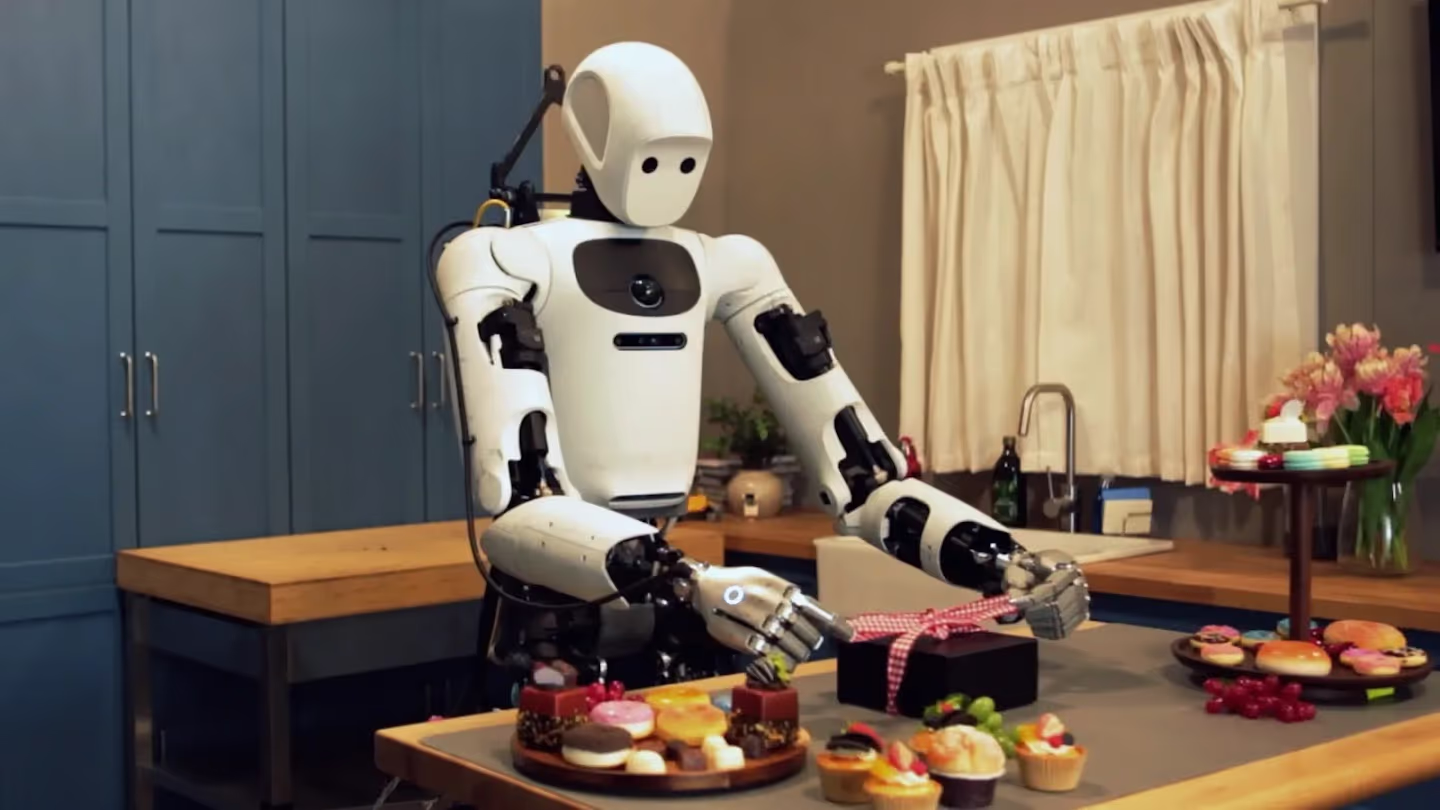
Most AI news this autumn has been about chatbots that write code faster. Gemini Robotics 2.5 is about something harder: getting a robot hand to tie a ribbon, fold a pair of trousers or sort metal brackets on a live car production line without dropping them. Google DeepMind's latest robot brain is a real step forward on paper, it has already been tested inside two Mercedes-Benz plants, and it arrives with an open safety benchmark aimed at the most worrying failure mode of physical AI. Here is what it actually does, what the numbers mean once you read the charts closely, and how far it still is from your warehouse.
Julian Goldie walks through the Gemini Robotics 2.5 announcement, the 96% Mercedes-Benz factory result and the ASIMOV-Jailbreak safety benchmark.
Executive Summary
- What it is: a vision-language-action (VLA) model that turns camera input and plain-English instructions into arm and hand movements. DeepMind calls it "our most capable vision-language-action (VLA) model to date".
- Headline gain: across 200+ distinct tasks, "a 30% to 100% higher success rate depending on the type of task, while completing tasks 20% to 30% faster" than previous baselines.
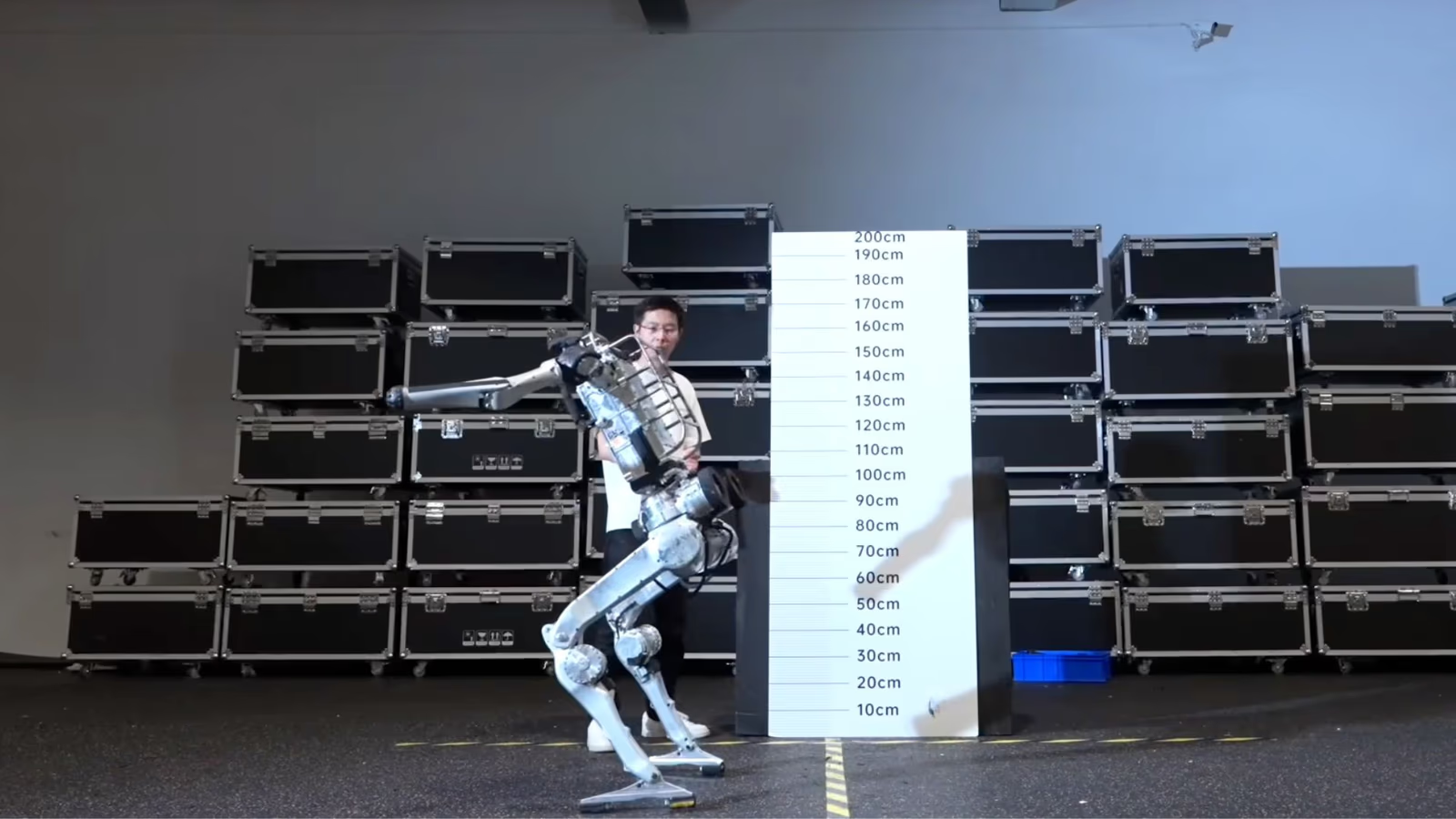
- Factory proof: on Mercedes-Benz lines in Kecskemét (Hungary) and Sindelfingen (Germany), Apptronik's Apollo 2 humanoid hit a 96% success rate picking and packing automotive parts.
- How it was built faster: Gemini 4 Argon acted as a simulation engine, generating thousands of practice runs and digital twins from real camera scenes.
- Safety: safe task completion improved by 33% around obstacles and 43% around nearby people. The new open ASIMOV-Jailbreak benchmark shows Argon resisting 99.5% of disguised unsafe requests, against 82% for Gemini Robotics ER 2.
- Access: rolling out to robotics partners only (Apptronik, Agile, Mercedes-Benz are credited). No public API, price or release date for general developers.
The short version: this is the most convincing evidence yet that the general-purpose model approach Google has taken with Gemini is transferring into physical robots. It is not yet a product you can buy, and every number in this article is self-reported by DeepMind.
What a Vision-Language-Action Model Does
A large language model such as Gemini 4 Hydrogen takes text (and images) in and produces text out. A vision-language-action model adds a third output: motor commands. You show it what its cameras can see, tell it "put the pliers in the black toolbox", and it produces the sequence of joint movements the robot's arm and fingers need to make that happen, adjusting continuously as the scene changes.
That last part is what makes robotics so much harder than chat. A chatbot can be wrong and you simply ask again. A robot that misjudges the grip on a glass breaks the glass. The world also never matches the training data exactly: lighting changes, objects sit at slightly different angles, a cardigan drapes differently every time you pick it up. VLA models try to handle this by inheriting the broad visual and language understanding of a foundation model and then learning the action layer on top, so the robot can generalise to objects and instructions it has never seen before rather than following a hard-coded script.
DeepMind splits its robotics stack into two layers, and it is worth keeping them straight:
- Gemini Robotics ER (embodied reasoning) is the planner. It understands the scene, tracks the workflow and decides what should happen next.
- Gemini Robotics (now 2.5) is the doer. It controls the hands and arms to carry out each step.
In the Mercedes-Benz pilot described below, both run together: ER tracks the kitting workflow while 2.5 drives the hands. That division mirrors the planner-executor pattern Google has been pushing in software, most recently with the Orchestrator feature that pairs Gemini 4 Carbon (planning) with Hydrogen (execution) in Antigravity.
Lineage: From Gemini Robotics to 2.5
Gemini Robotics 2.5 is the fifth public release in a line that has moved quickly. DeepMind's own post links the history:
| Release | Date | What changed |
|---|---|---|
| Gemini Robotics | March 2025 | First Gemini-based VLA model, plus the original ER model |
| Gemini Robotics 1.5 | September 2025 | Thinking before acting; cross-embodiment transfer |
| Gemini Robotics 2 | July 2026 | The baseline 2.5 is measured against |
| Gemini 4 Argon for Robotics | October 2026 | Argon applied to robotics reasoning and simulation |
| Gemini Robotics 2.5 | 10/11/2026 | Dexterity, reliability and safety steerability gains |
The cadence matters. Gemini Robotics 2 shipped in July, and the 2.5 release follows only four months later with step-change improvements on many individual tasks. That speed is the clearest sign that DeepMind's claim about Argon accelerating the research is more than marketing copy: it is hard to iterate on physical robots this fast without heavy use of simulation.
It also fits a wider pattern at Google this autumn. Since early October, Google has shipped Gemini 4 Argon, Gemini 4 Carbon, Gemini 4 Hydrogen and the Gemini Decision 1 routing model. Robotics is the part of that family where the frontier model is used less as a product and more as research infrastructure.
Gemini 4 Argon as a Simulation Engine
The most interesting technical claim in the announcement is not about the robot model at all. DeepMind says Gemini 4 Argon "acts as a simulation engine". In practice it does three jobs:
- Generates practice runs. From a single real camera scene, Argon produces thousands of varied simulated attempts at a task, so the robot model sees many more situations than could ever be physically staged.
- Builds a digital twin. It reconstructs a realistic virtual copy of the scene for those runs to take place in.
- Acts as a research assistant. It helps researchers form hypotheses about why a task fails and test fixes in simulation before trying them on real hardware.
This is the robotics equivalent of synthetic data in language modelling, and it attacks the single biggest bottleneck in the field: real-world robot data is slow and expensive to collect. Every hour of teleoperated demonstration needs a human operator, a robot and a physical set-up. If a frontier model can multiply each real scene into thousands of plausible variations, the cost of each new skill falls sharply.
The open question is the "sim-to-real gap". Simulated physics never perfectly matches the real thing, particularly for soft, deformable objects like fabric and food. The test results below suggest the gap is narrowing, because some of the largest gains are on exactly those deformable tasks. But DeepMind has not published how much of 2.5's training came from simulated versus real data, so outsiders cannot yet judge how general the technique is.
Benchmarks: 200+ Tasks, Four Categories
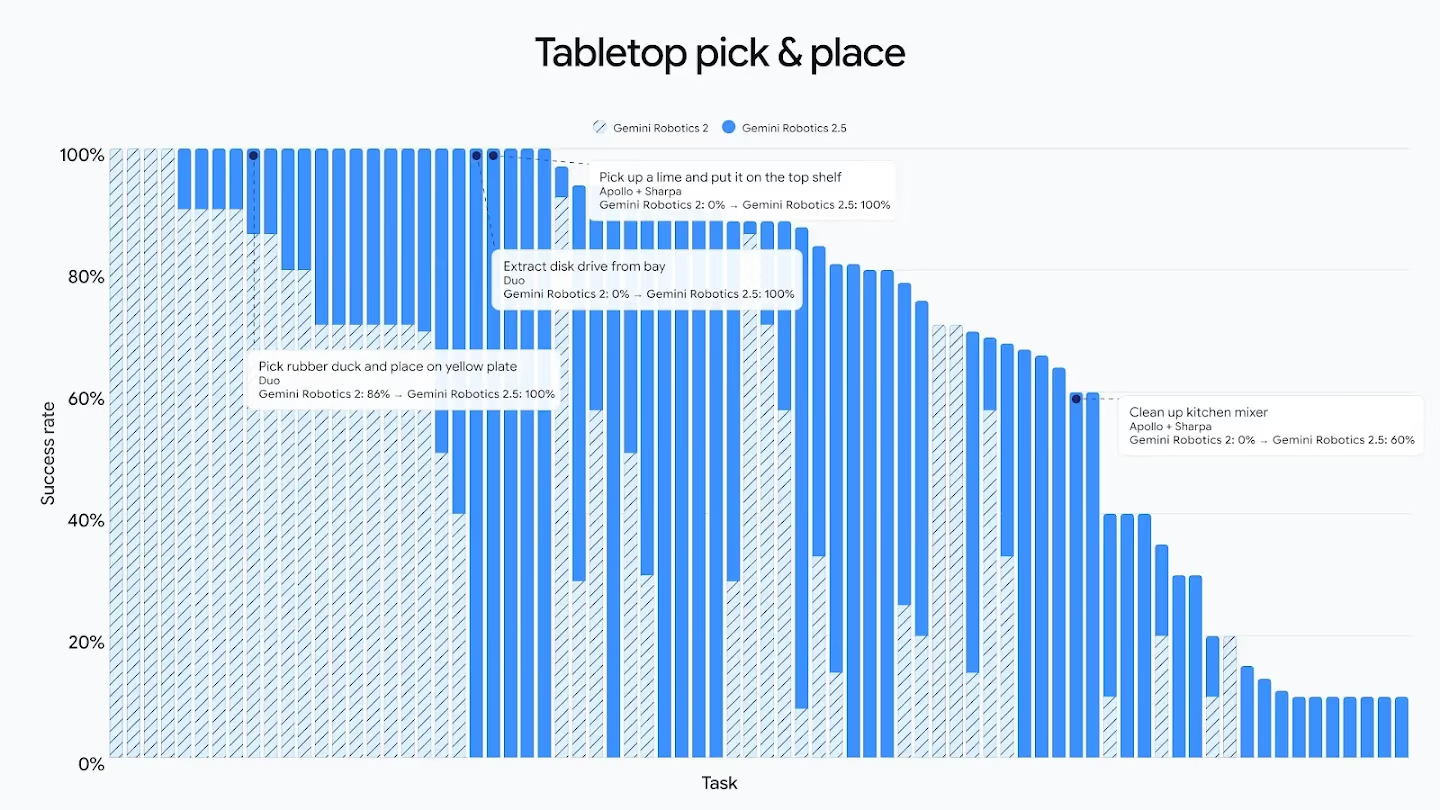
Robotics has no equivalent of SWE-bench or MMLU that everybody reports against, so DeepMind uses its own suite of more than 200 tasks, run on two robot platforms: the Franka Duo (two arms with parallel grippers) and Apptronik's Apollo 2 humanoid fitted with the SharpaWave five-finger hand. Results are grouped into four categories, each published as a bar chart comparing Gemini Robotics 2 against 2.5 task by task.
Tabletop pick and place
The simplest category, and the one where the older model was already strong on many tasks. The chart above shows a long tail of tasks where 2 already scored 100% and 2.5 matches it, and a large middle section where 2.5 fills in the gap. The highlighted examples are telling: picking up a lime and putting it on a top shelf with the humanoid went from 0% to 100%, and extracting a disk drive from a bay with the Duo went from 0% to 100%. Even here, though, the right-hand side of the chart shows a cluster of tasks where 2.5 still succeeds only around 10% of the time.
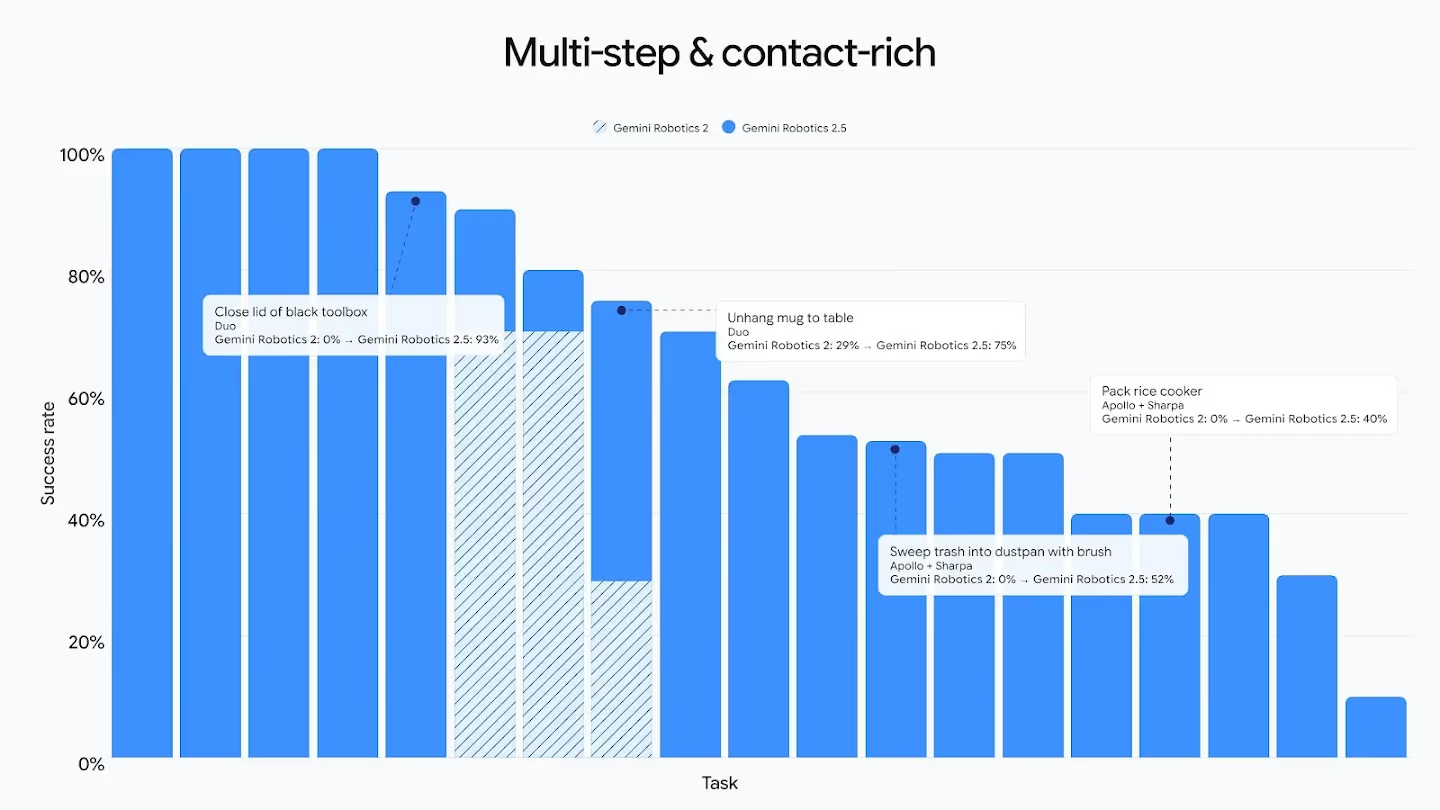
Multi-step and contact-rich
These are longer tasks where the robot has to push, sweep, open and close things rather than just grasp them. This is where the step change is most obvious: in DeepMind's chart, most tasks in this category show no hatched bar at all, meaning Gemini Robotics 2 scored zero. Examples DeepMind calls out:
- Close the lid of a black toolbox (Duo): 0% to 93%
- Unhang a mug to the table (Duo): 29% to 75%
- Sweep trash into a dustpan with a brush (Apollo + Sharpa): 0% to 52%
- Pack a rice cooker (Apollo + Sharpa): 0% to 40%
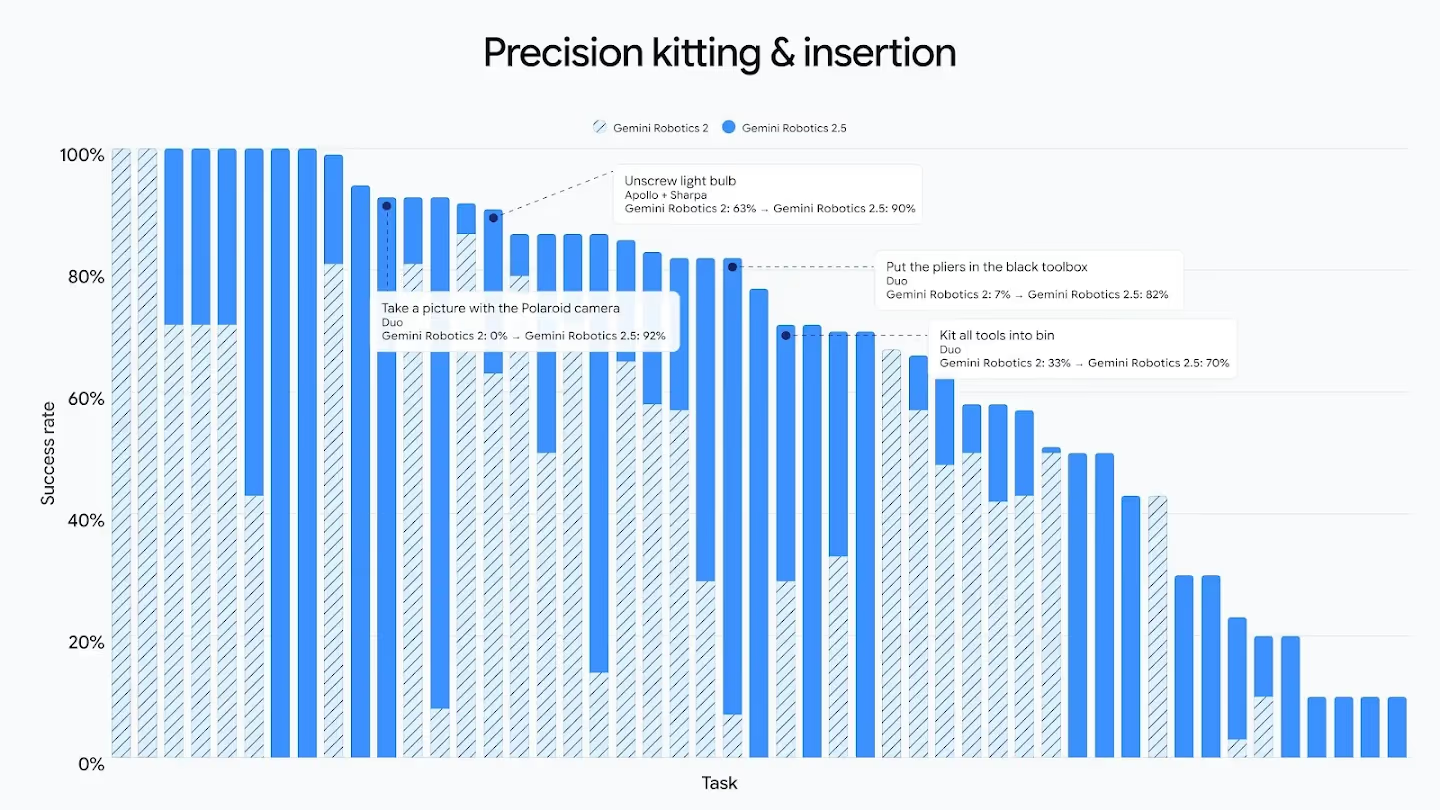
Precision kitting and insertion
This category is closest to industrial work: placing parts in specific slots, inserting objects, using fine motor control. Highlights include unscrewing a light bulb with the humanoid (63% to 90%), taking a picture with a Polaroid camera (0% to 92%), putting pliers in a black toolbox (7% to 82%) and kitting all tools into a bin (33% to 70%). Note the shape of the chart: a long tail of tasks on the right still sits at 10% to 30%, which tells you that "precision" is far from solved.
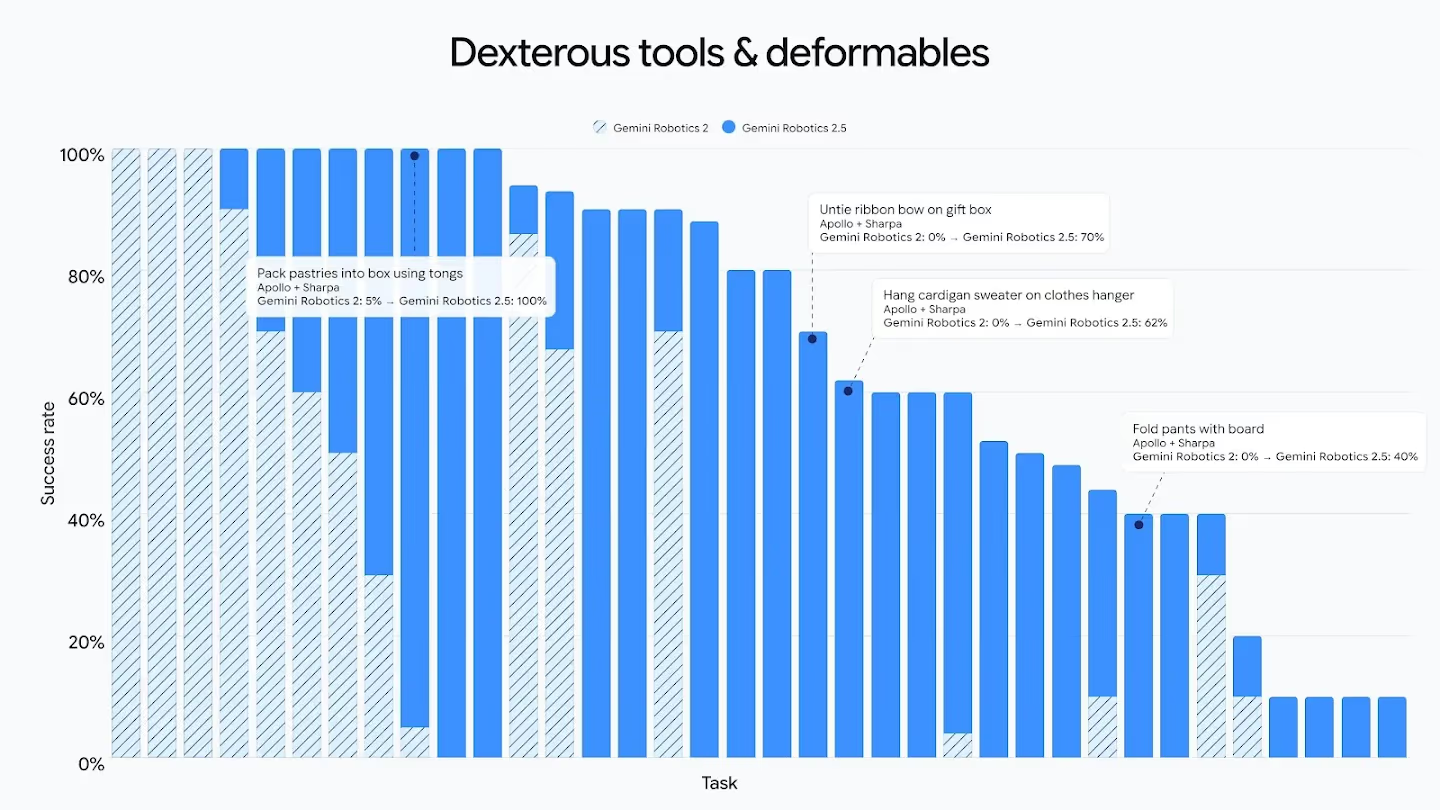
Dexterous tools and deformables
The hardest category for robots historically: using tools like tongs, and handling floppy objects like ribbon and clothing. DeepMind's callouts, all on the Apollo 2 humanoid with the Sharpa hand:
- Pack pastries into a box using tongs: 5% to 100%
- Untie a ribbon bow on a gift box: 0% to 70%
- Hang a cardigan sweater on a clothes hanger: 0% to 62%
- Fold trousers with a board: 0% to 40%
The pastry-and-tongs result is the most striking single number in the announcement: a tool-use task that was essentially impossible for the previous model now succeeds every time in DeepMind's tests.
How to read these charts honestly
Three caveats are worth keeping in mind. First, the tasks are chosen and run by DeepMind; there is no third-party replication. Second, DeepMind has not published the number of trials per task, so a jump from 0% to 40% could rest on a fairly small sample. Third, and most importantly, the charts are sorted by 2.5's success rate, which makes the improvement look visually dramatic. The fairer reading is that 2.5 turns many "impossible" tasks into "sometimes" tasks, and many "sometimes" tasks into "usually" ones. A 40% success rate on folding trousers is a research milestone, not a product.
The Mercedes-Benz Factory Pilot
Lab tasks are one thing. The part of this announcement most likely to matter commercially is a proof-of-concept run on active Mercedes-Benz production lines at two plants: Kecskemét in Hungary and Sindelfingen in Germany.
The job is kitting. Apollo 2 robots pick metal brackets out of bulk bins and place them into sequencing trays, so the right parts arrive at the right point on the line in the right order. It is repetitive, unglamorous and exactly the kind of work car makers struggle to staff. The robot also has to correct for gaps: if a tray position is empty or a part sits wrongly, it notices and fixes it.
DeepMind says Apollo 2 reached a 96% success rate on this task. Apptronik's co-founder and chief executive, Jeff Cardenas, said the models improved "dramatically in just a few weeks of post-training" and carried over to Mercedes-Benz production "with very little drop-off".
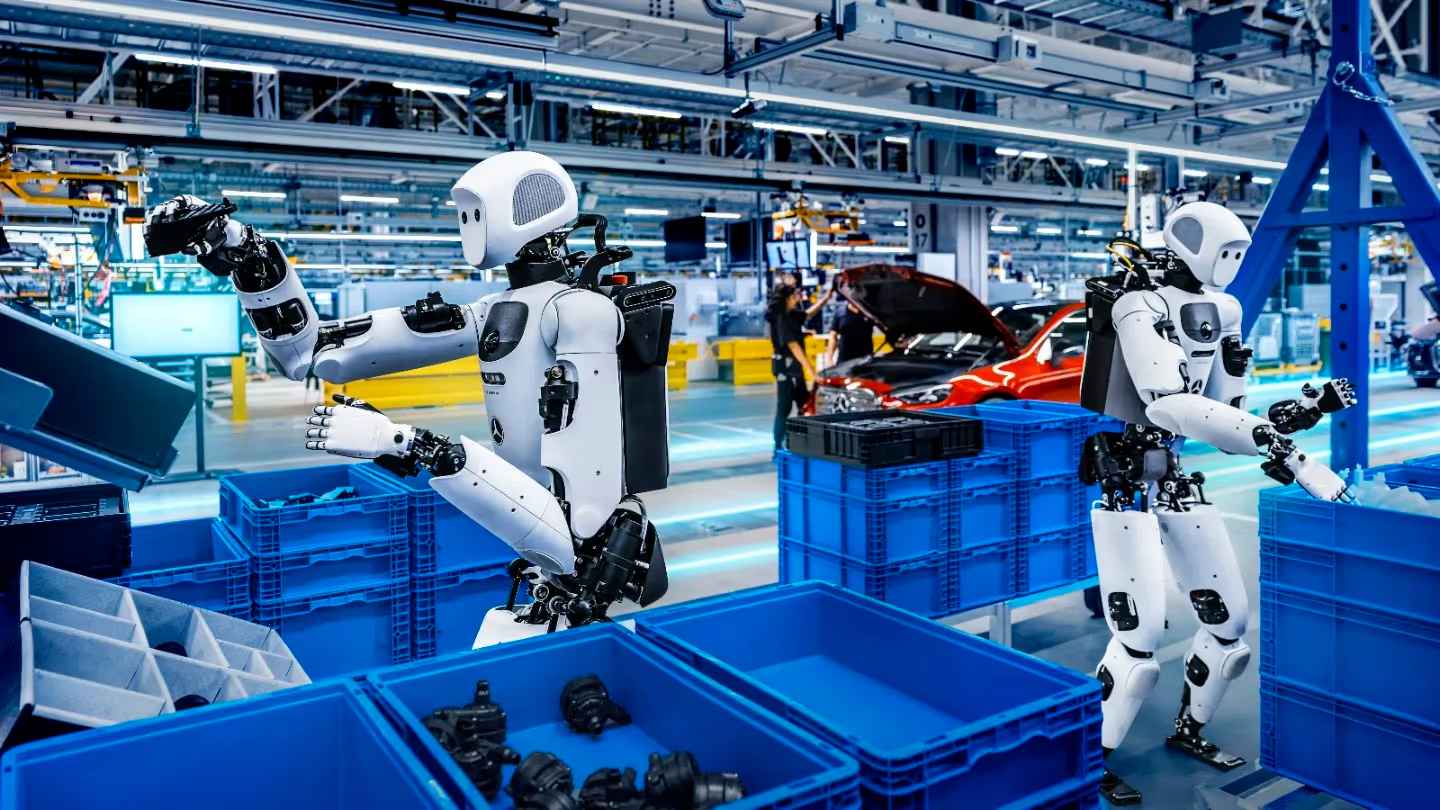
Why is 96% both impressive and not enough? Because factories measure reliability very differently from AI labs. A human kitting operator who got one in every 25 picks wrong would be retrained. A production line that stops once every 25 cycles would be unworkable. What makes the figure meaningful is the trajectory: a general-purpose model reaching that level after only weeks of task-specific post-training, rather than months of bespoke engineering. If that holds, the economics of putting humanoids on lines change, because each new task stops being a custom integration project.
It is also worth noting what this pilot is not. DeepMind describes it as a proof-of-concept. Neither Mercedes-Benz nor Apptronik has announced a fleet order or a production rollout date tied to this model. Treat it as strong evidence of direction, not a deployment.
Hardware: One Model, Many Bodies
DeepMind says Gemini Robotics 2.5 "works natively" with many robot types. The two named platforms in this release are very different:
| Platform | Type | Hand | Used for |
|---|---|---|---|
| Apptronik Apollo 2 | Full humanoid | SharpaWave, five fingers, 22 degrees of freedom | Dexterous tool use, deformables, factory kitting |
| Franka Duo | Two-arm tabletop rig | Two-fingered parallel grippers | Pick and place, precision insertion, contact-rich tasks |
Running one model across a 22-degree-of-freedom humanoid hand and a simple two-finger gripper is the "cross-embodiment" promise that DeepMind first highlighted with Gemini Robotics 1.5. Commercially this is the whole game. Robot makers do not want to train a new brain for every model of arm; integrators do not want to re-engineer software every time hardware changes. A single foundation model that adapts to many bodies is what would let robotics follow the path software took with cloud AI.
The partner list also tells you where Google sees the market: Apptronik for humanoids, Agile for industrial robotics and Mercedes-Benz as a demanding manufacturing customer. Compare that with Unitree, which leads on low-cost humanoid hardware out of China but relies on others for frontier-grade models.
Safety: Steering Around People and Jailbreaks
Safety in physical AI is a different problem from safety in chatbots. A chatbot's harm is mostly informational. A robot's harm can be immediate and physical. DeepMind makes three safety claims in this release.
1. Hazard steering at inference time
Gemini Robotics 2.5 uses inference-time reasoning guidance to steer around physical hazards in real time, which DeepMind likens to the safety classifiers applied to Gemini's text answers. The reported effect: safe task completion improved by 33% around obstacles and 43% around nearby people. The second figure is the one that matters most for any deployment where robots share space with workers.
2. Argon leads agentic robotics evaluations
DeepMind says Gemini 4 Argon currently leads its internal agentic robotics evaluations for refusing unsafe tasks, resolving uncertainty (asking rather than guessing when an instruction is ambiguous) and working near humans. Because Argon sits above the action model in the reasoning stack, its judgement effectively acts as a safety gate on what the robot is asked to do.
3. ASIMOV-Jailbreak, an open benchmark
The most useful contribution for the wider field is a new open-source benchmark. ASIMOV-Jailbreak contains "hundreds of prompts that disguise unsafe requests across dozens of scenes", and is hosted on Hugging Face as google/asimov_agentic. Think of it as the physical-world version of the jailbreak suites used to test chatbots: instead of trying to trick a model into writing malware, the prompts try to trick a robot into, say, handing a knife to someone in an unsafe way by dressing the request up as something innocent.
| Safety metric (DeepMind, self-reported) | Result |
|---|---|
| Safe task completion around obstacles | +33% |
| Safe task completion around nearby people | +43% |
| ASIMOV-Jailbreak resistance, Gemini 4 Argon | 99.5% |
| ASIMOV-Jailbreak resistance, Gemini Robotics ER 2 (previous baseline) | 82% |
Releasing the benchmark openly is the right call. It means rival labs, including the Chinese humanoid makers and US start-ups such as Figure, can be measured on the same test, and it gives regulators something concrete to point at. The usual caveat applies: a model that scores well on a published benchmark can be tuned to that benchmark. Independent red-teaming will matter more than the headline 99.5%.
For context on how Google approaches frontier safety in its software models, see our coverage of Gemini 4 Argon's cyber and safety evaluations and the agentic overreach data published with Hydrogen.
Real-World Results vs Benchmarks
The tracked creators who covered this release mostly took DeepMind's figures at face value, which is understandable: there is no way for a YouTuber to test a partner-only robot model. That makes it more important to separate what has been shown from what has been claimed.
- Shown: video of Apollo 2 robots performing kitting on real Mercedes-Benz lines; video of tabletop and household tasks; task-by-task bar charts.
- Claimed but not independently verified: the 30% to 100% improvement range, the 20% to 30% speed-up, the 96% kitting success rate and every safety figure.
- Not disclosed: number of trials per task, failure modes, cycle times in the factory, the share of simulated vs real training data, model size and latency.
None of this suggests the numbers are wrong. DeepMind has a good record of its robotics claims holding up when partners deploy them. But anyone building a business case should wait for partner-reported production metrics rather than lab percentages.
Availability and Pricing
This is the shortest section, because there is little to say. Gemini Robotics 2.5 is "rolling out to our robotics partners". There is:
- no public Gemini API endpoint for the model;
- no published pricing in pounds, dollars or anything else;
- no stated regional availability, including for the UK;
- no timeline for general availability.
If you are a robotics company, the route in is DeepMind's partner programme via the Gemini Robotics model page. If you are a developer who wants to experiment with Google's physical AI today, the realistic options are the Gemini Robotics ER family where offered, and the general Gemini 4 models through the Gemini API for scene understanding and planning.
Limitations and Open Questions
- Long tail of failures. Every one of DeepMind's four charts ends with a cluster of tasks still succeeding 10% to 30% of the time. Those are the tasks that will decide whether general-purpose robots are viable outside tightly controlled settings.
- Self-reported numbers only. No third-party benchmark, no academic replication, no trial counts.
- Factory reliability bar. 96% is excellent for a research model and not yet good enough for unattended production.
- Speed and cost. DeepMind says tasks finish 20% to 30% faster than before, but gives no absolute cycle times. A humanoid that is reliable but three times slower than a person may still not make economic sense.
- Closed access. Partner-only distribution means the wider research community cannot probe the model's weaknesses directly. The open ASIMOV-Jailbreak benchmark partly offsets this.
- Simulation dependence. If Argon-generated simulation is doing much of the heavy lifting, performance in environments that are hard to simulate (wet, dusty, cluttered, crowded) remains an open question.
How It Compares
Direct comparisons are impossible, because no two robotics labs report against the same benchmark. What can be compared is approach and evidence.
| Dimension | Gemini Robotics 2.5 | Typical humanoid start-up stack |
|---|---|---|
| Foundation model | Built on Gemini; Argon used for simulation and reasoning | Smaller in-house VLA or licensed model |
| Cross-embodiment | Humanoid and two-arm gripper rig, same model | Usually tied to the company's own robot |
| Factory evidence | Mercedes-Benz pilot, 96% on kitting | Varies; many pilots, few published success rates |
| Open safety benchmark | Yes, ASIMOV-Jailbreak on Hugging Face | Rare |
| Public access | Partners only | Usually none |
Google's structural advantage is obvious: it can use a frontier model like Argon as a research tool, which a robotics start-up cannot. The counter-argument, made by Chinese manufacturers such as Unitree, is that cheap, mass-produced hardware matters more than the best model. In practice the two are converging: hardware makers want the best brains, and model makers need bodies to run them in.
What It Means for UK Manufacturing
The Mercedes-Benz pilot took place in Hungary and Germany, but the work it targets is just as common in British automotive, aerospace and food production plants. Kitting, line-side sorting and packing are among the hardest roles to staff and among the most repetitive. Three practical takeaways for UK operations leaders:
- Start mapping tasks now. The tasks that improved most in DeepMind's tests (pick and place, kitting, tool use) are the ones to inventory first.
- Watch the integrators. Access will come through partners such as Apptronik and Agile rather than a Google sign-up page.
- Plan for collaboration, not replacement. The 43% improvement in safe completion around people is a sign that shared workspaces, not lights-out factories, are the near-term model. That has implications for health and safety assessments under existing UK workplace regulations.
Who Should Pay Attention
- Robotics companies: this sets a new public bar for dexterity and for safety reporting. Expect customers to ask how your stack scores on ASIMOV-Jailbreak.
- Manufacturers and logistics firms: the factory pilot is the strongest sign yet that general-purpose humanoids could handle real line-side work within a few product cycles.
- AI safety researchers: the open benchmark is immediately useful, and the inference-time steering approach is worth scrutinising.
- Developers and investors: robotics is now a front in the Google versus OpenAI versus Chinese labs race, not a side project. It belongs alongside our tracking of the China AI race and the compute supply chain.
The Bottom Line
Gemini Robotics 2.5 is a substantial jump, not an incremental update. Tasks that its predecessor could not do at all, from closing a toolbox to packing pastries with tongs, now work most or all of the time in DeepMind's tests, and a humanoid running it has sorted parts on a real Mercedes-Benz line with 96% success. Using Gemini 4 Argon as a simulation engine looks like the reason the progress came so fast, and the open ASIMOV-Jailbreak benchmark is a genuinely useful contribution to physical AI safety.
Keep it in proportion, though. The numbers are self-reported, the long tail of hard tasks is still there, 96% is not factory-grade reliability, and nobody outside DeepMind's partner list can use the model. The direction is clear. The timeline to your own warehouse floor is not.
Last updated: 15/11/2026. Figures from Google DeepMind's announcement of 10/11/2026; we will update this article if independent results or partner deployment data are published.