 AI Tools Review Editorial Team
Quick Answer:
Seedream 5.5 is ByteDance Seed's new image model, announced on 09/11/2026. It can edit the same picture 100 times in a row while keeping untouched areas pixel-identical, generates transparent-background (RGBA) assets directly, and renders small text far more reliably: ByteDance reports a severe text corruption rate of 0.4%, against 2.8% for Seedream 5.0 Pro and 0.7% for GPT Image 2.5 Sunburst. In ByteDance's own preference tests it leads GPT Image 2.5 Sunburst and Nano Banana 2.1 on text structure, but Nano Banana 2.1 still wins on image-to-image realism. It is rolling out in China now and is coming to Dreamina, CapCut and BytePlus. No official API price has been published.
Anyone who has tried to refine an AI image over a dozen prompts knows the problem: each edit nudges something you did not ask to change. Faces drift, colours shift, text goes soft, and by round ten the picture has quietly turned into a different one. ByteDance's Seedream 5.5 is built around fixing exactly that. It also adds the feature designers have wanted for years, genuine transparent-background output, and makes a serious push on small text. Here is what the official evaluations actually show, where the claims are weaker than the headlines, and how it stacks up against OpenAI and Google.
Julian Goldie covers the three Seedream 5.5 upgrades, the native transparent-image feature and where you can try it.
Executive Summary
- What it is: ByteDance Seed's next-generation image creation and editing model, the successor to Seedream 5.0 Pro.
- Upgrade 1, stable multi-turn editing: unedited regions are preserved at the pixel level with no colour shift, supporting continued work on the same image across 100 rounds of editing.
- Upgrade 2, native RGBA: images can be generated with an alpha channel, including full and partial transparency, ready to drop into layouts.
- Upgrade 3, realism and text: more natural lighting, materials and skin, less over-gloss and overexposure, and much more accurate dense small text in Chinese and English.
- Text accuracy: severe text corruption 0.4% and minor text corruption 1.7% in ByteDance's tests, both the lowest in its comparison set.
- Usability: higher usability and quality scores than Seedream 5.0 Pro in all six professional use cases tested; usability more than doubled in film and television and in office productivity.
- Access: rolling out on Jimeng, Doubao, Doubao Work and Volcano Ark; coming to Dreamina, CapCut and BytePlus. A Pro version will follow.
Lineage: Where 5.5 Fits
Seedream is the image half of ByteDance Seed's visual stack, alongside the Seedance video models we covered in our Seedance 2.0 review. ByteDance's Seed site currently lists Seed2.1 (its language model family), Seedance 2.5, Seedream 5.5, SeedRealtime, Seed Audio 1.0 and Seed GR-RL among its models.
The direct predecessor is Seedream 5.0 Pro, which ByteDance pitched as a model that "understands design". Seedream 5.5 is the standard tier of a new generation, and ByteDance explicitly says "a Pro version of the Seedream 5.5 series will follow". That matters for reading the benchmarks: in several charts the new standard model is being compared against the previous Pro model, and still wins.
The launch timing is also pointed. OpenAI shipped ChatGPT Images 2.5 with its Flare and Sunburst models, and Google has been iterating its Nano Banana line inside Gemini. Image models are now a three-way race between the US labs and ByteDance, with Alibaba's Qwen-Image pushing from the open-weights side.
100-Round Editing: Why Drift Matters
Most image models edit by regenerating. You ask for a different necklace, and the model produces a whole new image that is supposed to look like the old one with a different necklace. Do that once and you rarely notice. Do it twenty times, each time feeding the last output back in, and the small errors compound: skin tones creep, backgrounds blur, fine details degrade. ByteDance describes this directly: "as one output becomes the next input, small errors can accumulate over successive edits, causing detail loss and image degradation".
Seedream 5.5 uses targeted training to preserve unedited regions at the pixel level. ByteDance's demos show three kinds of long edit chain:
- A portrait, edited 100 times. Clothing, accessories and tabletop objects change repeatedly, yet by the end the model can still make precise edits to small items such as rings and eyeglass frames, with natural contact between accessories and skin, coherent occlusion and consistent lighting.
- Four floral designs spanning realistic flowers, still-life arrangements, journal collages and traditional painting. After repeated additions and replacements, the model can still change the shape or material of a specified flower, rendering openwork lace and bead sheen.
- An interior makeover. An old study gradually becomes a colourful space. As a box is moved around, perspective, occlusion and cast shadows update, and previously hidden areas are filled in plausibly.
Why does 100 rounds matter commercially? Because that is how real creative work happens. An e-commerce team swapping outfits on the same model photo, an agency iterating on a campaign visual with a client, or a game studio building variations of a scene all need the same base image to survive many changes. Until now, the practical workaround has been to go back to the original and re-apply every edit from scratch, or move into Photoshop. Stable multi-turn editing removes that friction, if it holds up outside the demos.
The caveat: ByteDance has not published a quantitative drift metric (such as pixel difference in unedited regions after N rounds) or a comparison with competitors on long edit chains. The 100-round claim is supported by demo videos, not a benchmark. OpenAI made similar multi-turn editing claims for ChatGPT Images 2.5, so a head-to-head test is the obvious next step for independent reviewers.
AI Search's weekly round-up includes a Seedream 5.5 segment alongside Gemini 4 Carbon, Hydrogen and a long list of new image, audio and robotics models.
Native RGBA: Transparent Assets
This is the upgrade most people will underrate. Almost every AI image model outputs a flat rectangle. If you want a product shot, a character or a logo on a transparent background, you generate it on a plain backdrop and then cut it out with a background-removal tool, which struggles with hair, fur, glass, smoke and anything semi-transparent.
Seedream 5.5 generates images with an alpha channel directly, "including full and partial transparency". ByteDance's demos include:
- A snowy owl with spread wings, where the wingtip feathers, the tiny gaps between them and the claw outlines are preserved without a cut-out step.
- Stylised lettering that borrows brushwork, colours and material effects from a reference image, output as a transparent asset that stays accurate and legible.
- A reusable set of character assets placed into different settings, keeping their defining features while poses and groupings change.
Partial transparency is the important detail. A wine glass, a soap bubble or a wisp of smoke is not simply "in" or "out": it should let some of the background show through. Generating that natively means the asset composites correctly over any background, which is what designers, motion graphics artists and game developers need. It also slots naturally into agent workflows, where an AI produces a set of assets that another tool assembles into a layout.
Julian Goldie's video calls this the feature "most people will miss", and we agree. For anyone producing marketing assets at volume, RGBA output could save more time than any realism improvement.
Realism and Small-Text Rendering
Less plastic, more photograph
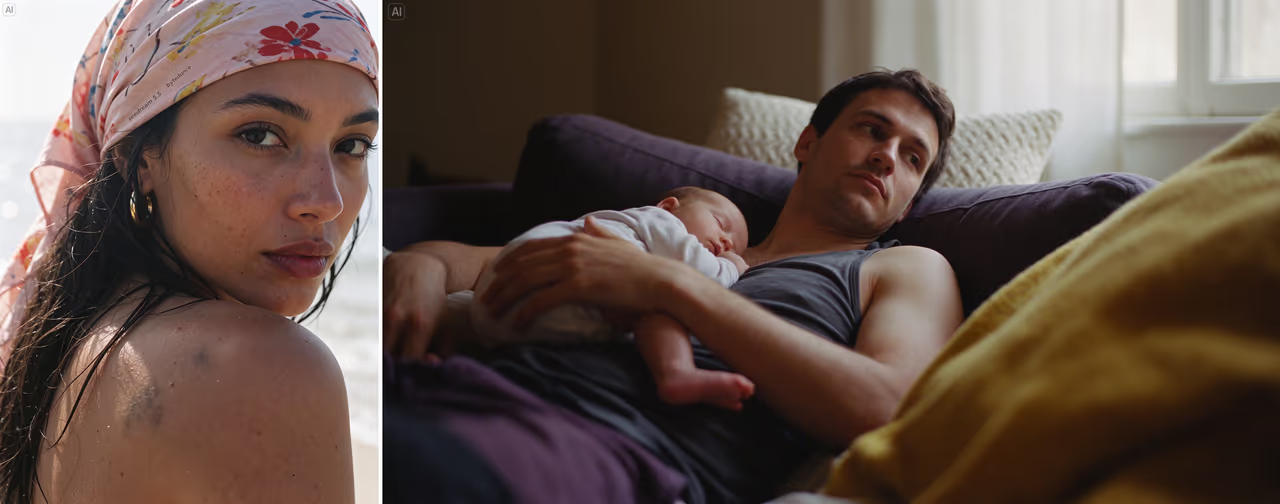
The "AI look" most people recognise comes from a handful of habits: overly glossy skin, blown-out highlights, too-perfect lighting and blotchy texture in shadow. ByteDance says Seedream 5.5 renders lighting, materials and skin more naturally and "reduces excessive gloss, overexposure, and blotchy textures". Its examples include a woman looking back over a sunlit shoulder with visible skin texture and backlit strands of hair, and a father holding a sleeping baby in soft window light with detail retained in the shadows.
Dense small text, in two scripts
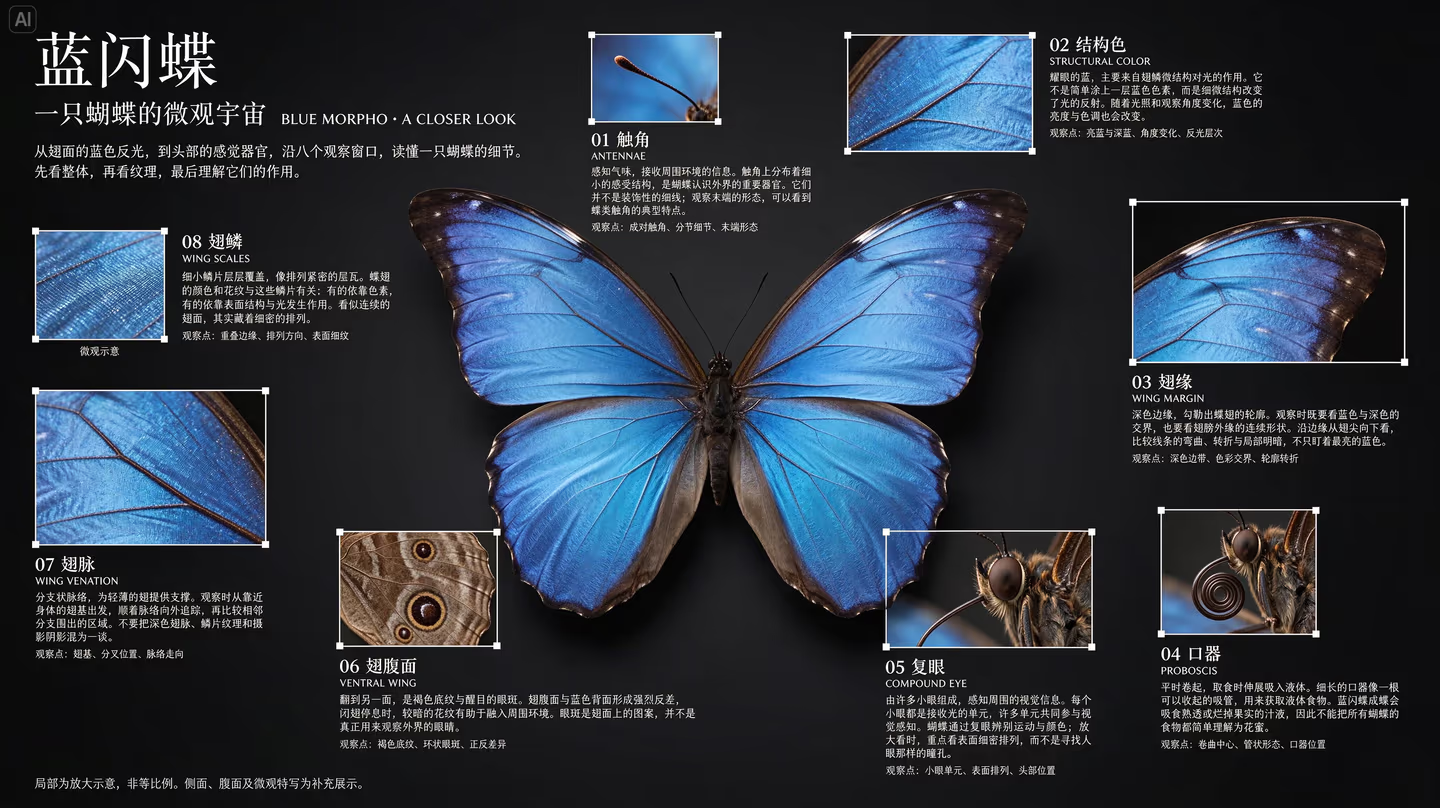
Text has been the weak point of image models for years: headlines are fine, but body copy dissolves into gibberish. ByteDance shows two demanding examples. One is a newspaper-style page about Shakespeare with several passages of small English text between a portrait and a theatre illustration. The other is a blue morpho butterfly infographic with eight illustrated notes in small Chinese characters, many of them with high stroke counts.
Chinese is a harder test than English for this. A single character can have more than 20 strokes, and at small sizes a model has to get every one right for the text to be readable. Strong small-text Chinese rendering is a practical advantage for ByteDance's home market, and a meaningful one for anyone producing bilingual packaging, menus or signage.
Benchmarks: ByteDance's Numbers, Read Carefully
ByteDance published three sets of evaluations. All were run by ByteDance using experienced human evaluators on its MagicArena platform. None is an independent public leaderboard.
1. Six professional use cases vs Seedream 5.0 Pro
ByteDance tested six use cases: e-commerce, marketing, film and television, gaming, office productivity and fashion design, measuring both a usability rate (would a professional use this output?) and a mean opinion score (MOS). Seedream 5.5 improved both measures in all six. In film and television and in office productivity, usability rates were "more than twice those of the previous version".
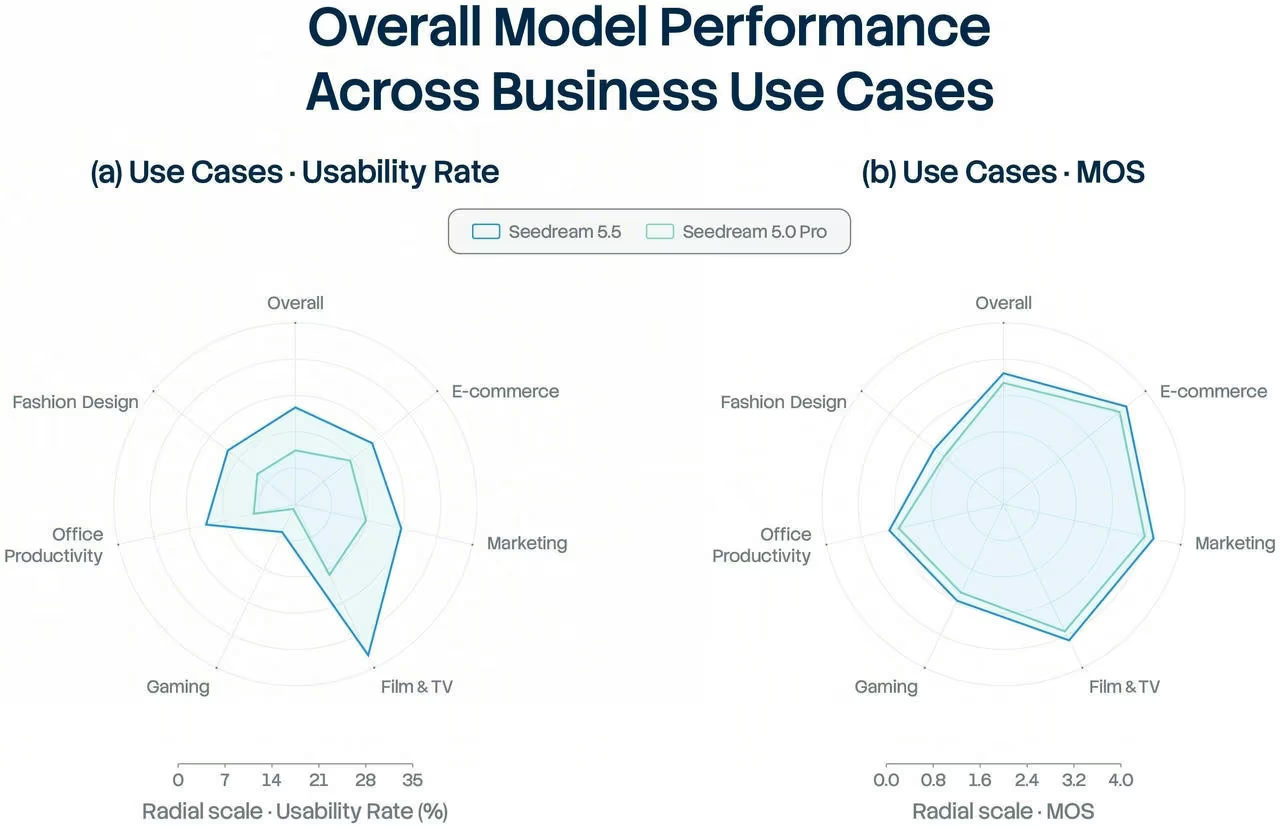
Look at the scale on the left-hand chart: the radial axis for usability runs only to 35%. Even with the improvement, the overall usability rate for both models sits well below a third, and gaming in particular remains low. In other words, by ByteDance's own strict professional standard, most outputs still are not used as-is. That is an honest and useful number, and a reminder that "state of the art" in image generation still means a lot of re-rolls.
2. Text structure and realism vs rivals (GSB)
The second evaluation uses GSB (Good/Same/Bad) preference scoring: experts compare pairs of images, and a positive score means Seedream 5.5 was preferred. Here are the exact figures from ByteDance's chart:
| Seedream 5.5 vs… | Text structure, image-to-image | Text structure, text-to-image | Realism, image-to-image | Realism, text-to-image |
|---|---|---|---|---|
| GPT Image 2.5 Sunburst | +20.72% | +16.01% | +36.05% | +37.29% |
| Nano Banana 2.1 | +3.82% | +5.23% | -6.18% | +21.79% |
| Seedream 5.0 Pro | +18.54% | +5.00% | +55.62% | +39.44% |
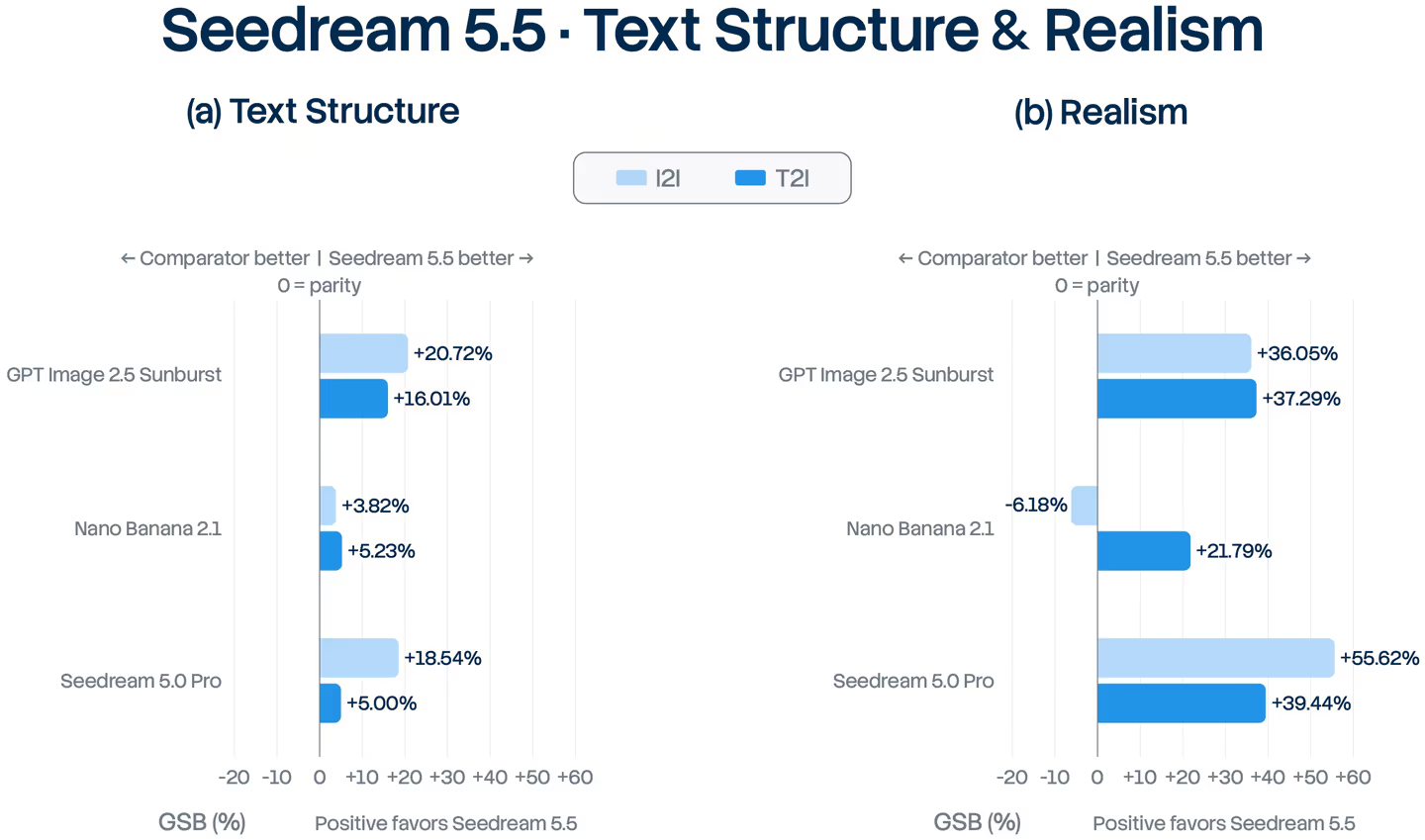
Two things stand out. Against GPT Image 2.5 Sunburst the margins are large across the board, especially on realism. Against Google's Nano Banana 2.1 the text-structure lead is narrow (single digits), and on image-to-image realism Google's model is actually preferred. ByteDance's own write-up says Seedream 5.5 "shows a substantial advantage in text-to-image realism", which is accurate, but the full chart is more balanced than the headline suggests.
There is also a timing wrinkle. Launch coverage noted that OpenAI shipped a newer GPT Image 2.6 Sunburst model on 04/11/2026, five days before Seedream 5.5 was announced. ByteDance's comparison is against 2.5, so the gap to OpenAI's current model may be smaller.
3. Text corruption rates
The third evaluation counts how often generated text is broken, across Chinese and English including dense small text. Lower is better.
| Model | Severe text corruption | Minor text corruption |
|---|---|---|
| Seedream 5.5 | 0.4% | 1.7% |
| Seedream 5.0 Pro | 2.8% | 2.6% |
| Nano Banana 2.1 | 1.7% | 3.0% |
| ChatGPT Image 2.5 Sunburst | 0.7% | 7.4% |
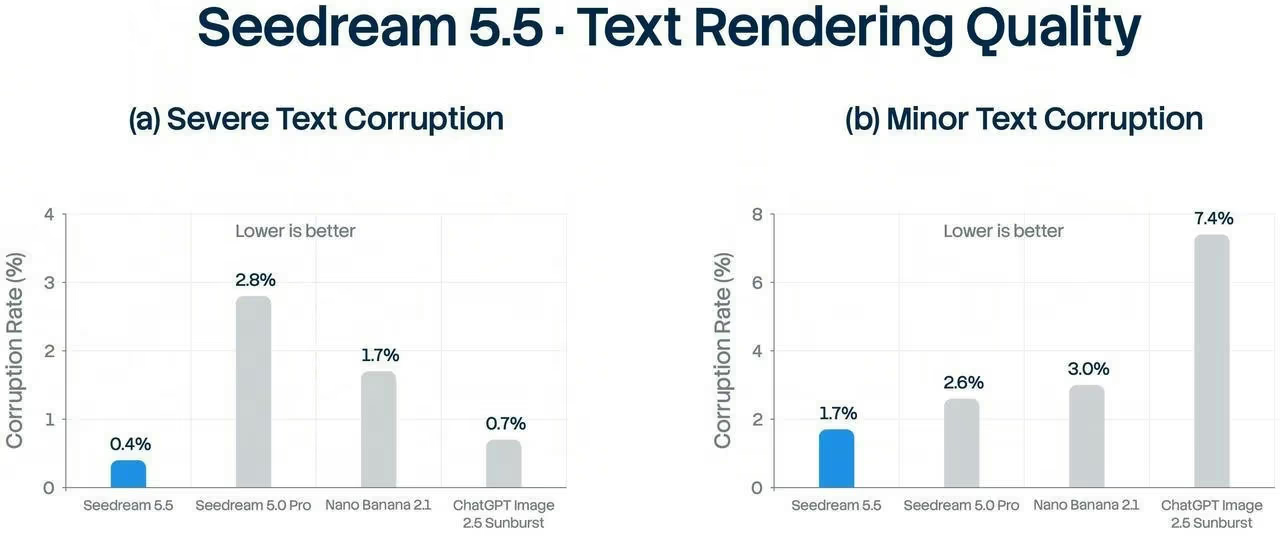
This is the most convincing chart in the launch. A seven-fold reduction in severe text errors versus Seedream 5.0 Pro is a big generational jump. OpenAI's model is close on severe errors (0.7%) but makes many more minor errors (7.4%), which fits the pattern of strong headline text with wobblier small print. The usual caveat applies: the test prompts are ByteDance's, and a Chinese-heavy prompt set would naturally favour a model trained with ByteDance's data.
Real-World Results vs Benchmarks
Because international access via Dreamina, CapCut and BytePlus is still rolling out, most English-language coverage so far, including the creator videos embedded above, is based on ByteDance's demos rather than hands-on testing. The Decoder and The Next Web both stressed that the performance claims are ByteDance's own. Independent leaderboard results were not available at launch.
What we can say from the official samples:
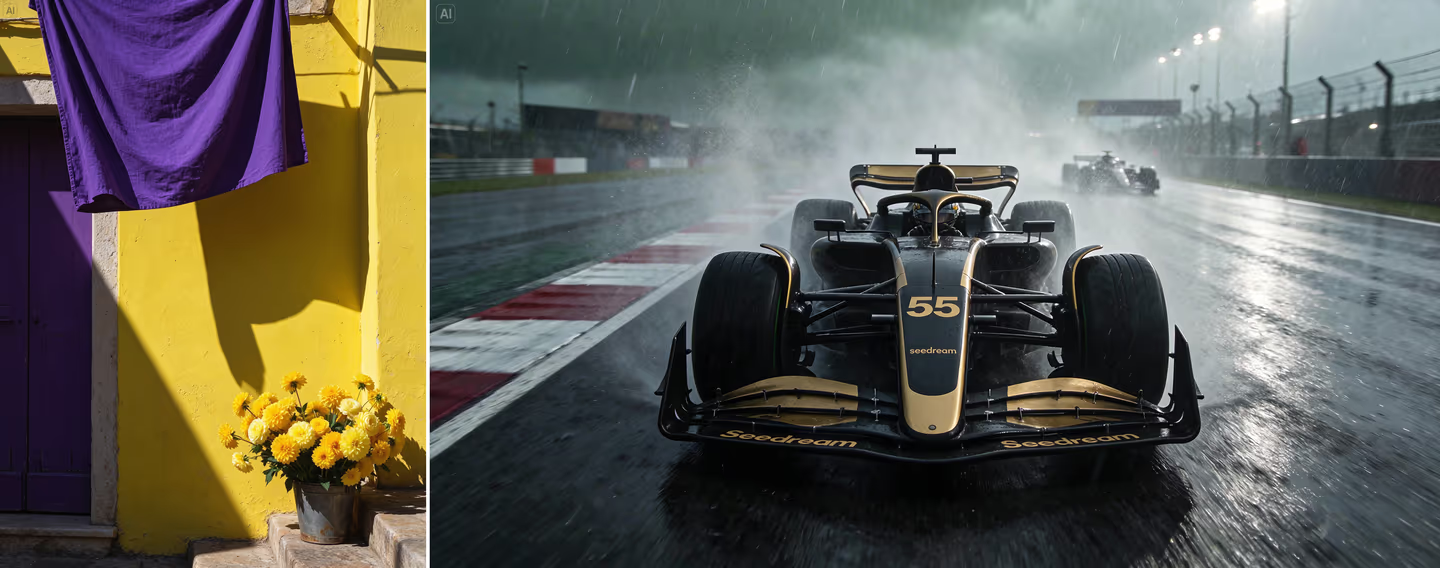
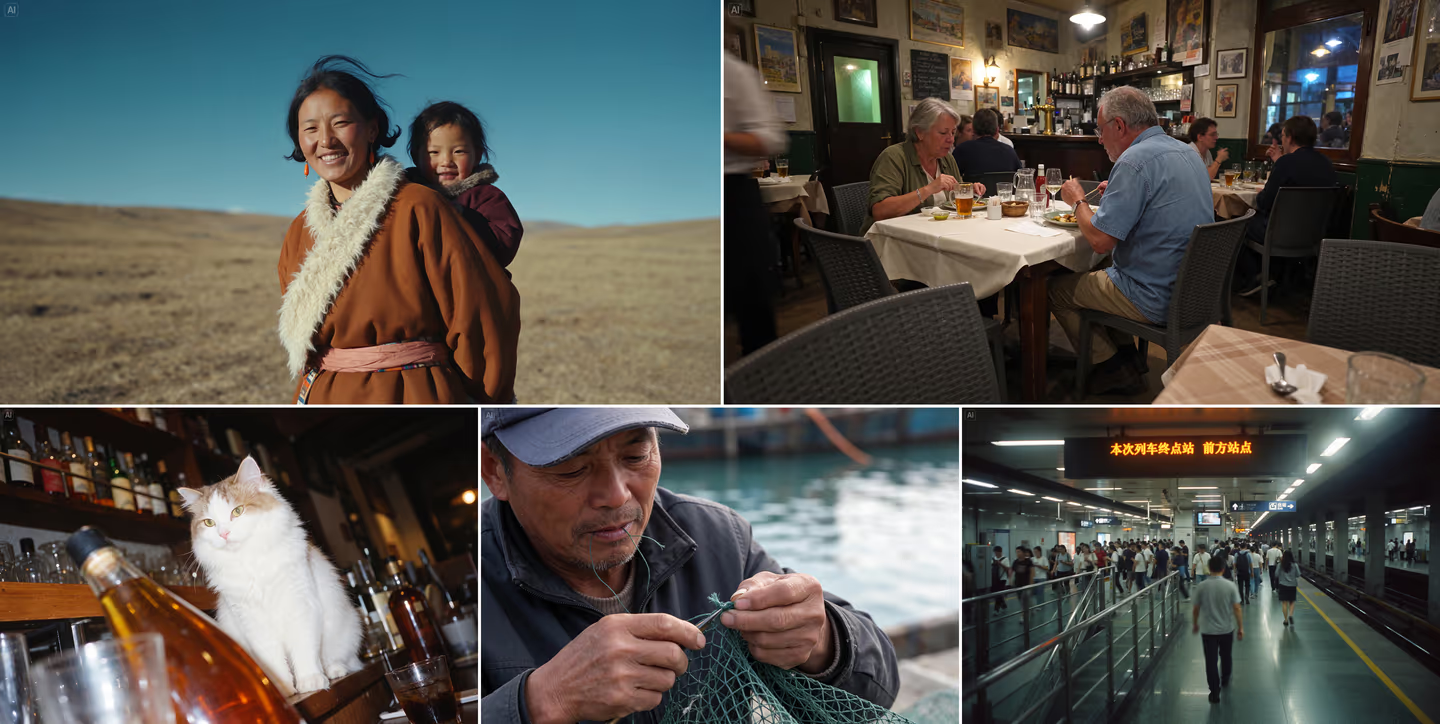
- The realism samples genuinely avoid the over-smoothed, high-gloss look common in earlier models, especially in the street and documentary-style scenes.
- The newspaper and infographic samples show dense, legible text, which is the clearest visible improvement.
- The 100-round editing claim is shown in video form only; we have not been able to reproduce a 100-step chain ourselves yet.
We will update this section with hands-on results once Seedream 5.5 is live on Dreamina in the UK.
Availability and Pricing
| Channel | Market | Status at launch |
|---|---|---|
| Jimeng | China (creative app) | Rolling out |
| Doubao and Doubao Work | China (assistant app) | Rolling out |
| Volcano Engine Ark | China (cloud API) | Rolling out |
| Dreamina | International (creative app) | Coming |
| CapCut | International (video editor) | Coming |
| BytePlus ModelArk | International (cloud API) | Coming |
Pricing: ByteDance's launch materials do not include an official per-image API price. Several third-party sites quote figures, and one report claims API costs falling by 60%, but none of these is backed by a published BytePlus or Volcano Engine rate card. We will not repeat unconfirmed prices; check the BytePlus pricing page once Seedream 5.5 appears there. For UK users, Dreamina and CapCut access will follow those apps' existing credit and subscription plans.
Speed: launch coverage widely reported generation being nearly 40% faster than its predecessor, but this figure does not appear in ByteDance Seed's official blog post, so treat it as unverified.
Copyright, Labelling and Safety
ByteDance's sample images carry a visible "AI" label in the corner, consistent with China's rules requiring AI-generated content to be marked. Whether the international Dreamina and CapCut versions add visible or invisible watermarks by default will matter to brands that need to disclose AI use under the EU AI Act and the UK's advertising codes.
The Next Web noted that Seedream sits alongside Seedance under a copyright arrangement ByteDance agreed with Hollywood studios in August. ByteDance has not published a dedicated safety card for Seedream 5.5 comparable to the system cards that accompany frontier language models, and the blog post does not discuss safeguards against misuse such as non-consensual imagery or impersonation. The improved photorealism and stable editing that make the model useful also make those questions more pressing.
Limitations
- Vendor-run evaluations only. Every number in this article comes from ByteDance's own MagicArena tests.
- Not the strongest everywhere. Nano Banana 2.1 is preferred on image-to-image realism, and the text-structure lead over it is small.
- Possibly outdated comparison. The OpenAI comparison uses GPT Image 2.5 Sunburst, not the newer 2.6 Sunburst.
- Low absolute usability. Professional usability rates in ByteDance's own chart remain well under a third overall.
- Staggered international rollout. UK users depend on Dreamina, CapCut and BytePlus, which were "coming" rather than live at announcement.
- No official price. Without a published rate card, it is impossible to compare cost per image with OpenAI or Google.
- No safety card. There is no published equivalent of a system card for misuse testing.
How It Compares
| Feature | Seedream 5.5 | GPT Image 2.5 Sunburst | Nano Banana 2.1 |
|---|---|---|---|
| Severe text corruption (ByteDance test) | 0.4% | 0.7% | 1.7% |
| Minor text corruption (ByteDance test) | 1.7% | 7.4% | 3.0% |
| Native transparent output | Yes, full and partial (RGBA) | See our ChatGPT Images 2.5 review | Not claimed in ByteDance comparison |
| Long edit chains | 100 rounds claimed | Multi-turn editing supported | Multi-turn editing supported |
| Where UK users get it | Dreamina, CapCut, BytePlus (rolling out) | ChatGPT, OpenAI API | Gemini app, Gemini API |
If you already pay for ChatGPT or Gemini, those image models are the path of least resistance. Seedream 5.5's pitch is for production work: text-heavy layouts, bilingual assets, long iterative edits and transparent cut-outs. For short video work, its natural pairing is Seedance inside CapCut. If you want open weights you can run yourself, look at Qwen-Image 2.1 instead. For broader tool comparisons, see Midjourney, Ideogram and FLUX in our directory.
Practical Workflows
Based on what ByteDance has shown, these are the workflows where Seedream 5.5 should make the biggest difference once it reaches you:
- E-commerce outfit and product swaps. Generate one hero model shot, then swap clothing, accessories or props across many rounds while keeping the face, pose and lighting fixed.
- Transparent product cut-outs. Generate products, glassware or packaging as RGBA assets and drop them straight into templates in Canva or Figma, skipping background removal.
- Bilingual infographics and packaging. Lean on the improved small-text rendering for menus, labels and explainer graphics in English and Chinese, but always proofread.
- Character sets for campaigns or games. Create a set of transparent character assets once, then reuse them across scenes and compositions.
- Interior and room visualisation. Iteratively restyle a room while perspective and shadows stay consistent.
A practical tip for any multi-turn editing model: keep each instruction narrow ("change only the ring to a silver band") and save checkpoints every ten or so rounds, so you can roll back if something drifts.
Who Should Use It
- E-commerce and marketing teams producing high volumes of variants: the multi-turn editing and RGBA output are directly useful.
- Designers working with text-heavy visuals: the 0.4% severe text corruption rate, if it holds, is class-leading.
- CapCut and Dreamina users: you will get it inside tools you already use, with no new subscription.
- Developers on BytePlus: worth testing once pricing is published, especially for transparent asset generation at scale.
- Not yet for: anyone who needs guaranteed UK availability today, published pricing, or a formal safety card for procurement sign-off.
The Bottom Line
Seedream 5.5 is aimed squarely at professional production rather than viral one-off images, and its three upgrades, stable 100-round editing, native RGBA transparency and much cleaner small text, address real pain points. ByteDance's text corruption results are its strongest evidence, and the honest usability chart is a welcome touch.
The benchmarks are ByteDance's own, Google's Nano Banana 2.1 still wins on image-to-image realism, the OpenAI comparison may already be out of date, and UK access and pricing are still to come. If you work in e-commerce, marketing or design, it is worth trying as soon as it lands in Dreamina or CapCut. If you need a settled, priced API today, wait for BytePlus to publish the details, and for the promised Pro version.
Last updated: 15/11/2026. Benchmarks from ByteDance Seed's announcement of 09/11/2026. We will add hands-on test results and official pricing when available.