 AI Tools Review Editorial Team
Quick Answer:
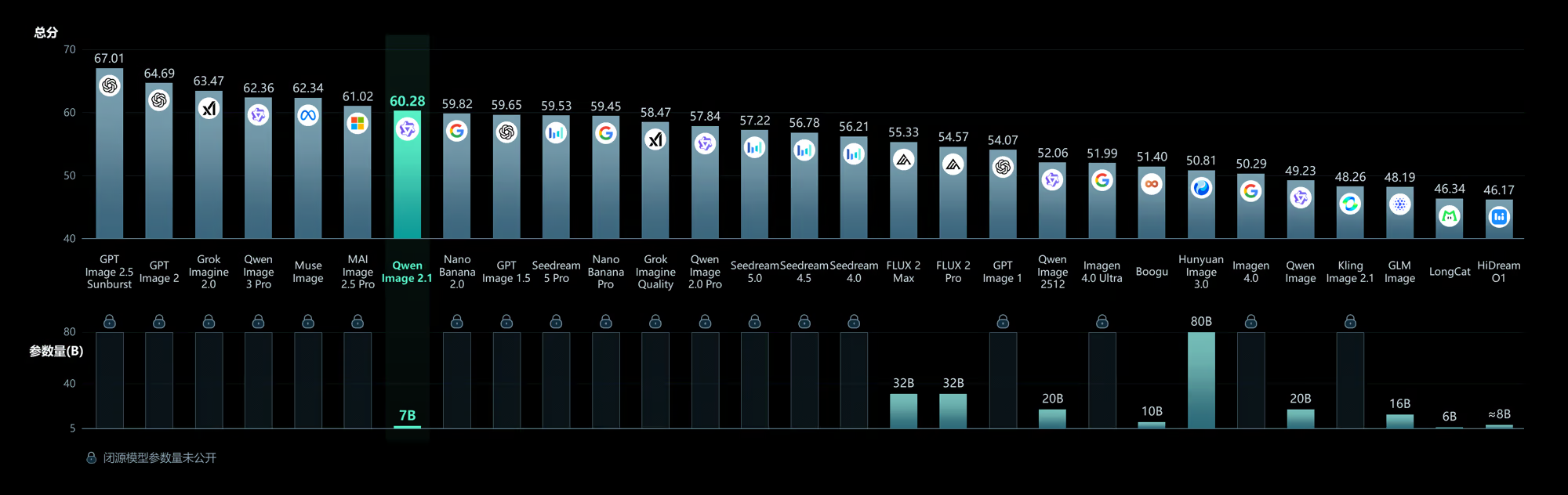
Alibaba’s Qwen team released Qwen-Image-2.1 on 20/09/2026 as open weights: a roughly 7B-parameter visual generator that does text-to-image and editing in one model, with native 2K output, native transparent RGBA images and up to 10 reference images. On Qwen’s own chart it scores 60.28, behind GPT Image 2.5 Sunburst (67.01) and several others but at a fraction of the size. The catch is the licence: it is non-commercial (Qwen Research License), unlike earlier Apache 2.0 Qwen-Image models.
Julian Goldie called Qwen Image 2.1 “absolutely insane”, and the headline features are indeed unusual for a model that small: it edits, it generates transparent PNGs, and it takes up to ten reference images, all from a 7B generator that can run on a mid-range graphics card with offloading.
The reality is more nuanced. The benchmark chart is Qwen’s own, the licence blocks most commercial use, and independent evaluations were still pending in the early coverage. Here is what is verified from the model card and the launch chart, what is vendor claim, and who should care.
Julian Goldie introduces Qwen Image 2.1 and its editing and transparency features.
Executive Summary
- Release: 20/09/2026, as Qwen/Qwen-Image-2.1 on Hugging Face and ModelScope.
- Architecture: a 32-layer single-stream diffusion transformer with about 7B parameters, read through an 8B Qwen3-VL text encoder, down from roughly 20B in the previous Qwen-Image.
- Capabilities: text-to-image and editing in one checkpoint, native 2K output, native RGBA transparency, up to 10 reference images and local edits via circles, painted annotations or masks.
- Quality: 60.28 on Qwen’s own benchmark chart, which ranks it seventh among the 29 models shown, at a fraction of the size of the open models beside it.
- Licence: Qwen Research License, non-commercial only. Earlier models were Apache 2.0.
- Run it: 14.2 GB in BF16, 7.26 GB INT8; one tester reports about 6 GiB of VRAM at 1024 by 1024 with offloading.
Our view: the most interesting small image model of the season for hobbyists, researchers and prototype builders, and a poor fit for any commercial product until you have a licence. For the larger, hosted Qwen options, see our Qwen Image 3 review.
What Qwen-Image-2.1 Is
Qwen-Image-2.1 is a unified model: a single checkpoint that both generates images from text and edits existing ones. Its visual generator has 7B parameters and 32 single-stream diffusion-transformer layers, and prompts are read by a Qwen3-VL 8B text encoder, according to coverage of the release. The previous Qwen-Image used a heavier dual-stream design at roughly 20B parameters, and its image transformer was 40.9 GB in BF16, compared with 14.2 GB for the new generator.
The model card describes two architectural tricks. Mixed-granularity attention applies token-level masking to text tokens and coarser chunk-level masking to image generation, and a prefix KV cache lets input images and edit instructions be computed once and reused across denoising steps, which is what makes multi-reference editing cheaper. Another report mentions two 9B checkpoints for prompt rewriting (PE-T2I and PE-I2I) and a 64-channel VAE that handles RGBA, producing native 2048 by 2048 images in 40 steps. Pair this with a model card that offers a standard Diffusers pipeline and you have a model that is straightforward to run for anyone comfortable with Python.
Capabilities: Transparency, References and Local Edits
| Aspect ratio | Supported size |
|---|---|
| 1:1 | 2048 × 2048 |
| 4:3 | 2400 × 1792 |
| 3:4 | 1792 × 2400 |
| 3:2 | 2528 × 1696 |
| 2:3 | 1696 × 2528 |
| 16:9 | 2752 × 1536 |
| 9:16 | 1536 × 2752 |
Benchmarks: Qwen’s Own Chart
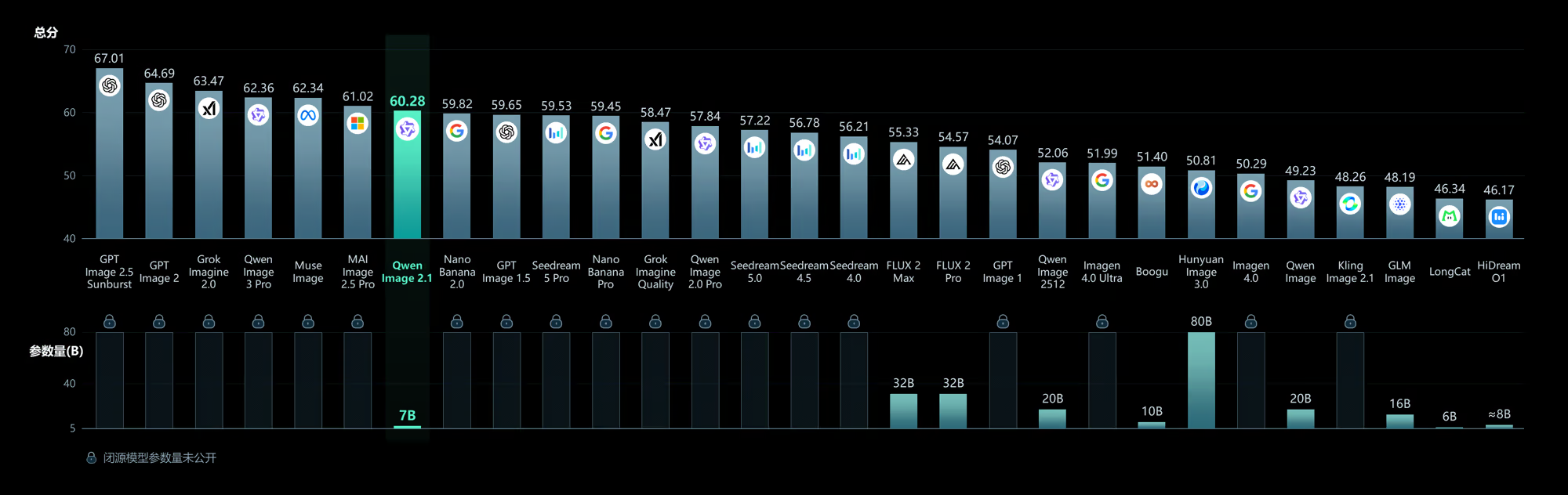
Qwen’s launch chart, shown as the header image above, ranks 29 image models on an overall score, and puts the 7B Qwen Image 2.1 at 60.28. The chart’s axis labels (credit: Qwen / Alibaba, vendor-published and not independently verified) are in Chinese: the upper panel is the overall score and the lower panel the parameter count in billions, with a padlock marking closed models whose size is not disclosed.
Selected rows from the chart:
| Model on Qwen’s chart | Overall score | Parameters |
|---|---|---|
| GPT Image 2.5 Sunburst | 67.01 | Not disclosed |
| GPT Image 2 | 64.69 | Not disclosed |
| Grok Imagine 2.0 | 63.47 | Not disclosed |
| Qwen Image 3 Pro | 62.36 | Not disclosed |
| Muse Image | 62.34 | Not disclosed |
| MAI Image 2.5 Pro | 61.02 | Not disclosed |
| Qwen Image 2.1 | 60.28 | 7B |
| Nano Banana 2.0 | 59.82 | Not disclosed |
| GPT Image 1.5 | 59.65 | Not disclosed |
| FLUX 2 Max | 55.33 | 32B |
| Qwen Image 2512 | 52.06 | 20B |
| Qwen Image | 49.23 | 20B |
Three readings. First, Qwen Image 2.1 sits above Nano Banana 2.0 (59.82) and GPT Image 1.5 (59.65) on this chart but below GPT Image 2.5 Sunburst, GPT Image 2, Grok Imagine 2.0, the larger Qwen Image 3 Pro, and Meta’s Muse Image. Second, among the models that disclose a size, it beats FLUX 2 Max (32B, 55.33) and Qwen’s own 20B models (52.06 and 49.23) while being much smaller. Third, the chart is self-published, the model card carries no benchmark numbers, and reviewers recommend waiting for third-party evaluations. Treat the ranking as encouraging rather than settled.
For comparison with other recent image models we have covered, see ChatGPT Images 2.5, Nano Banana 2 and Qwen Image 3.
Running It Locally
The 7B generator is 14.2 GB in BF16 and 7.26 GB as an INT8 build. One tester ran it at 512 by 512 using about 3.05 GiB of VRAM and roughly 15.2 GiB of system RAM with CPU offload, and at 1024 by 1024 reported 6.14 GiB of VRAM with the text encoder on the CPU. That is a single report, not a benchmark, but it suggests the model fits on consumer cards that struggle with 20B-class generators. Many models at this quality tier want 24 GB or more of VRAM.
The model card’s example uses torch 2.4 or newer, transformers 5.17 or newer, Diffusers installed from GitHub, 40 inference steps and bfloat16 on CUDA, with a QwenImage21Pipeline. It suggests enable_model_cpu_offload() to reduce memory. Editing uses the same pipeline with an input image supplied. There is also an official Hugging Face Space demo and Qwen Chat for free tries, though the Space queue can be long.
The Licence Change
The most important detail for builders is the licence. Earlier Qwen-Image releases were Apache 2.0. Qwen-Image-2.1 ships under the Qwen Research License Agreement, tagged qwen-research on Hugging Face. Its grant is for non-commercial purposes only, and commercial use requires a separate licence, requested from Qwen. Self-hosting, modifying and redistributing are permitted with attribution and the licence included, which makes it open weights rather than open source in the strict sense.
That has practical consequences. Hosting platforms that list only Qwen Image 2.0, such as fal.ai and Replicate, are probably avoiding the new licence. Alibaba Cloud Model Studio serves image generation under 3.0 model IDs, with one report listing qwen-image-3.0 at $0.003 input and $0.03 output per image and qwen-image-3.0-pro at $0.003 input and $0.04 to $0.075 output per image, rather than a paid qwen-image-2.1 API. If you need a commercially safe path, use the hosted 3.0 models or another licensed model, and read the full licence text before you commit. This is a summary of reporting, not legal advice.
Who Should Use It
- Researchers and hobbyists: a small, capable, unified model with transparency and multi-reference editing is a strong base for experiments.
- Designers prototyping: transparent PNG generation and local edits suit mock-ups, stickers and product cut-outs, as long as the work stays non-commercial.
- Product teams: evaluate it, but plan on a licence request or a hosted alternative before shipping.
- Safety-conscious deployers: community reaction reports light content filtering, which may be a feature for researchers and a risk for public-facing apps.
Limitations and Open Questions
We could not verify independent quality tests, and the model card offers no scores. Claims such as strength at panoramas, infographics and try-on come from informal social posts rather than measurements. The announcement does not state a multilingual text-rendering claim. Hardware numbers come from one tester. And the licence blocks the most common reason to adopt an open model, which is to build a product on it. Check the Hugging Face page for updates before you rely on any detail here.
The Bottom Line
Qwen-Image-2.1 shows how far a 7B image generator has come: unified generation and editing, native 2K, transparency and ten-image referencing, running within reach of consumer hardware. Its own chart puts it a few points behind the leading closed models, and its non-commercial licence limits who can benefit. Try it for research and prototyping now, wait for independent tests, and sort out the licence before commercial use. Our Qwen 4 guide covers the language-model side of Alibaba’s family.
Sources
- Hugging Face: Qwen/Qwen-Image-2.1 model card: architecture, capabilities, supported sizes, usage, licence tag.
- Qwen launch benchmark chart (hosted by Qwen on the model card): overall scores. Chart credited to Qwen / Alibaba and downloaded for this article.
- eesel AI: Qwen Image 2.1 review: hardware reports, licence terms, pricing context. eesel sells competing AI products.
- AI Weekly: Alibaba ships Qwen-Image-2.1: text encoder, VAE and prompt-rewriting checkpoints.
- AlternativeTo: Alibaba launches Qwen-Image-2.1: licence change coverage (page not directly readable by our fetcher; cited from search summary).
- Julian Goldie SEO on YouTube: New Qwen Image 2.1 Is Absolutely INSANE! (13/10/2026).
Last updated: 13/10/2026. The benchmark chart is Qwen’s own and unverified; hardware figures come from a single tester. Check the Hugging Face page and licence for updates.
Get the free guide: Claude vs ChatGPT, Gemini & Grok
A 20-page playbook covering everything you need to choose and use the big four AI models in 2026, full cost and feature comparisons, what each is best (and worst) at, and how-tos for images, vectors, building a website, Claude Code and more.