 AI Tools Review Editorial Team
Quick Answer:
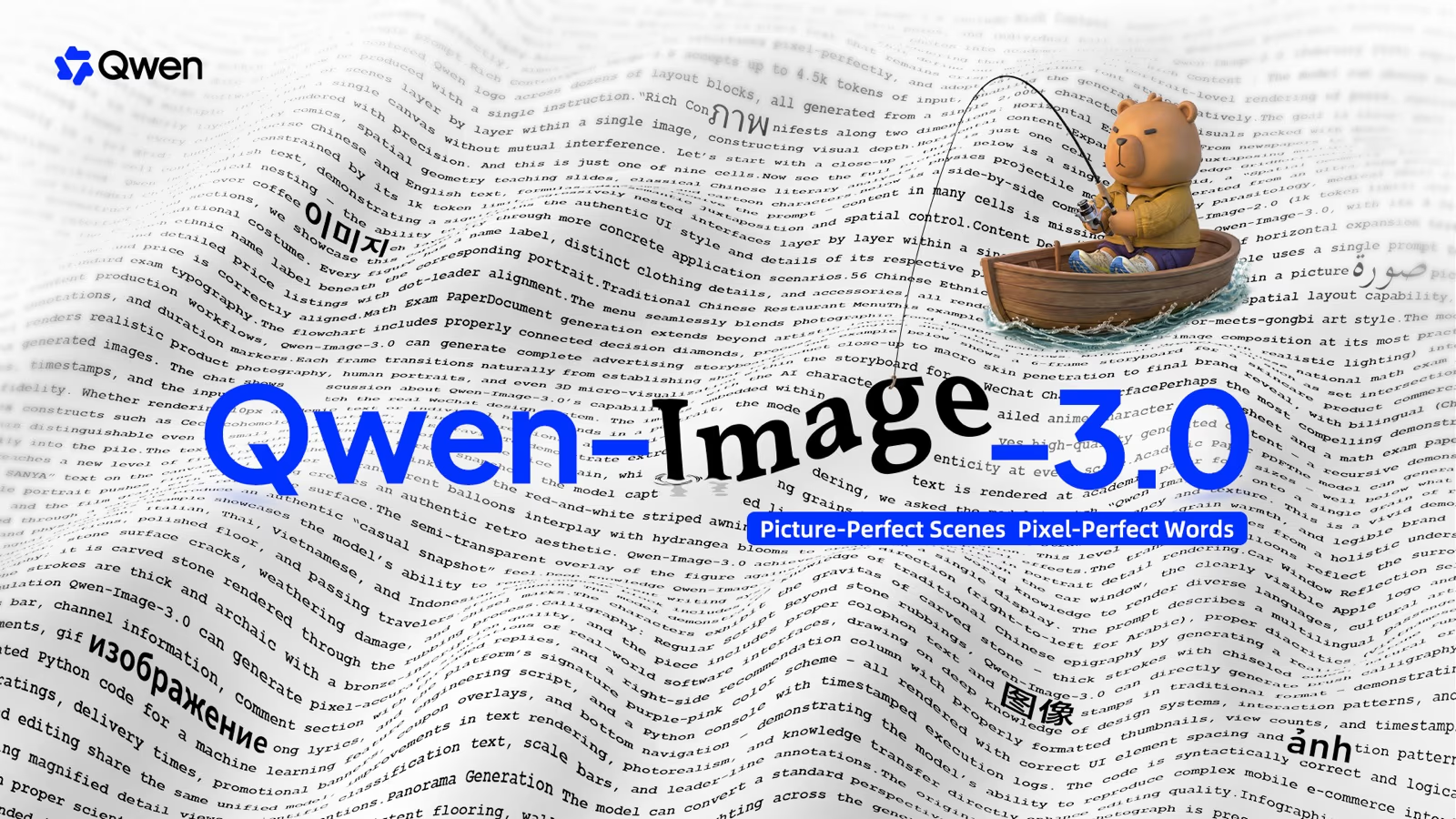
Qwen-Image-3.0, released 21 July 2026 by Alibaba's Qwen team, is a text-to-image model built around ultra-long prompts (up to 4.5k tokens) and dense, information-heavy layouts, newspapers, exam papers, multi-panel infographics, rendered legibly in one pass across 12 languages and 20+ fonts. What makes it notable beyond its example gallery is what it shipped without: no benchmark scores, no model weights, no technical report and no model card, a sharp break from Qwen-Image 1.0 and 2.0, both of which released openly with published evaluations. It is accessible only through the hosted Qwen Chat interface, with no pricing published and no way to self-host at time of writing.
Image generation models are usually judged on how pretty their outputs are. Qwen-Image-3.0's pitch is different: it wants its images to be useful, dense enough with legible text and correct layout to function as a working document rather than a piece of art. That is a genuinely interesting repositioning. It is also a release with an unusually large evidence gap between its claims and what Alibaba has actually published to support them.
Here is what Qwen-Image-3.0 actually does, what is missing from its launch, and how much weight to put on the example gallery in the absence of any measured scores.
Summary
Qwen-Image-3.0 is the third generation of Alibaba's dedicated image-generation foundation model, announced by the official Qwen account on 21 July 2026. Where Qwen-Image 1.0 was framed around "precision" and 2.0 added "variety, completeness, beauty and authenticity," Alibaba frames 3.0 around a single idea it calls "Real" (实): images dense and accurate enough in their text and layout to be used as an actual document, not just admired as an illustration.
The headline capability is prompt length: Qwen-Image-3.0 accepts inputs up to 4,500 tokens, roughly 4.5 times the prior generation's limit, and uses that budget to construct complex single-image layouts, dense newspaper pages, academic exam papers with mathematical notation, multi-panel comics, and infographic grids, in one generation pass rather than stitched together from multiple calls. It renders legible text down to 10 pixels and supports 12 languages natively.
- Best for: exploring what long-prompt, layout-dense image generation looks like via the hosted Qwen Chat demo; not yet suitable for production workflows that need reproducible, benchmarked, or self-hostable output.
- Headline numbers: 4.5k-token prompt input, 12 languages, 20+ fonts, text legible to 10px, none independently verified against a published benchmark.
- Defining trait: a public capability demo with an unusually large gap between its claimed abilities and its published supporting evidence.
- Main caveat: no weights, no technical report, no benchmark scores and no model card, meaning every claim in this article beyond the example gallery rests on Alibaba's own marketing description rather than a reproducible evaluation.
From Qwen-Image 1.0 to 3.0
Qwen-Image is Alibaba's dedicated image-generation and editing line, distinct from the general-purpose Qwen 3.8 Max language model this site has covered separately. The original Qwen-Image, a 20-billion-parameter MMDiT (multimodal diffusion transformer) model, shipped as a fully open release: weights on Hugging Face and ModelScope, a public GitHub repository, day-zero support in the Diffusers library, and documented strong performance on Chinese text rendering specifically. Qwen-Image 2.0 followed with Alibaba's own internal Qwen-Image-Bench evaluation, on which, by outside reporting, it placed only fifth among the models it was tested against, a genuinely public, checkable result.
Qwen-Image-3.0 breaks that pattern. Both of its predecessors released openly with technical reports and benchmark participation; 3.0 released with a polished marketing gallery and an official announcement thread on X, but no weights, no GitHub update, no technical report and no benchmark scores of any kind. Coverage from outlets including Unite.AI explicitly flagged this as the story: not what the model can do, but what Alibaba chose not to show.
Capabilities Deep Dive
Ultra-long prompts and dense layouts
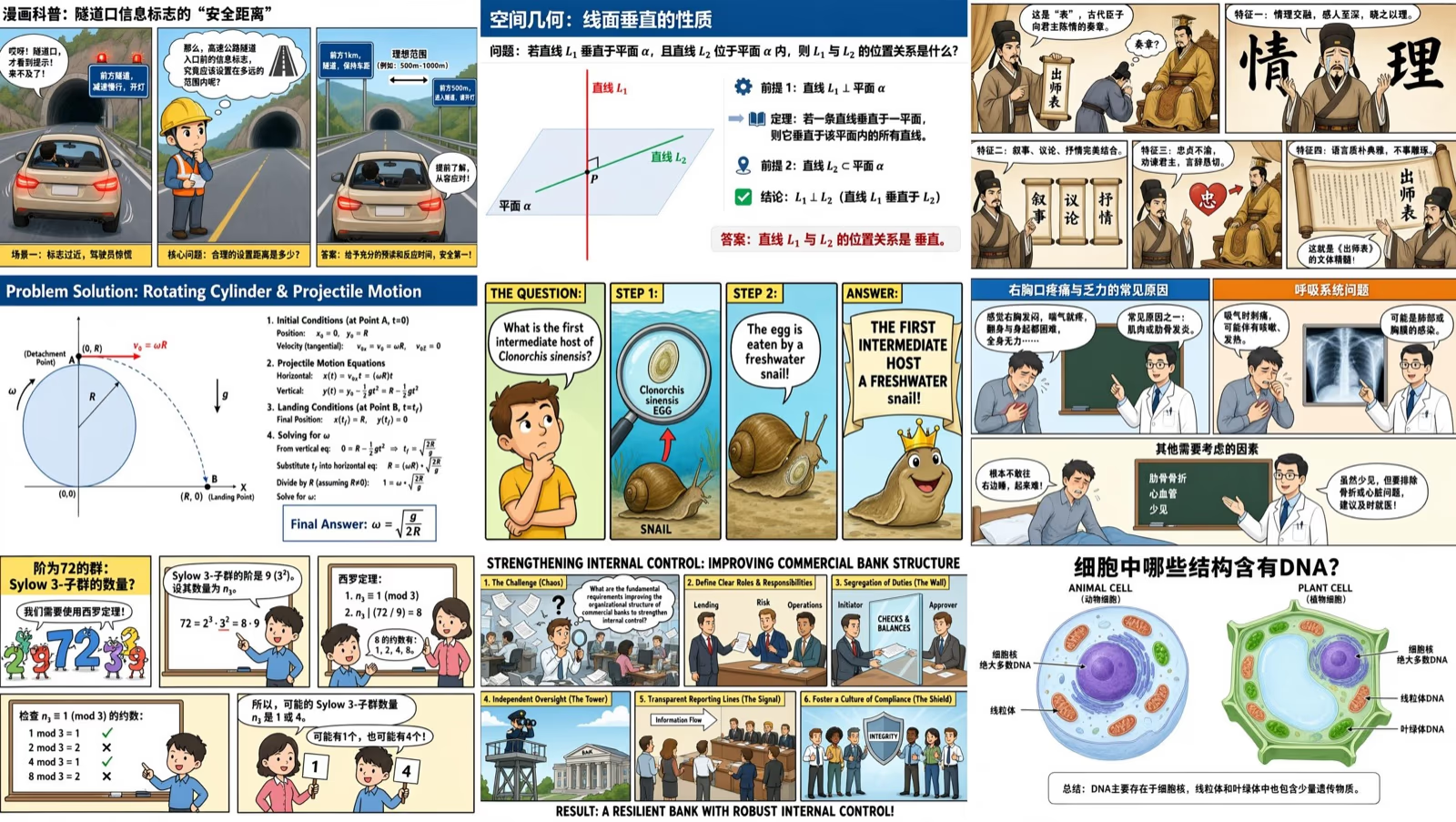
The core new capability is accepting prompts up to 4,500 tokens, letting a single instruction describe an entire complex layout, a 3x3 infographic grid, a full newspaper front page, a nested UI with picture-in-picture panels, rather than a caption for one simple scene. Alibaba's own examples include a full academic exam paper with correctly rendered mathematical derivations, a dense Chinese-language newspaper page with legible body text throughout, and multi-panel comic storyboards where each frame maintains consistent character design and transitions logically from the last.
Text rendering and multilingual support
Alibaba says Qwen-Image-3.0 renders legible text down to 10 pixels, small enough for dense body copy rather than only large headline text, and natively supports 12 languages with more than 20 fonts, aimed at commercial-grade text-and-image content rather than illustrative art alone. The example gallery includes captions and labels correctly rendered in Korean, Russian, Vietnamese, Thai, Arabic and Chinese scripts alongside English, and stylistic variety spanning classical stone-rubbing calligraphy, retro black-and-white photography with authentic surface damage, and clean modern UI mockups.
Stylistic range
Beyond dense informational layouts, Alibaba's gallery also shows a wide stylistic range within the same model: a semi-transparent, hydrangea-patterned overlay on a "casual snapshot" portrait, an authentic-looking retro black-and-white photograph complete with period-correct film grain and surface damage, traditional Chinese stone-rubbing calligraphy with visibly weathered stone texture, and a clean, modern e-commerce UI mockup with correctly aligned product cards and pricing labels. The claim being made across these examples is that the same underlying model handles both photographic realism and flat graphic-design layout equally well, rather than being specialised for one or the other, though again, this is demonstrated only through curated examples rather than a scored evaluation across style categories.
World knowledge and structured content
Beyond raw text rendering, several examples in Alibaba's gallery demonstrate a degree of world knowledge embedded in the layout itself: a bank internal-control flowchart with logically sequenced steps (define roles, segregate duties, independent oversight, transparent reporting), a biology exam comic that correctly identifies a parasite's intermediate host, and a worked physics problem with dimensionally consistent equations for projectile motion off a rotating cylinder. If genuine, this suggests the model is drawing on more than pattern-matched visual templates when constructing these dense layouts, though without a technical report describing training data or methodology, it is not possible to say how much of this reflects generalisable reasoning versus memorised worked-example patterns from training data.
The Missing Benchmarks, Weights and Report
This is the part of the story that most of the outside coverage of Qwen-Image-3.0 has focused on, and it is worth stating plainly: at time of writing, Alibaba has published no benchmark scores for Qwen-Image-3.0 against any standard image-generation evaluation, no downloadable model weights, no technical report describing architecture or training methodology, no model card, no licence, and no disclosed parameter count. For a lab whose prior two releases in this same product line were both open and benchmarked, that is a deliberate and notable departure, not an oversight.
Alibaba has not publicly explained the omission. Plausible reasons discussed in outside coverage range from competitive pressure to ship a capability demo quickly ahead of a fuller release, to the model still being in a pre-release evaluation phase internally, to a decision that the qualitative gallery makes the case Alibaba wants to make (creative and commercial usefulness) better than a benchmark score would. All of that is speculation; none of it is confirmed.
The architectural continuity question is a good illustration of how much is unknown. Qwen-Image 1.0 was documented as a 20-billion-parameter MMDiT (multimodal diffusion transformer) model, a specific, checkable architectural claim backed by a public technical report. Alibaba has not stated whether Qwen-Image-3.0 uses the same MMDiT approach at a larger scale, a substantially different architecture, or some hybrid pipeline combining a diffusion backbone with a separate layout-planning stage to handle the long-prompt structured outputs. Without that disclosure, even basic questions, is this the same model family scaled up, or a new approach entirely, cannot be answered from the outside.
What this means practically: every specific claim in this article about what Qwen-Image-3.0 can do, the 4.5k-token limit, the 10px text legibility, the 12-language support, comes from Alibaba's own launch materials and announcement thread, not from an independently reproducible test. That is a materially weaker evidentiary basis than, say, this week's Laguna S 2.1 release, which shipped a full technical report and published evaluation trajectories alongside its benchmark scores. Readers should weight the two releases' claims accordingly.
Real-World Use vs the Demo Gallery
A curated launch gallery, however impressive, is not the same thing as a representative sample of typical output quality. Model makers naturally select their best generations to showcase, and without independent benchmark testing or a broad set of third-party trials, there is no way to know what proportion of Qwen-Image-3.0's attempts at a given dense-layout prompt actually succeed cleanly versus need retries, or how consistently the model avoids subtle text errors at the smaller end of its claimed 10-pixel legibility range.
Early community reaction on X, per outside coverage, was split along predictable lines: supportive posts treated the gallery examples as a genuine advance in text rendering and layout control, while more sceptical commentary questioned whether success on long, structured prompts reflects deeper compositional reasoning or simply better pattern-matching against layout types the model saw frequently in training. Without a technical report to check either interpretation against, both remain reasonable readings of the same evidence.
There is also a practical usability question separate from raw capability: a 4,500-token prompt is a substantial piece of writing in its own right, closer to drafting a detailed brief than typing a one-line image caption. For the dense-layout use cases Qwen-Image-3.0 is aimed at, exam papers, infographics, newspaper mockups, that upfront effort may be worthwhile, but it is a meaningfully different interaction model from the quick, iterative prompting most image generators are built around, and Alibaba's materials do not say how the model behaves with shorter, simpler prompts by comparison.
Access and Pricing
Qwen-Image-3.0 is accessible only through the hosted Qwen Chat interface at chat.qwen.ai at time of writing. There is no API pricing page specific to Qwen-Image-3.0 published by Alibaba, no standalone downloadable weights, and no self-hosting option, a contrast with Qwen-Image 1.0 and 2.0, both of which are freely downloadable from Hugging Face and ModelScope under open licences and remain usable today for anyone wanting a self-hostable, if less capable, alternative.
Limitations
- No independent verification of any capability claim: every figure in this article (4.5k tokens, 10px legibility, 12 languages) is Alibaba's own stated figure, not a measured or reproduced result.
- No weights, no self-hosting, no licence: access is limited to the hosted Qwen Chat interface, with no way to run the model independently or audit its behaviour offline.
- No benchmark scores against any standard evaluation, including Alibaba's own Qwen-Image-Bench used for the prior generation, making direct comparison to rivals impossible on measured terms.
- Curated gallery, unknown failure rate: launch examples are necessarily best-case; typical output quality and consistency across many attempts at similarly complex prompts is unknown.
- No disclosed pricing, parameter count or architecture details, making it difficult to assess likely inference cost or compare compute efficiency against other image models.
How It Compares
Qwen-Image-3.0 is difficult to compare directly to other image generators precisely because of what it is missing: without published benchmark scores, any comparison to models like Midjourney, Google's image models or the open-weight Qwen-Image 2.0 rests on example outputs rather than measured performance. What can be said is that Qwen-Image-3.0's stated focus, dense, information-heavy layouts with small, legible text across many languages, targets a different axis than most consumer image generators, which typically optimise for photorealism or aesthetic composition of a single simple scene rather than newspaper-density text layout.
Within Alibaba's own Qwen line, the more useful comparison is to Qwen 3.8 Max, a general-purpose language model this site has separately reviewed with full published benchmarks. The contrast between that release's transparency and Qwen-Image-3.0's opacity is itself informative about how selectively even a single lab applies its own usual openness standards, depending on the product line and, plausibly, competitive pressure.
It is also worth setting Qwen-Image-3.0 against the same week's other major Chinese-lab-adjacent release, Poolside's Laguna S 2.1, even though the two models serve entirely different purposes (image generation versus agentic coding). The contrast in disclosure practice between the two, one publishing a full technical report and public evaluation trajectories, the other publishing neither, is a useful case study for anyone trying to build a general heuristic for how much to trust a given lab's launch claims: track record on disclosure, not just track record on capability, is itself a signal worth weighing.
Who Should Use It
Try Qwen-Image-3.0 if you want to experiment with long-prompt, layout-dense image generation via the free hosted Qwen Chat interface, and you are generating one-off creative or exploratory content where inconsistent results across attempts are an acceptable cost.
Look elsewhere if you need a self-hostable or licensable model for production use, want measured benchmark performance to justify a workflow decision, or need Alibaba to publish a technical report before you can assess data provenance or safety considerations for your use case. Qwen-Image 2.0 remains a reasonable, fully open fallback for those needs today.
The Bottom Line
Qwen-Image-3.0's example gallery is genuinely impressive on its own terms: dense, legible, multilingual layouts that would have looked implausible from a text-to-image model even a year earlier. But the release is also a useful reminder to separate a polished demo from a verified capability. Alibaba shipped a marketing gallery and an ultra-long prompt limit; it did not ship the benchmark scores, weights, technical report or model card that would let anyone outside the company check those claims independently.
That gap does not mean the model is not capable, Alibaba's track record with Qwen-Image 1.0 and 2.0 suggests real underlying engineering, but it does mean treating Qwen-Image-3.0's launch claims with the same caution you would apply to any un-benchmarked release, however good the highlight reel looks. Until Alibaba publishes more, the honest summary is: promising demo, unverified claims.
Last updated: 25 July 2026. Sourced from Qwen's official announcement thread on X, Alibaba's Qwen-Image-3.0 launch gallery, and independent coverage from Unite.AI, Decrypt and AIbase, which first flagged the absence of benchmarks, weights and a technical report.
Update 13/10/2026: Alibaba has since released an open-weights 7B model with native transparency; see our Qwen-Image-2.1 guide.
Get the free guide: Claude vs ChatGPT, Gemini & Grok
A 20-page playbook covering everything you need to choose and use the big four AI models in 2026, full cost and feature comparisons, what each is best (and worst) at, and how-tos for images, vectors, building a website, Claude Code and more.