 AI Tools Review Editorial Team
Quick Answer:
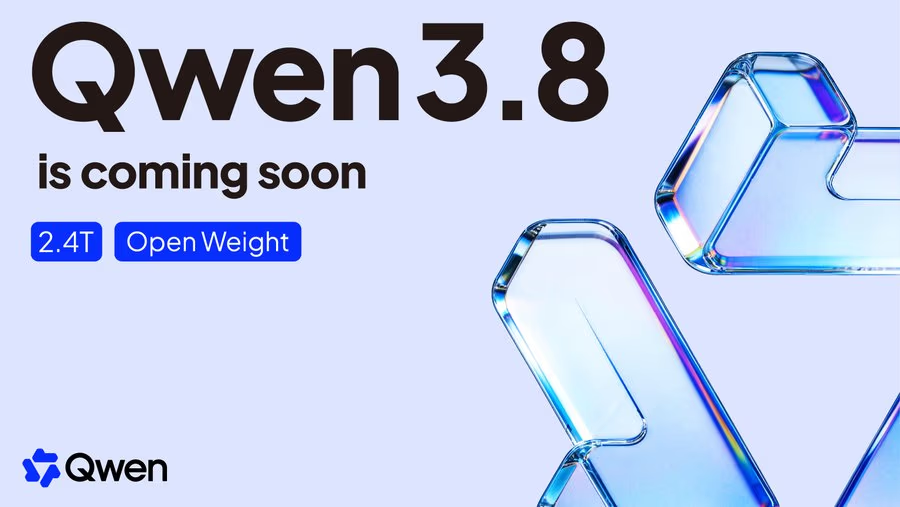
QwenWork is Alibaba's all-in-one workplace AI agent. Its international edition entered public beta on 1 September 2026 on web and desktop, with English and Simplified Chinese at launch. It offers a Standard tier built on Qwen3.8 Flash (Alibaba claims a 75% cut in tokens per task and roughly double the generation speed) and an Advanced tier for harder work, sold as subscriptions with credits for individuals and enterprises.
Alibaba's Qwen team has spent 2026 shifting from chatbot to agent, and QwenWork is the clearest product of that shift. Julian Goldie SEO's latest video, "New Qwen Work Update Is ABSURD!", covers the newest changes, but the story is bigger than one update.
This guide pulls together what Alibaba has said publicly: what the international launch includes, how the Standard and Advanced tiers differ, what the Awareness feature does, where the personal-agent strategy announced at Yunqi on 22 September fits and what you should check before putting an agent with browser and file access on a work machine.
Julian Goldie SEO demonstrates the latest QwenWork update and how it can be used for everyday work tasks.
Executive Summary
What it is: QwenWork is a workplace agent that can navigate websites and a local computer from natural-language instructions, generate office documents, run research, build websites and produce images, video and audio. The international edition was announced on 1 September 2026 (Dot Daily Dose).
- Status: public beta on web and desktop client, via the QwenWork international site.
- Languages: English and Simplified Chinese now; Traditional Chinese, Spanish, Portuguese, Japanese, Korean and more planned.
- Target markets: fast-growing regions across Asia, the Middle East and Latin America.
- Tiers: Standard, powered by Qwen3.8 Flash, and Advanced, using what Alibaba calls industry-leading models for complex tasks.
- Business model: subscriptions with a credit system, with separate individual and enterprise plans. Specific prices were not stated in the coverage we reviewed.
- Recognition: the launch coverage says Jefferies ranked it the top workplace AI agent on 17 August 2026. We have not seen the underlying report, so treat that as a vendor-cited claim.
Our view: QwenWork is a credible entrant in the crowded workplace-agent market, and the Standard tier's efficiency claims are the most interesting part. But the figures come from Alibaba, the product is a beta, and the sensible approach is a time-boxed trial on non-sensitive work.
The International Launch in Detail
According to the launch coverage, QwenWork International extends the product Alibaba built for China to global users, with a focus on markets where adoption of AI work tools is growing fast (Dot Daily Dose). It is available as a web app and as a desktop client, and the desktop client matters because it is what lets the agent act on local files and applications.
Core capabilities listed by Alibaba
- Natural-language navigation of websites and local computers.
- Office document generation, research and file comprehension.
- Reusable workflow skills, so that a process you have taught the agent can be repeated.
- Voice input.
- Browser automation.
- Web development with hosting, database services and custom domains.
- Multimodal generation of images, video and audio.
Taken at face value, that is a broad scope: a single agent that can research a topic, draft a report, build and host a small website and generate supporting images. The usual caveat applies, which is that breadth in a feature list does not tell you how reliably each task completes. Only testing on your own work will tell you that.
Standard and Advanced Tiers
QwenWork offers two model tiers. The Standard tier runs on Qwen3.8 Flash. Alibaba says it reduces token consumption per task by 75% and roughly doubles generation speed compared with the current mode, bringing "flagship-level capability within reach of everyday workloads" (Dot Daily Dose). The Advanced tier uses higher-end models for complex tasks.
Those numbers are claims from the vendor about its own system, and they are relative to QwenWork's current mode rather than to a competitor. They are plausible directionally, because agents burn through tokens on long tasks and a cheaper, faster model makes everyday use affordable under a credit system. But we have not seen an independent measurement, so do not budget on the 75% figure until you have run your own tasks and looked at the credit usage.
For background on the model family behind these tiers, see our reviews of Qwen 3.8 Max and Qwen3.8-27B, and our guide to what is known about Qwen 4.
Why credits matter
A credit system means the cost of a task depends on how much work the agent does. A simple summary may cost little, while a long research-and-build job could consume much more. Before adopting QwenWork for a team, run three representative tasks and note the credit cost of each. That gives you a realistic cost per task rather than relying on a subscription headline.
Awareness: Persistent Context and Preferences
One feature stands out in the launch material: Awareness. It is described as providing session continuity, so the agent remembers your collaboration preferences between sessions, and it is opt-in and under the user's control (Dot Daily Dose). This is the same direction the whole industry is moving, where an agent knows how you like documents formatted, who your colleagues are and what you were doing yesterday.
Persistent memory makes an agent more useful and also raises the stakes on privacy. Before enabling it, check what is stored, where, for how long and whether you can inspect and delete it. The fact that it is opt-in is the right default, and for a work account you should confirm that your organisation's policy permits it.
The Bigger Picture: Qwen as a Personal Agent
QwenWork sits inside a wider strategy. At the Yunqi Conference on 22 September 2026, Alibaba announced that it is accelerating Qwen's evolution into a Personal Agent, an assistant it describes as a kind of chief operating officer for the user, so that people think of "my Qwen" rather than "using Qwen" (36Kr). Alibaba gave several figures to support the shift:
- Average conversation rounds per user have risen to between five and eight.
- More than 60% of questions get better answers when medium and long-term context is used.
- Demand for complex personal tasks has risen fivefold in ten months.
- Service coverage has widened from a few core areas, such as college entrance exams, healthcare and work, to more than 20 scenarios including finance, shopping, transport, reservations and learning.
- More than 400 scenario functions are accessed after the app launch.
Alibaba describes three layers of context: general context about who the user is, domain context that spans areas such as health, finance and education, and a harness layer for planning, tool use and task completion. Qwen's product lead, Zheng Sishou, is quoted as saying personal needs are not the same as simple needs, because behind seemingly simple questions intentions vary widely. The company also announced AI glasses and AI earphones.
The same coverage notes the competitive backdrop: Meta's Muse Personal Agent reached number one on the US App Store and Google Play on 21 September 2026. In other words, the race to be the default personal agent is now explicit, and QwenWork is Alibaba's work-focused front in that race. For the equivalent move at Google, see our guide to Gemini in Workspace.
Practical Use Cases
The best way to judge any agent is to give it a job with a clear finish line. These are sensible first tests for QwenWork, based on its stated capabilities.
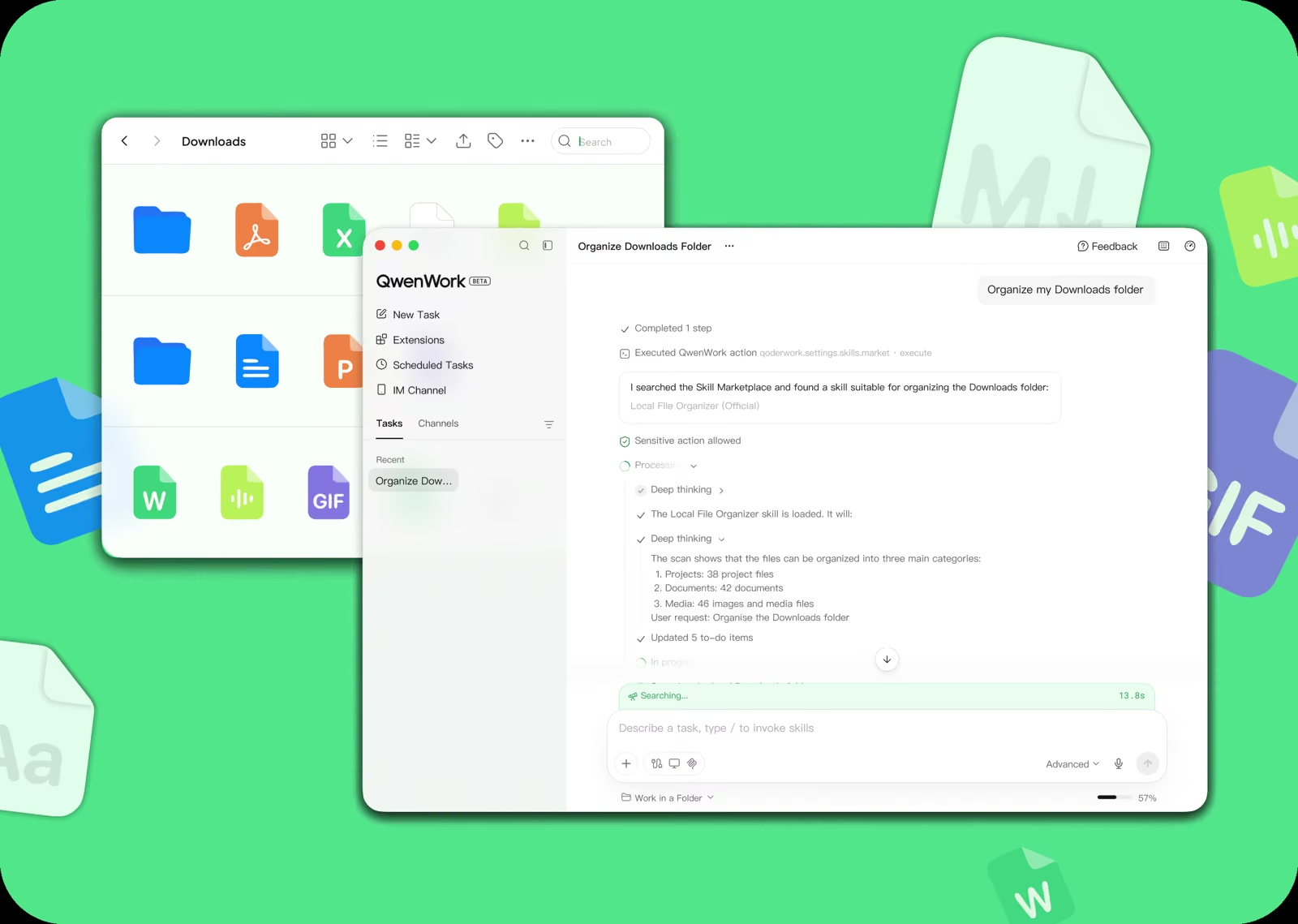
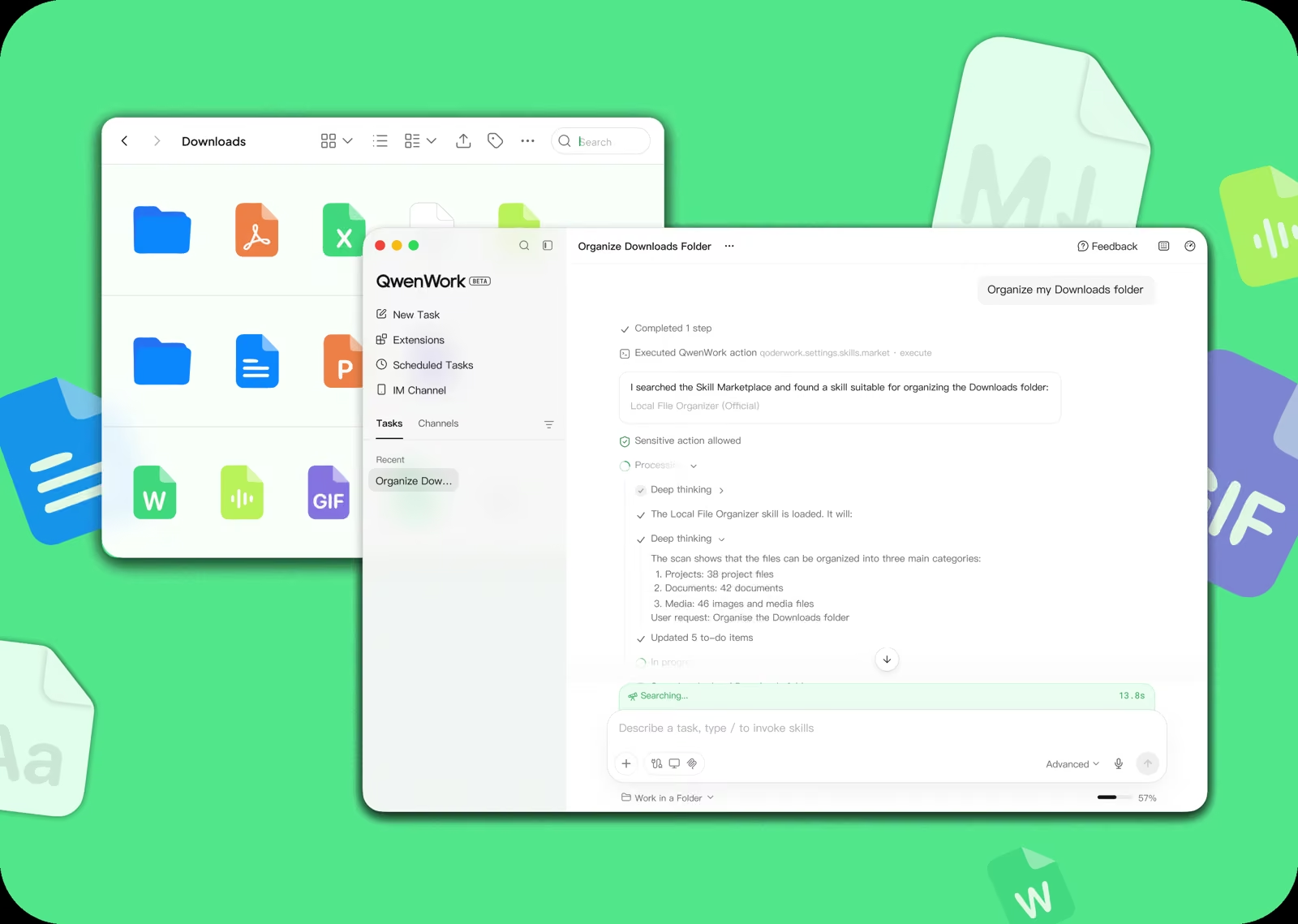
- File organisation: point the desktop client at a messy folder and ask it to sort and rename files. Alibaba's own hero image shows this scenario.
- Research and report: ask for a sourced briefing on a market, then check every citation.
- Document drafting: generate a first draft of a proposal, a policy or a report in your house style.
- Small websites: use the web development and hosting features for a landing page or prototype, remembering that hosting your own domain involves its own checks.
- Repeatable workflows: teach it a reusable skill, such as a weekly report, and measure whether it repeats the task reliably.
For content and SEO teams, the interesting angle is the combination of research, document creation and web publishing in one agent. Pair that with a model comparison from our best AI models guide when you decide which tier to use for which job.
A Seven-Day Trial Plan
Because QwenWork is a beta with credit-based pricing, a structured trial protects both your data and your budget. This plan assumes an individual or small team using the Standard tier first.
- Day 1: create an account on the international site, read the privacy settings and leave Awareness switched off. Install the desktop client on a test profile rather than your main work machine.
- Day 2: run a file organisation task on a copy of a messy folder. Check that nothing was deleted and that names make sense.
- Day 3: run a research task on a topic you know well, so you can spot errors. Verify every source it cites.
- Day 4: generate a report or proposal draft and edit it. Note how much of the draft survived your edit.
- Day 5: repeat one of the earlier tasks on the Advanced tier and compare quality and credit cost with Standard.
- Day 6: teach it one reusable workflow and run it twice. Measure consistency.
- Day 7: review credit usage, accuracy and time saved. Decide whether to continue, and if so whether to enable Awareness.
Record three numbers for every task: how many credits it used, how long it took and how much you had to correct. Those three figures tell you more than any launch claim, and they let you test Alibaba's efficiency promise on your own workload. If the Standard tier handles most of your tasks at a low credit cost, the economics may well suit you. If you find yourself constantly switching to Advanced, the headline saving will not apply to your work.
What to watch next
- Additional languages, which Alibaba says are planned.
- Published pricing and credit allowances for individuals and enterprises.
- Independent benchmarks of Qwen3.8 Flash in agent tasks.
- Enterprise controls and certifications.
- How the personal-agent strategy announced at Yunqi shows up in the product, including the AI glasses and earphones.
Security, Privacy and Data Residency
Any agent that can act on a local computer and browse the web deserves a security review before it touches work data. QwenWork is run by Alibaba, and for many organisations that raises procurement and data-governance questions that have nothing to do with product quality. We have not found public detail in the launch coverage on data residency, retention or certifications, so ask Alibaba directly.
- Scope of access: what folders, accounts and sessions can the desktop client see?
- Data retention: are prompts, files and Awareness memories stored, and for how long?
- Training use: is your content used to improve models?
- Hosted sites: where are web projects and databases hosted?
- Admin controls: can an enterprise restrict features, audit actions and manage users?
- Prompt injection: a browser agent that reads untrusted pages can be tricked by hidden instructions. Keep it away from sensitive accounts.
Our piece on Manus 2.0 and Cue covers the same class of risks for agents with wallets and their own identities, and applies to any agent you give real permissions.
How It Compares
| Agent | Strength | Question to ask |
|---|---|---|
| QwenWork | Broad scope, low-cost Standard tier, desktop and web | Independent accuracy, data handling, pricing |
| Gemini in Workspace | Native to Google apps and permissions | Locked to the Google suite |
| Manus 2.0 and Cue | Agents with their own computer, email and wallet | Security and cost control |
| Hermes Agent | Self-hosted agent you control | Setup and maintenance effort |
For the open-source side of this market, our explainer on Hermes Agent shows how a self-hosted agent differs from a hosted workplace product like QwenWork.
Limitations and Caveats
- Beta status. Expect rough edges, changing features and changing limits.
- Vendor figures. The 75% token reduction and the double speed are Alibaba's claims relative to its own current mode.
- Ranking claim unverified. The Jefferies ranking is cited in launch coverage; we have not seen the report.
- Limited languages. Only English and Simplified Chinese at launch.
- No stated prices. The coverage mentions subscriptions and credits but not specific prices.
- Governance unknowns. Residency and retention details were not in the sources we reviewed.
Who Should Try It
- Individual professionals and freelancers: try the Standard tier on low-risk tasks and measure credit use.
- Small teams in Asia, the Middle East and Latin America: these are Alibaba's target markets, so support and roadmap are likely to favour you.
- Enterprises: run a security review first and pilot with non-sensitive data.
- Developers and agencies: test the website building and hosting features for prototypes.
- Anyone locked into another suite: compare against the agent built into your existing tools before adding a new one.
The Bottom Line
QwenWork is the product behind Alibaba's argument that the next phase of AI is agents that do things rather than chatbots that answer. The international beta puts it within reach of far more users, and the Standard tier's efficiency claims, if they hold, make everyday agent use cheaper.
Until independent testing confirms the numbers, treat it as a promising beta. Try it on a handful of real but non-sensitive tasks, track credit usage per task, ask hard questions about data handling and decide on the evidence. We will update this article as more verified detail emerges, and you can follow related developments across our Insights section.
Last updated: 01/10/2026. Sourced from Dot Daily Dose coverage of the QwenWork international launch (1 September 2026) and 36Kr's report on the Yunqi Conference (22 September 2026). Vendor claims are labelled as such.
Get the free guide: Claude vs ChatGPT, Gemini & Grok
A 20-page playbook covering everything you need to choose and use the big four AI models in 2026, full cost and feature comparisons, what each is best (and worst) at, and how-tos for images, vectors, building a website, Claude Code and more.