 AI Tools Review Editorial Team
Quick Answer:
Hy4 preview is Tencent's new open-weight flagship, released 28/08/2026 by the Tencent Hy Team (the Hunyuan lineage). It is a 770-billion-parameter Mixture-of-Experts model with 49 billion parameters activated per token, a 1-million-token context window, and open weights under a genuine, unrestricted Apache License 2.0 - no monthly-active-user thresholds or custom Tencent community-licence clauses. On Tencent's own published benchmark appendix it posts large generation-over-generation gains versus its Hy3 predecessor and is competitive with Qwen 3.8 Max, DeepSeek V4 Pro 0813, GLM 5.3 and Kimi K3 on agentic coding and search benchmarks, while still trailing GPT-5.6 Sol and Claude Opus 5 on the hardest reasoning evaluations. Hosted access via Tencent Cloud TokenHub and OpenRouter is priced at $0.834 per million input tokens and $2.501 per million output tokens; self-hosting the weights is free but demands serious GPU capacity.
Three different tracked AI YouTube channels covered the same open-weight release within days of each other in late August 2026 - one calling it “Best Open Model?!”, another folding it into a rapid-fire news roundup, and a third building a hands-on demo around it. The model behind all three: Tencent's Hy4 preview, a 770-billion-parameter open-weight MoE that the company itself says delivers “the largest generation-over-generation gain we've measured” across its Hunyuan/Hy lineage.
This is the full picture, built entirely from Tencent's own GitHub repository, Hugging Face model card, official benchmark appendix and press release - the real architecture, the real numbers (including the ones that don't favour Hy4), the real licence terms, and an honest look at what Tencent has and has not published on safety.
WorldofAI's coverage naming Hy4 preview as a contender for best open model, alongside the same week's GPT-6 Astra and Opus 5.1 rumours.
Executive Summary
Hy4 preview is Tencent's latest open-weight flagship, positioned by the company as a “new-generation Mixture-of-Experts flagship model” built specifically around real-world productivity work: software engineering, office and analysis tasks, game development, and scientific research. It follows Hy3 preview in an unusually candid, iterate-in-public release pattern - Tencent's own README says plainly “we would rather ship early and hear what breaks”, and flags known issues (over-long reasoning, a tendency to over-verify its own work) rather than presenting the model as finished.
At 770B total parameters with 49B active per token, Hy4 preview sits in the same weight class as the largest open releases from Qwen, DeepSeek, GLM and Kimi. Unlike several of those, it ships under a completely standard Apache 2.0 licence with no usage caps, and Tencent has published an unusually detailed benchmark appendix - more than 40 individual evaluations, comparing Hy4 preview against six other named models, with methodology footnotes for nearly every row.
- Best for: teams that want a genuinely open-weight (Apache 2.0), self-hostable flagship-class MoE model for agentic coding and search workloads, and are comfortable with a model Tencent itself labels a “preview”.
- Headline numbers: 770B/49B MoE, 1M-token context, Apache 2.0 licence, $0.834/$2.501 per million tokens (input/output) via Tencent Cloud TokenHub and OpenRouter.
- Defining trait: the largest single generational jump Tencent says it has measured in the Hy/Hunyuan line, with an unusually transparent, self-critical benchmark appendix.
- Main caveat: Tencent's own numbers show it still trailing GPT-5.6 Sol and Claude Opus 5 on the hardest reasoning suites (CritPt, Humanity's Last Exam), and there is no published system card or safety-evaluation document to speak of.
Lineage
Hy4 preview is the successor to Hy3 preview in Tencent's Hy line - the naming Tencent's own GitHub repository, Hugging Face model card and press materials all use, even though creator coverage (and much of the community) shorthands it “HY4” or refers back to the older “Hunyuan” brand the line grew out of. Tencent's repository consistently calls it “Hy4 preview”, developed by “the Tencent Hy Team”.
Tencent officially released and open-sourced Hy4 preview on 28/08/2026, alongside an FP8-quantised variant (Hy4 preview-FP8). The launch came with a two-week free-access promotion on Tencent's own WorkBuddy and CodeBuddy products, and Tencent extended free access to the outgoing Hy3 model through 30/09/2026 - giving existing users a runway to migrate rather than cutting them off immediately. The model is also being rolled into Tencent's consumer-facing Yuanbao and ima apps.
Tencent frames the step from Hy3 to Hy4 preview as a scale-up on three axes at once - model size, context length and training data - rather than a single-variable change, and describes the resulting jump as “the largest generation-over-generation gain we've measured”, explicitly enough to put Hy4 preview, in the company's own words, “at the open-source frontier”. That is a vendor framing, but as the Benchmarks section below shows, Tencent has backed it with an unusually granular published appendix rather than a single marketing chart.
Architecture and Training
Hy4 preview is a Mixture-of-Experts (MoE) model with 770 billion total parameters, of which 49 billion are activated per token. The backbone runs 78 layers deep: the first layer uses a standard dense feed-forward network, and the remaining 77 replace it with MoE blocks, each containing 256 routed experts plus 1 shared expert. Every token activates the top-8 routed experts alongside the shared expert - meaning only a small fraction of the model's total capacity is engaged for any given forward pass, which is what keeps a 770B-parameter model inference-affordable at all.
On top of that backbone sits a built-in 10-billion-parameter Multi-Token-Prediction (MTP) layer (0.7B activated) dedicated to speculative decoding, which is what lets Tencent's own deployment recipes enable 3-step speculative decoding out of the box for faster inference. For attention, Tencent says it took inspiration from DeepSeek and GLM, implementing Gated DeepSeek Sparse Attention (Gated DSA) with IndexCache for cross-layer sparse-index reuse, and uses identity Hyper-Connections (iHC) along the residual pathway to widen inter-layer information flow.
| Property | Value |
|---|---|
| Architecture | Mixture-of-Experts (MoE) |
| Total parameters | 770B |
| Activated parameters | 49B |
| Layers | 78 (1 dense + 77 MoE) |
| Hidden size | 6,144 |
| Attention type | Gated DeepSeek Sparse Attention (DSA) |
| Attention heads | 64 |
| Routed / shared experts | 256 / 1 per layer |
| Activated routed experts per token | 8 |
| Context length | 1,048,576 tokens (1M) |
| Vocabulary size | 120,832 |
On training, Tencent's disclosure is directional rather than granular: the company says it partnered with in-house software engineers, game developers, finance analysts and security experts to build post-training data directly around the work those teams ship, rather than publishing exact pre-training token counts or a full data-mixture breakdown. Reasoning mode defaults to “high” (deep chain-of-thought) and can be set to a lighter, direct-response mode via a reasoning_effort parameter. Tencent recommends inference at temperature=0.9, top_p=1.0.
Capabilities Deep Dive
Agentic coding
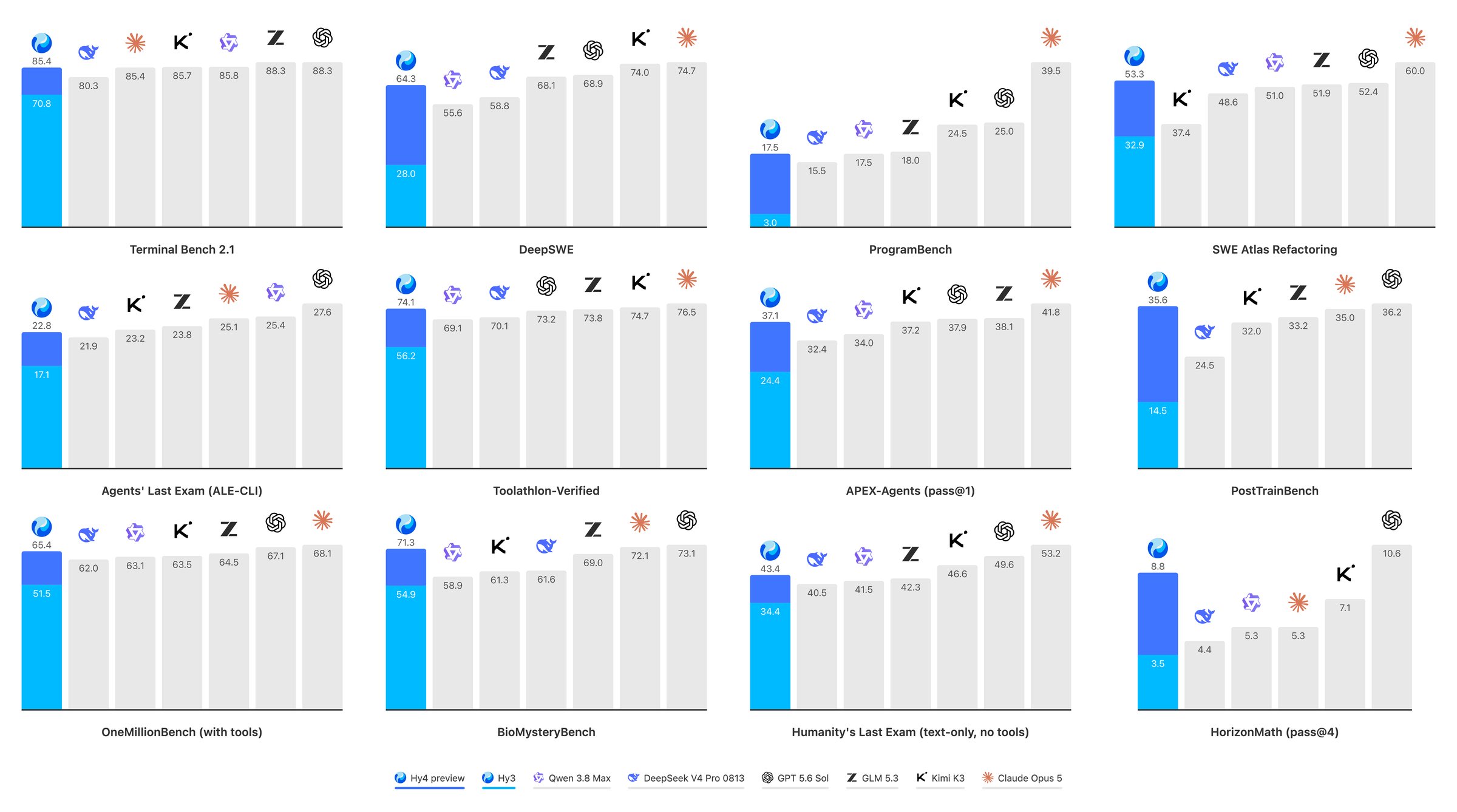
This is Hy4 preview's single strongest published category. Tencent's benchmark appendix shows the model roughly doubling several of Hy3's scores outright - DeepSWE jumps from 28.0 to 64.3, and SWE-Marathon from 5.0 to 31.9 - putting it ahead of DeepSeek V4 Pro 0813, Qwen 3.8 Max, GLM 5.3 and Kimi K3 on multiple SWE-bench and refactoring-focused suites (see Benchmarks below for the exact figures).
Agentic search and long-context retrieval
With a 1-million-token context window, Hy4 preview is built to hold entire codebases or large document sets in context at once. On OneMillionBench (with tools) - a benchmark specifically designed to test usable long-context retrieval rather than a synthetic needle-in-a-haystack test - Tencent reports 65.4 for Hy4 preview versus 51.5 for Hy3, edging out DeepSeek V4 Pro 0813 (62.0*) and Qwen 3.8 Max (63.1*).
Office, finance and “working agent” tasks
Tencent groups a large cluster of benchmarks under “Working Agent” - OfficeQA Pro, JobBench, WorkspaceBench, BankerToolBench and several internal finance-agent suites (Hy-FinAgentBench, Hy-FinmodelBench) - reflecting the company's stated focus on turning messy, multi-file business context into shareable documents, spreadsheets and financial models. Scores here are consistently and substantially ahead of Hy3, though - as with the coding suites - GPT-5.6 Sol and Claude Opus 5 hold a lead on several of the harder internal benchmarks.
STEM and scientific reasoning
Tencent specifically calls out condensed matter physics, molecular dynamics and pure mathematics as target domains, evaluated via BioMysteryBench, ArXivMath, MathArena Apex 2025 and similar suites. Progress is real (BioMysteryBench: 71.3 vs Hy3's 54.9) but this is also where the gap to GPT-5.6 Sol and Claude Opus 5 is widest and most consistent - see Benchmarks below.
Benchmarks: The Real Numbers
Tencent publishes two benchmark assets on Hy4 preview's official Hugging Face model card and GitHub repository: a headline chart directly comparing Hy4 preview against Hy3 and six other named models (Qwen 3.8 Max, DeepSeek V4 Pro 0813, GPT 5.6 Sol, GLM 5.3, Kimi K3, Claude Opus 5) across twelve benchmarks, and a much longer benchmark appendix table covering more than 40 individual evaluations across five task categories. Figures marked with an asterisk in Tencent's own table are Tencent's own third-party reproductions of other labs' models, not those labs' self-reported numbers - a distinction Tencent itself flags in its methodology notes.
- SWE-bench Multilingual: Hy4 preview 82.9 vs Hy3's 75.8 - ahead of DeepSeek V4 Pro 0813 (77.3*), GLM 5.3 (81.3*) and Kimi K3 (80.8*), just behind Qwen 3.8 Max (82.6*), and behind Claude Opus 5 (89.5/85.8*) and GPT 5.6 Sol's reported figure (74.1*, lower than Hy4 here).
- SWE-bench Pro: Hy4 preview 65.7 vs Hy3's 57.9 - ahead of DeepSeek V4 Pro 0813 (60.3*), GLM 5.3 (64.6*) and Kimi K3 (63.3*), behind Qwen 3.8 Max (67.7/61.6*) and well behind Claude Opus 5 (79.2/79.9*).
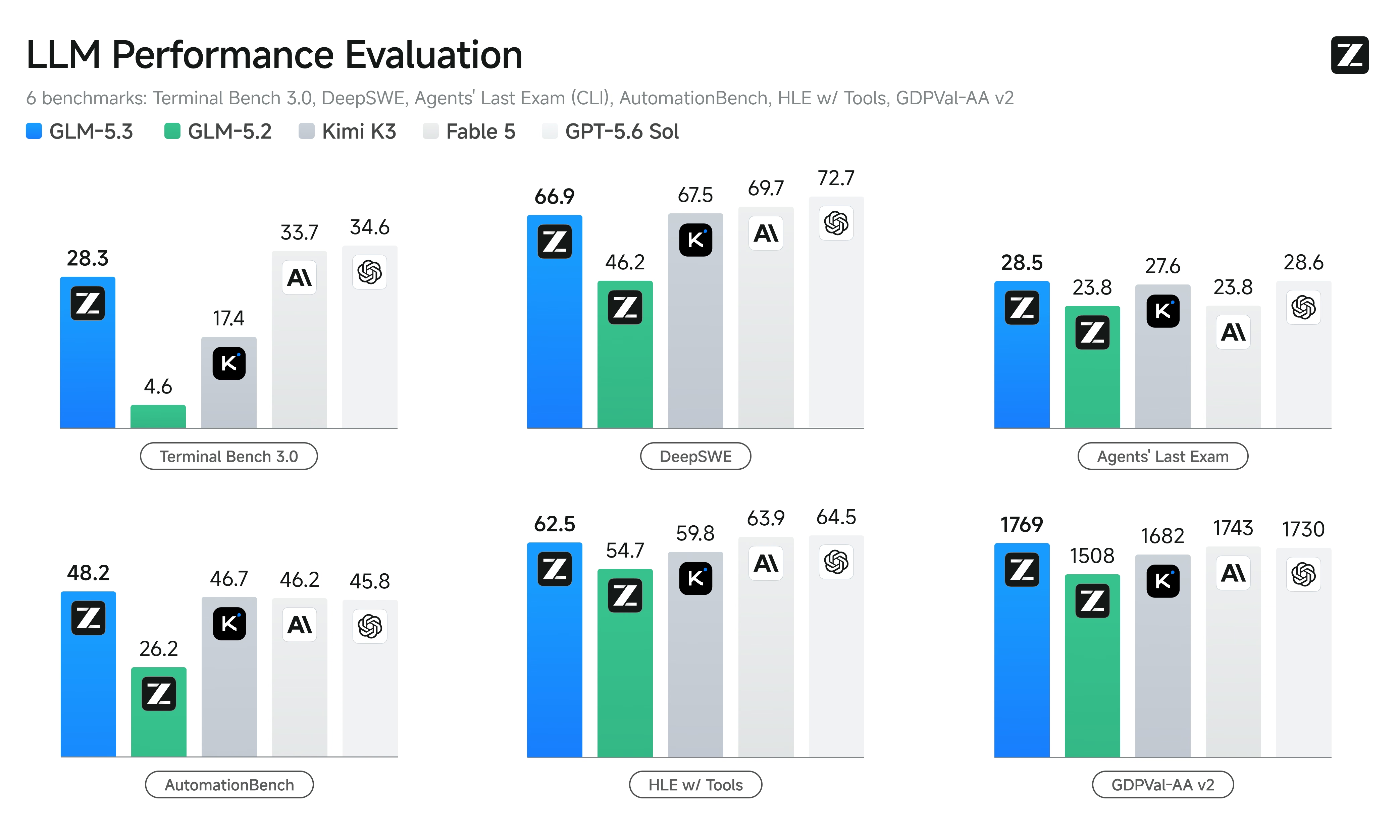
- DeepSWE: Hy4 preview 64.3, more than double Hy3's 28.0, but behind every other named model except Hy3 itself - DeepSeek (62.7/58.8*), Qwen (56.6/55.6*), GLM (66.9/68.1*), Kimi (67.5/74.0*), GPT 5.6 Sol (72.7/68.9*) and Claude Opus 5 (68.8/74.7*) all score higher.
- Terminal-Bench 2.1: Hy4 preview 85.4 vs Hy3's 70.8 - a strong result but the closest of the field, with GPT 5.6 Sol (88.8/88.3*), Kimi K3 (88.3/85.7*) and GLM 5.3 (88.2/88.3*) all slightly ahead.
- GDPval-AA V2 (Elo, official third-party benchmark): Hy4 preview 1,678 vs Hy3's 1,213 - ahead of DeepSeek V4 Pro 0813 (1,580) and Kimi K3 (1,675), behind Qwen 3.8 Max (1,717), GLM 5.3 (1,763), GPT 5.6 Sol (1,711) and Claude Opus 5 (1,831).
- GPQA Diamond: Hy4 preview 92.3 vs Hy3's 90.9 - within a point or two of the entire field (91.7-94.7), the tightest-clustered benchmark in the appendix.
- CritPt (official third-party physics-reasoning benchmark): Hy4 preview 16.9 vs Hy3's 4.9 - a large relative jump, but the lowest score in the field except Hy3: DeepSeek (18.0), GLM (19.1), Qwen (20.0), Kimi (23.4), Claude Opus 5 (29.1) and GPT 5.6 Sol (32.3) are all ahead.
- Humanity's Last Exam (no tools, text-only): Hy4 preview 43.4 vs Hy3's 34.4 - ahead of DeepSeek (42.7/40.5*) and roughly level with GLM (42.3), but behind Qwen (43.6/41.5*), Kimi (46.9/46.6*), GPT 5.6 Sol (49.5/49.6*) and Claude Opus 5 (54.9/53.2*).
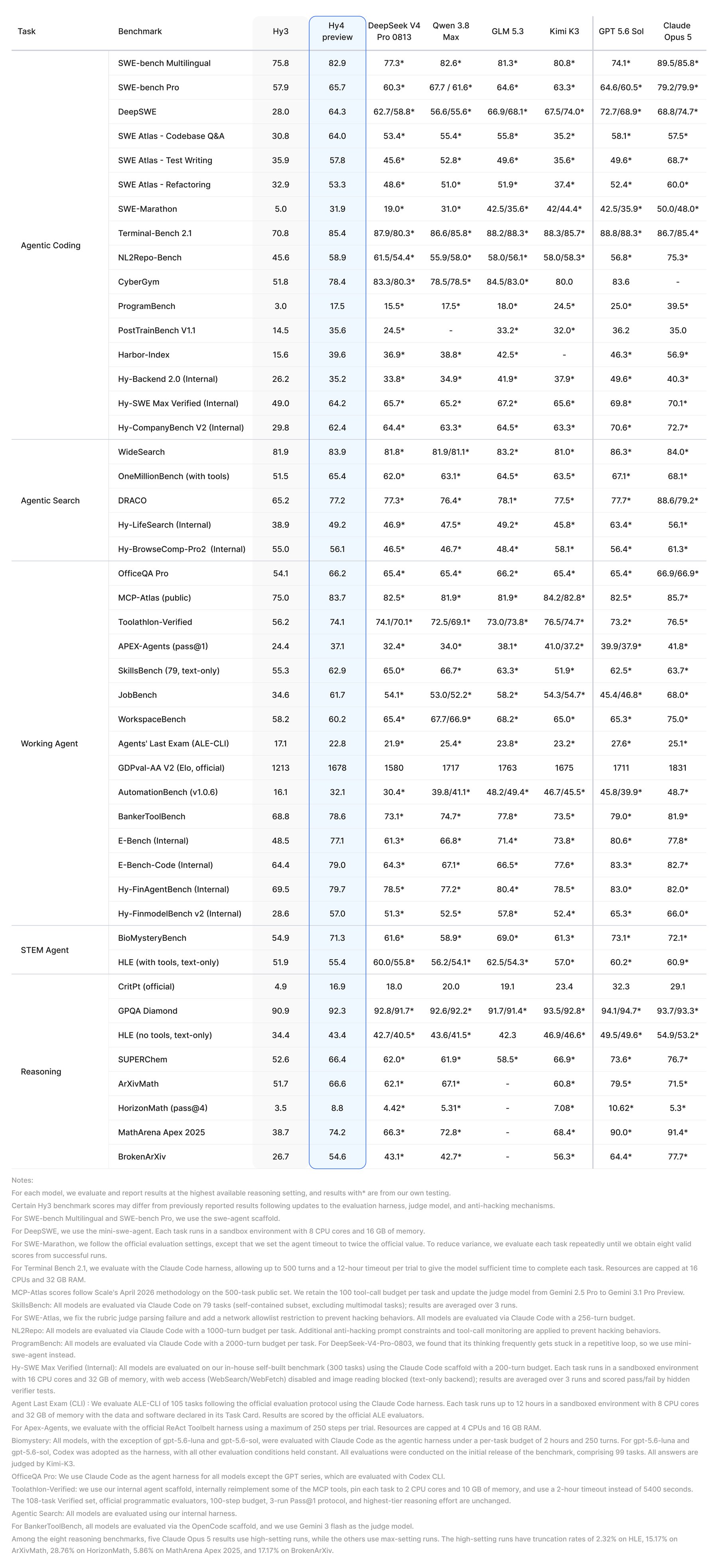
The honest read of Tencent's own numbers: Hy4 preview is a genuine step up from Hy3 on essentially every benchmark it published, and it is competitive with - and frequently ahead of - the other named open-weight models (Qwen 3.8 Max, DeepSeek V4 Pro 0813, GLM 5.3, Kimi K3) on agentic coding and search tasks specifically. But it is not the overall leader of the field: on the hardest reasoning-heavy suites (CritPt, Humanity's Last Exam, HLE with tools) and on several coding benchmarks (DeepSWE, SWE-bench Pro), GPT 5.6 Sol and Claude Opus 5 hold a consistent lead, sometimes a wide one. Tencent's own internal blind evaluation - 163 in-house experts rating outputs on 203 real engineering tasks - found Hy4 preview edging out GLM 5.3 (2.99 vs 2.92 average score, 46.8% wins / 12.8% ties / 40.4% losses) and Kimi K3 (2.99 vs 2.94, 51.2% wins / 7.9% ties / 40.9% losses) - a narrow, self-reported margin, not a rout.
AI Search's news roundup placing the Hy4 reveal alongside the same week's other major open-model releases, including GLM-5.3 Flash and Qwen 3.8 Flash Next.
System Card: Safety and Alignment
Here the disclosure gap is real, and it is worth stating plainly rather than filling it in with assumptions: Tencent has not published a system card, an RSP/ASL-equivalent risk framework, or a dedicated cyber/bio/autonomy evaluation for Hy4 preview of the kind Anthropic, OpenAI or Google DeepMind publish alongside frontier releases. Hy4 preview's own “Known Limitations” section, quoted in full below, is the closest thing Tencent offers to a self-assessment, and it is framed around capability shortfalls rather than safety risk:
“This is an early version of Hy4. There is real headroom left in both pre-training and post-training, and we are shipping with known issues - among them, spending longer than necessary reasoning through complex tasks, and a tendency to over-verify its own work.”
Hy4 preview's benchmark appendix does include one security-adjacent evaluation - CyberGym, an offensive-security benchmark - where the model scores 78.4 (up from Hy3's 51.8), roughly in line with the other named open models (DeepSeek 83.3/80.3*, GLM 84.5/83.0*, Qwen 78.5/78.5*). But a single capability benchmark on offensive-security tasks is not a substitute for a published safety evaluation: it says the model can perform at that level on security-relevant tasks, not what safeguards, if any, Tencent has put around that capability before or after release.
Given that Hy4 preview ships open weights under an unrestricted Apache 2.0 licence - meaning anyone can download, fine-tune and redeploy it without Tencent's ongoing oversight - the absence of a published safety document is a more consequential gap here than it would be for a closed, API-only model where the vendor retains some control over how the model is served.
Julian Goldie's hands-on build demo, wiring Hy4 preview's MoE architecture and 1-million-token context window into a real agentic workflow.
Agentic Safety
Hy4 preview is explicitly positioned and benchmarked as an agentic model - the "Agentic Coding", "Agentic Search" and "Working Agent" categories account for the majority of Tencent's own benchmark appendix, and the model ships with native tool-call and reasoning parsers (hy_v4) for both vLLM and SGLang out of the box. Julian Goldie SEO's hands-on video (embedded above) demonstrates exactly this kind of deployment: wiring Hy4 preview into an agent harness to plan and execute multi-step engineering tasks using its 1-million-token context window.
Tencent has not published goal-misgeneralisation, deceptive-behaviour-under-observation, or sandbagging evaluations for Hy4 preview - the kind of agentic-specific safety testing that has become standard for frontier closed-model launches. Given that gap, the standard agentic-deployment discipline applies regardless of vendor: scope tool permissions tightly, keep a human in the loop for irreversible actions (file deletion, financial transactions, code deployment), and log everything reviewable, particularly for a self-hosted open-weight model where you also carry the full responsibility for how it is sandboxed.
Honesty and Calibration
Tencent has not published a dedicated hallucination-rate, refusal-consistency, or self-reported misalignment study for Hy4 preview. The company's own “Known Limitations” note is the only calibration-adjacent signal in the official documentation, and it points at a specific, verifiable failure mode: a “tendency to over-verify its own work” and to spend “longer than necessary reasoning through complex tasks”. That is a candid admission worth taking at face value - it suggests a model that over-indexes on caution and repeated self-checking within its chain-of-thought rather than one prone to confident fabrication, but Tencent has not published data to quantify either tendency.
Practically, over-verification has a direct cost implication distinct from dishonesty: a model that re-checks its own reasoning at length before answering will consume more output tokens per task even on a low per-token price, which matters more for Hy4 preview than for many rivals given its default “high” reasoning-effort setting (switchable via the reasoning_effort parameter, as noted in Architecture above).
Real-World Performance vs Benchmarks
Tencent's own comparison against a blind panel of 163 internal engineers rating 203 real engineering tasks - not a benchmark suite, but actual work Tencent's teams ship - is the most useful real-world signal in the official documentation, precisely because it is close but not overwhelming: Hy4 preview beat GLM 5.3 by 46.8% wins to 40.4% losses (12.8% ties), and beat Kimi K3 by 51.2% to 40.9% (7.9% ties). Those are competitive, plausible margins rather than the kind of landslide result that should make you suspicious of cherry-picking.
The creator coverage tells a consistent story: Julian Goldie SEO's hands-on build video frames Hy4 preview around its 1-million-token context and “recursive self-improvement loop” for real business automation tasks, while WorldofAI's roundup treats it as a serious open-model contender worth asking “Best Open Model?!” about, alongside that week's GPT-6 Astra and Claude Opus 5.1 rumours. As always, the only way to know your own real cost and quality on your specific workload is to run it yourself - Tencent's benchmark appendix, however detailed, still reflects Tencent's own evaluation harnesses and task selection.
Pricing and Licensing
Hy4 preview is released under the standard, unmodified Apache License 2.0. Tencent's own LICENSE file in the GitHub repository states this without qualification - there is no custom Tencent community-licence clause, no monthly-active-user threshold, and no field-of-use restriction of the kind that accompanied some earlier Hunyuan model releases. In practice this means the weights (published as tencent/Hy4-preview and the FP8-quantised tencent/Hy4-preview-FP8 on Hugging Face, ModelScope, GitCode and CNB) can be downloaded, modified, fine-tuned and redeployed commercially with only standard Apache 2.0 attribution obligations.
For hosted access rather than self-hosting, Tencent's official pricing - confirmed both in Tencent's own press release and on OpenRouter's listing - is:
- Input tokens: £0.62 ($0.834) per million tokens.
- Output tokens: £1.85 ($2.501) per million tokens.
- Cache hits: £0.031 ($0.042) per million tokens.
- Launch promotion: free access on Tencent's WorkBuddy and CodeBuddy products for two weeks from the 28/08/2026 launch; Hy3 access is extended through 30/09/2026 for existing users migrating across.
(GBP figures are approximate conversions and will move with the exchange rate; always check Tencent Cloud's dollar-denominated pricing for the current figure.) Hosted access is available via Tencent Cloud TokenHub or OpenRouter; third-party routers can show different blended rates depending on the hosting provider, so treat OpenRouter's displayed price as indicative rather than fixed.
Self-hosting is genuinely free of licensing cost but not of infrastructure cost: Tencent's own deployment recipes recommend an 8-way tensor-parallel vLLM or SGLang setup using the prebuilt vllm/vllm-openai:hy4-preview or lmsysorg/sglang:hy4-preview container images - in practice, 8x 80GB-class datacentre GPUs at minimum for the full BF16 model, less for the FP8 variant. Tencent also provides AngelSlim, its own open-source toolkit for further low-bit quantisation and speculative-sampling compression, plus a documented finetuning pipeline for teams that want to adapt the base weights further.
Limitations
- No published safety documentation: no system card, RSP/ASL-equivalent framework, or dedicated cyber/bio/autonomy evaluation exists for Hy4 preview, despite open weights being freely redistributable.
- Self-acknowledged early-release issues: Tencent itself flags over-long reasoning and a tendency to over-verify its own work as known limitations of this preview.
- Trails on the hardest reasoning benchmarks: GPT 5.6 Sol and Claude Opus 5 lead consistently on CritPt, Humanity's Last Exam and several STEM-reasoning suites in Tencent's own appendix.
- Heavy self-hosting requirements: a 770B-parameter MoE model needs multi-GPU, datacentre-class infrastructure to self-host even in FP8; this is not a model that runs on consumer hardware.
- Preview status: Tencent explicitly labels this a preview, not a finished numbered release, and says further pre-training and post-training work is planned.
- Third-party benchmark figures are Tencent's own reproductions: every competitor score marked with an asterisk in Tencent's appendix is Tencent's in-house evaluation of the other model, not that vendor's self-reported number - useful for like-for-like comparison, but not independent of Tencent's own testing harness.
How It Compares
Against Qwen 3.8 Max and DeepSeek V4 Pro 0813, Hy4 preview trades places benchmark-by-benchmark rather than leading outright - ahead on SWE-bench Pro and OneMillionBench, narrowly behind Qwen on SWE-bench Multilingual, and consistently ahead of DeepSeek on the agentic-coding cluster. Against GLM 5.3 and Kimi K3, Tencent's own blind internal evaluation gives Hy4 preview a narrow edge on real engineering tasks, though GLM 5.3 and Kimi K3 both score higher on DeepSWE and Terminal-Bench 2.1 specifically.
Against the closed frontier - GPT 5.6 Sol and Claude Opus 5 - the gap is real and Tencent does not hide it in its own appendix: both closed models lead on essentially every pure-reasoning benchmark (CritPt, GPQA Diamond, HLE) and on several of the harder coding suites (DeepSWE, SWE-bench Pro). Hy4 preview's pitch is not “beats the frontier” but “open-weight, self-hostable, and close enough on agentic coding and search to be a credible substitute at a fraction of the access cost” - a similar positioning to GLM-5.3-Flash's “approaching the frontier at a fraction of the price” framing, though Hy4 preview is a much larger model aimed more squarely at maximum open-weight capability than at minimum cost.
Who Should Use It
Use it now if you need a genuinely open-weight (unrestricted Apache 2.0), self-hostable flagship-class model for agentic coding, long-context document work, or search-heavy agent pipelines, and you have (or can rent) the multi-GPU infrastructure to run a 770B-parameter MoE model - or are happy to access it hosted via Tencent Cloud TokenHub or OpenRouter instead.
Hold off or pair it with extra guardrails if you need a documented safety and alignment posture before deployment, you are running high-stakes autonomous agents where the absence of a published system card matters to your risk tolerance, or your workload leans heavily on the hardest pure-reasoning tasks - Tencent's own numbers say GPT 5.6 Sol and Claude Opus 5 are still ahead there.
The Bottom Line
Hy4 preview backs up Tencent's claim of a major generational leap with an unusually transparent benchmark appendix that does not flatter the model everywhere - and that honesty is itself a point in its favour. It is a large step up from Hy3 on essentially every published metric, genuinely competitive with Qwen 3.8 Max, DeepSeek V4 Pro 0813, GLM 5.3 and Kimi K3 on agentic coding and search, released under an unrestricted Apache 2.0 licence, and priced reasonably for hosted access at $0.834/$2.501 per million tokens.
What it is not, yet, is a closed-frontier-beater on hard reasoning, or a model with the kind of published safety documentation that would let you deploy it with full confidence at scale without doing that homework yourself. Tencent labels it a preview and says so candidly in its own limitations section - take that framing at face value, judge it on the real numbers in this review, and treat the safety gap as something you need to fill in yourself before any high-stakes autonomous deployment.
Last updated: 30 August 2026. This review is based on Tencent's official Hy4-preview GitHub repository and README, its Hugging Face model card, its official benchmark appendix, its 28/08/2026 press release, and OpenRouter's pricing listing; figures may be refined as further independent benchmarks and disclosures land.
Get the free guide: Claude vs ChatGPT, Gemini & Grok
A 20-page playbook covering everything you need to choose and use the big four AI models in 2026, full cost and feature comparisons, what each is best (and worst) at, and how-tos for images, vectors, building a website, Claude Code and more.