 AI Tools Review Editorial Team
Quick Answer:
Ox Alpha - the anonymous model that topped OpenRouter's usage charts for a week in August 2026 - is Z.ai's GLM-5.3-Flash, confirmed on 26/08/2026. It is a 320-billion-parameter Mixture-of-Experts model with only 18 billion parameters active per token, MIT-licensed with open weights, natively multimodal, and priced from £0.11 ($0.15) per million input tokens and £0.37 ($0.50) per million output tokens (currently half that under a launch promotion). Z.ai's own benchmark chart shows it beating its predecessor GLM-5.2 by a wide margin and running close to Claude Opus 4.8 on several agentic tests - though not all of them. The most striking claim, that the entire stealth preview ran on domestically produced Chinese chips, remains unverified by any independent party.
For a week, the most-used model on OpenRouter had no name. Developers building agents on Hermes Agent, Claude Code and Cline routed hundreds of billions of tokens through a free, anonymous endpoint called “ox-alpha” without knowing which lab, or which country, was behind it.
On 26/08/2026, Z.ai ended the mystery: Ox Alpha was GLM-5.3-Flash all along. This is the full picture - the real architecture, the real benchmark numbers straight from Z.ai's own chart, the real pricing, and an honest look at what the company has and has not disclosed about safety and the hardware it claims to run on.
Matthew Berman's breakdown of the Ox Alpha reveal, GLM-5.3-Flash's pricing and where it lands against the rest of the frontier.
Executive Summary
GLM-5.3-Flash is Z.ai's attempt to prove that a much smaller, much cheaper model can sit close to the frontier if the architecture and training data are good enough. At 320B total parameters with 18B active per token - roughly a seventeenth of the parameters engaged for any given response - it undercuts Z.ai's own flagship GLM-5.3 on price by a wide margin while, on the six benchmarks Z.ai chose to publish, beating its immediate predecessor GLM-5.2 comfortably and trading blows with Claude Opus 4.8, GPT-5.6 Terra and Gemini 3.7 Flash.
What makes this launch unusual isn't the model itself - it's how Z.ai chose to release it. Rather than announcing GLM-5.3-Flash directly, the company ran it anonymously on OpenRouter and OpenCode under the codename “ox-alpha” for roughly a week, watching it climb to the top of OpenRouter's usage leaderboard before attaching its real name, pricing and documentation. That stealth period is also the source of the launch's most contested claim: that every request during the preview was served on domestically produced Chinese AI chips.
- Best for: cost-sensitive agentic coding and automation workloads, developers who want open weights, and anyone already routing through OpenRouter who was unknowingly using Ox Alpha already.
- Headline numbers: 320B/18B MoE, MIT licence, 1M-token context, £0.11/£0.37 ($0.15/$0.50) per million tokens list price.
- Defining trait: frontier-adjacent agentic benchmarks at a fraction of flagship pricing.
- Main caveat: the benchmark chart and the chip claim are both self-reported by Z.ai, with no independent verification of either as of writing.
Lineage: The Stealth Launch
Ox Alpha first appeared as a free, stealth-labelled model on OpenRouter and OpenCode around 20/08/2026. Community testers noticed it almost immediately: an unusually long effective context window (approaching 1 million tokens), native image understanding, and response patterns - tokenisation quirks, error-message formatting, reasoning style - that closely resembled Z.ai's GLM family. Over the following days, testers compared notes but, as one analysis of the reveal put it, those clues were “directionally useful” without being able to “prove which post-training checkpoint sat behind the endpoint.”
The guessing game ended on 26/08/2026, when Z.ai confirmed - via its founder Jie Tang - that Ox Alpha was GLM-5.3-Flash, and released the model's weights, API pricing and documentation the same day. By that point Ox Alpha had reportedly become the single most-used model on OpenRouter, accounting for close to 20% of weekly token share on the platform, with the top applications driving that traffic including Hermes Agent, Claude Code and Cline.
GLM-5.3-Flash sits alongside, not above, Z.ai's existing lineup. It follows GLM-5.2 and the flagship GLM-5.3, released 17/08/2026, whose open weights were deliberately delayed for what Z.ai called safety hardening given the flagship's strong offensive-cybersecurity capability. Flash takes the opposite path: it shipped with open weights from day one, positioned as the efficient, multimodal, agent-facing sibling rather than the raw-capability flagship.
Architecture and Training
According to Z.ai's official Hugging Face model card, GLM-5.3-Flash starts from a newly trained base model rather than a fine-tune of GLM-5.2, with “architecture and training recipe redesigned around capability and efficiency.” The headline number is the parameter split: 320 billion total parameters, with only 18 billion active for any given token - a Mixture-of-Experts design that routes each token through a small fraction of the network's total capacity, keeping inference cost low relative to the model's effective size.
For the first time in the GLM series, Z.ai has combined sparse and linear attention in a hybrid stack, which the company says sharply reduces long-context serving costs while preserving long-context accuracy. Z.ai's own documentation quantifies this as roughly a 3.01x reduction in attention computation and a 4.44x reduction in KV-cache size compared with the full GLM-5.3 flagship. The model also adopts what Z.ai calls Manifold-Constrained Hyper-Connections (mHC), a scaling-efficiency technique layered on top of the attention redesign.
Training data is where the “natively multimodal” claim comes from: Z.ai says the model was trained on a 30-trillion-token multimodal pre-training corpus spanning text, image and video, making GLM-5.3-Flash the first model in the GLM-5 series built for multimodal input from the ground up rather than adapted after the fact. Officially, the model supports video, image, text and file input, with text-only output, a 1-million-token context window and up to 128,000 tokens of output. Z.ai's evaluation footnotes note that its own internal testing was capped at 300,000 tokens of context, and third-party routers list the practical maximum context at 1,310,720 tokens.
The model supports a reasoning_effort parameter (low / high / max, defaulting to max) for controlling how much the model “thinks” before answering - though unlike some rivals, thinking mode itself cannot be switched off entirely. It ships released under the MIT licence, with day-one support for vLLM, SGLang, Transformers, KTransformers and Unsloth.
Capabilities Deep Dive
Agentic coding and tool use
This is where GLM-5.3-Flash is positioned to compete. Its adoption pattern backs this up: OpenRouter's own usage data during the stealth period showed the top three applications routing traffic to it were all agent frameworks - Hermes Agent, Claude Code and Cline - rather than chat interfaces. Z.ai's benchmark chart (below) shows Flash comfortably ahead of GLM-5.2 on every agentic metric published.
Native multimodal input
Unlike earlier GLM-5-series models, Flash accepts image and video input natively rather than through a bolted-on vision adapter, which Z.ai frames as “native multimodal visual coding” - reading a screenshot, diagram or UI state as part of an agentic coding loop rather than requiring a separate captioning step.
Long-context efficiency
The hybrid sparse/linear attention stack is specifically aimed at making long-context use affordable. A million-token context window is not new in isolation, but doing it at 18B active parameters with a claimed 4.44x reduction in KV-cache versus the full flagship is the more meaningful efficiency claim, since KV-cache size is usually the practical ceiling on how many concurrent long-context sessions a provider can serve economically.
Cost-to-capability ratio
Z.ai's own framing for the model is explicit: it says Flash “outperforms GLM-5.2 across benchmarks and real-world workloads at one-tenth the price, while approaching Claude Opus 4.8 on coding and agentic benchmarks.” That is a vendor claim, but the pricing at least is independently checkable, and it holds up - see Pricing, below.
Benchmarks: The Real Numbers
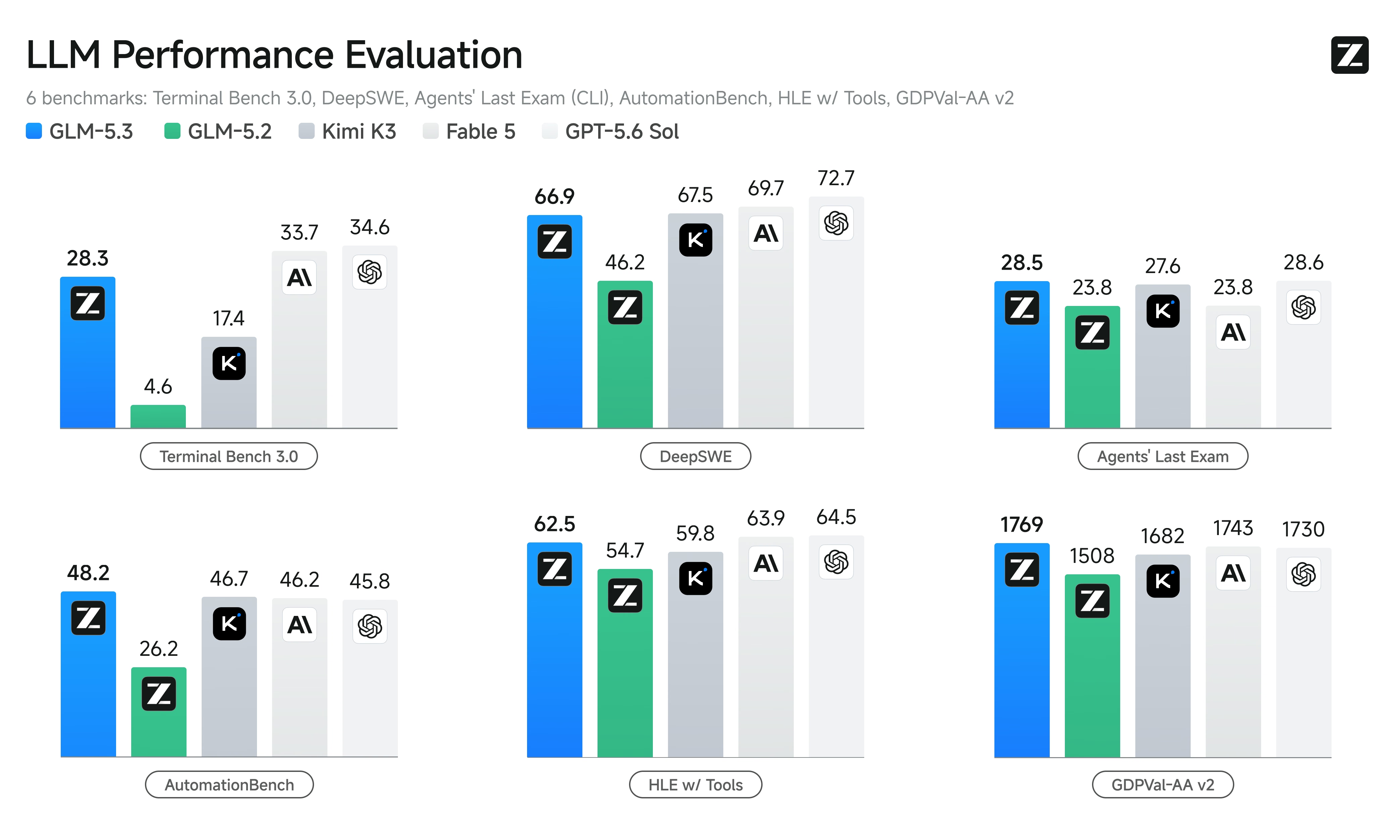
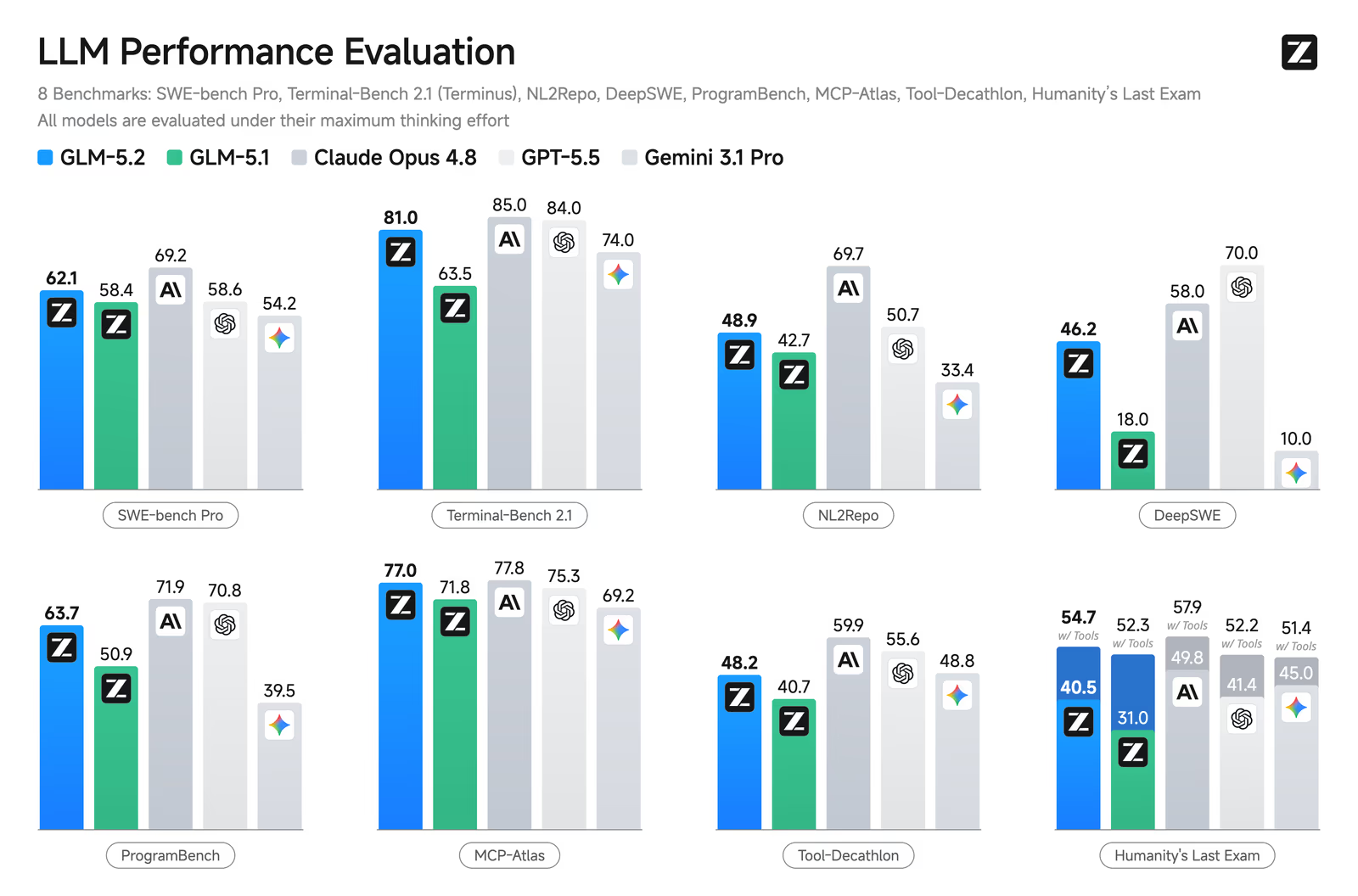
Z.ai's Hugging Face model card publishes one chart, covering six benchmarks, comparing GLM-5.3-Flash against GLM-5.2, DeepSeek-V4-Vision-Exp, Claude Opus 4.8, GPT-5.6 Terra and Gemini 3.7 Flash. These are Z.ai's own vendor-reported numbers, not an independent evaluation, and should be read as such.
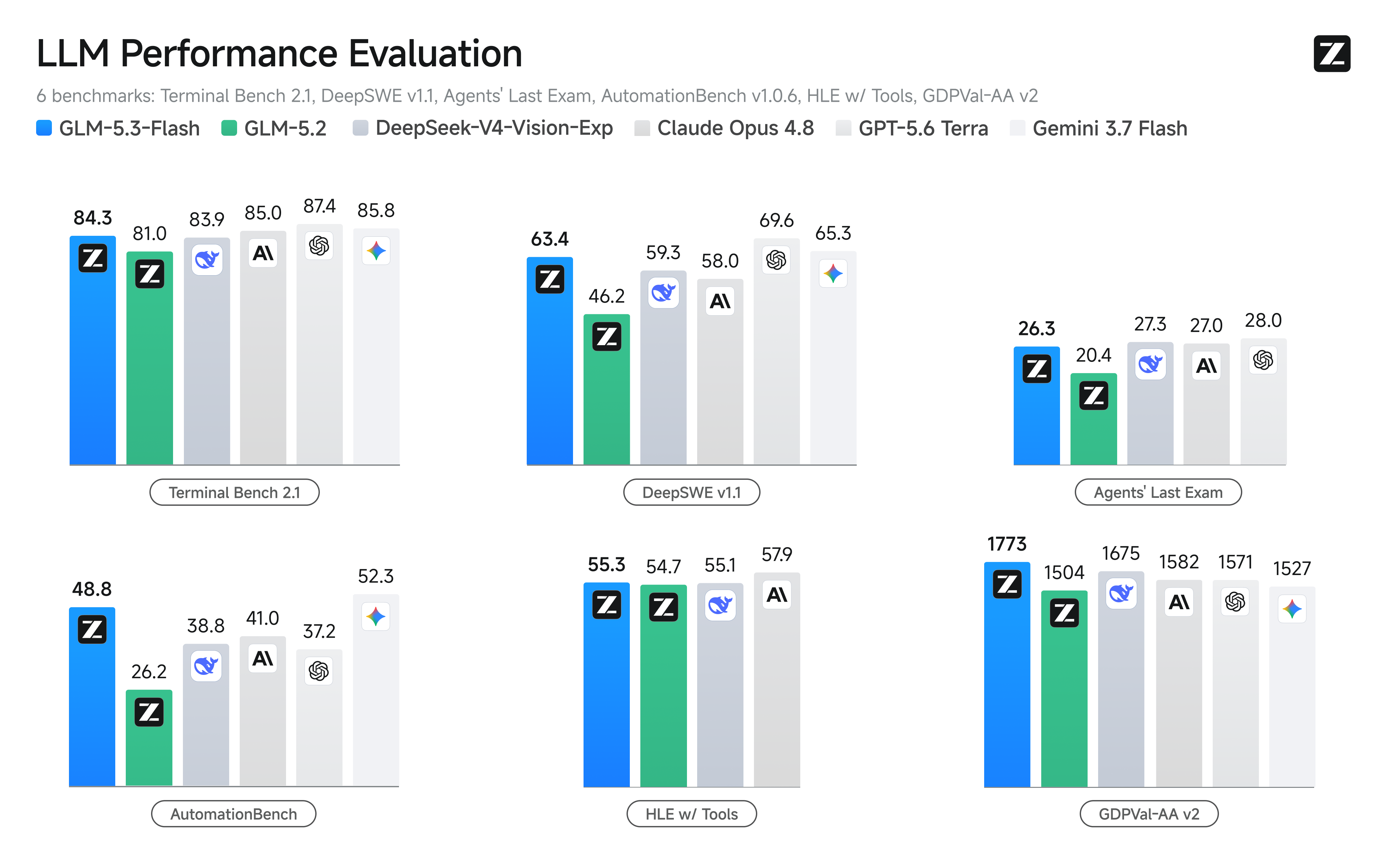
- Terminal Bench 2.1: Flash 84.3 vs GLM-5.2's 81.0, DeepSeek-V4-Vision-Exp's 83.9, Claude Opus 4.8's 85.0, GPT-5.6 Terra's 87.4 and Gemini 3.7 Flash's 85.8 - a clear gain over its predecessor, but not a lead over any of the closed comparators.
- DeepSWE v1.1 (agentic software engineering): Flash 63.4, a large jump over GLM-5.2's 46.2, ahead of DeepSeek-V4-Vision-Exp (59.3) and Claude Opus 4.8 (58.0), though behind GPT-5.6 Terra (69.6) and Gemini 3.7 Flash (65.3).
- Agents' Last Exam: Flash 26.3 vs GLM-5.2's 20.4, roughly level with the closed-model comparators (27.0-28.0).
- AutomationBench: Flash 48.8, its widest published lead - well ahead of GLM-5.2 (26.2), DeepSeek-V4-Vision-Exp (38.8), Claude Opus 4.8 (41.0) and GPT-5.6 Terra (37.2), though behind Gemini 3.7 Flash (52.3).
- HLE with tools (Humanity's Last Exam): Flash 55.3, essentially level with GLM-5.2 (54.7) and DeepSeek-V4-Vision-Exp (55.1), behind Claude Opus 4.8 (57.9).
- GDPval-AA v2 (knowledge work, scored by Artificial Analysis): Flash 1773, its second-widest lead - ahead of GLM-5.2 (1504), DeepSeek-V4-Vision-Exp (1675), Claude Opus 4.8 (1582), GPT-5.6 Terra (1571) and Gemini 3.7 Flash (1527).
The honest read: Z.ai's claim of “approaching Claude Opus 4.8” is fair rather than exaggerated. Flash beats Opus 4.8 on three of the six published metrics (DeepSWE, AutomationBench, GDPval-AA v2) and trails it on the other three (Terminal Bench, Agents' Last Exam, HLE w/ tools), never by more than about three points either way. It is not a clean sweep against any single closed model, and Z.ai chose which six benchmarks to publish - there is no way to know from this chart alone how Flash would fare on suites it didn't select.
Independently, Artificial Analysis has scored the model (under its stealth “Ox Alpha” identity) at 57 on its Intelligence Index, ranking it 8th overall - matching GPT-5.6 Terra and edging out Gemini 3.7 Flash's 56. That is a genuinely third-party number, and it is a strong showing for an 18B-active-parameter model.
Julian Goldie's walkthrough of how the community traced Ox Alpha back to Z.ai, the China-chip claim, and the real benchmark picture.
Safety and Alignment
Here is where GLM-5.3-Flash's disclosure is thinnest, and it is worth being direct about that rather than filling the gap with assumptions. Z.ai published a dedicated safety article, “Preparing GLM-5.3 for Open Release: A Responsible Path to Cyber Defense,” alongside its flagship GLM-5.3 launch. That piece describes model-level alignment baked into the released checkpoint, differential training data designed to distinguish authorised security research from malicious activity, adversarial data covering jailbreak variants and disguised intent, and staged red-team access for professional security partners ahead of the broader API release.
Critically, that safety disclosure was written for the GLM-5.3 flagship, not specifically for GLM-5.3-Flash. Flash's own Hugging Face model card does not include a dedicated cybersecurity benchmark table (there is no CyberGym or ExploitBench score published for Flash, unlike for the flagship), a system-card-style risk write-up, or an RSP/ASL-equivalent safety framework of the kind Anthropic or OpenAI publish alongside frontier releases. Whether the same intent-based safety training described for the flagship was applied identically to Flash's post-training is not stated in Flash's own documentation.
That is a real gap, not a technicality: Flash is the model that shipped open weights immediately and reached the top of OpenRouter's usage charts, so it is arguably the more safety-relevant release of the two, and it is the one with the thinner public safety documentation.
Agentic Safety and the Chip Claim
Because GLM-5.3-Flash is already being routed through agent frameworks like Hermes Agent, Claude Code and Cline at scale, the usual agentic-deployment discipline applies regardless of vendor: scope permissions tightly, keep a human in the loop for irreversible actions, and log everything you can actually review. Z.ai has not published agentic-specific evaluations (goal misgeneralisation, deceptive behaviour under observation, and so on) for Flash, so there is no vendor data to weigh here either way - treat the absence of evidence as reason for caution, not reassurance.
The second, more geopolitically loaded claim from the launch is the hardware story. Z.ai and co-founder Jie Tang said that every request served during the anonymous stealth preview ran on domestically produced Chinese AI chips - reportedly around 100,000 of them - processing roughly 16 trillion tokens in the first three days and about 62 trillion tokens across the full week before the official reveal, at a claimed capacity approaching 100 trillion tokens per day.
None of that is independently verified. Z.ai has not named the chip vendor, published power-consumption figures, or released throughput benchmarks. CNBC reported it was unable to independently confirm the claim, and analysts at SemiAnalysis flagged the 100-trillion-tokens-per-day figure as the most striking - and least substantiated - part of the announcement. Treat the chip-independence narrative as a self-reported claim under active scrutiny, not a confirmed fact, whatever role it may have played in the reported jump in Zhipu AI's share price after the reveal.
Honesty and Calibration
Z.ai has not published a dedicated honesty or calibration study for GLM-5.3-Flash - no hallucination rate, no refusal-consistency data, no self-reported misalignment score of the kind Anthropic publishes for Claude or the kind Z.ai itself published for the flagship GLM-5.3's cyber-risk profile. The only third-party signal available is indirect: Artificial Analysis, which scored the model on its Intelligence Index, separately noted that the model (as “Ox Alpha”) was notably slow and unusually verbose, consuming around 150 million output tokens to run its evaluation suite against a roughly 110-million-token median across other models - about 36% more output than typical to answer the same set of questions.
Verbosity is not the same failure mode as dishonesty, but it is directly relevant to how much you should trust benchmark comparisons and how much a given task will actually cost you in practice: a model that reasons at length before answering can rack up real token spend even at a low per-token price, and burning more tokens is not automatically the same as thinking more usefully.
Real-World Performance vs Benchmarks
The single most interesting real-world data point for GLM-5.3-Flash isn't a benchmark at all - it's the fact that, while completely anonymous with no marketing, no name, and no established reputation, it still climbed to become the top model by weekly token share on OpenRouter, reportedly around 19-20 percentage points of Z.ai's roughly 23% combined platform share. Developers chose to route production agent traffic through it purely on the strength of its output, before knowing who built it.
That is a genuinely useful signal that the model performs well in real agentic harnesses, not just on curated benchmark suites. But it comes with the verbosity caveat above: a model that is popular because it is capable and cheap can still be more expensive per task than its headline per-token price suggests if it habitually generates long outputs. As with any model, the only way to know your real cost and quality is to run your own workload through it rather than trusting a vendor chart or a leaderboard position alone.
AI Search's roundup placing the Ox Alpha reveal alongside the same week's other major model releases.
Pricing, Access and Deployment
Z.ai's official API pricing table, confirmed directly from its documentation, lists GLM-5.3-Flash at:
- List price: £0.11 ($0.15) per million input tokens, £0.37 ($0.50) per million output tokens, £0.022 ($0.03) per million cached-input tokens.
- Current launch promotion (until 00:00 UTC+8 on 09/09/2026): £0.055 ($0.075) per million input tokens, £0.185 ($0.25) per million output tokens, £0.011 ($0.015) per million cached-input tokens - a straight 50% discount off list.
- Cached-input storage: free for a limited time, per Z.ai's pricing page.
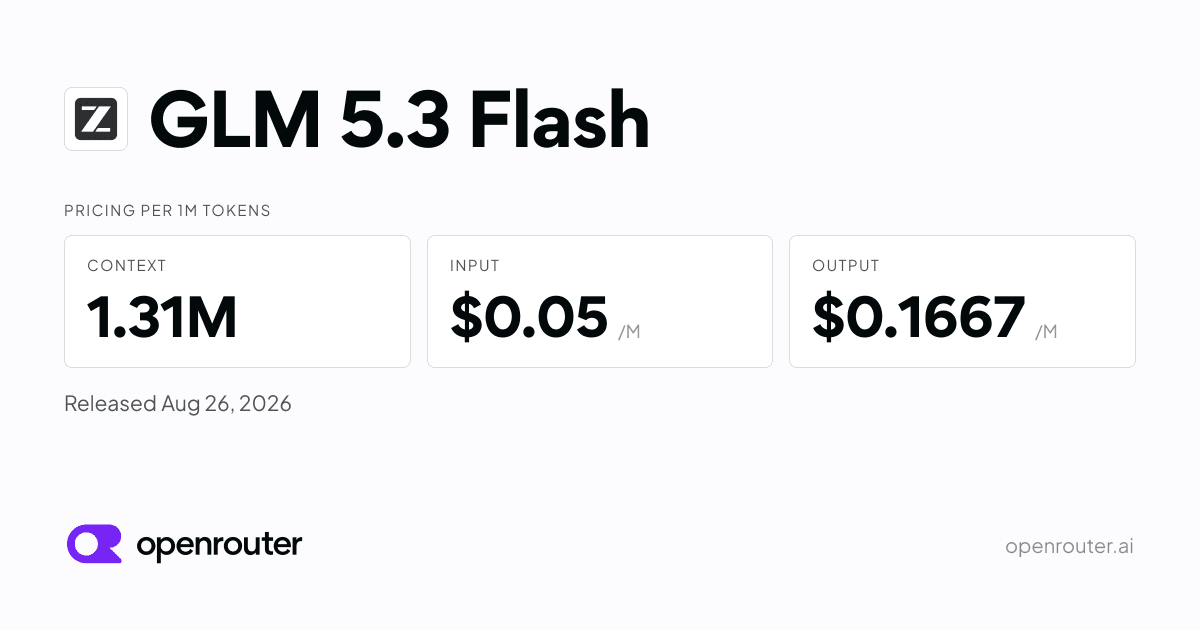
(GBP figures are approximate conversions at roughly $1 = £0.74 and will move with the exchange rate; always check Z.ai's dollar-denominated pricing page for the current figure.) Third-party routers like OpenRouter blend pricing across multiple hosting providers and can show different numbers again - at the time of writing, OpenRouter listed an aggregate rate of $0.05 input / $0.1667 output per million tokens, distinct from Z.ai's own direct API pricing above.
The model is available via Z.ai's own API (model code glm-5.3-flash), is included for all GLM Coding Plan subscribers, and - because its weights are MIT-licensed and public on Hugging Face - can be self-hosted on your own infrastructure with vLLM, SGLang, Transformers, KTransformers or Unsloth if you have the hardware to run a 320B-parameter MoE model.
Limitations and Known Issues
- Thin independent safety disclosure: no dedicated system card, cyber-risk benchmark, or agentic-safety evaluation has been published specifically for Flash, unlike the flagship GLM-5.3.
- Unverified hardware claim: the Chinese-chip story is entirely self-reported, with no vendor named and no throughput or power data released.
- Vendor-chosen benchmarks: the published comparison chart covers six benchmarks Z.ai selected; it is not an independent or comprehensive evaluation.
- Verbosity: Artificial Analysis found the model used around 36% more output tokens than the median to complete its evaluation suite, which can inflate real-world cost despite a low headline price.
- Promotional pricing is temporary: the 50% launch discount ends 09/09/2026; budget against list pricing for anything beyond short-term testing.
- Text-only output: despite multimodal input support, the model only produces text - no image or video generation.
How It Compares
Against its own stablemate, GLM-5.3, Flash trades raw capability for cost and immediate open-weight access - GLM-5.3 held back its weights for safety hardening and costs roughly ten times more per token, while Flash shipped open on day one. Against GPT-5.6 Terra and Gemini 3.7 Flash, Z.ai's own chart shows Flash competitive but not consistently ahead - it wins on AutomationBench and GDPval-AA v2, loses on Terminal Bench and DeepSWE. Against Claude Opus 4.8, the gap is genuinely narrow in both directions across the six published metrics, though Opus 4.8 carries the far more detailed public safety and alignment disclosure of the two.
Within the open-weights field specifically, Flash's pitch is efficiency: at 18B active parameters it undercuts DeepSeek V4's active-parameter count on several variants while matching or beating DeepSeek-V4-Vision-Exp on five of the six published benchmarks, and it offers native multimodal input that Qwen3.8's smaller open releases don't match at this price point.
Who Should Use It
Use it now if you run cost-sensitive agentic coding or automation pipelines, want open weights you can self-host, or need a model that reads screenshots and UI states natively without a separate vision step. The pricing (especially under the current promotion) and the DeepSWE/AutomationBench numbers make a strong case for agentic workloads specifically.
Hold off or pair it with extra guardrails if you need a documented safety and alignment posture before deployment, you are running high-stakes autonomous agents where the absence of a published system card matters to your risk tolerance, or you need independently verified infrastructure claims for compliance reasons - none of that exists for Flash yet.
The Bottom Line
GLM-5.3-Flash earned its adoption honestly - developers routed real production traffic through it before they even knew its name, and the model held up. On Z.ai's own six-benchmark chart it beats GLM-5.2 decisively and sits within a few points of Claude Opus 4.8, GPT-5.6 Terra and Gemini 3.7 Flash in either direction, at a fraction of flagship pricing and with open MIT-licensed weights available from day one.
The launch narrative, though, runs ahead of the documentation in two places: the safety and alignment disclosure that exists for the GLM-5.3 flagship has not been extended to Flash specifically, and the headline claim that the entire stealth preview ran on unnamed Chinese chips remains unverified by anyone outside Z.ai. Judge the model on the numbers you can check - the pricing, the open weights, the independent Artificial Analysis score - and treat the rest as claims still awaiting confirmation.
Last updated: 30 August 2026. This review is based on Z.ai's official Hugging Face model card and documentation, Z.ai's published pricing page, and independent reporting on the Ox Alpha reveal; figures may be refined as further independent benchmarks and disclosures land.
Get the free guide: Claude vs ChatGPT, Gemini & Grok
A 20-page playbook covering everything you need to choose and use the big four AI models in 2026, full cost and feature comparisons, what each is best (and worst) at, and how-tos for images, vectors, building a website, Claude Code and more.