 AI Tools Review Editorial Team
Quick Answer:
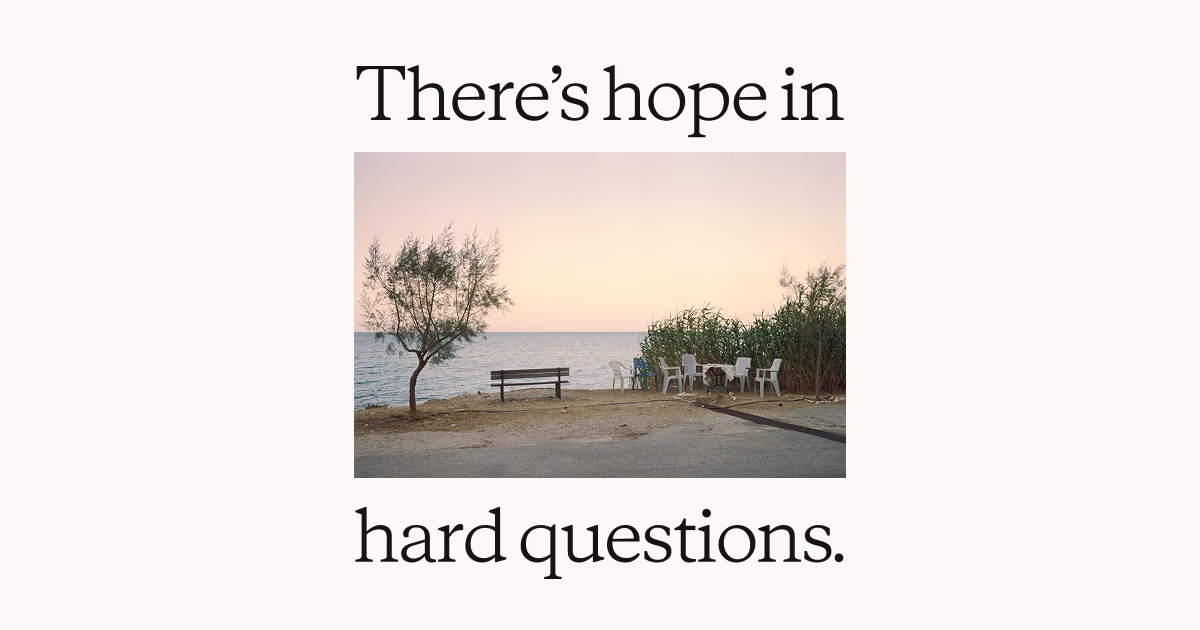
In mid-July 2026, Anthropic launched "There's hope in hard questions" - a two-minute brand film for Claude, produced by the agency Mother and directed by Myles McAuliffe, built around unresolved public anxieties about AI rather than product features. It opens with a burning house and moves through crowd surveillance, homelessness and cemetery rows while a voiceover asks "who's going to hit the brakes if we really need to?" The film is grounded in real research - roughly 81,000 people surveyed across 159 countries and 70 languages using a Claude-powered interview tool called Anthropic Interviewer - and sits at claude.com/hard-questions, where Anthropic has pledged to publicly track its answers. Reaction has split between "unusually honest" and "tone-deaf doomerism", with OpenAI's Sam Altman among the ad's most visible critics.
Most AI companies advertise capability. Anthropic just spent a campaign asking whether its own product can be trusted at all - and showing, in quick succession, burning homes, surveillance cameras and a field of graves to make the point.
The film has been called a masterstroke of brand honesty and a corporate-communications disaster in the same week, sometimes by the same commentator. Here is what "hope in hard questions" actually says, the research it stands on, and why an AI lab would choose to run an ad this uncomfortable.
Summary
"There's hope in hard questions" is Anthropic's first major brand campaign for Claude, and it deliberately breaks the genre convention of AI advertising. Instead of demos, benchmarks or a triumphant voiceover, the film sits with the questions people actually have about AI - job displacement, surveillance, trust, control - and refuses to resolve most of them. It closes not with a call to buy, but with an invitation to submit your own hardest question, and a public commitment from Anthropic to keep answering.
The film is not improvised anxiety theatre. It is downstream of a genuine research effort: Anthropic built a purpose-made tool, Anthropic Interviewer, that uses Claude to conduct structured, adaptive interviews at scale, and ran it against roughly 81,000 people in 159 countries. The questions in the film - "who's going to hit the brakes?", "why do we have to have this stuff?" - are drawn directly from what real respondents said, not copywriters' invention.
- What it is: a two-minute film plus a public-facing microsite (claude.com/hard-questions) inviting submitted questions, with Anthropic committing to answer them over time.
- Who made it: agency Mother (credited in some coverage as "Mother-Made"), directed by Myles McAuliffe.
- The research base: Anthropic Interviewer, run across ~81,000 respondents (159 countries, 70 languages), building on an earlier 1,250-person pilot of workers, scientists and creatives.
- The reaction: split hard between "the most honest thing an AI company has done" and "the worst corporate communications ever" - including public mockery from OpenAI's Sam Altman.
What "Hope in Hard Questions" Actually Is
Strip away the imagery and the campaign has a simple structure. A two-minute film runs across broadcast and social placements. A dedicated site, claude.com/hard-questions, hosts the film alongside an "audio experience" and a form for the public to submit their own toughest AI questions. A companion page at anthropic.com, informally referred to in coverage as "path to hope", is where Anthropic says it will show its progress answering what people send in.
That structure - film, submission mechanism, public tracker - is the part that separates this from a typical thirty-second spot. Anthropic is not just running an ad; it is opening a standing channel for public scrutiny of its own answers, which is a much larger and riskier commitment than a marketing campaign usually makes. Whether it follows through visibly enough to matter is, at time of writing, untested.
The campaign launched in the second week of July 2026, with the film drawing wide press and social coverage from around 14 July as clips spread across X and YouTube commentary channels - including several of the creators tracked by this site, who used the ad as a jumping-off point for their own "is Anthropic serious about this?" discussions. Placement was high-profile by design: coverage of the rollout points to the film airing during a men's World Cup quarter-final broadcast, putting it in front of one of the largest single television audiences of the year.
The tonal shift is notable against Anthropic's own recent advertising history. Earlier in 2026 the company ran a lighter, comedic Super Bowl spot for Claude with the tagline "ads are coming to AI, but not to Claude" - poking fun at rivals' ad-supported models rather than raising existential questions. Going from a joke about ad formats to a film about graves and surveillance inside the space of a few months is itself part of why "hope in hard questions" reads as such a hard pivot to longtime Claude watchers.
Inside the Film: What It Shows
The film alternates deliberately between two visual registers: grainy, home-movie-style footage of ordinary human moments, and crisp, almost clinical imagery of the fears people raised in Anthropic's research. That contrast is the whole point - it places AI next to everyday life rather than above it, and refuses to let either register dominate for long.
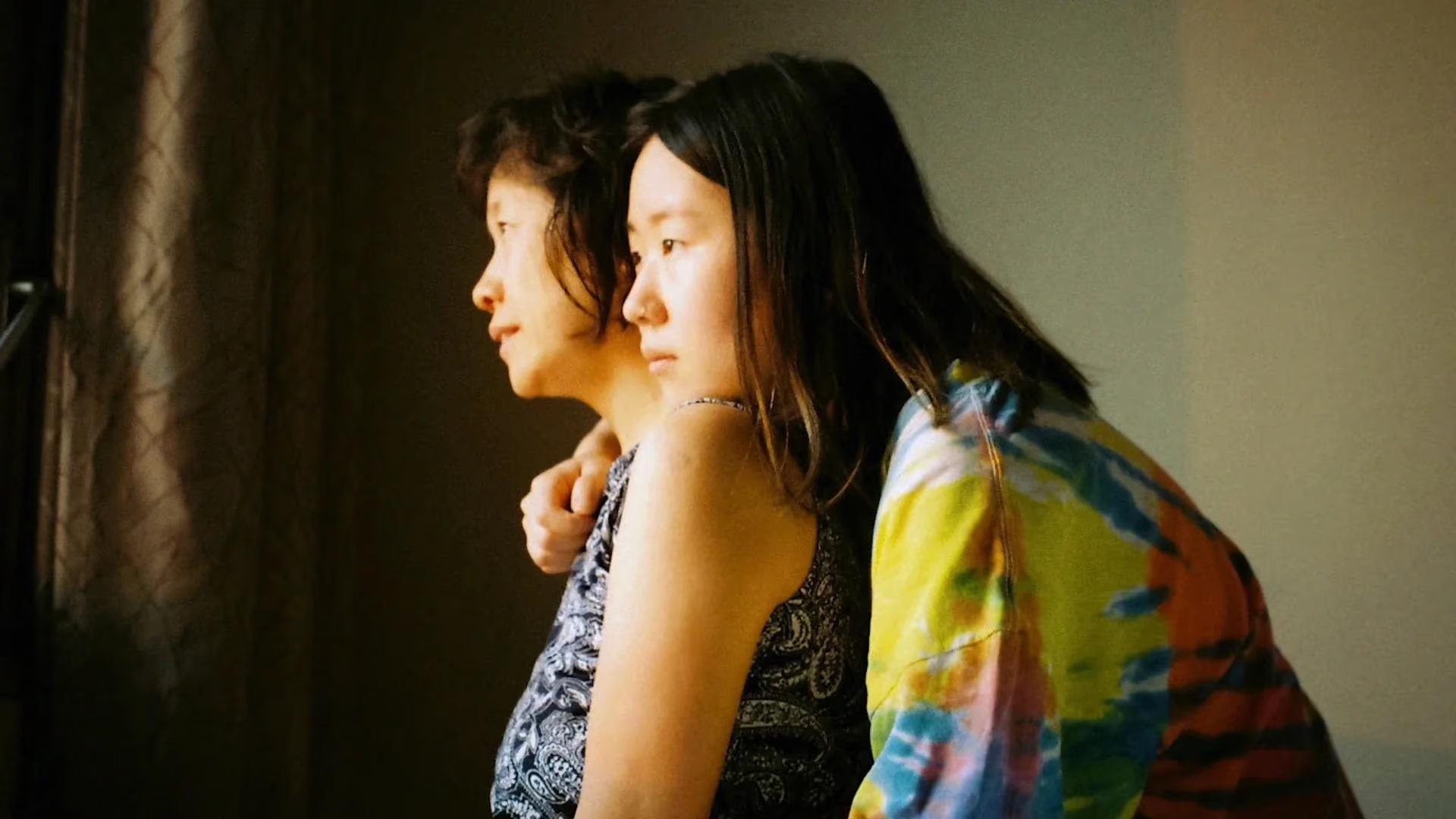
On the harder side, the film opens on a burning house before cutting through a sequence of stills: a crowd being scanned by facial-recognition cameras, a person sleeping rough on a city street, labourers extracting the raw minerals that eventually become the phones and chips AI runs on, and rows of cemetery headstones widely reported to have been filmed at Arlington National Cemetery. A voiceover threads the sequence with questions rather than answers: "Can AI be trusted?", "Who's gonna hit the brakes if we need to?", "Wait a minute, why do we have to have this stuff?"
Not every question in the film is bleak. Others are hopeful in a smaller, more personal register - "could AI help people stop feeling misunderstood?" is one example widely quoted in coverage - and the film's title is a genuine thesis rather than a marketing gloss: Anthropic's argument is that sitting honestly with the hard questions, rather than avoiding them, is itself the source of hope. Whether the execution earns that thesis is exactly what split the audience, covered in detail below.
The Research Behind It: Anthropic Interviewer
The questions dramatised in the film were not written cold. They come from Anthropic Interviewer, a research tool Anthropic built specifically to run structured qualitative interviews at scale using Claude itself as the interviewer. The tool works in three stages: researchers define a study's goals, Claude drafts an interview guide grounded in research best practice which a human team refines, Claude then conducts the live conversations - adapting its follow-up questions to what each participant actually says - and finally synthesises the transcripts against the original research plan, surfacing themes and representative quotations.
Anthropic first tested the approach on a smaller, more targeted study: 1,250 professional interviews split across the general workforce (1,000 people), scientists (125) and creative professionals (125), each conversation lasting roughly ten to fifteen minutes and conducted directly inside Claude.ai. That pilot is what surfaced the specific anxiety later dramatised in the film - creative professionals in particular expressed worry about displacement and about the ethics of AI systems trained on their work, a finding that directly shaped the decision to avoid triumphalist "look what AI can do" messaging in the final campaign.
The campaign's headline number comes from scaling that method up dramatically: a global pilot study of close to 81,000 people across 159 countries and 70 languages, examining how AI has actually affected their working lives, hopes and fears. That is, by a wide margin, one of the largest qualitative research exercises any AI lab has published, and it is the evidentiary backbone Anthropic points to when critics accuse the campaign of manufacturing anxiety for effect - the anxieties shown were reported by real respondents, not invented for the shoot.
Anthropic also layered in more conventional research alongside the Claude-run interviews: reporting on the campaign's rollout points to a separate public survey of roughly 52,000 Americans, plus in-person focus groups, feeding the same question bank. The combination - large-scale AI-conducted interviews, a traditional survey, and face-to-face groups - is unusually thorough for a single ad campaign, and is presumably why Anthropic is comfortable calling the film "research-grounded" rather than simply "inspired by".
The Questions People Actually Asked
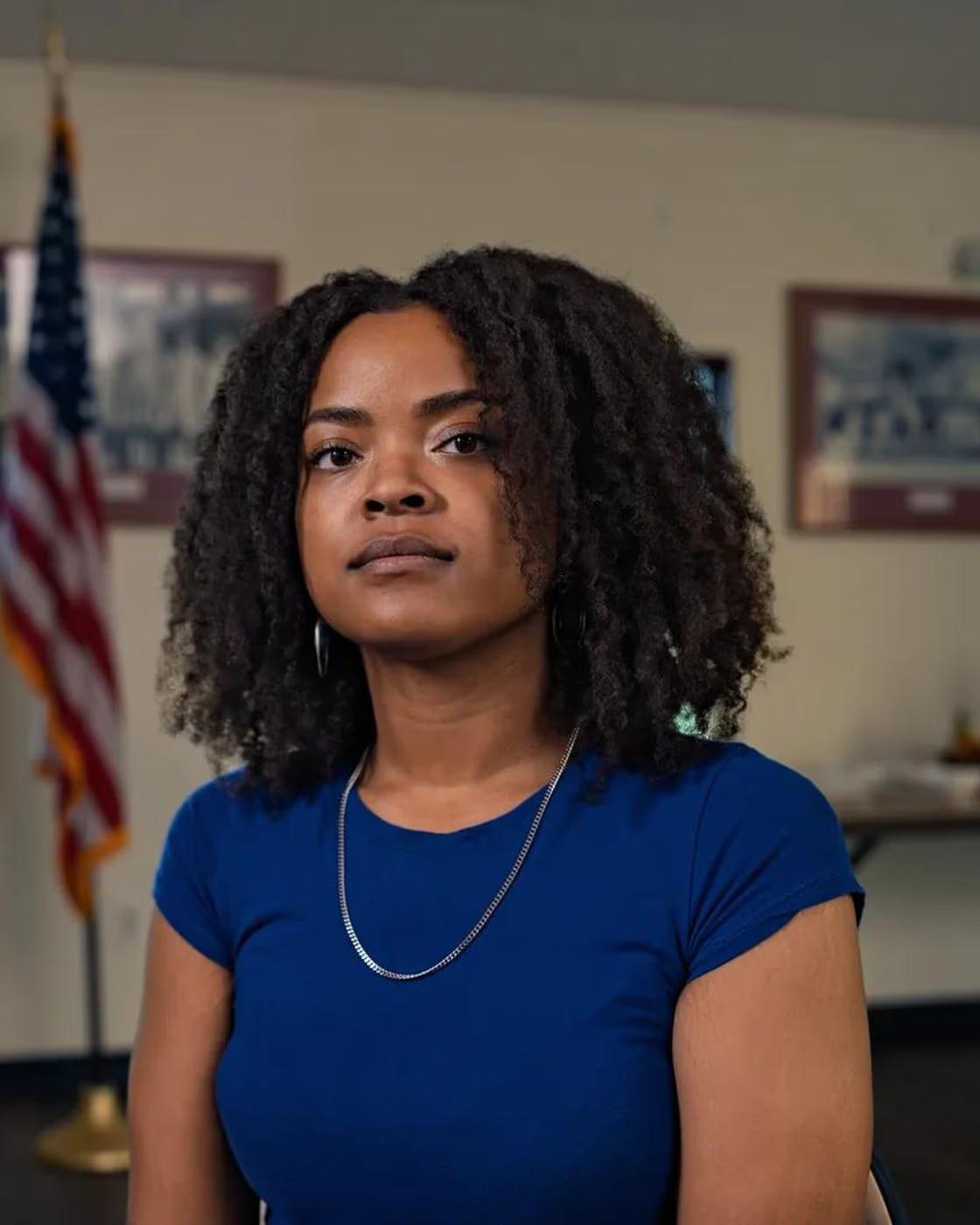
The claude.com/hard-questions site foregrounds individual respondents rather than aggregate statistics, which is a deliberate choice - it is easier to dismiss a survey number than a named person's stated concern. One example widely cited in coverage is Kamille, described on the site as a substitute teacher and tattoo artist, whose featured question - "will AI help with quicker medical diagnosis?" - stems from her own six-year journey to get a chronic illness correctly diagnosed. The site pairs that kind of individual story with a broader thematic breakdown across three groups Anthropic studied specifically: the general workforce, scientists, and creative professionals, each with a distinct cluster of concerns (job security and skills for workers, credit and methodology questions for scientists, authorship and displacement for creatives).
This structure - real people, real stated questions, organised by professional context - is what gives the "research-grounded" framing its credibility, and it is also what makes the surrounding imagery (graves, surveillance, burning homes) land as strangely as it does for some viewers: the questions are earnest and specific, but the visual treatment of them is closer to a public-service warning film than a research readout.
Reception: Doomer Ad or Honest Marketing?
The public reaction has been sharply, almost comically divided. On one side, the ad has been read as an unusually candid piece of corporate communication - an AI lab choosing to sit with the public's fear rather than talk over it, at real reputational cost. On the other, it has been mocked as tonally bizarre: a company selling an AI product by implying that AI might contribute to civilisational catastrophe.
The most-quoted reaction came from OpenAI's own CEO, Sam Altman, who wrote that he initially assumed the ad was satire and "kept looking for the handle to be spelled c1audeai or something" - a pointed jab from Anthropic's most direct competitor. Other commentators went further: one widely-shared critique called it representative of "the worst corporate communications ever" from an otherwise well-regarded company, and multiple pieces singled out the cemetery imagery specifically as "exceptionally weird and sinister" for a product advertisement.
Sympathetic coverage framed the same imagery differently: as evidence that Anthropic's marketing team was willing to let genuine public anxiety - about jobs, surveillance, and trust - dominate the frame instead of smoothing it into reassurance. Industry analysis pointed out that this fits a broader shift already underway in AI marketing, where "capability alone is getting harder to communicate in a believable way" and brands increasingly lean on values storytelling instead. Whichever read you take, the split reaction is itself the story: few recent AI ads have generated this much genuine, undecided debate rather than simple praise or dismissal.
The Strategic Calculation
Anthropic has spent much of 2026 positioning itself as, in one industry writer's phrase, "the ethical foil to other AI companies" - the lab willing to say uncomfortable things about its own technology in public. This campaign is that positioning taken to its logical extreme in a paid-media format most companies use exclusively for reassurance and desire.
The research findings explain why the tone landed where it did rather than somewhere more upbeat. Anthropic's own studies found creative professionals specifically worried about displacement and about the ethics of how their work trains AI systems - concerns that a triumphant "look what Claude can do" campaign would have aggravated rather than addressed. The strategic bet is that acknowledging the fear directly, in public, at Anthropic's own reputational expense, reads as more trustworthy than pretending the fear does not exist. Whether that bet pays off in actual brand trust, versus simply generating attention, is not yet resolvable from launch-week reaction alone.
There is also a more prosaic commercial logic underneath the values framing: attention. A campaign this genuinely divisive generates far more organic discussion - across X, YouTube commentary, and mainstream press - than a competent-but-forgettable capability ad would. Cynical and sincere readings of the campaign are not mutually exclusive; sophisticated brand strategy usually manages to be both at once.
Part of a Pattern: From the Pause Warning to Path to Hope
This is not the first time in 2026 that Anthropic has put uncomfortable-sounding warnings about its own technology into a public channel. In June, the company publicly argued that Claude's capability was advancing faster than the field's ability to interpret or oversee it - the substance of our earlier analysis, Anthropic's call for a global AI pause - and called for coordinated, industry-wide restraint on the most capable training runs.
The throughline between that policy statement and this consumer-facing campaign is the same underlying argument, aimed at two different audiences. The pause comments were addressed to regulators, competitors and the policy community: capability is outrunning oversight, and only collective coordination closes the gap. "Hope in hard questions" takes the identical premise - that AI raises real, unresolved risks that deserve to be named rather than marketed around - and aims it at the general public who actually use Claude day to day. Read together, the two moments describe a consistent (if commercially convenient) brand identity: the AI lab that keeps telling you to worry, while continuing to ship increasingly capable systems like Opus 4.8 and Mythos 1.
That consistency cuts both ways in how it is received. It gives Anthropic's messaging more credibility than a one-off stunt would - this is clearly a considered, repeated stance rather than a single viral swing. But it also sharpens the standard critique: a company that keeps warning about the gap between AI capability and AI oversight is also the company racing hardest to expand that capability, and no amount of research-grounded marketing changes that underlying tension.
How It Compares to Other AI Marketing
Set against the rest of the industry, the contrast is stark. OpenAI, Google and the wave of well-funded challengers covered in our June 2026 model wars roundup have consistently marketed on capability and convenience: faster, smarter, more useful, integrated everywhere. Anthropic's campaign is the rare example of a frontier lab using its largest media buy of the year to interrogate its own product category rather than celebrate it.
That makes for an unusual category comparison. It is closer in spirit to values-led advertising from consumer sectors that have previously weathered public trust crises - insurance, pharmaceuticals, oil and gas - than to typical tech-product marketing. Several marketing trade outlets explicitly framed it this way: as an early example of AI brands borrowing the "we hear you, we're listening" register that other high-anxiety industries adopted once feature marketing alone stopped moving public opinion.
The Fair Criticisms
- The imagery may not fit the medium. Even critics sympathetic to the underlying message argue that graves, surveillance footage and a burning house are an odd choice for a piece of paid product advertising, regardless of how well-researched the anxieties behind them are.
- Concern-as-content still monetises attention. However sincere the research, the campaign functions as brand marketing for a commercial product, and generating widespread unease is, whatever else it is, an effective attention strategy.
- The "public tracker" is unproven. Anthropic has promised to publicly answer submitted questions over time. As of launch, that commitment is a promise rather than a track record, and its credibility depends entirely on follow-through the company has not yet had time to demonstrate.
- The timing tension persists. As with June's pause comments, a company simultaneously warning the public about AI's risks while shipping ever more capable systems invites the obvious "then why do it" question, and the campaign does not really answer it.
- The safety record is more complicated than the ad implies. Critics have pointed out that in February 2026, Anthropic dropped the central commitment of its own Responsible Scaling Policy - the pledge to halt training on a model unless it could guarantee in advance that safety mitigations were adequate - during a public standoff with the Pentagon over unrestricted military use of Claude, covered in our reporting on the government blacklist dispute. A brand film asking "who's going to hit the brakes?" lands differently against a company that recently softened its own hardest internal brake.
Why It Matters Beyond the Ad
Whatever you make of the execution, the underlying research effort is genuinely significant. An 81,000-person qualitative study, conducted by an AI system rather than a traditional survey panel, is a new kind of instrument for understanding public sentiment about a fast-moving technology - and Anthropic Interviewer itself, separate from the ad campaign built on top of it, is a notable piece of applied AI research in its own right, with potential uses in market research and workplace-adoption studies well beyond marketing.
For anyone building on or evaluating Claude, the more durable signal is not the ad's tone but what it discloses about how Anthropic sees its own user base: workers worried about displacement, scientists asking about credit and methodology, creatives asking about authorship - the same concerns that show up, in more technical form, in the safety and alignment sections of Anthropic's model system cards. Marketing campaigns are ephemeral. The research infrastructure and the pattern of public disclosure behind them are not, and that pattern is worth tracking independently of whether any individual ad lands well.
The Bottom Line
"There's hope in hard questions" is a genuine outlier in AI marketing: a two-minute film that spends its biggest media moment of the year on discomfort rather than desire, grounded in one of the largest qualitative research exercises any AI lab has published. It is also, unmistakably, still an advertisement for a commercial product from a company racing to build more capable AI systems even as it asks the public whether that is wise.
Both readings are correct at once, and the honest response is to hold them together rather than pick a side. The research behind the campaign deserves to be taken seriously on its own terms. The execution deserves the scrutiny it has received. And the real test - whether Anthropic's promised public tracker of answered questions amounts to anything more than a launch-week pledge - is one that only time, not this campaign, can settle.
Last updated: 16 July 2026. Sourced from Anthropic's official campaign pages (claude.com/hard-questions, anthropic.com/about-anthropic-interviewer, anthropic.com/research/anthropic-interviewer) and reporting from TechCrunch, Ad Age, LBBOnline and Content Grip.