 AI Tools Review Editorial Team
Quick Answer:
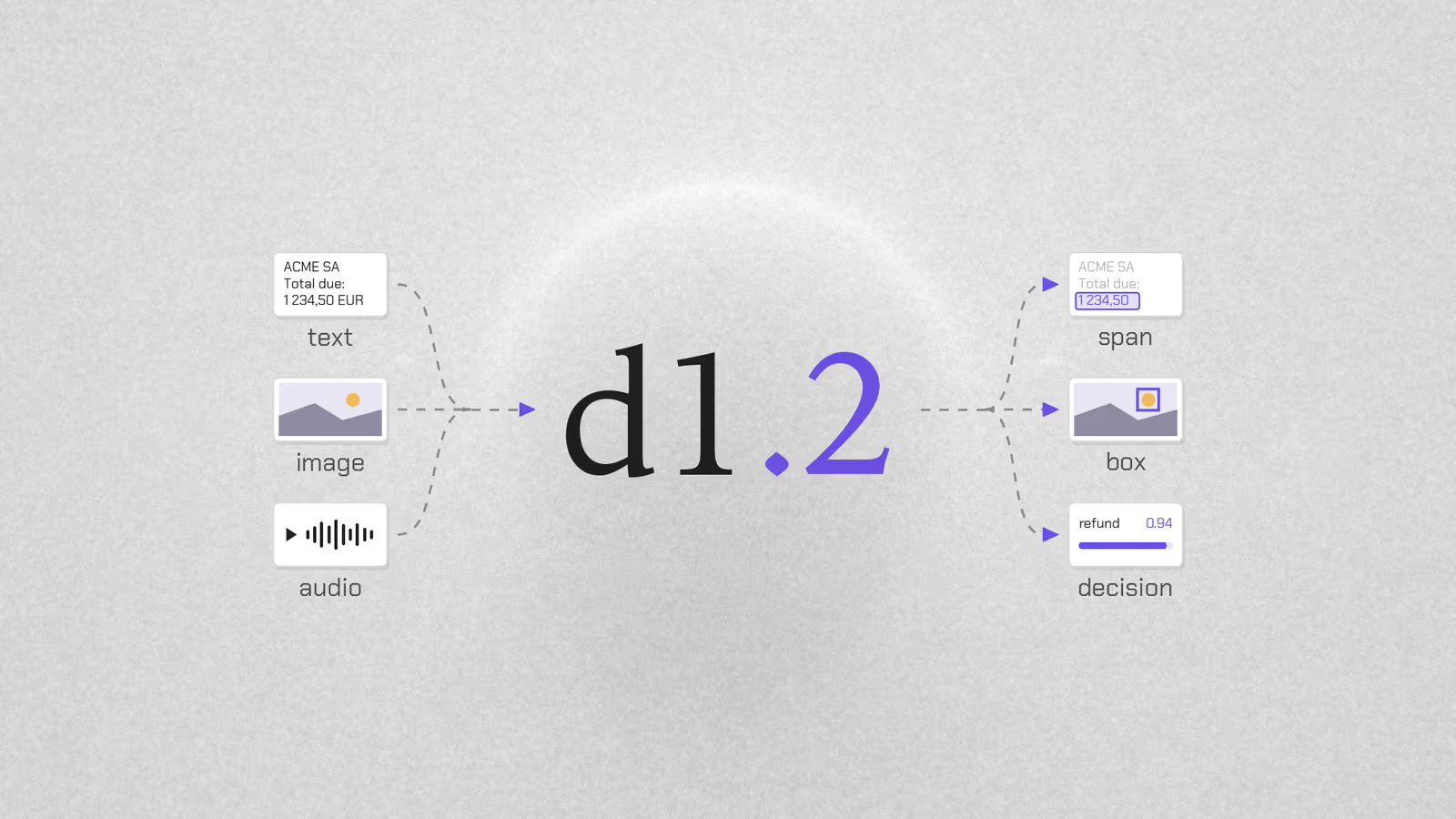
On 16/11/2026 Liquid AI released d1.2 and d1.2-ultra, the successors to its d1 decision models. Both now accept audio as well as text and images, and both add five new tasks: reading a value from the input, finding every passage of a kind, locating objects in a picture, estimating a number with a range, and picking every option that applies. They still generate zero output tokens. d1.2 costs $0.02 and d1.2-ultra $0.042 per million input tokens (about £0.015 and £0.032), with a 65,536-token input limit per question. Liquid reports that d1.2-ultra scores 75 on the Artificial Analysis Decision Index v2.1, the highest of 18 models charted, while d1.2 scores 69. The calibration and new-task accuracy figures are Liquid's own measurements. The older d1, d1.1 and d1-ultra are now deprecated.
When we reviewed the original d1 in October, the idea was strong and the evidence was thin: no launch post, no paid price, no accuracy figures. Seven weeks later Liquid AI has shipped a successor with all three, and has widened the model from a classifier into something closer to a general-purpose reader of documents, pictures and recordings that still never writes a word.
This review sets out exactly what changed between d1 and d1.2, what the published numbers do and do not show, what it costs, and where the launch post and the documentation disagree. Every figure below comes from a page we fetched on 18/11/2026.
75
d1.2-ultra, AA Decision Index v2.1
Highest of 18 models charted; d1.2 scores 69
$0.02 / $0.042
Per million input tokens
d1.2 / d1.2-ultra; output is free
5 + audio
New tasks and a new input type
Read, spans, boxes, estimate, multi-choice
0.8 pts
d1.2-ultra calibration error
Liquid's own measurement, 22,505 questions
Source: Liquid AI launch post and documentation, 16/11/2026
Julian Goldie SEO's take on d1.2 and d1.2-ultra for business automation. We check its claims against Liquid's own post and documentation below.
Executive Summary
- Released 16/11/2026, according to Liquid AI's launch post. Two hosted models: d1.2 (default, cheaper) and d1.2-ultra (more capable).
- Audio input is new. Both models take text, images and audio. The documentation allows up to eight clips and 300 seconds of audio per request.
- Five new tasks join the original Noul (yes/no), Choice (pick one) and Score (rate on a scale): read a value, find every passage, locate objects, estimate a number, and pick several options. The source video's claim of "five new capabilities" is accurate.
- Prices are published: $0.02 per million input tokens for d1.2 and $0.042 for d1.2-ultra. Output tokens are always zero and free.
- Input limit: 65,536 tokens per question, counting the state, images and audio. Up to 128 questions per call.
- Benchmark: d1.2-ultra scores 75 on the Artificial Analysis Decision Index v2.1, two points above three models tied on 73. d1.2 scores 69.
- Calibration: Liquid measures a calibration error of 0.8 points for d1.2-ultra and 1.2 for d1.2, against 2.7 to 7.2 for three named rivals. This is a vendor measurement.
- Deprecated: d1, d1.1 and d1-ultra still run but get no updates, no new tasks and no audio.
- Caveats: the new-task accuracy figures come from internal test sets; the official SDKs cannot yet read the new answer types; values are read from text, not from images; and the hosted models have no downloadable weights.
Lineage: From d1 to d1.2
Liquid AI is the MIT spin-out best known for small, efficient Liquid Foundation Models that run on phones and laptops. We have covered that side of the company in our reviews of LFM2.5-DSpark and the RIPL inference engine. Decision models are a separate product line. Liquid's documentation describes them as models that, instead of generating text token by token, evaluate a situation and return calibrated probabilities across a fixed set of outcomes "in a single call with zero generated tokens".
Our review of the original d1 covers the concept and its three question types in depth, so we will only summarise here. A Noul is a yes/no question answered with a probability. A Choice picks one of several named options and returns a probability for each. A Score rates something on an ordered scale. Those three remain the core of d1.2.
Between d1 and d1.2 there were two intermediate hosted models that this site did not review separately: d1.1 and d1-ultra. We know they existed because Liquid's deprecations page now lists all three older models with their replacements: d1 and d1.1 map to d1.2, and d1-ultra maps to d1.2-ultra. The page says the deprecated models "are still served on the Liquid API, but they are no longer updated and don't answer the new question types or take audio". Liquid's pricing page still lists d1.1 at $0.02 and d1-ultra at $0.042 per million input tokens, so the new models arrive at the same rates as the ones they replace.
The name of the underlying API also tells a story. The documentation index describes the endpoint as answering typed questions "using TypeSafe's System One API", and the client libraries are the TypeSafe SDKs. TypeSafe is the company behind Jev, which we covered in What Is Jev?. Liquid's models are therefore drop-in compatible with an interface that already had users, which lowers the cost of switching in either direction.
What Changed Versus d1
The table compares what we could confirm about d1 at its launch (from our October review, which relied on secondary coverage because Liquid had published no launch post) with what Liquid has now published for d1.2 and d1.2-ultra.
| d1 at launch (our October review) | d1.2 / d1.2-ultra | |
|---|---|---|
| Inputs | Text was all the launch coverage described | Text, images and audio |
| Question types | Noul, Choice, Score | Noul, Choice, Score, plus text, number, date, spans, box, boxes, number with a range, and Choice with multiple |
| Input limit | 32,000-token context reported | 65,536 tokens per question |
| Paid price | Not published; free tier only | $0.02 (d1.2) and $0.042 (d1.2-ultra) per million input tokens |
| Launch post | None | Yes, with benchmark charts |
| Benchmark evidence | A reported leaderboard position with no score | Artificial Analysis Decision Index v2.1 scores of 75 and 69 |
| Calibration data | None published | 0.8 and 1.2 points (Liquid's measurement) |
| Tiers | One model | Two: default and ultra |
| Weights | Hosted only | Hosted only; separate open-weight d1 models exist |
Two notes on that table. First, the 32,000-token figure for d1 came from secondary reporting at the time. Vercel's AI Gateway catalogue, which we queried on 18/11/2026, now lists the deprecated d1 with a 65,536-token context and d1-ultra with 32,768, so limits on the older models may have changed since launch. Second, migration is deliberately trivial. The documentation says: "To migrate, change model to d1.2 (from d1 or d1.1) or d1.2-ultra (from d1-ultra). The request and response format is unchanged."
The Five New Tasks
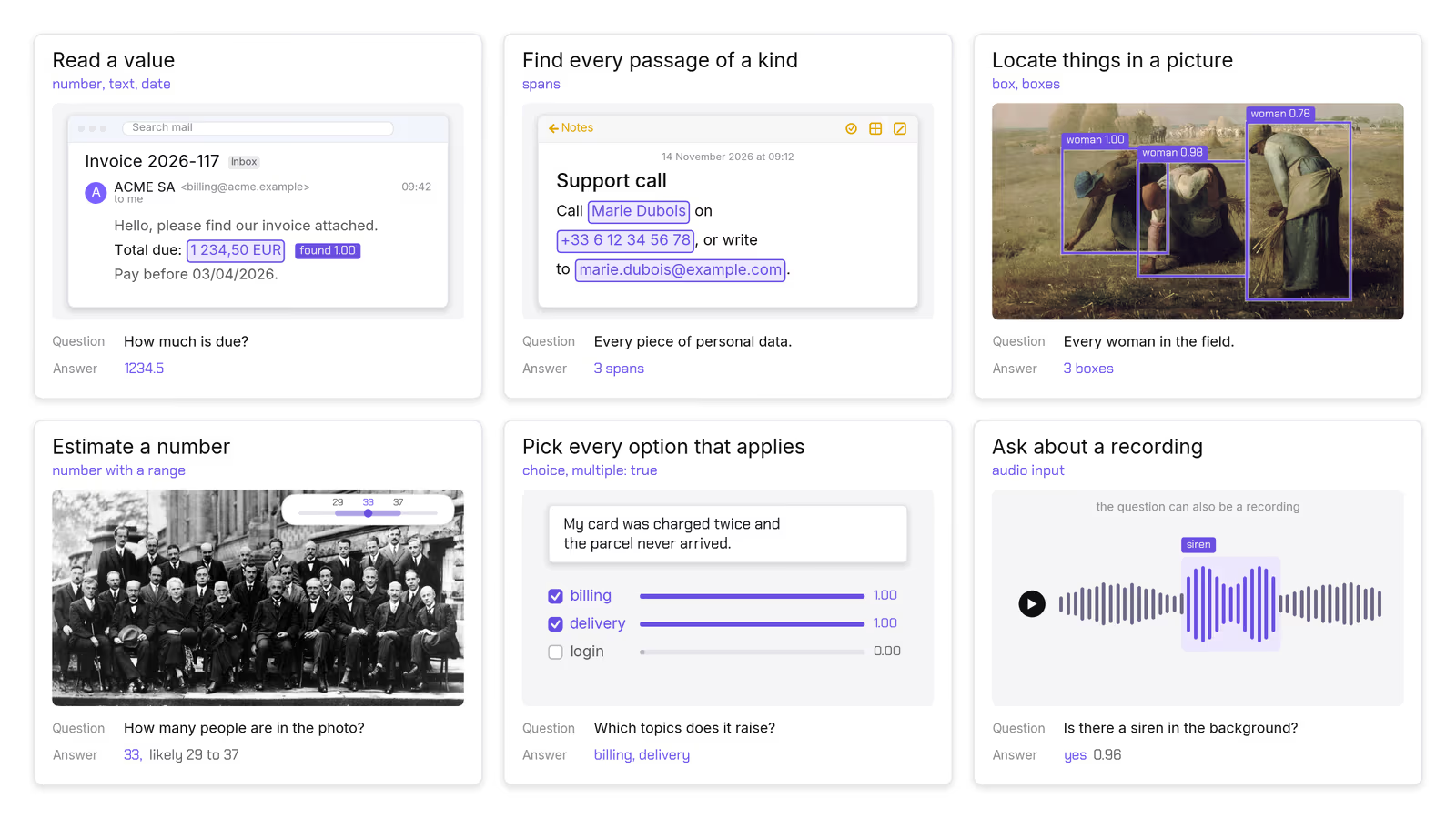
The original d1 could only choose among answers you supplied. The five new tasks let d1.2 return something from the input itself: a value, a passage, a rectangle. Liquid calls these typed answers. They use the same endpoint and request format, and the documentation notes that earlier models return an HTTP 422 error if you send them one of these questions.
Read a value
Question types text, number and date pull a single value out of the input. Liquid's example is asking "How much is due?" about an invoice: the model returns the value along with the characters it read it from. Crucially, if the invoice does not show the value, "it answers 'not found' instead of guessing". In the response this appears as a found field: the documentation says a value is treated as missing when found is under 0.5, and its value and span are then null.
The documentation adds a detail worth knowing: "Values are read, not converted." A number or date is parsed from the span of text the model pointed at, so 4 % reads as 4 with the unit %. Dates come back in ISO 8601 format. In the launch post's example, an invoice reading "Total due: 1 234,50 EUR" and "Pay before 03/04/2026 (day/month/year)" returns the number 1234.5 and the date 2026-04-03, and a question about VAT, which the invoice does not state, returns nothing.
Find every passage
The spans type returns every passage of a given kind in a text, each with its position. The headline use is redaction: ask for every piece of personal data in a note and get back each name, phone number and email address with character offsets. You can request between 1 and 64 passages, with 16 as the default. The answer includes a count and an at_least flag, which signals that the text may hold more instances than the model returned.
Locate things in a picture
box returns a rectangle around one object, or "not found". boxes returns a rectangle around every instance, with a count. Coordinates are given as fractions of the picture (top, bottom, left, right), and each box has its own confidence. Liquid's examples are finding the signature on a scanned form and finding every tree in a photo. One restriction: a request with a box or boxes question must contain exactly one image.
Estimate a number
A number question with a range asks for a quantity that is not written anywhere, such as how many people are in a photograph. The model returns a best guess (the median) and an interval running from the 10th to the 90th percentile. The documentation is candid about the limits: the model considers at most 128 values between your low and high bounds, and estimates "are reliable on counts and scores, less so on free quantities".
Pick every option that applies
Setting multiple to true on a Choice question turns pick-one into pick-any. Each option gets its own independent probability, and the answer lists every option at 0.5 or above. Liquid's example is a support message that says "My card was charged twice and the parcel never arrived", which is both a billing and a delivery issue. With the old single Choice you would have had to force one label or ask a separate Noul per topic.
Audio Input
Both models now accept audio clips alongside, or instead of, a text state. Liquid's examples are identifying which language someone is speaking and detecting a siren in the background. The documentation lists call routing, voice-command routing and spoken-intent detection as target uses.
The documented limits are specific:
- Formats: WAV, MP3, FLAC and OGG (Opus or Vorbis), sent as Base64.
- Clips per request: up to 8.
- Total length: up to 300 seconds per request.
- Request size: the whole JSON body must stay under 4.5 MB. The documentation notes this binds first for uncompressed WAV, which fits about 100 seconds of 16-bit mono audio at 16 kHz.
- Billing: 10 input tokens per second, rounded up per clip. A 42-second call is 420 tokens.
There is one inconsistency between Liquid's two sources. The launch post says "The question itself can also be a recording, spoken instead of typed." The hosted-model documentation says "Questions are always written as text." We could not test which is correct, so if spoken questions matter to you, verify it before you build on it.
Benchmarks: The Artificial Analysis Decision Index
The biggest gap in the d1 launch was the absence of a score. The headline claim at the time was a position on the Jev Decision Index on Hugging Face, reported second-hand, with no number attached. For d1.2 Liquid has switched to a different yardstick, the Artificial Analysis Decision Index v2.1, and has published the chart.
Liquid describes the index as evaluating decision models "on six benchmarks, from decisions and extraction on resumes, receipts and research papers to tool calling and hard knowledge questions". The chart's own subtitle names them: AA-Paperclip, EvalSafe-O*NET-AA, When2Call, AA-Omniscience-Decision v1.1, HLE-MultiChoice v1.1 and AA-Symmetry v1.1. The scoring rule matters: it is accuracy less the Brier score of the chosen answer's probability, on a 0 to 100 scale where 100 means certain and right. In Liquid's words, "a confident wrong answer costs more than a hesitant one". That makes it a test of probabilities as well as picks.
Artificial Analysis Decision Index v2.1
0-100, higher is better. All 18 models on the chart Liquid published. The two Liquid models are the first and seventh rows.
d1.2-ultra (Liquid AI)
Drex Max v1.1
SubQ Snap 1.2
GLiDE v1.2
Mammoth 27B
Decider v1.3 (Perplexity)
d1.2 (Liquid AI)
Elephant 9B
Jev 1.14
Gemini Decision 1
Decider Flash v1.3
Microsoft-Decision-1
Mercury Decide
Celeris-1.1 Decision
Drex 2.0
Clef
GPT-6 Luna (Decisions)
Clef-Omni
Show data table
| Benchmark | Decision Index v2.1 score |
|---|---|
| d1.2-ultra (Liquid AI) | 75 |
| Drex Max v1.1 | 73 |
| SubQ Snap 1.2 | 73 |
| GLiDE v1.2 | 73 |
| Mammoth 27B | 71 |
| Decider v1.3 (Perplexity) | 70 |
| d1.2 (Liquid AI) | 69 |
| Elephant 9B | 66 |
| Jev 1.14 | 66 |
| Gemini Decision 1 | 66 |
| Decider Flash v1.3 | 64 |
| Microsoft-Decision-1 | 62 |
| Mercury Decide | 62 |
| Celeris-1.1 Decision | 62 |
| Drex 2.0 | 62 |
| Clef | 60 |
| GPT-6 Luna (Decisions) | 60 |
| Clef-Omni | 58 |
Source: Artificial Analysis chart as published in Liquid AI's d1.2 launch post, 16/11/2026
Three things stand out. First, d1.2-ultra's lead is real but narrow: 75 against a three-way tie on 73. Liquid's phrasing, "two points ahead of the previous best decision model", is accurate. Second, the cheaper d1.2, at 69, is not a leader on raw score. Six models sit above it, including Perplexity's Decider v1.3 on 70. Its case rests on price, which we come to next. Third, the big-lab entries are mid-table: Gemini Decision 1 on 66, Microsoft-Decision-1 on 62 and GPT-6 Luna on its Decisions API on 60. The Gemini figure matches the 66 we reported in our Gemini Decision 1 vs OpenAI Decisions API comparison, which is some reassurance that the chart is a faithful copy of Artificial Analysis's results.
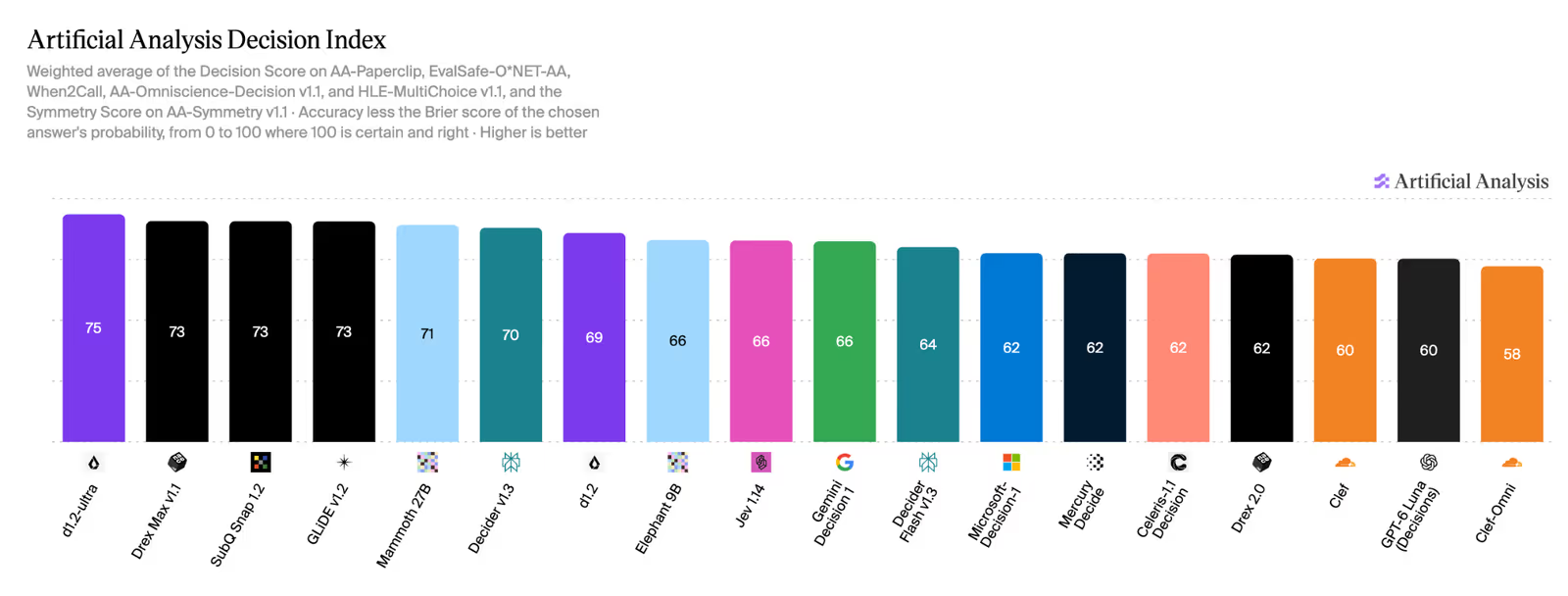
A caveat on provenance. The chart carries Artificial Analysis branding, but we took it from Liquid's post. We could not load a public Decision Index page on Artificial Analysis's own site to cross-check every figure, so treat it as an independent benchmark reported by the vendor it flatters.
Score Versus Cost
Liquid makes a second, more careful claim: "no model scores higher than d1.2 for less money, and no model scores higher than d1.2-ultra at any price." This refers to a second Artificial Analysis chart plotting each model's index score against its average cost per million tasks.
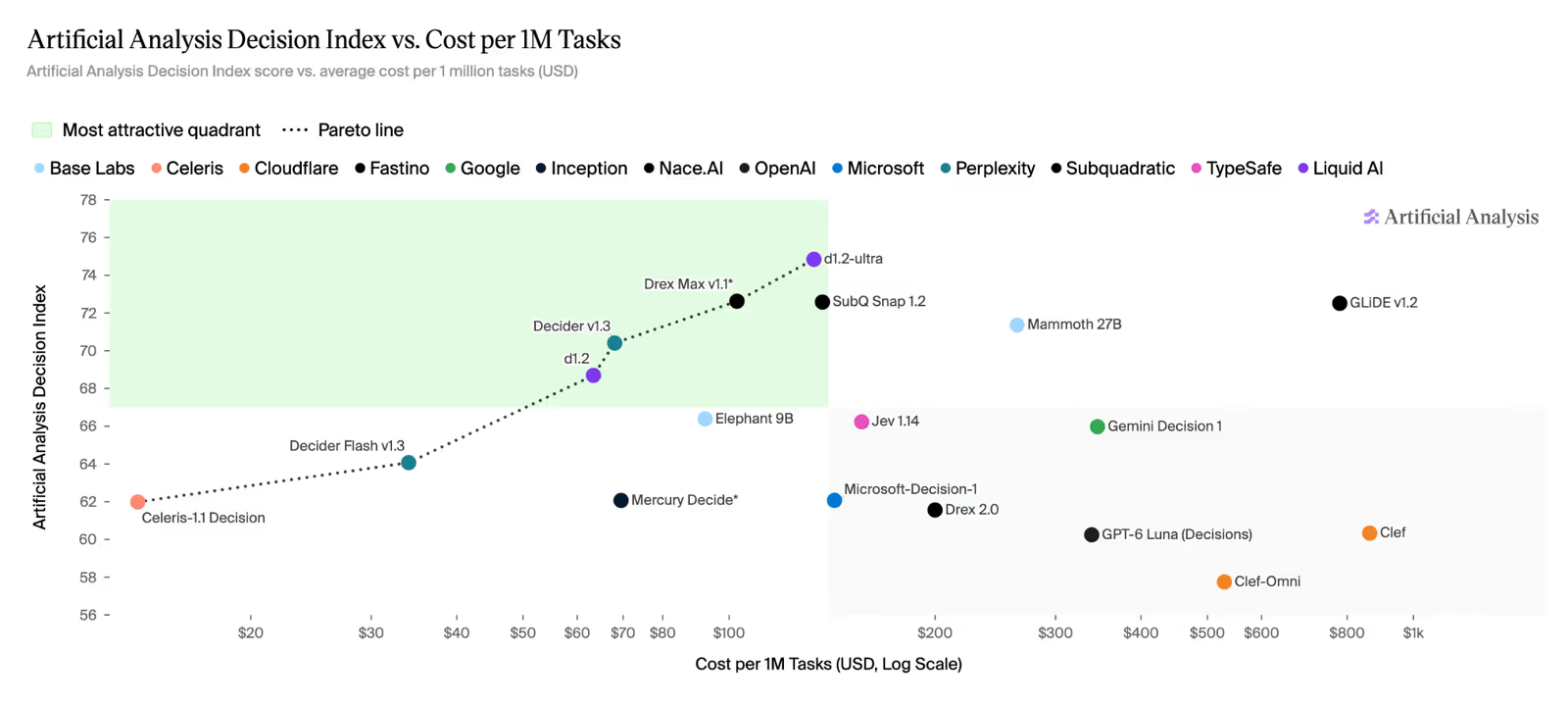
The chart does not print the cost values, so the bars below are our readings from its logarithmic axis and are marked with "~". Treat them as accurate to within roughly 5%, good enough to rank the models but not to quote to the dollar.
Cost per one million tasks on the Decision Index
US$, lower is better. Approximate values read from Artificial Analysis's log-scale chart. Selected models.
Celeris-1.1 Decision · index 62
Decider Flash v1.3 · index 64
d1.2 (Liquid AI) · index 69
Decider v1.3 (Perplexity) · index 70
Drex Max v1.1 · index 73
d1.2-ultra (Liquid AI) · index 75
SubQ Snap 1.2 · index 73
Microsoft-Decision-1 · index 62
Jev 1.14 · index 66
GPT-6 Luna (Decisions) · index 60
Gemini Decision 1 · index 66
GLiDE v1.2 · index 73
Show data table
| Benchmark | Cost per 1M tasks (US$) |
|---|---|
| Celeris-1.1 Decision | ~$14 |
| Decider Flash v1.3 | ~$34 |
| d1.2 (Liquid AI) | ~$63 |
| Decider v1.3 (Perplexity) | ~$68 |
| Drex Max v1.1 | ~$103 |
| d1.2-ultra (Liquid AI) | ~$133 |
| SubQ Snap 1.2 | ~$137 |
| Microsoft-Decision-1 | ~$143 |
| Jev 1.14 | ~$156 |
| GPT-6 Luna (Decisions) | ~$339 |
| Gemini Decision 1 | ~$346 |
| GLiDE v1.2 | ~$784 |
Source: Our readings from the Artificial Analysis Decision Index vs Cost chart in Liquid AI's launch post, 16/11/2026
Read alongside the scores, this is the most useful picture in the launch. d1.2-ultra reaches the top score at roughly $133 per million tasks, which is about a sixth of what GLiDE v1.2 costs for a score two points lower, and well under half the cost of Gemini Decision 1 or GPT-6 Luna for a score nine to fifteen points higher. d1.2 gets to 69 for about $63, roughly half the cost of d1.2-ultra.
The claim has edges, though. Decider v1.3 scores one point more than d1.2 for only a few dollars more, so the two are near neighbours on the line, not a rout. Drex Max v1.1 offers 73 for about $103, which is a legitimate middle option between the two Liquid models. And if your task is easy, Celeris-1.1 Decision and Decider Flash v1.3 are cheaper still. Two models on the chart, Drex Max v1.1 and Mercury Decide, carry an asterisk that the launch post does not explain.
Calibration
A decision model's probabilities are only useful if they mean what they say. Liquid puts it simply: "When it says 80%, it should be right about 80% of the time, which lets you set a threshold." That is what allows you to auto-approve confident cases and send uncertain ones to a person. Calibration error measures the gap between predicted probability and observed accuracy, in percentage points.
In our d1 review we wrote that calibration was Liquid's claim and that only a test could show it. Liquid has now run one. Across 13 benchmarks and 22,505 questions answered by all five models, it reports the following.
Calibration error across 13 benchmarks
Percentage points, lower is better. 22,505 questions answered by all five models. Measured by Liquid AI, not independently.
d1.2-ultra (Liquid AI)
d1.2 (Liquid AI)
Jev 1.14
Decider v1.3 (Perplexity)
GPT-6 Luna (Decisions API)
Show data table
| Benchmark | Calibration error (points) |
|---|---|
| d1.2-ultra (Liquid AI) | 0.8 pts |
| d1.2 (Liquid AI) | 1.2 pts |
| Jev 1.14 | 2.7 pts |
| Decider v1.3 (Perplexity) | 3.7 pts |
| GPT-6 Luna (Decisions API) | 7.2 pts |
Source: Liquid AI d1.2 launch post, 16/11/2026
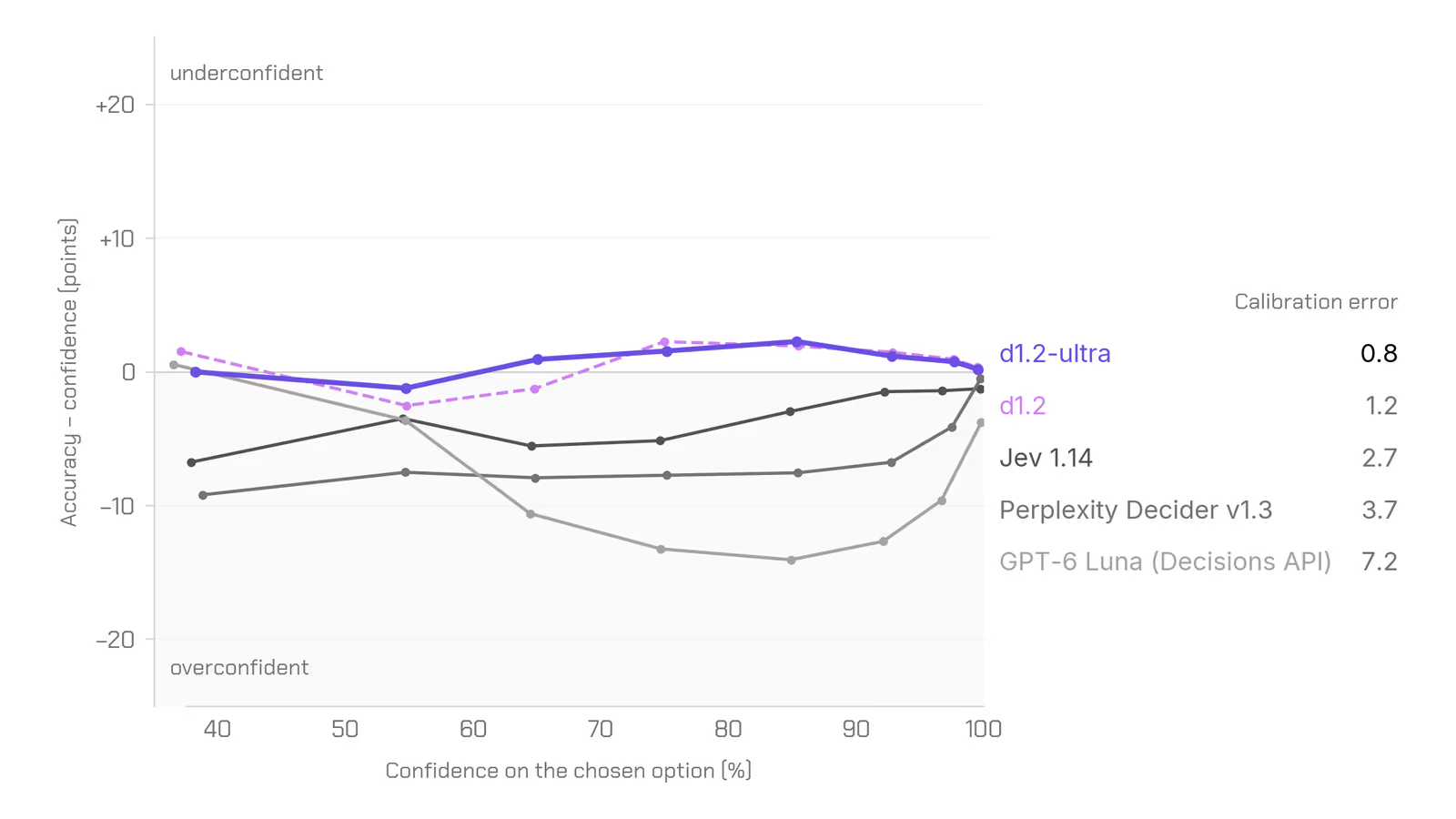
The plot is more informative than the single numbers. Both Liquid models hug the zero line across the whole confidence range. The three rivals shown all sit below it, meaning they are overconfident, and GPT-6 Luna's line dips to roughly 14 points below zero at around 85% confidence. If that holds on your data, a threshold of 0.85 on Luna would let through far more errors than the number suggests.
Now the caveats. This is a vendor benchmark: Liquid chose the 13 benchmarks, ran the test and picked the comparison set, and the post does not list which benchmarks they were. Only three rivals are shown, and none of the three models tied on 73 in the Decision Index (Drex Max, SubQ Snap, GLiDE) is among them. The Decision Index itself does reward good probabilities, which gives indirect independent support, but the 0.8 figure specifically is unverified. Liquid's own documentation ends its typed-answers section with the right advice: "Calibrate any decision threshold on data from your own use."
Accuracy on the New Tasks
Liquid is upfront that "no public benchmark measures the five new tasks yet", so it evaluated them on "internal test sets built from held-out splits of public datasets". A read or a box counts as right when it finds the target, or says "not found" when the target is absent.
Accuracy on the five new tasks
Per cent, higher is better. Liquid AI's internal test sets built from public datasets.
- d1.2-ultra
- d1.2
Read a value from a receipt · CORD, SROIE
Find personal data: precision · Nemotron PII
Find personal data: recall · Nemotron PII
Locate a described object · RefCOCO, RefCOCO+, RefCOCOg
Estimate object count, within one · COCO
Pick every object present · COCO
Show data table
| Benchmark | d1.2-ultra | d1.2 |
|---|---|---|
| Read a value from a receipt | 98% | 96% |
| Find personal data: precision | 94% | 92% |
| Find personal data: recall | 93% | 88% |
| Locate a described object | 94% | 94% |
| Estimate object count, within one | 93% | 92% |
| Pick every object present | 87% | 90% |
Source: Liquid AI d1.2 launch post, 16/11/2026 (internal benchmarks)
The gap between the two models is small on most rows and largest on recall for personal data, where d1.2-ultra finds 93% of items and d1.2 finds 88%. For redaction that difference matters, because every missed item is a leak. On locating a described object the two tie at 94%, and on picking every object present in a photo the cheaper d1.2 actually scores higher, 90% against 87%. So "ultra" is not uniformly better, and for image-heavy work the default model may be the right choice at less than half the price.
For audio, Liquid says that on held-out recordings both models answer "95% to 97%" of questions about which sound they hear (ESC-50) or which language is spoken (FLEURS, 43 languages), where each question offers three to six options or asks a yes-or-no question. Liquid notes the options include close confusions such as Spanish and Portuguese.
These are encouraging numbers and they are also the least verifiable in the launch. The test sets are internal, there is no comparison against any other model, and the scoring rule (finding the target counts as right) is more forgiving than exact-match scoring would be. A 93% recall on a public PII dataset also tells you little about your own documents, with your own formats and your own kinds of identifier.
Pricing, Limits and Access
This is the section we could not write for d1. Prices come from Liquid's pricing page and documentation. Sterling figures use the ECB reference rate of $1 = £0.758 on 17/11/2026 and are rounded.
| d1.2 | d1.2-ultra | |
|---|---|---|
| Input price per million tokens | £0.015 ($0.02) | £0.032 ($0.042) |
| Output price | Free (zero tokens generated) | Free (zero tokens generated) |
| Inputs | Text, images, audio | Text, images, audio |
| Input limit per question | 65,536 tokens | 65,536 tokens |
| Questions per call | Up to 128 | Up to 128 |
| Images per request | Up to 8 (exactly 1 with box questions) | Up to 8 (exactly 1 with box questions) |
| Audio per request | Up to 8 clips, 300 seconds in total | Up to 8 clips, 300 seconds in total |
| Image billing | 1.5 tokens per 32 x 32 pixel patch | 1.5 tokens per 32 x 32 pixel patch |
| Audio billing | 10 tokens per second | 10 tokens per second |
| Request size | Under 4.5 MB | Under 4.5 MB |
| Liquid's positioning | Default; faster, under half the price | Most capable, for harder decisions |
| Parameter count, latency | Not published | Not published |
Those prices are extremely low in absolute terms, so a few worked examples help. The arithmetic is ours, using Liquid's published rates:
- A short text decision. The documentation's first example, a one-sentence complaint with one Noul question, bills 54 input tokens. A million such calls is 54 million tokens: about $1.08 on d1.2 or $2.27 on d1.2-ultra.
- An image. A 1024 x 1024 image is 1,024 patches and 1,536 tokens. A million of those costs about $30.72 on d1.2 or $64.51 on d1.2-ultra, before the question text.
- A recording. The maximum 300 seconds of audio is 3,000 tokens, which is $0.00006 on d1.2 or about $0.00013 on d1.2-ultra per request.
- Extraction questions cost more. A question's tokens include its answer slots, so a spans or boxes question costs more as its maximum grows: about 250 and 415 tokens respectively at the default of 16.
The billing model rewards batching. A request "bills its text and pictures once, and each extra question adds only its own text", so asking ten questions about one document is far cheaper than ten separate calls. The pricing page also says every new organisation starts with $2 (about £1.52) of free credit, which at d1.2's rate is 100 million input tokens. That is ample for a serious pilot.
Where to call it. The launch post says the models are available on the Liquid API with a key from console.liquid.ai, and adds "Coming to OpenRouter and Vercel soon." Vercel appears to have moved quickly: when we queried the Vercel AI Gateway catalogue on 18/11/2026, both liquid/d1.2-ultra and liquid/d1.2 were already listed at the same $0.042 and $0.02 rates with a 65,536-token context. However, the gateway listing describes both as text and image models and does not mention audio or the new tasks, so do not assume the gateway route exposes everything the direct API does. We could not confirm an OpenRouter listing. Liquid's pricing page states that "the price is the same wherever you call our models from".
The API in Practice
A call has a model, a state (the text or JSON object to evaluate), a set of named questions, and optional images and audio arrays. The endpoint is unchanged from d1: https://api.liquid.ai/decisions/v1/systemone. This is the launch post's invoice example, lightly reformatted:
import os, requests

invoice = "ACME SA\nInvoice 2026-117\nTotal due: 1 234,50 EUR\nPay before 03/04/2026 (day/month/year)"

response = requests.post(
    "https://api.liquid.ai/decisions/v1/systemone",
    headers={"Authorization": f"Bearer {os.environ['LIQUID_API_KEY']}"},
    json={
        "model": "d1.2-ultra",
        "state": invoice,
        "questions": {
            "payee": {"type": "text", "instructions": "Who issued the invoice?"},
            "total": {"type": "number", "instructions": "How much is due?"},
            "due": {"type": "date", "instructions": "By when must it be paid?"},
            "vat": {"type": "number", "instructions": "How much VAT is charged?"},
        },
    },
)
a = response.json()["answers"]
print(a["payee"]["text"], a["total"]["number"], a["due"]["date"], a["vat"]["number"])
# ACME SA 1234.5 2026-04-03 None
Four questions, one request, one charge for the invoice text, and a clean null for the VAT figure the invoice never states. Notice that the example uses plain requests instead of the SDK. That is not a style choice. The documentation states that the TypeSafe SDKs "can't read these answers yet: they drop them from the response, and a multiple-choice question makes the call fail." For now the SDKs are only good for Noul, Choice and Score on text, and everything new needs a direct HTTP call.
Liquid also publishes an agent skill for coding assistants, installable in Claude Code, Codex and others. According to the documentation it can inspect a codebase, "recommend structured replacements for prompt-and-parse LLM calls", and help design questions. For a team with dozens of scattered classification prompts, that is a sensible way to find candidates for migration.
The documentation's practical tips for typed answers are worth repeating, because each one is a trap if you miss it:
- Values are read from text, not pictures. "A value that only appears in an image is not found, so send the document's text (from a PDF's text layer or from OCR) as the state." d1.2 does not replace your OCR step for extraction.
- Ask spans on their own. A spans question sent alongside other question types "can return fewer passages". Send it in its own request for best recall.
- JSON states return paths. If the state is a JSON object, each value read also carries a JSON Pointer to where it was found.
- Images must be uploaded. Remote image URLs are not accepted; send Base64. Formats are JPEG, PNG and WebP, up to 10,000 patches across all images.
Use Cases, Including Lead Qualification
Liquid's documentation lists the established uses: classification, routing, scoring, triage, content moderation, guardrails, replacing an LLM as a judge, approving agent tool calls, and model routing. The new tasks add document reading, redaction of personal data and locating objects, and audio adds call and voice-command routing.
The source video frames d1.2 around business automation and lead qualification. Liquid does not use that phrase in the pages we read, so treat it as the presenter's application, not a vendor claim. It is a reasonable fit, though, and it shows how the pieces combine. For an inbound enquiry you could ask, in a single call:
- a Noul: is this a genuine sales enquiry and not spam or a supplier pitch?
- a Choice with multiple: which of our services does it mention?
- a Score: how strong is the buying intent, on a defined scale?
- a number and a date: what budget and deadline does the message state, if any?
The honest "not found" is what makes the last line usable. A language model asked for a budget will sometimes supply one. A model that returns null when the email does not state a budget gives your CRM a blank field instead of an invention. The probabilities then let you route confidently: high-intent, high-confidence leads straight to a salesperson, uncertain ones to a review queue.
What d1.2 cannot do is write the reply. Any workflow that ends in a drafted email still needs a language model for that step. The realistic architecture is a decision model at the front as a cheap, fast gate, and a generative model behind it for the minority of cases that need prose. The same applies to agent approval checks of the kind we describe in our coverage of OpenAI Dots and Hermes Agent.
Limitations and What Is Unverified
- Hosted only. Liquid's documentation labels d1.2 and d1.2-ultra "Hosted". There are no weights to download, so data leaves your network. The pages we read give no release plan for these two models' weights.
- Vendor-measured evidence. The calibration figures and all the new-task accuracy figures are Liquid's own. Only the Decision Index is third-party, and we saw it via Liquid.
- No latency or throughput figures. Liquid calls d1.2 "faster" than d1.2-ultra but publishes no millisecond numbers for either. Parameter counts are also unpublished.
- No head-to-head with d1. The launch post does not show how the old d1, d1.1 or d1-ultra score on the same index, so we cannot say how much more accurate d1.2 is on the original three question types.
- SDK gap. The TypeSafe SDKs drop typed answers and fail on multiple-choice questions. You must call the endpoint directly for anything new.
- Extraction needs text. Values and spans are read from the text state, not from images. Scanned documents still need OCR first.
- Audio is capped at 300 seconds per request, and uncompressed WAV hits the 4.5 MB body limit at about 100 seconds.
- Estimates are bounded. At most 128 candidate values, and "less so" reliable on free quantities than on counts.
- Spoken questions are unclear. The launch post says a question can be a recording; the documentation says questions are always text.
- Gateway parity is unclear. Vercel's listing shows text and image only, and OpenRouter availability was not confirmed.
- Data terms. Vercel's catalogue does not flag the Liquid endpoints as zero-data-retention. Check Liquid's terms before sending personal data, particularly if you plan to use the model to find personal data.
- Still no explanations. You get a probability and, for extraction, a span. You do not get reasons.
How It Compares
The decision-model field has filled up quickly. When d1 launched it had a handful of rivals. The Artificial Analysis chart now shows 18 models from 13 vendors, including Google, OpenAI, Microsoft, Perplexity and Cloudflare.
Versus Jev. Jev 1.14 scores 66 on the index against 75 and 69 for the Liquid pair, and costs more per task than either on the Artificial Analysis chart. Liquid also measures Jev's calibration error at 2.7 points against its own 0.8 and 1.2. Because both use the same System One request format, switching between them is close to a one-line change, which makes a side-by-side test cheap. See our Jev review for the background.
Versus Google and OpenAI. Gemini Decision 1 scores 66 and GPT-6 Luna on the Decisions API scores 60, and both sit at roughly $340 per million tasks on the chart, about two and a half times d1.2-ultra and more than five times d1.2. The big labs' advantage is convenience: if you already have Google or OpenAI credentials, billing and compliance sign-off, their decision endpoints need no new vendor. Our Gemini Decision 1 vs OpenAI Decisions API comparison and GPT-6 Sol and Luna review cover those options.
Versus Microsoft-Decision-1. It scores 62 at a cost per task slightly above d1.2-ultra. Its draw is the Azure estate around it, as we explain in our Microsoft-Decision-1 review.
Versus Perplexity's Decider v1.3. This is d1.2's closest rival: one point higher on the index for a few dollars more per million tasks. Liquid's counter is calibration, where it measures Decider at 3.7 points against d1.2's 1.2. If you rely on thresholds, that could matter more than a one-point difference in score.
Versus the 73-point group. Drex Max v1.1, SubQ Snap 1.2 and GLiDE v1.2 all score 73. Drex Max is cheaper per task than d1.2-ultra, SubQ Snap is about the same, and GLiDE is several times dearer. Liquid published no calibration comparison against any of them.
Versus Liquid's own open-weight models. If data cannot leave your servers, Liquid documents d1-2B (1.9 billion parameters; text, images, video), d1-omni-2B (2.2 billion; adds audio) and d1-omni-600M (587 million; the smallest, with up to 30 seconds of speech). They support typed answers on some runtimes, though the documentation notes that llama.cpp supports only Noul, Choice and Score and that spans are available only on the Liquid API. Liquid published no Decision Index scores for these in the launch post. The open models are licensed free for companies under $10 million in annual revenue. Other fast-inference approaches, such as the diffusion model in our Mercury 2 review, come at the same problem from the text-generation side; its sibling Mercury Decide scores 62 here.
Who Should Use Which Model
Start with d1.2 if you run high-volume classification, routing or moderation and cost matters; if your work is image-based (it ties or beats d1.2-ultra on two of Liquid's three image tests); or if you are migrating from d1 or d1.1, where it is the documented replacement at the same price.
Choose d1.2-ultra if wrong decisions are expensive; if you are redacting personal data, where its recall is five points higher; or if you depend on tight probability thresholds and want the best calibration on offer. At $0.042 per million tokens the premium is trivial for most workloads, so a reasonable default is to start on ultra and step down only if a test shows d1.2 is as good on your data.
Look elsewhere if your data must stay on your own hardware (consider Liquid's open-weight d1 models), if you need written explanations with each decision, if you need to process recordings longer than five minutes in one pass, or if your procurement process will not accept vendor-measured accuracy.
Whichever you choose, the pilot method from our d1 review still applies: pick your busiest decision route, shadow-run the new model alongside the old one, measure accuracy per class, and check that probabilities above your threshold are right as often as they claim. With $2 of free credit covering tens of millions of tokens, the test costs you engineering time and nothing else.
The Bottom Line
d1.2 fixes most of what we criticised about d1. There is a launch post. There are prices, and they are low. There is a third-party index on which d1.2-ultra leads, narrowly, and a cost chart on which both models sit on the efficient frontier. Our October verdict was "worth testing, not yet worth committing to". For classification, routing and scoring on a hosted API, that now moves to worth adopting if your own test confirms it.
The new tasks deserve more caution. Reading values, finding personal data and drawing boxes are valuable, and the refusal to guess when a value is absent is the right design. But their accuracy rests on Liquid's internal tests, the SDKs do not support them yet, extraction still depends on your own OCR, and the launch post and documentation disagree on at least one feature. Treat them as a promising beta inside a solid product.
And the central limitation has not moved. These are hosted models with no explanations and no weights. If that suits your data, d1.2 and d1.2-ultra are among the strongest options on the published evidence. If it does not, no benchmark will change that.
Sources
- Liquid AI: d1.2: State-of-the-Art Omnimodal Decision Models (16/11/2026): release date, five new tasks, audio, Decision Index and cost charts, calibration figures, new-task accuracy table, invoice example, image billing. All four in-body images.
- Liquid AI documentation: d1.2: model table, 65,536-token limit, question limits, typed answers, SDK limitations, image and audio requirements and token usage, agent skill.
- Liquid AI documentation: Decision Models: definition, model line-up including open-weight d1 models, primitives, recommended uses.
- Liquid AI documentation: Deprecations: d1, d1.1 and d1-ultra deprecated, with replacements.
- Liquid AI pricing: per-token prices, $2 free credit, platforms, open-weight licence terms.
- Vercel AI Gateway: Liquid d1.2 Ultra and the gateway model catalogue, queried 18/11/2026: gateway listing, price, context length and listed modalities.
- Julian Goldie SEO: NEW Liquid AI Models are CRAZY! (18/11/2026): the source video; its claims were checked against the pages above.
- Frankfurter (ECB reference rates): $1 = £0.758 on 17/11/2026.
Last updated: 18/11/2026. Sourced from Liquid AI's launch post, documentation and pricing page, and Vercel's AI Gateway catalogue. Calibration and new-task accuracy figures are Liquid AI's own measurements. Cost-per-task values are our readings from an Artificial Analysis chart and are approximate.