 AI Tools Review Editorial Team
Quick Answer:
OpenAI published an engineering post on <strong>02/11/2026</strong> describing <strong>Pando</strong>, a new Git-compatible backend for its monorepo, built after Codex agents overwhelmed its existing servers. OpenAI reports a cut of nearly <strong>80%</strong> in median push latency and about <strong>1 petabyte</strong> of Git data served per day. It does <strong>not</strong> replace Git: engineers and agents keep using the normal Git client. Pando is internal and not available to buy.
When coding agents write software, the bottleneck moves. Models can draft a change in minutes, but the change still has to be pushed, fetched by test machines, reviewed and merged, and all of that runs on version-control infrastructure designed for people typing at human speed. OpenAI says it hit that wall, and its answer is a new Git backend called Pando.
The story spread quickly under headlines about the end of Git. The reality is more interesting and more useful. OpenAI kept Git, rebuilt the machinery behind it, and used Codex to do most of the building. This article explains what Pando is, how the design works, which numbers are solid and which are not, and what developers running their own agent-heavy repositories should take from it.
Nate B Jones interviews Vijaye Raji, OpenAI's CTO of Applications, about Pando and what agent-scale code generation does to engineering systems.
Executive Summary
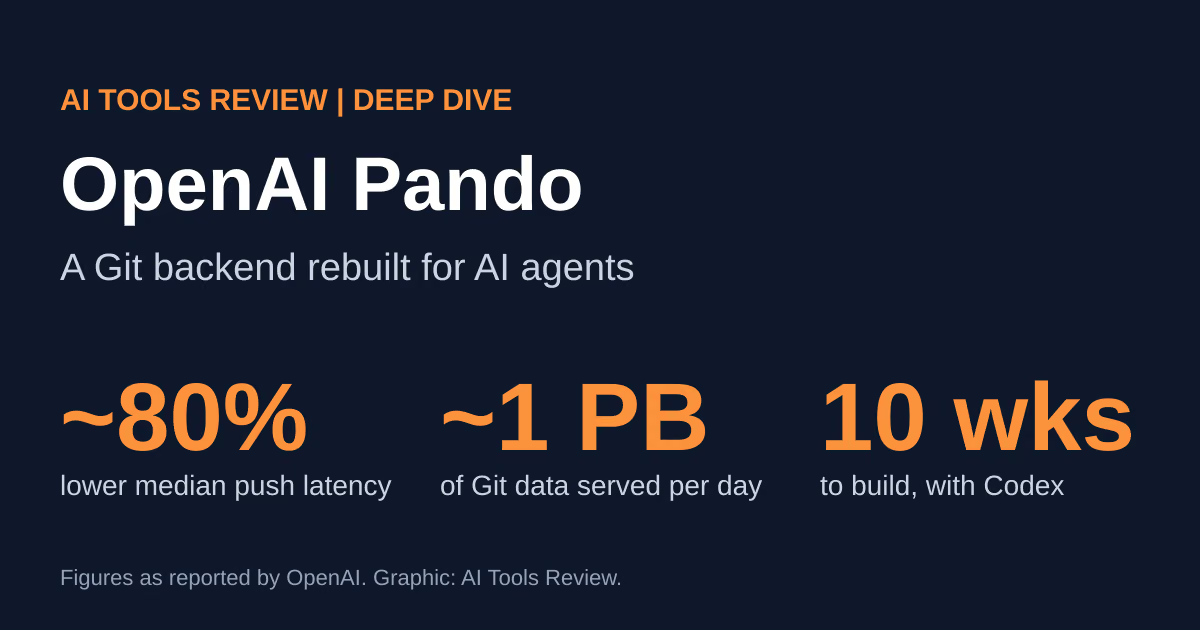
Pando is a server-side Git backend. OpenAI's own summary on social media, quoted by trade press, is that it was built to handle more pushes and fetches without changing how engineers and agents use Git, that it cut push latency by about 80% and that it now serves nearly a petabyte of Git data a day.
- The problem: parallel development with Codex multiplies pushes, and CI systems repeatedly fetch the same commits after each one.
- The design goals: coordinate updates per branch rather than globally, and reuse packfiles across many readers.
- The claimed results: nearly 80% lower median push latency; clone and fetch able to saturate a 10 Gbps link on a standard cloud VM; and, per secondary reports, 99.99% merge reliability.
- The build: OpenAI says it built Pando with Codex in about 10 weeks, with one engineer designing the core architecture and agents doing much of the implementation.
- Availability: internal only. No pricing or installation guide exists, and OpenAI describes wider sharing as under consideration.
The wider lesson is that AI productivity gains are not only about models. They push load onto every system downstream of code generation, which then needs redesigning.
The Problem: Agents Turn Git Into a Hot Path
Git is a distributed system, but most organisations run it with a central server that everyone pushes to and fetches from. That arrangement copes well with human rhythms: a developer commits a few times an hour, and a CI job fetches once per run. Coding agents change the shape of the traffic in three ways.
- More concurrent branches. Engineers and agents can each pursue several changes at once, so many more branches are updated at the same time.
- Many more fetches of identical data. After a single push, many automated jobs, such as tests, linters and review bots, fetch the same commits. Each fetch can mean the server doing the same work again.
- Higher retry and failure costs. If pushes are slow or merges fail, agents retry, which adds more load.
According to coverage of OpenAI's post, engineers encountered slower pushes and downloads and failed merges, and merge reliability had at times dropped below 90%. One outlet also cites a 2,442% rise in quarterly monorepo commits between Q1 2024 and Q4 2026. We would treat that figure with caution: Q4 2026 has not finished, so we cannot verify what it refers to, and we have not seen it in an OpenAI primary source.
This theme appears across the agent economy. We covered a related cost problem in Grok Bot's cost problem: agent usage multiplies resource consumption in ways that per-seat thinking does not anticipate. Pando is the infrastructure-side version of the same story.
How Pando Works
OpenAI's design, as summarised by trade and developer coverage of its post, rests on two ideas: coordinate each branch independently, and store and serve repository data so it can be shared.
Per-branch coordination and causal consistency
Distributed systems that replicate repositories typically either coordinate updates across replicas, which adds communication overhead, or order everything through one shared log, which forces unrelated branch updates to compete. Pando instead uses causal consistency: updates to a given ref are serialised, but there is no single global sequence across all refs. Readers receive the history and dependencies for the data they ask for, though different refs are not guaranteed to be read at the same instant.
The practical effect is that unrelated branches can accept updates concurrently. The trade-off, which OpenAI's own description acknowledges, is that a reader looking at several branches at once may see them at different versions. Each individual branch stays consistent, and a commit is fetchable immediately after a successful push.
Packfiles in object storage plus a metadata service
When someone pushes, Pando validates the incoming Git packfile and stores it as an immutable object in cloud blob storage. A metadata service records the new ref version, the earlier versions it depends on, and where the pack is stored. The ref pointer and the metadata are updated in the same transaction. Received packs are not unpacked into server-local repositories before they become deliverable, which removes a major cost from the push path.
Reusing packs on fetch, with regional caches
On fetch, clients tell the server what they have and what they want. Pando maps that to ref versions and combines stored packs, including dependencies, then points the client to the data using Git's packfile-uri mechanism rather than streaming it through the server. A service OpenAI calls Express caches blob data in regional caches, with a separate cache for metadata. Because many CI machines ask for the same commit, they can all be served from the same cached pack.
Background compaction
Each push creates a small pack. Pando groups consecutive ref versions into covers at several levels and, once a cover is full enough, rebuilds its objects into one larger pack. That keeps the number of packs a client must fetch small and speeds up history searches, while keeping lower-level packs for readers who are only slightly behind.
Client-side changes
OpenAI also changed the Git client. Coverage of its post mentions an explicit-haves change that lets force-with-lease checks work against the branch's true position, and a published OpenAI fork of Git on GitHub. The company says client improvements are tracked in a public patch tracker, which is a route by which the wider Git community could benefit even if Pando itself stays internal.
The Numbers, and How Much to Trust Them
Every performance number in this story originates from OpenAI. That does not make them wrong, but nobody has measured them independently. Here is how we would rate each claim.
- Median push latency down by nearly 80%. Stated by OpenAI and repeated widely. Equivalent to roughly a fivefold speed-up in the median case. It is a median, so tail behaviour is not described.
- Nearly 1 PB of Git data a day. A scale figure rather than a performance comparison. Plausible for a monorepo with heavy CI fan-out, but it says nothing about efficiency.
- Clone and fetch saturating 10 Gbps. Reported as a demonstration on a standard cloud VM. Useful evidence that the fetch path is no longer compute-bound.
- Cache hit rates above 99%, and more than 57 TB of packfiles in a single hour. Reported by a trade outlet summarising the post. Impressive, and consistent with the caching design, but we have not seen them in a primary source.
- Merge reliability of 99.99% versus sometimes below 90%. Reported by the same outlet. Reliability is defined by OpenAI and depends on what counts as a failed merge.
- Built in 10 weeks with Codex. OpenAI's claim. It also says a single engineer designed the core architecture. This tells us about Codex's usefulness for systems work but is not independently checkable.
A comparison simulation on OpenAI's page, which models fetch behaviour for many CI machines, is described in coverage as an illustrative model, not a production benchmark. Treat it as an explanation of why the design should help, not as evidence of by how much.
Is This the End of Git?
The video that drew attention to this story, a conversation between Nate B Jones and OpenAI's CTO of Applications Vijaye Raji, is titled with a question: the end of git? The honest answer from the available evidence is no. Pando is explicitly designed to be invisible to the people using it. The Git object model, protocol and command-line client remain. What changes is how a server coordinates writes and delivers reads at a scale that human-paced hosting was never designed for.
That distinction matters for anyone thinking about their own stack. The pattern OpenAI demonstrates, keep the interface and rebuild the engine, is a low-risk way to modernise infrastructure. It also mirrors how other layers are changing for agents. Tooling, such as the agent-focused hardware we reviewed in OpenAI Codex Micro and the software changes in the August 2026 Codex updates, is evolving around agent workflows while keeping familiar interfaces.
Nate B Jones's newsletter summary adds a point that is easy to miss: when one part of a workflow speeds up, the rest of the organisation has to absorb the consequence. His examples include a company reporting a fivefold rise in merged changes per engineer that simply moved the wait into testing, review and deciding what to build. Pando solves the repository part of that problem. The testing, review and decision parts remain.
What It Means for Teams Using AI Coding Agents
Most teams do not run a monorepo at OpenAI's scale, and Pando is not available to them. The lessons are still practical.
- Measure agent traffic separately. If you adopt coding agents, track pushes, fetches and CI fan-out per change. The load profile differs from human-only development.
- Cache aggressively at the CI layer. If many jobs fetch the same commit, shared caches or mirrors deliver the same benefit Pando's packfile reuse gives OpenAI, at far smaller scale.
- Watch merge reliability. A falling merge-success rate is an early sign that your repository infrastructure is the bottleneck, not your agents.
- Expect the constraint to move. After faster code generation, review, testing and decision-making become the limiting factors. Plan automated checks and review tooling accordingly.
- Do not assume you need to leave Git. OpenAI's choice to preserve the protocol suggests that for most organisations the better path is optimising hosting and CI rather than changing version-control systems.
Hosting providers are likely to watch this closely. If agent traffic becomes normal, expect Git hosts to compete on how well they handle high-concurrency branch updates and repeated fetches, just as they compete on CI today.
Availability and Open Questions
As of 04/11/2026, coverage of OpenAI's announcement says there are no general installation instructions or pricing for Pando, and that how the technology might be shared is still being considered. Trade press also reports that OpenAI is exploring other settings where many agents collaborate on shared repositories. One outlet claims a limited preview for enterprise partners and a wider launch in Q1 2027, with pricing tied to repository size. That does not match the other reports and we have not found OpenAI confirmation, so we do not rely on it.
Open questions worth watching: whether OpenAI open-sources the backend or offers it as a product; how Pando handles very large binary assets; how it compares with the scaling work done by Git hosts and monorepo tools; and whether third-party measurements confirm OpenAI's numbers.
The Bottom Line
Pando is a credible, well-reasoned response to a real problem: agents turn version control into a hot path, and servers built for human cadence strain under the load. The design choices, per-branch causal consistency, immutable packs in object storage, regional caching and compaction, are sensible and keep Git itself intact. The headline gains of about 80% lower median push latency and around a petabyte a day come from OpenAI and should be read as such.
For most teams the takeaway is not to wait for Pando but to expect agent-scale development to stress every system downstream of code generation, and to look for the next bottleneck before it finds you.
Sources
- Interesting Engineering: OpenAI builds Pando Git backend after Codex strains monorepo (03/11/2026), summary of OpenAI's engineering post and tweet.
- Classmethod: I Looked Into Pando, OpenAI's Rebuilt Git Server (04/11/2026), technical walkthrough of OpenAI's post, Scaling Git at OpenAI.
- Nate B Jones: OpenAI's Git Backend for AI Agents, Vijaye Raji interview (06/11/2026), public preview of the newsletter post.
- Nate B Jones on YouTube: The end of git? OpenAI CTO on the future of coding. (06/11/2026).
Hero: AI Tools Review graphic summarising figures as reported by OpenAI. We could not retrieve OpenAI's original post or images directly, so this article relies on secondary coverage of it.
Last updated: 07/11/2026. We could not access OpenAI's primary post, so details come from secondary coverage and every performance figure is OpenAI's own claim. We have not tested Pando.
Get the free guide: Claude vs ChatGPT, Gemini & Grok
A 20-page playbook covering everything you need to choose and use the big four AI models in 2026, full cost and feature comparisons, what each is best (and worst) at, and how-tos for images, vectors, building a website, Claude Code and more.