 AI Tools Review Editorial Team
Quick answer:
The $44 trillion figure is a scenario, not a forecast. On 17/10/2026 Anthropic co-founder Jack Clark told the IMF and World Bank meetings that AI could expand the US economy by close to half within four years. The number comes from the extreme change case of Anthropic's Economic Scenario Explorer: $44.4 trillion of US GDP in 2030 (2025 prices), against $34.1 trillion (modest) and $36.3 trillion (substantial). The authors attach no probabilities, and the same extreme case has unemployment among displaced cognitive workers at 17.9 per cent.
When an AI lab's co-founder tells central bankers that the economy of the world's largest economy could grow by a third more than it otherwise would within four years, the headline writes itself. "Singularity" is the word that went viral. The primary sources are far more careful, and considerably more interesting.
This guide goes to the working paper behind the number, the scenario page that Anthropic published, and the other claims bundled into the video that prompted this coverage. We separate what is modelled from what is claimed, show the labour-market arithmetic that most summaries skip, and correct one attribution that did not survive checking.
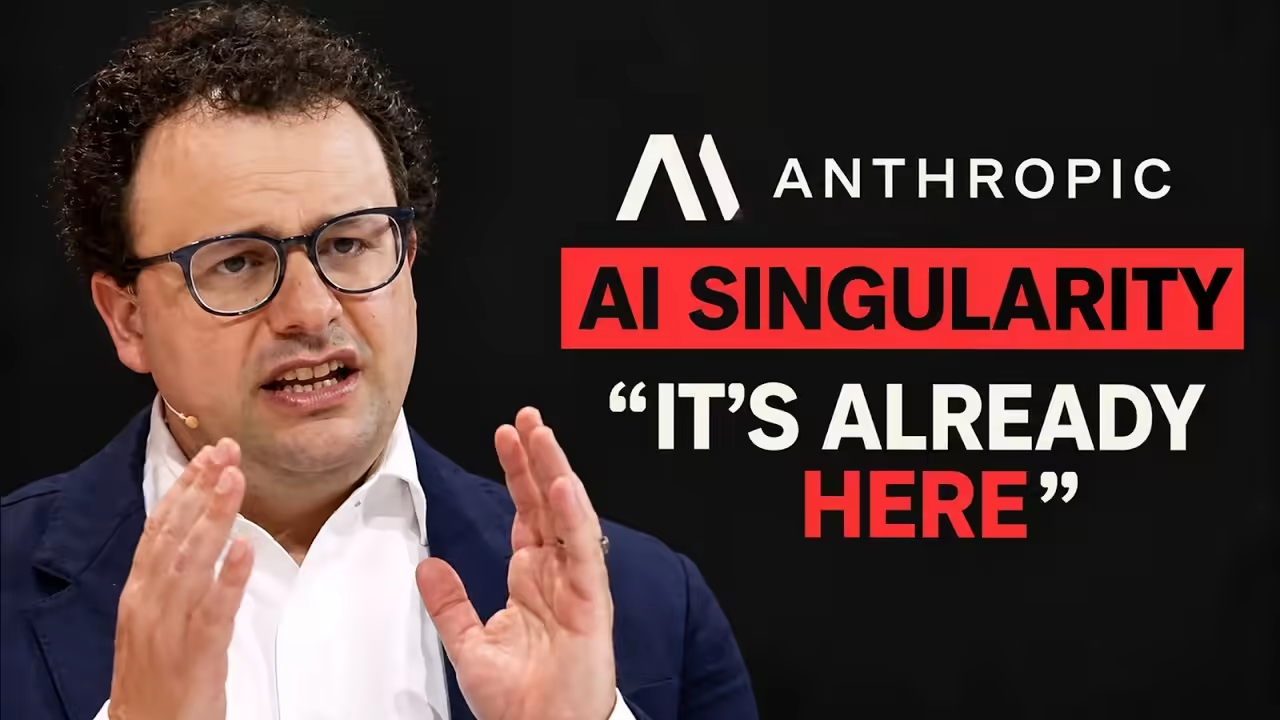
AI Revolution X covers Jack Clark's IMF remarks, a physics benchmark, Anthropic's economic scenarios and the jobs debate. The title is stronger than the sources; the description links to them.
Executive Summary
The story has three layers, and it helps to keep them apart. First, a speech: Jack Clark's Per Jacobsson Lecture in Bangkok on 17/10/2026. Second, a model: the Economic Scenario Explorer, version 1.0, published in September 2026 by The Anthropic Institute and described in Working Paper No. 2026-02, "Economic Scenarios for Transformative AI", by Anton Korinek, Charles I. Jones, Szymon Sacher, Tess Cotter and Peter McCrory. Third, a set of adjacent claims in the video, including a 98 per cent physics result that belongs to a different lab's model.
- Three scenarios for 2030: US GDP of $34.1 trillion (modest, 1.6 per cent above the no-AI path), $36.3 trillion (substantial, 8.3 per cent) and $44.4 trillion (extreme, 32.4 per cent), all in 2025 prices.
- Not predictions: the paper says so plainly, and attaches no probabilities. It adds that none of the three can be ruled out on today's data.
- The distribution is the story: in the extreme case total labour income is almost exactly what it would have been without AI, so all of the extra GDP accrues as capital income.
- Public expectations sit in the middle: a survey of 10,980 US adults, run through the model, lands close to the substantial scenario.
- Correction: the 98 per cent physics figure is GPT-6-Astra in Codex on the TheoPhysEval benchmark, not Claude Opus 5.5.
Currency note: every economic figure here is a US dollar value from a US-only model, so we quote them in dollars as published rather than converting at an assumed exchange rate.
What Jack Clark Actually Said in Bangkok
Clark, Anthropic's co-founder and head of policy, delivered the Per Jacobsson Foundation Lecture at the IMF and World Bank Annual Meetings on 17/10/2026. The audience was central bankers and finance ministers. According to Reuters-based coverage, his core message was that AI could expand the US economy by close to half its current size within four years, and that policymakers should plan for it now rather than after it happens.
Two quotations are widely reported. On what rapid growth would make possible: "If you end up with this level of GDP growth, you have moves available to you as a policymaker that are unimaginable today." And on preparation: "Policymakers should get ready to spend." He also argued that the pace of change calls for unusual and serious international rules, not just optimism about GDP charts.
Reporting also records Clark's caveats. He expects AI capability to keep advancing quickly, but expects diffusion through the wider economy to be slower and messier than enthusiasts assume. He described the top-end number as sounding very outlandish. That is the opposite of a victory lap, and it is easy to lose in a headline.
What about the word "singularity"? Coverage differs. The Reuters-based reports we found say Clark pointed to growing evidence towards a singularity-like acceleration in which AI development outpaces human control. One outlet, 36Kr, reports him declaring that the singularity had arrived. We could not corroborate that stronger wording in any other source, and Reuters itself was not accessible to our fetch tooling, so we treat it as unverified. The video's title goes further still. Treat both as framing rather than as a quotation.
How the Economic Scenario Explorer Works
The working paper builds what it calls a simple, integrated framework. Its aim is not to forecast but to convert a small set of parameters into paths for productivity, growth, wages, the labour share, job reallocation and unemployment from now until 2030. It is a standard task-based model: AI can automate or augment a growing fraction of tasks. Workers are split into two groups: cognitive occupations (management, professional, sales and office work) and all other occupations such as construction or electrical work.
Five ideas do the work. AI adoption raises productivity but displaces some workers, which lowers demand for cognitive labour. Displaced workers must search for jobs elsewhere, and that search is subject to frictions, because a software engineer cannot easily become an electrician. AI raises demand for capital, which lifts the return on it and its share of income. AI also speeds the discovery of new ideas, though the paper finds that effect surprisingly minor: labour productivity rises through that channel by well under one per cent in all three scenarios, because research stays bottlenecked by physical tasks. Finally, some new tasks may be created for people.
The scenario parameters are concrete and, in principle, measurable. They are the share of tasks AI can affect (m), how widely it is deployed (d), the productivity gain per affected task (a), the share of affected instances that are automated rather than augmented (psi), and the reinstatement ratio of new tasks created for each task automated (rho). The paper's closing argument is that each of these can be measured in the coming years, so the data will eventually tell us which scenario we are in.
The model is anchored on mid-2026 and, importantly, the paper observes that almost all divergence between scenarios arrives after 2027. Today's readings are shared; the scenarios separate only as the reach and use of AI diverge. That is a useful reminder that no observation made this year can adjudicate between them.
The Three Scenarios Side by Side
The table below uses figures from the working paper's results section and Anthropic's scenario page. GDP is quoted in 2025 prices; US output over the past year is described by Anthropic as above $30 trillion.
| 2030 outcome | Modest | Substantial | Extreme |
|---|---|---|---|
| US GDP (2025 prices) | $34.1 trillion | $36.3 trillion | $44.4 trillion |
| GDP vs no-AI path | +1.6% | +8.3% | +32.4% |
| Share of economy tasks affected by AI | 4% | 12% | 30% |
| Productivity gain on affected tasks | about 35% | about 57% | more than doubled |
| Affected instances automated | 50% | 75% | 90% |
| Labour share of income | 59.4% | 56.1% | 45.2% |
| Cognitive employment vs mid-2026 | -0.5% | -3.9% | -21.5% |
| Unemployment, all workers | 3.9% | 4.6% | 11.9% |
| GDP growth in 2030 | 2.4% a year | 5.4% a year | 15.4% a year |
Some of these deserve context from the paper itself. The modest case is described as AI behaving like a normal technology: GDP 1.6 per cent higher is "an extra ten months of ordinary growth accumulated over four years", and unemployment is 3.9 per cent against a normal 3.8 per cent. The substantial case is "more significant than the internet". Its 5.4 per cent growth in the twelve months to 2030 compares with a peak of 4.7 per cent during the dot-com boom in 1999, using Federal Reserve data cited by the authors. The extreme case "goes well beyond any event in history".
One detail changes how the headline reads. The $44.4 trillion figure is 32.4 per cent above the no-AI path, but the paper also states GDP in the extreme case is 40 per cent higher than in mid-2026. Both are true; they use different baselines. Clark's "close to half within four years" is the second kind of number, whereas the 32 per cent figure is the gap versus a world without AI.
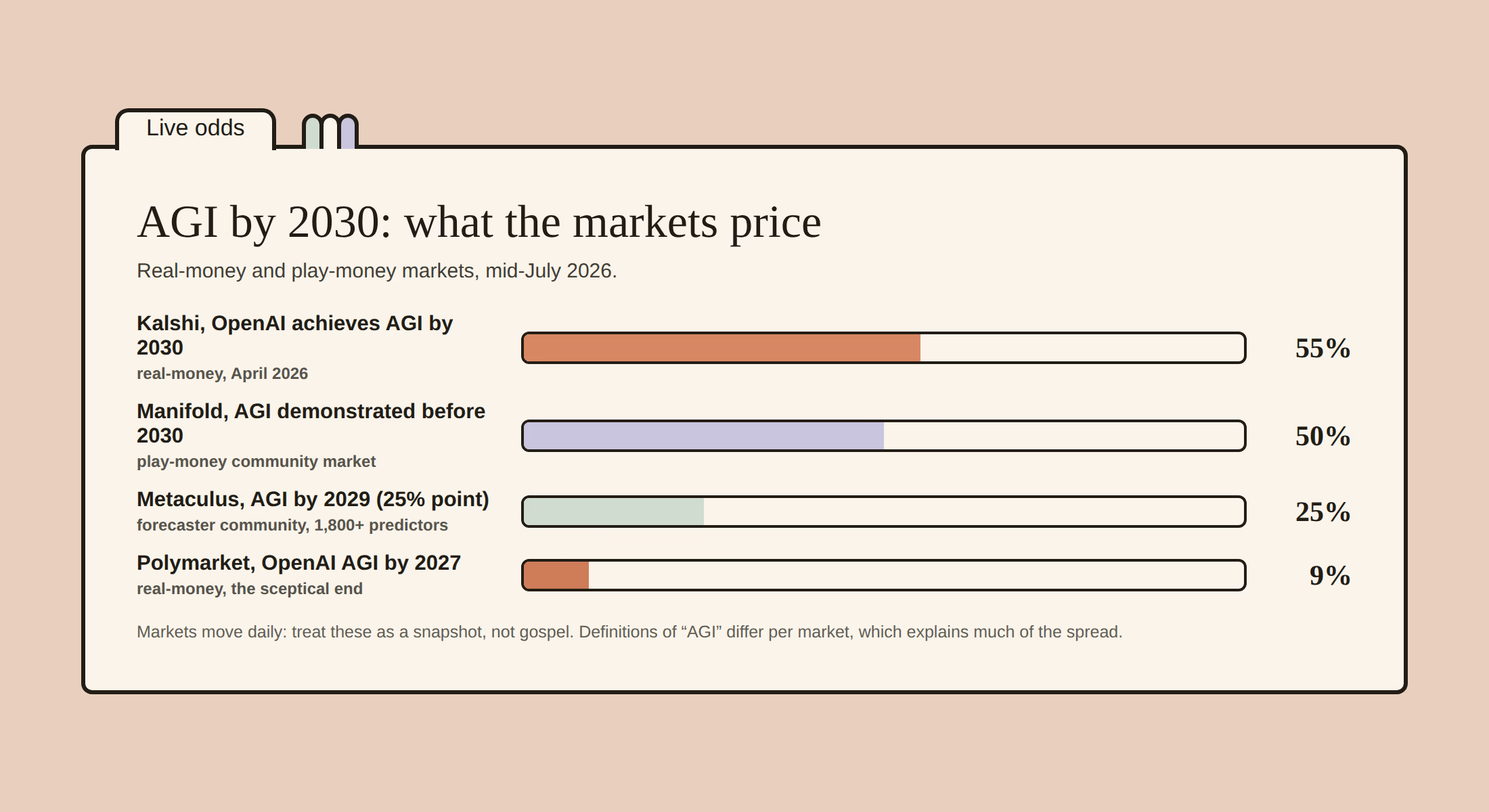
If you are tracking where these scenarios sit relative to wider forecasting, our AGI timeline guide to prediction-market odds covers the capability side, and our analysis of which jobs AI could replace by 2030 covers the occupational side.
Inside the $44.4 Trillion Extreme Case
The extreme scenario is the one that travelled. Its assumptions are specific. By 2030, 30 per cent of tasks in the economy, roughly half of the tasks cognitive workers performed in 2025, have been impacted by AI. AI more than doubles productivity on the tasks it touches. Ninety per cent of affected instances are automated and just 10 per cent augmented. And the reinstatement effect is switched off entirely, meaning no new cognitive tasks are created for people.
Anthropic's public page describes this as AI outperforming humans on most knowledge tasks and doing nearly all of them autonomously, and says it likely requires recursively self-improving AI and rapid adoption. The abstract of the paper is a little more specific on the quantity: AI performs almost half of today's cognitive work by 2030. That difference in wording matters, because "nearly all knowledge tasks" sounds like something close to full automation, while the model's actual input is that about half of cognitive tasks are impacted.
The growth numbers are what make it vivid. GDP growth in 2030 reaches 15.4 per cent a year. If sustained, the paper notes, per capita incomes would double every five years, compared with every 35 years in the US over the past century. Anthropic's page summarises this as doubling the economy roughly every 4.5 years.
Notice too what the model leaves out of the growth story. The authors report that the "ideas channel", AI accelerating scientific and technical discovery, adds relatively little. Because the model ends in 2030 and omits feedback between research and automation, it cannot generate singularities in the formal growth-theory sense or explosive research-driven acceleration. The authors say the innovation effects are probably a lower bound. In other words, the model that produced the "singularity" headline explicitly cannot produce a singularity.
That is worth sitting with. The most dramatic number in the discussion comes from a framework whose own authors call it a stark simplification, and which cannot represent the very thing the headline names. It is a useful stress test of economic institutions, not a map of a technological explosion. For a view of where self-improvement claims actually stand, see our fact-check of Weco AIDE² and recursive self-improvement and our explainer on OpenAI's "An Alien Mind" and the RSI warning.
Jobs, Wages and the Labour Share
The stakes are highest in the labour market, and the paper is direct about the current evidence. In macroeconomic data so far, the labour market effects of AI have been relatively muted even as usage has grown rapidly, though evidence on starting wages in exposed occupations is mixed. The authors offer two readings consistent with that: we are in a modest scenario and effects will stay small, or we are at the very beginning of a more extreme one. The policy implications of the two are very different.
The same mechanics, different magnitudes
In every scenario the mechanics are identical: output rises, cognitive employment shrinks, and employment elsewhere grows. What the scenarios disagree about is size and speed. In the substantial case, cognitive employment is 3.9 per cent below its mid-2026 level while employment in other occupations is up 4.6 per cent. Cognitive unemployment rises from 2.9 to 4.5 per cent, an increase of more than half. The average wage is 2.1 per cent above the no-AI path, but cognitive wages are 0.3 per cent below it while other wages are 5.9 per cent higher.
The extreme case: a bigger economy that pays labour the same
In the extreme scenario, cognitive wages are 11.5 per cent below the no-AI path, which, given about 2 per cent annual wage growth without AI, leaves them slightly lower in 2030 than in mid-2026. Wages in all other occupations, where labour is relatively scarce, are 33.6 per cent higher. Unemployment among workers who began in cognitive occupations reaches 17.9 per cent, which the paper calls far above any postwar US rate, and the economy-wide rate reaches 11.9 per cent. For comparison, annual rates peaked slightly below 10 per cent after the global financial crisis and at about 8 per cent in the Covid-19 recession.
The labour share of income falls from 60 to 45 per cent. That is a shift of 15 percentage points of GDP from labour to capital, in four years. The paper contrasts this with the substantial scenario's four-point fall, which it notes is only slightly less than the entire decline in the US labour share over the four decades after 1980.
Then comes the line that deserves to be quoted more often than the headline GDP figure: total labour income in 2030 is almost exactly what it would have been without AI. The labour share falls by a quarter while GDP rises by a third, and 0.45 multiplied by 1.32 is roughly 0.60. All of the increase in GDP therefore accrues as capital income, which is 81 per cent above its no-AI path.
Could the gains compensate the losses?
In the textbook sense, yes. The wage bill of the cognitive occupations, counting the unemployed at zero, is 31 per cent below its previous path, and the economy's gain is almost three times that loss. The paper calculates that a transfer of about 9 per cent of GDP, roughly the size of Social Security and Medicare combined, would hold cognitive workers' income at its no-AI level and leave the rest of the economy more than 20 per cent ahead. But it adds that transfers of that scale in response to technological change have no precedent, and that past displacements, such as the regional effects of Chinese import competition, show compensation mostly does not happen on its own. Which institutions could deliver shared prosperity is, in the authors' words, beyond their framework.
This is the section to read alongside Clark's remark that policymakers should "get ready to spend". The paper's arithmetic gives that phrase a number. It also connects to Anthropic's own corporate commitments, which we cover in our piece on the Anthropic Public Benefit Fund and its 5 per cent share pledge, and to the capital-intensity questions raised by the Anthropic IPO prospectus and its compute bet.
What 10,980 Americans Expect
To complement the three constructed scenarios, Anthropic ran a representative survey of 10,980 US adults in August. It asked when AI will be able to do each of eight cognitive tasks of increasing difficulty, how widely it will be used, how large the productivity gains will be, whether workers will be automated or augmented, and how long a displaced worker will take to find a new job. Anthropic's page also reports a site-visitor sample of 32,135.
Feeding each respondent's answers into the model produces a distribution of outcomes. The median American expects a capable AI, one that handles six of the eight tasks by 2030, but limited diffusion: AI deployed on about two-fifths of the tasks it could perform, augmenting rather than automating half the time, and raising productivity on affected tasks by around 55 per cent. The resulting medians are close to the substantial scenario: GDP 8.6 per cent above the no-AI path and unemployment around 4.6 per cent in both cognitive occupations and the broader economy. Anthropic says about 10 per cent of respondents hold views that line up with the extreme scenario.
One methodological note: the outcome table in the paper is computed from the 3,259 respondents who answered all five of the model-relevant items, with survey weights, and holds some parameters fixed at the substantial scenario's values. That is a sensible approach, but it means the survey result reflects the model's structure as well as public opinion. It tells us the public is more cautious than the extreme case, and more optimistic about AI capability than about diffusion.
Why Capital and Wage Rigidity Matter
The most valuable parts of the paper for sceptical readers are its robustness checks, because they show how sensitive the labour-market story is to two numbers that nobody has measured well.
The first is the elasticity of capital supply: how easily the economy can add capital, including compute and data centres. In the base case it is set at 3. If it is very low (1), the extreme scenario's GDP gain drops from 32.4 to 21.3 per cent, the net return to capital rises to 10.3 per cent, and the average wage falls 9.2 per cent below the no-AI path. If capital is perfectly elastic, GDP is 43.3 per cent above the no-AI path and the average wage is 30.1 per cent higher. The wage and the return to capital move in opposite directions, so bottlenecks in the physical build-out are directly bad for workers in the model.
The paper also highlights "so-so technologies", systems used widely but only marginally more productive. Under one combination of parameters inside its own ranges, 2030 GDP is 7.2 per cent higher, yet total labour income is lower by 4.3 per cent of no-AI GDP, and holding cognitive workers' income whole would take a transfer equal to 84 per cent of the GDP gain. That is the pessimistic corner: modest growth with a large distributional cost.
The second parameter is wage rigidity, how quickly the cognitive wage adjusts. In the extreme case with the baseline setting, cognitive wages are 11.5 per cent below the no-AI path and cognitive unemployment is 17.9 per cent. With very rigid wages, wages end 2.8 per cent above the path but cognitive unemployment rises to 24.0 per cent. With fully flexible wages, cognitive wages fall by more than 42 per cent while unemployment is just 2.6 per cent. The authors summarise the point neatly: the effects of AI are felt in the cognitive labour market through wages or through unemployment, and either is clearly costly to the workers affected.
The 98% Physics Claim, Checked
The video also states that GPT-6 Astra and Claude Opus 5.5 together tackle advanced physics, citing arXiv 2610.16733. We read the abstract and the numbers are narrower than the framing suggests.
The paper is "TheoPhysEval: Assessing AI agents at autonomous theoretical physics problem solving", submitted on 09/10/2026 with a long author list including Suvrat Raju and Praneeth Netrapalli. It presents 50 unpublished research-level theoretical physics problems with verifiable answers. The best agent, GPT-6-Astra harnessed in Codex, reaches what the authors call near-perfect accuracy of 98 per cent, at an average cost of under $3 per problem. The abstract does not mention Claude Opus 5.5 or any Claude model, so the 98 per cent figure should not be attached to Anthropic's model.
There is a second caveat in the same abstract, and it is the more interesting one: agents change little in accuracy when denied web search and background papers, which the authors read as evidence of significant memorisation of the literature. A high score on unpublished problems is therefore still entangled with what the models absorbed in training. We have not independently replicated the benchmark. For the head-to-head between the two named models on other tests, see our Claude Opus 5.5 vs GPT-6 Astra comparison, our GPT-6 Sol vs Claude Opus 5.5 guide and our full Claude Opus 5.5 review.
We also tried to verify the CEPR discussion paper (DP21939) cited for the jobs section of the video, and could not retrieve it: the CEPR page returned an access error and a search did not surface the paper. We therefore do not rely on it here. Related CEPR column research we found, on US vacancies and European firms, reports early task-level substitution without clear aggregate labour-market effects, which is consistent with the paper's own reading of the data so far, but is not the same source.
Critiques and Context
Scepticism is not hard to find. Gary Marcus has called the scale of the revenue and growth framing a fantasy, arguing it extrapolates from models that still hallucinate and make basic errors, and that the evidence does not yet exist. Anthropic's own page records that reviewers questioned whether AI-exposed occupations would shrink at all, and also whether the model might underestimate AI's acceleration of technological progress. Critics on both flanks, in other words, are already in the footnotes.
Context matters for motive too. Commentary in the press has noted that the lecture came in a week of strain in AI infrastructure financing, when CoreWeave shares fell 16 per cent intraday on 14/10/2026 and its notes traded below 80 cents on the dollar, and while Anthropic's own IPO push depends on steep revenue growth. That is the commentator's interpretation, not established fact, but readers should hold both ideas: a company with an interest in a large-economy narrative published a carefully hedged model, and the hedges are real.
The paper also discloses that the authors used Claude as a research and writing assistant, and that the views are the authors' own rather than Anthropic's or the Institute's. That is the sort of disclosure to look for in any lab-authored economics.
What It Means for Workers, Firms and Policy
For workers in cognitive occupations, the most robust lesson is not a number but a mechanism: the model's cost lands as lower relative wages, higher unemployment or both, depending on how fast wages adjust. Roles at the boundary matter. The paper's two-group structure is coarse, but it correctly highlights that moving between occupations is hard and slow. Skills that transfer to tasks AI does not touch are the hedge, and our jobs-by-2030 guide goes through which categories look most exposed.
For firms, the parameters are a checklist. Share of tasks affected, deployment, productivity per task and automate-versus-augment are things you can measure in your own organisation today. The substantial scenario assumes three-quarters of affected instances are automated; many companies are still mostly augmenting. If you run agent workflows, note the distinction in our explainer on agent swarms.
For policymakers, the paper's four sentences on institutions are the real content. If effects are modest, existing institutions suffice. If AI raises output while displacing work, "the mechanisms by which people receive resources from an immensely more prosperous economy may themselves need to change", and the range of options runs from retraining to insurance and income support. Anthropic's corporate pledges and its wider public stance, including Dario Amodei's argument for pacing the frontier and the Hard Questions campaign, sit around this question. For a wider view on what happens if capability outruns oversight, see Google's post-AGI paper.
Limitations and What to Watch
- Scenarios, not predictions: no probabilities are attached, so there is no "Anthropic forecast" of $44 trillion.
- US only, cognitive only: robotics and physical-task automation are excluded, which is why the model stops at 2030.
- Omitted forces: policy responses, business cycles, aggregate demand effects (including the data-centre build-out), financial disruption and catastrophic risks are all outside the model.
- Coarse workers: only two groups of workers, no tenure or skill penalty on moving jobs, and no regional detail, so displacement costs are probably understated.
- Unmeasured elasticities: capital supply elasticity and wage rigidity are not measured, yet they swing wage and employment outcomes sharply.
- Secondary-source drift: the physics result is not Claude's, the CEPR paper could not be verified, and "singularity has arrived" is not corroborated.
- Authored by the lab's Institute: the paper is an Anthropic Institute working paper and has not, as far as we can tell, been peer reviewed.
What to watch: the measurable parameters. If task coverage, deployment share and displaced-worker re-employment times begin to move, the paper says the data will reveal which scenario we are in. Until 2027, the scenarios barely diverge, so absence of dramatic labour-market change this year is not evidence for the modest case.
The Bottom Line
The honest version of this story is more useful than the viral one. Anthropic published a transparent, adjustable model and three clearly labelled scenarios. A co-founder used the top one to tell finance ministers to prepare. The model's own authors say that scenario is not a prediction, cannot produce a real singularity, and implies that in the extreme case workers collectively earn what they would have anyway while capital owners capture the entire gain.
Take three things away. First, the GDP number is the least informative part; the labour share and the transfer arithmetic are the content. Second, check the attribution on every adjacent claim, because the 98 per cent physics result is GPT-6-Astra's. Third, the debate is now framed as measurable parameters, which means the next two years of data will settle more than the next two years of commentary.
Sources
- Anthropic Institute, Economic Scenario Explorer (v1.0, September 2026).
- Korinek, Jones, Sacher, Cotter and McCrory, "Economic Scenarios for Transformative AI", The Anthropic Institute Working Paper No. 2026-02, September 2026 (PDF).
- Reuters, Anthropic's Clark says AI's impact accelerating quickly, could vastly boost US GDP, 17/10/2026 (not directly accessible to us; quotations taken from secondary coverage).
- Startup Fortune, Anthropic's Jack Clark tells the IMF AI could push US GDP to $44 trillion.
- 36Kr, Anthropic announces singularity arrival (uncorroborated framing).
- Chandra et al., TheoPhysEval, arXiv 2610.16733, 09/10/2026.
- CEPR, Discussion Paper 21939 (cited in the video description; page not accessible to us, so not relied upon).
- AI Revolution X, Anthropic Just Shocked The World... AI SINGULARITY Is Here! (source video; thumbnail used as the cover image).
Last updated: 19 October 2026. Figures are from the Anthropic Institute working paper and scenario page (September 2026) and reporting of Jack Clark's lecture of 17/10/2026. Scenario outputs are model results, not forecasts.
Get the free guide: Claude vs ChatGPT, Gemini & Grok
A 20-page playbook covering everything you need to choose and use the big four AI models in 2026, full cost and feature comparisons, what each is best (and worst) at, and how-tos for images, vectors, building a website, Claude Code and more.