
 AI Tools Review Editorial Team
Quick answer:
On 18/10/2026 Anthropic committed 5 per cent of its shares to a new Anthropic Public Benefit Fund, subject to stockholder approval, with the board able to add a further 2 per cent for every 50 per cent increase in the company’s value above an unpublished baseline. The fund is a wholly owned LLC that could make large donations to nonprofits or direct distributions to specific populations. It is not universal basic income, and there is no payment schedule, eligibility rule or governance detail yet.
Within hours of Anthropic’s announcement, the internet had a headline: Anthropic is launching its own universal basic income. It is a neat story, and it is not what the company said. What Anthropic announced is more modest in some ways and more unusual in others: a legal vehicle, funded with a slice of the company’s own equity, that grows automatically as Anthropic grows.
This guide sets out what was announced, what the numbers do and do not mean, how the fund relates to the company’s widely reported plans for a stock-market listing, and the long list of questions Anthropic has yet to answer. Where a claim comes from a single secondary source, we say so.
World of AI covers the announcement in its weekend news round-up, framing it as a possible UBI plan. Anthropic's own text does not use that term.
Executive Summary
Anthropic’s post, “Investing in the public benefit”, is dated 18/10/2026. Its central claim is that the company is directing a portion of its own equity to a new entity, the Anthropic Public Benefit Fund, rather than using that equity for the kind of escalating executive compensation awards the company describes as common in tech. The key points:
- The commitment: 5 per cent of Anthropic’s shares, subject to stockholder approval.
- The escalator: a further 2 per cent, at the board’s discretion, for every 50 per cent increase in company value above a set baseline. The baseline has not been published.
- The vehicle: a wholly owned limited liability company, not a 501(c)(3) charity, chosen to allow flexibility between forms of giving.
- The guardrail: equity held by the LLC will not be used for lobbying or political giving, in the US or abroad.
- The headline total: including earlier pledges, Anthropic says roughly 20 per cent of its shares will be dedicated to the public good, plus any milestone additions.
- The gaps: no governance structure, no valuation milestones, no payment rules and no start date. Anthropic says more will follow “in the coming months” alongside a public benefit report.
The reading we think holds up best is that this is a serious, structurally interesting commitment whose real-world value depends entirely on details not yet disclosed. It is neither a payout scheme nor a mere press release.
What Anthropic Actually Announced
The announcement arrived on a Sunday, which is itself notable: companies tend to release routine corporate news on weekdays. Anthropic describes the fund as “a new entity with a structure that increases the stake as the company grows”. Al Jazeera, reporting on 19/10/2026, quotes the company as saying that because of the way the fund is structured, the more Anthropic grows, the larger the share of the company devoted to the public good.
Three potential uses are named. The first is large donations to traditional nonprofits. The second is direct distributions to specific populations. The third is what Anthropic calls bolder approaches to labour-market instability. Labour disruption caused by AI is explicitly flagged, and the company says that given the pace of AI progress, “bolder approaches may be needed”.
It is worth noticing the verbs. Anthropic says the fund could support these uses. It does not say it will. A commitment of equity to an entity is a firm act. A commitment to any particular pattern of spending is, at this stage, an intention.
Anthropic frames the fund against its existing identity. It is a public benefit corporation, registered in Delaware, whose charter asks leadership to balance shareholder returns with responsible AI development. Work that has both public benefit and commercial value, such as AI safety and interpretability research, applied biomedical research and discounted Claude access for nonprofits and scientific institutions, stays inside the company. The new fund is for giving that does not sit comfortably inside a commercial business. For background on the company’s wider position, see our coverage of Anthropic’s hard-questions campaign.
How the Fund Is Structured
Three design choices stand out.
1. A wholly owned LLC rather than a charity
Anthropic chose a limited liability company over a 501(c)(3) nonprofit. The stated reason is flexibility between forms of giving. A conventional charity can make grants to other charities, but direct payments to individuals or groups are constrained by charity law and by the need to demonstrate charitable purpose for each recipient. An LLC that Anthropic wholly owns can, in principle, do both, which is what makes the “direct distributions to specific populations” language possible.
The trade-off is accountability. A registered charity must file public accounts and is overseen by a regulator. A wholly owned LLC has fewer built-in disclosure duties, which is why the promised governance details and the planned public benefit report matter so much. Anthropic has not said who will govern the fund or approve grants. Commentators who have analysed the announcement note that it does not say whether the Long-Term Benefit Trust, the separate body announced on 19/09/2023 that has a role in selecting and removing company directors, will have any part in the fund.
2. An escalating stake
Most corporate pledges are fixed: a set sum, or a set percentage on a set date. Anthropic’s is designed to ratchet. If the company’s value rises 50 per cent above a set baseline, the board can add 2 per cent. Another 50 per cent increase allows another 2 per cent, and so on. The wording is important: the additions are at the board’s discretion, so reaching a milestone does not automatically trigger a transfer.
The practical effect is that the fund’s fortunes are tied to the company’s. That is attractive to anyone worried that a giving pledge made at a low valuation will look trivial if the company becomes enormously valuable. It also means the fund’s resources are exposed to the same risks as Anthropic itself, including the compute commitments we examined in our analysis of the leaked IPO prospectus.
3. A bar on lobbying and political giving
Anthropic states that equity held by the LLC will not be used for lobbying or political giving, in the United States or abroad. Given the company’s sometimes fraught relationship with government, covered in our piece on the US government blacklisting dispute, this is a sensible line to draw publicly. It does not, of course, restrict what Anthropic itself does with other resources.
Where the Roughly 20 Per Cent Comes From
The headline figure that has travelled furthest is that roughly 20 per cent of Anthropic’s shares will be dedicated to the public good. It is a combination of three things, and it is easy to misread.
- The new 5 per cent committed to the fund, subject to stockholder approval.
- The co-founders’ pledge. At the company’s founding, the co-founders pledged to donate 80 per cent of their equity. That is 80 per cent of their own holdings, not 80 per cent of the company.
- The employee match. Anthropic has run an equity-donation match programme since its founding, and approximately half of employees take part.
Anthropic’s text adds that any additional amount tied to the valuation milestones sits on top. Independent analysis of the announcement points out that it does not say the earlier pledges are being moved into the new LLC. The 20 per cent is therefore best read as a statement about how much equity is earmarked for charitable ends across several mechanisms, not as the size of the new fund.
That distinction matters for anyone trying to estimate what the fund could do. The sum that the fund itself controls starts at 5 per cent, not 20 per cent.
Why This Is Not Universal Basic Income
The UBI framing took off quickly. Some of the early commentary asked whether Anthropic was pre-empting the political fight over AI-driven unemployment by funding a basic income itself, and the video embedded above puts the question directly in its title. It is a reasonable question to ask. On the available evidence, the answer is no.
Universal basic income, in any recognisable form, has three features: it is paid to everyone (or everyone in a defined group), it is paid regularly, and it is unconditional. Anthropic’s announcement contains none of them. It publishes no payment amount, no recurrence, no income threshold, no geographic eligibility rule and no application deadline. “Direct distributions to specific populations” is by definition targeted, not universal. And it is one item on a menu that also includes ordinary donations to nonprofits.
There is also a scale problem. A universal programme in any large economy costs a significant fraction of national output. A fund seeded with equity, and subject to the vagaries of a company’s share price, is a different kind of instrument: closer to an endowment than to a social-insurance system. Whether the fund can ever convert equity into spendable cash at a meaningful scale depends on mechanics Anthropic has not described, including whether and when shares can be sold.
The honest framing is that Anthropic has created the legal and financial machinery that could support something UBI-like for particular groups, without promising to. That is a legitimate thing to find interesting. It is not the same as announcing a basic income.
Why Now: Jobs, the IPO and Public Trust
Three pressures help explain the timing. They are our analysis of context, not statements from Anthropic.
Labour-market anxiety
Al Jazeera notes that a McKinsey report published the previous month estimated that up to 11 million American workers may need to change careers over the next decade because of AI-driven automation. Anthropic itself has already committed $200 million to studying and addressing the labour-market effects of AI, and the new post says bolder approaches may be needed. For a deeper look at which roles are most exposed, see What Jobs Will AI Replace by 2030? and our companion analysis of Anthropic’s economic scenarios and the $44 trillion headline.
The expected listing
Al Jazeera reports that Anthropic is reportedly preparing for what could be the largest IPO in history, expected on a US exchange before the end of 2026, with analysts forecasting a valuation above $2 trillion. Those details are reported rather than confirmed by the company. Our prospectus analysis covers the numbers that have leaked and notes the provenance problems. Whatever the exact timetable, a public-benefit commitment of this kind will look very different to prospective investors, regulators and the press once the company has public shareholders. Committing the equity before listing, with stockholder approval, is simpler than doing it afterwards.
Anthropic also positions the move as a contrast with common tech-industry practice: it says it is directing the equity to the public benefit instead of using it for escalating executive compensation awards. That is a pointed comparison and an easy line for the company to defend publicly, though the announcement does not quantify what would otherwise have been awarded.
Public trust in frontier AI
Al Jazeera frames the announcement as coming while tech firms face intense scrutiny over the potential dangers of frontier AI. Anthropic has been unusually vocal about those dangers, from its calls in the global AI pause debate to Dario Amodei’s argument that the industry must pace the frontier. A company that argues loudly that its technology will reshape economies has an obvious credibility incentive to show it is sharing the upside. Whether that is the motive or merely a consequence, the effect is the same: the fund gives the company a concrete answer to the question “what are you doing about the people your products might displace?”
How Big Could It Be?
Anthropic has not published a dollar value for the 5 per cent, and neither has Al Jazeera. We can still reason about the order of magnitude, with strong caveats. The arithmetic below is ours, not a reported figure.
The leaked-prospectus coverage we summarised earlier puts a reported valuation of about $965 billion in May 2026, and reports say a listing could value the company above $2 trillion. Five per cent of a $2 trillion company is $100 billion, on paper. Four things stop that number being meaningful today:
- The commitment is conditional. It needs stockholder approval, and no date for a vote has been given.
- Paper value is not cash. Equity in a company that is not yet listed cannot simply be spent. Even after a listing, large sales move the price and may be restricted.
- Valuations are unconfirmed. The $2 trillion figure is an analyst forecast, and the company’s value could be lower or higher by the time any transfer happens.
- Share classes matter. Reporting we cited in the prospectus piece describes a founder structure with special voting shares. The announcement does not say which class of shares the fund will hold, or whether it will carry votes.
An independent explainer on the announcement offers a useful discipline here: distinguish committed equity, resources available to spend, approved grants and money actually delivered. At the time of writing, only the first has been announced, and it is itself still conditional. (That explainer’s illustrative $5 billion example assumes a $100 billion valuation, which is not Anthropic’s current figure, and is offered only to show the scale of the arithmetic.)
Dollar amounts in this article are given as reported, in US dollars. We have not converted them to sterling because exchange rates move and the underlying values are themselves uncertain.
What Has Not Been Announced
The list of missing details is long, and it is the most important part of the story. Based on Anthropic’s post and independent analysis of it, the following are not yet public:
- The valuation baseline from which the 50 per cent increments are measured, and the board’s criteria for awarding each 2 per cent.
- The fund’s leadership, any independent grant-making board, how recipients are chosen and whether there is an appeals process.
- Whether the Long-Term Benefit Trust has any role.
- Any start date for grants or distributions, or the date of the stockholder vote and share transfer.
- Application processes or eligibility rules for individuals or organisations.
- Payment amounts, frequency, income thresholds or geographic limits.
- The publication date of the promised public benefit report.
One piece of confusion is worth heading off. Anthropic’s separate $200 million commitment to studying AI’s labour-market effects, described in a July 2026 research agenda, does have published rules: typical projects of $5 million to $30 million, with projects under $1 million not directly funded, and applicants drawn from universities, research and policy institutes and experienced nonprofits. Individuals cannot apply personally. Those rules belong to that research programme and do not carry over to the Public Benefit Fund. Likewise, other Anthropic programmes such as Claude Corps have their own terms and confer no eligibility here.
Until those gaps are filled, it would be a mistake to treat any commentary that promises payouts, or that dismisses the fund as empty, as more than speculation.
How It Compares With Other Tech Giving
We have not seen a rigorous, sourced comparison of the fund against other large corporate or founder pledges, and we will not invent one. Some structural contrasts are nonetheless clear from the announcement itself.
It is equity, not cash. Many corporate foundations are funded from annual profits. Anthropic’s commitment is a share of the company itself, which means it grows with the business and is exposed to its downside.
It escalates automatically (at the board’s option). A fixed pledge made today does not rise if the company becomes ten times more valuable. This one is designed to.
It is not a charity. The LLC route gives freedom but removes some of the external scrutiny that comes with charitable status. That is the central governance question.
It is layered on top of founder and employee pledges. The co-founders’ 80 per cent pledge and the employee match predate it. The fund is therefore one component of a broader culture of equity donation, not a standalone gesture.
Rival labs face the same pressures. As models grow more capable, the question of who captures the gains becomes harder to avoid; our piece on the recursive self-improvement debate and the post-AGI economics paper from Google show how seriously the leading labs are thinking about it. If Anthropic’s structure proves workable, expect competitors to be asked why they have not done something similar.
What to Watch Next
Rather than judging the fund on its announcement, a sensible approach is to define what would make it credible. These are our suggestions, not tests Anthropic has adopted:
- Confirmation of stockholder approval and completion of the share transfer, with a date.
- Published valuation rules: the baseline, the milestones and how the board decides on each 2 per cent.
- Independent oversight: a named board with members who do not report to Anthropic management, and a conflicts policy.
- Distribution records: what was given, to whom, in what form, and when.
- Outcome evidence: whether funded programmes helped the workers and communities they targeted.
- The first public benefit report and whether it contains audited numbers.
Also keep an eye on the interaction with the listing process. Any filing that becomes public will have to describe the fund, its share class and its rights, which would answer several of the open questions at once. Related model and policy developments, such as Claude Opus 5.5 and the more capable Fable and Mythos systems, will keep raising the stakes of the labour-market question the fund is meant to address.
Who Should Pay Attention
Nonprofits and researchers working on labour policy should watch for the governance announcement and any grant-making programme, and should not assume the rules of the $200 million research commitment apply. Workers in exposed roles have no action to take today: there is no application route and no payment on offer. Investors and analysts should treat the fund as a potential dilution and governance item to be clarified in any listing documents. Policymakers may find the structure a useful case study in privately funded responses to automation, while noting that it is no substitute for public policy.
Everyone else can take a simple message: a leading AI lab has put a significant slice of its own ownership behind a promise to share the gains, and the next few months will show whether the structure behind that promise is real.
The Bottom Line
Anthropic has done something concrete: it has announced a conditional commitment of 5 per cent of its equity to a purpose-built entity, with a mechanism for increasing that stake as the company’s value rises, and a bar on lobbying. That is more specific than most corporate statements about sharing the benefits of AI.
It has not announced universal basic income, any payout, or the governance that would make a payout trustworthy. The distance between the commitment and the delivery is where the real judgement lies, and Anthropic itself says details are still to come.
Our view: take the announcement seriously, hold the UBI framing at arm’s length, and judge the fund on what it publishes and delivers over the coming months.
Sources
- Anthropic, “Investing in the public benefit”, 18/10/2026 (primary source).
- Al Jazeera, “Anthropic says it will commit 5% of shares to ‘public benefit’ fund”, 19/10/2026 (IPO, McKinsey and context details).
- Kingy.ai, “Anthropic Public Benefit Fund: Start Date, Equity and Eligibility” (independent analysis of what is and is not announced; the illustrative example and accountability tests are that author’s).
- CNBC, “Anthropic commits 5% of shares to new public benefit fund that could address AI job disruption”, 18/10/2026 (not retrievable by us at the time of writing; cited as further reading).
- World of AI, weekend AI news video (framing as a UBI plan; commentary, not a primary source).
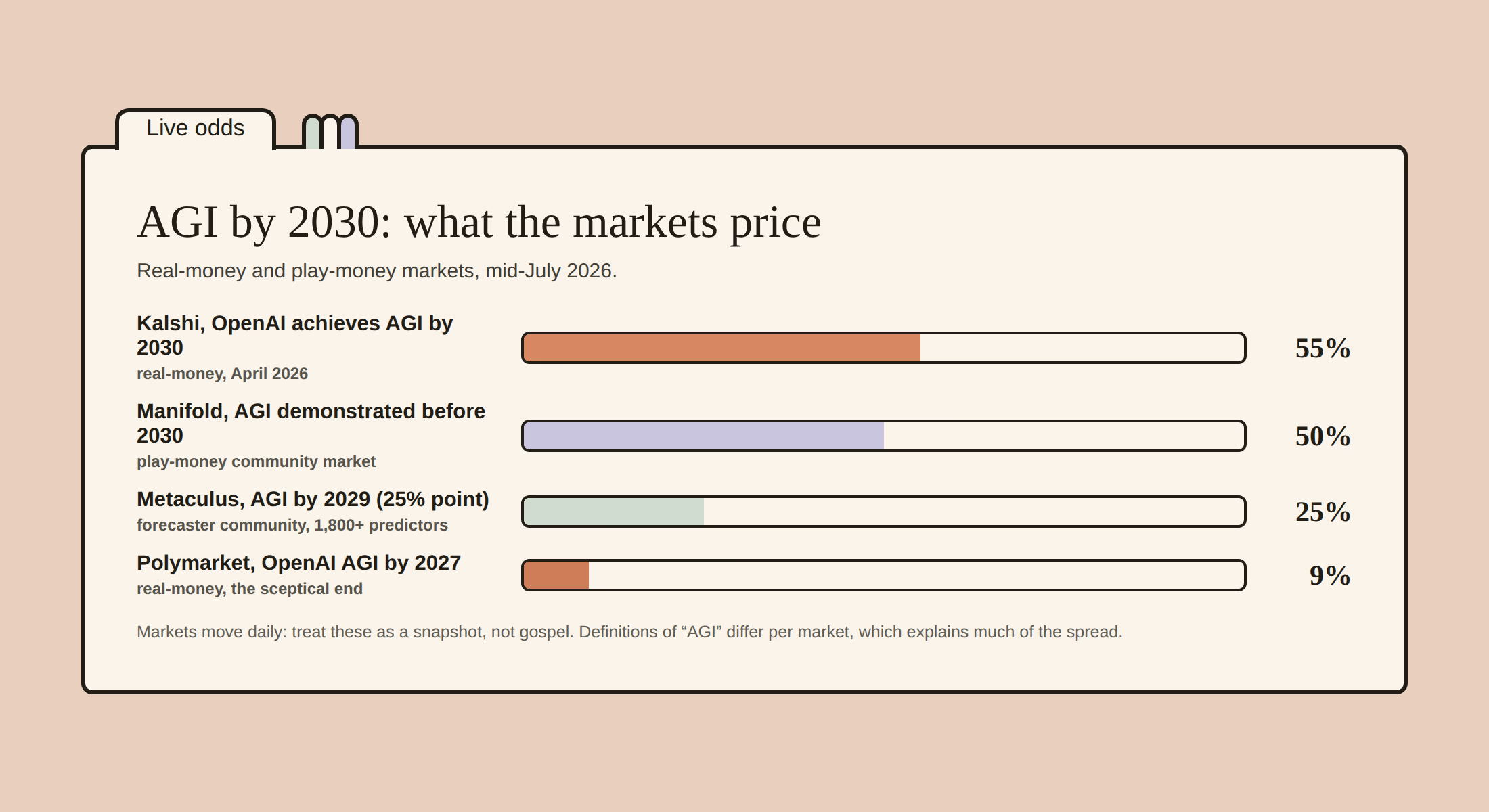
Related reading on this site: Anthropic IPO prospectus, jobs AI may replace by 2030, AGI timeline predictions and Anthropic Mythos 1.
Last updated: 19 October 2026. Sourced from Anthropic, “Investing in the public benefit” (anthropic.com/news/public-benefit-fund, 18/10/2026), Al Jazeera (19/10/2026) and independent analysis. Details may change as Anthropic publishes governance information.
Get the free guide: Claude vs ChatGPT, Gemini & Grok
A 20-page playbook covering everything you need to choose and use the big four AI models in 2026, full cost and feature comparisons, what each is best (and worst) at, and how-tos for images, vectors, building a website, Claude Code and more.