 AI Tools Review Editorial Team
Quick answer:
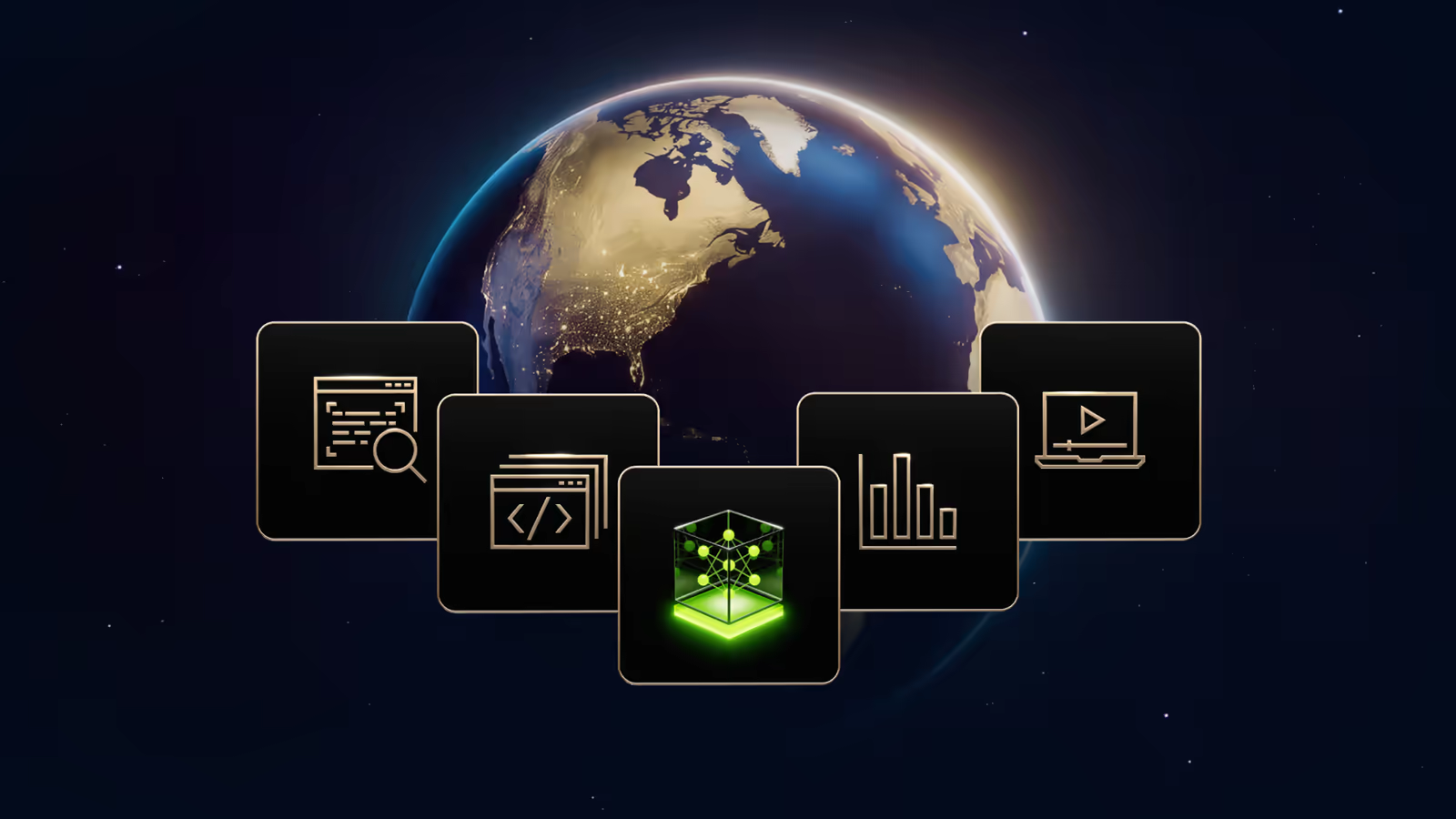
Nemotron 3.5 Bolt is NVIDIA's family of open models for local agents. The first, Bolt 74B-A9B (launched 15 October 2026), has 74 billion total and 9 billion active parameters, uses native 2-bit quantisation to fit in 24GB of memory and scores 21.4 on the Artificial Analysis Intelligence Index, fourth among models under 100B parameters. The second, Bolt E4B (23 October 2026), is an 8B-total, 4B-effective model post-trained from Google's Gemma 4 E4B with a 64K context window, aimed at conversational agents, game characters and robots. The E4B card lists the OpenMDW-1.1 licence. Both are genuinely useful for on-device work, but neither is a frontier model and most E4B numbers are NVIDIA's own.
Most of NVIDIA's Nemotron 3.5 launch coverage has been about the big model, Super VL. Quietly, the more interesting question for everyday builders is what NVIDIA put underneath it: Bolt, a pair of models designed to run on the hardware you already own.
Here is what Bolt actually is, which of the two models people are really talking about when they say "Bolt", the real benchmark numbers from NVIDIA's model card and Artificial Analysis, and where the honest limits sit.
Julian Goldie covers the E4B variant, a robot running AI offline, the 8B parameter and 64K context specs, and why the '4GB' name is misleading.
Summary
Bolt is NVIDIA's answer to a simple question: what should an open model look like if it has to live on a laptop, a desktop graphics card or a small robot, and still behave like an agent that can call tools and hold a conversation? NVIDIA's own wording for the larger model is that it is "optimized to balance intelligence and speed per GB for local agentic workloads". That "per GB" framing is the whole point. Cloud models are judged on raw capability; local models are judged on how much capability you get for each gigabyte of memory you have to spare.
The family arrived in two steps. Bolt 74B-A9B went live on Hugging Face on 15 October 2026 alongside Nemotron 3.5 Super VL. Bolt E4B followed on 23 October 2026, which is the model most recent YouTube coverage, including the Julian Goldie video above, is about. They share a name and a philosophy but are entirely different models, built on different foundations, and mixing them up is the most common error in the early coverage.
- Best for: private, offline or low-latency agents on consumer GPUs, Jetson-class edge devices, laptops and desktop AI boxes such as DGX Spark.
- Headline numbers: 74B-A9B scores 21.4 on the Artificial Analysis Intelligence Index; E4B scores 53.10 on MultiChallenge and 84.79 on IHEval in NVIDIA's harness.
- Defining trait: engineered for intelligence per gigabyte of memory, not for peak capability.
- Main caveat: E4B's model card says it is intended mainly for post-training, adaptation and quantisation rather than direct production inference, and its benchmark numbers are vendor-reported.
Two Models, One Name
It is worth separating the two Bolt models properly, because their specifications, target hardware and evidence base are different.
Bolt 74B-A9B: the 24GB model
Artificial Analysis describes Nemotron 3.5 Bolt 74B-A9B as the first model in NVIDIA's new Bolt family. It has 74 billion total parameters and 9 billion active per token, a 256,000-token context window, and accepts vision and text input while producing text output. NVIDIA says it uses native 2-bit quantisation so that it fits in 24GB of memory and can run alongside other applications on the same machine. That 24GB target is deliberate: it matches the memory of a high-end consumer graphics card and the unified memory budgets of newer laptops.
NVIDIA's launch blog says the model is the number one open model in its class on PinchBench and the number two open model on BrowseComp, and includes a chart of GDPVal tokens per second, though the text does not give the underlying figures. It lists support from llama.cpp, Ollama, LM Studio, Unsloth, Canonical and vLLM, and ties the launch to NVIDIA RTX Spark laptops arriving on 16 October, with the model also running on GeForce RTX PCs, DGX Spark, DGX Station and RTX PRO workstations.
Bolt E4B: the small conversational model
Bolt E4B is a different animal. The Hugging Face card for NVIDIA-Nemotron-3.5-Bolt-E4B-BF16 states that it is post-trained from Google's Gemma-4-E4B-it and has 8 billion total parameters, 4 billion effective, with up to 64K tokens of input and output. NVIDIA positions it for "conversational and physical agents": think non-player characters in games, voice assistants and robots. NVIDIA's launch demo paired it with a Reachy Mini robot running on a Jetson Orin Nano 8GB, entirely offline.
Reports on the modalities conflict, and it is worth being precise. The Hugging Face card lists text input and text output. NVIDIA's technical report reportedly says that the NIM microservice also accepts image and audio input, but that the post-training itself was text-only. Until NVIDIA reconciles the two, treat E4B as a text model and treat any multimodal use as experimental.
Architecture & Training
The two Bolt models take different routes to the same goal. The 74B-A9B model is a Mixture-of-Experts design: only 9 billion of its 74 billion parameters are active for any token, so the compute cost per token is closer to a 9B dense model, while the memory cost is set by the total parameter count. Native 2-bit quantisation is what brings that total down to 24GB. For comparison, the same weights at 16-bit precision would need roughly eight times the memory, so quantisation at this level is not an optional extra; it is the product.
E4B reuses Google's Gemma 4 E4B architecture, where "E4B" refers to effective parameters: the model stores 8 billion parameters but behaves, for compute purposes, like a 4 billion parameter network. NVIDIA's contribution is the post-training. The model card says it used multi-environment reinforcement learning with GRPO across instruction following, multi-step tool use, multi-turn conversation and structured output, built with NVIDIA's NeMo RL and NeMo Gym libraries. Thinking can be switched on or off with an enable_thinking flag, a runtime thinking budget is supported, and a conversational_mode option produces shorter, less formatted replies suited to voice and in-game dialogue.
The training data window runs from December 2025 to May 2026, with a May 2026 data cutoff. The card lists vLLM (version 0.31.0 is referenced) as the serving stack, Linux as the only supported operating system, and testing on NVIDIA Hopper, Blackwell and Jetson hardware. It also flags bias concerns in the underlying datasets, including gender and ethnicity skews, and recommends bias audits before deployment, which matters if you plan to put a character or assistant in front of the public.
One line on the model card deserves emphasis: it says E4B is intended mainly for post-training, adaptation and quantisation, not for direct production inference. In plain terms, NVIDIA is releasing a strong base for people to specialise, not a polished assistant you should ship unchanged. That is a common pattern for the Nemotron line, and it is reflected in how Nemotron 3.5 Lightning was pitched at agent builders rather than end users.
Benchmarks
Bolt 74B-A9B on the Artificial Analysis Intelligence Index
Artificial Analysis, an independent benchmarking firm, scores Bolt 74B-A9B at 21.4 on its Intelligence Index (rounded to 21 in its headline). It ranks fourth among models under 100B parameters and first among US models in that class. The comparison with NVIDIA's own models is instructive:
- Versus Nemotron 3 Super (12.8): Bolt is 8.6 points higher.
- Versus Nemotron 3 Ultra (23, with 550B total and 55B active parameters): Bolt trails by only 1.5 points despite having about a seventh of the total parameters and a sixth of the active ones.
- Versus Nemotron 3.5 Super VL (26.5): Bolt is behind, as you would expect from a larger sibling.
On individual benchmarks, Artificial Analysis shows Bolt beating Ultra on AutomationBench-AA (15.5% against 3.0%) and AA-Briefcase (912 Elo against 874), while trailing it on AA-LCR (70% against 79%) and Humanity's Last Exam (25% against 28%). The pattern fits the design: strong on agentic, tool-style work; weaker on long-context recall and hard reasoning.
There is a cost to that result. Bolt used about 82,000 output tokens per Intelligence Index task, 1.8 times Super VL (46,000) and 2.9 times Ultra (28,000), though 28% fewer than Nemotron 3 Super (114,000). A model that thinks at length is cheap per token locally, but it is slower to a final answer, which matters in voice and gaming. Artificial Analysis did not publish output speed or pricing for Bolt in the article we reviewed; its speed measurements were for Super VL.
Bolt E4B on NVIDIA's model card
NVIDIA's Hugging Face card reports the following BF16, reasoning-mode results from its own harness, comparing E4B with its Gemma 4 E4B-it base and with Alibaba's Qwen3.5 4B:
| Benchmark | Bolt E4B | Gemma 4 E4B-it | Qwen3.5 4B |
|---|---|---|---|
| MultiChallenge | 53.10 | 42.08 | 51.76 |
| RoleBench | 67.05 | 49.95 | 53.66 |
| IHEval | 84.79 | 67.04 | 60.57 |
| BFCL-v3 | 68.51 | 66.39 | 70.95 |
| Tau2-Bench | 55.10 | 38.50 | 75.06 |
| RULER (64K) | 86.99 | 86.55 | 95.15 |
Other figures reported from NVIDIA's technical report include IFBench at 63.79% and AgentIF at 25.81%. Read the table honestly. Bolt E4B is a clear improvement on its Gemma base across nearly every row, which shows the reinforcement learning post-training works. Against Qwen3.5 4B it wins on instruction following, role-play and multi-turn tests, but loses on function calling (BFCL-v3), on the agentic Tau2-Bench by a wide margin (55.10 against 75.06), and on long-context retrieval at 64K. Since the card itself notes the numbers come from NVIDIA's harness and may differ from vendor-reported results, wait for independent replication before treating any single row as settled. The aggregate Gradually benchmark score is listed as unavailable because there are not yet enough independent results.
Hardware & Local Deployment
This is where the "4GB" name causes trouble. The Julian Goldie video above makes the point directly: the name is misleading. NVIDIA's 4GB figure refers to a quantised build; a separate Q4_K_M release of about 4GB is published. The BF16 checkpoint on Hugging Face is considerably larger, and one launch report lists the common download at 6.18GB. Add the KV cache for a long conversation and you should plan for at least 4 to 5GB of free video memory on the quantised version, and comfortably more for the full-precision one.
For the larger model the guidance is cleaner: 24GB. That covers a GeForce RTX card with 24GB, many unified-memory laptops and the DGX Spark class of desktop AI computer. Creators are already doing this: in a video published the day before this article, Alex Finn describes running DeepSeek 4.1 Flash across two DGX Sparks, and our DeepSeek V4.1 Flash and M6 Mac Mini local AI pages cover the alternatives if you are weighing hardware.
For the E4B model, NVIDIA lists GeForce RTX, Jetson, and RTX or DGX Spark systems as targets, tested on Hopper, Blackwell and Jetson. The robot demo is the most telling: a Reachy Mini controlled by a Jetson Orin Nano 8GB with no network connection. If that sounds like a pairing for simulation-trained robots, it is; NVIDIA's Isaac Lab 3.0 covers the training side of the physical-AI stack, and Bolt supplies the conversational layer on top.
Serving is straightforward for the usual toolchains. Support is listed for vLLM, llama.cpp, Ollama, LM Studio and Unsloth for the 74B-A9B model, and Linux with vLLM for E4B. The E4B card documents tool calling and the DFlash speculative decoding option through NIM, NVIDIA's packaged microservice format.
Why Local Agents Matter
A fair question is why NVIDIA, which sells the datacentre GPUs that train frontier models, is spending effort on tiny models. There are three practical reasons. First, privacy and sovereignty: a model that never leaves the device cannot leak a customer's data to a third party, which is increasingly a procurement requirement in finance, healthcare and the public sector. Second, latency: a game character or robot that waits for a round trip to a cloud endpoint feels broken, while an on-device model responds as fast as the hardware allows. Third, cost: once the hardware is bought, each extra token is effectively free, which changes the economics for always-on agents that would be ruinous at per-token cloud prices.
There is also a strategic angle. Every local model that runs well on an RTX card makes that card more valuable. The pattern is similar to NVIDIA's earlier open releases, and it sits alongside the broader open-weights debate we covered in NVIDIA's open weights letter and Anthropic's response. In a router-based architecture, such as the one NVIDIA described with Switchyard in the Lightning article, a local Bolt model would handle private, high-volume steps while a cloud model takes only the hardest ones.
The caveat is the one every local-AI enthusiast learns: local models are good enough for a lot of work, but not all of it. Bolt 74B-A9B's Intelligence Index of 21.4 is excellent for its size, but frontier cloud models score far higher, and for hard coding or research tasks you will still reach for the cloud. The sensible stance is hybrid.
Licence & Availability
Bolt E4B ships under OpenMDW-1.1, with the base Gemma 4 E4B model listed as Apache 2.0. NVIDIA describes OpenMDW as permitting commercial use and modification, and it is the same licence as on Super VL. The launch blog for the 74B-A9B model does not state a licence in the text we reviewed, so verify the Hugging Face card for that model before commercial deployment. Weights for E4B are available for local deployment and as a downloadable NVIDIA NIM microservice; no hosted API price is documented, so "open weights" should not be read as "free hosted access".
Release dates in the coverage vary slightly because of time zones and staggered uploads. The model card lists E4B's release as 23 October 2026, the date NVIDIA's launch blog gave. The 74B-A9B model was released on 15 October 2026 with Super VL. One third-party database still lists E4B as not open source, but that page predates the release and should be disregarded.
Limitations
- Vendor-reported numbers: every E4B score comes from NVIDIA's harness. Independent replication is thin.
- Not a finished assistant: the E4B card says it targets post-training, adaptation and quantisation rather than direct production inference.
- Mixed agentic results: E4B trails Qwen3.5 4B on Tau2-Bench and BFCL-v3, two of the most relevant tool-use tests.
- Token hunger: the 74B-A9B model uses roughly 82,000 output tokens per Intelligence Index task, which slows real-world responses.
- Platform limits: E4B officially supports Linux only and is tested on NVIDIA hardware, so Apple Silicon and AMD users depend on community ports.
- Bias: the model card flags gender and ethnicity skews in the underlying datasets and recommends audits before public deployment.
- Missing data: we found no published pricing, speed or memory benchmarks for the 74B-A9B model beyond NVIDIA's 24GB claim.
How It Compares
Within NVIDIA's own range, Bolt sits between the tiny and the large. Lightning (31.6B total, 3.6B active) targets high-volume cloud agent steps; Super VL (120B total, 12B active) is the multimodal workhorse needing around four H100s; Bolt 74B-A9B is the one you can run at home. Among small open models, the realistic competitors are Qwen3.5 4B at the E4B end and, for larger local models, the DeepSeek V4.1 Flash class that people are running on DGX Spark pairs. If you follow open Chinese releases, our Ling 3.1 Flash piece covers another end of that market.
What differentiates Bolt is less raw score than packaging: aggressive quantisation designed in rather than bolted on, a first-party robot and gaming story, NVIDIA's own tuning for Jetson and RTX, and a permissive licence. If your target is NVIDIA hardware, that integration is a real advantage.
Who Should Use It
Worth trying now if you are building a private on-device assistant, a game character, a kiosk, or a robot on Jetson; if you have a 24GB GPU or a DGX Spark and want a capable local agent model; or if you plan to fine-tune a small, permissively licensed base using NVIDIA's NeMo tooling.
Worth skipping if you need frontier reasoning, you run on Apple Silicon and want first-party support, or you want a drop-in chatbot with no tuning. In those cases a hosted frontier model, or a local model with broader community tooling, will serve you better today.
The Bottom Line
Nemotron 3.5 Bolt is a sensible, narrowly aimed release. The 74B-A9B model's independent Intelligence Index score of 21.4 is impressive for something designed to fit in 24GB, and E4B convincingly improves on its Gemma base. The caution is the usual one: E4B's evidence is mostly NVIDIA's own, the "4GB" label oversells how little memory you need, and NVIDIA itself describes E4B as a base to adapt rather than a finished product. Try it if you are on NVIDIA hardware, and keep a cloud model on hand for the hard problems.
Last updated: 28 October 2026. Sourced from NVIDIA's launch blog (blogs.nvidia.com), the Hugging Face model card for NVIDIA-Nemotron-3.5-Bolt-E4B-BF16, Artificial Analysis's Nemotron 3.5 Super and Bolt article, and third-party model databases. Hero image: NVIDIA blog. Benchmark figures for E4B are vendor-reported.
Get the free guide: Claude vs ChatGPT, Gemini & Grok
A 20-page playbook covering everything you need to choose and use the big four AI models in 2026, full cost and feature comparisons, what each is best (and worst) at, and how-tos for images, vectors, building a website, Claude Code and more.