 AI Tools Review Editorial Team
Quick Answer:
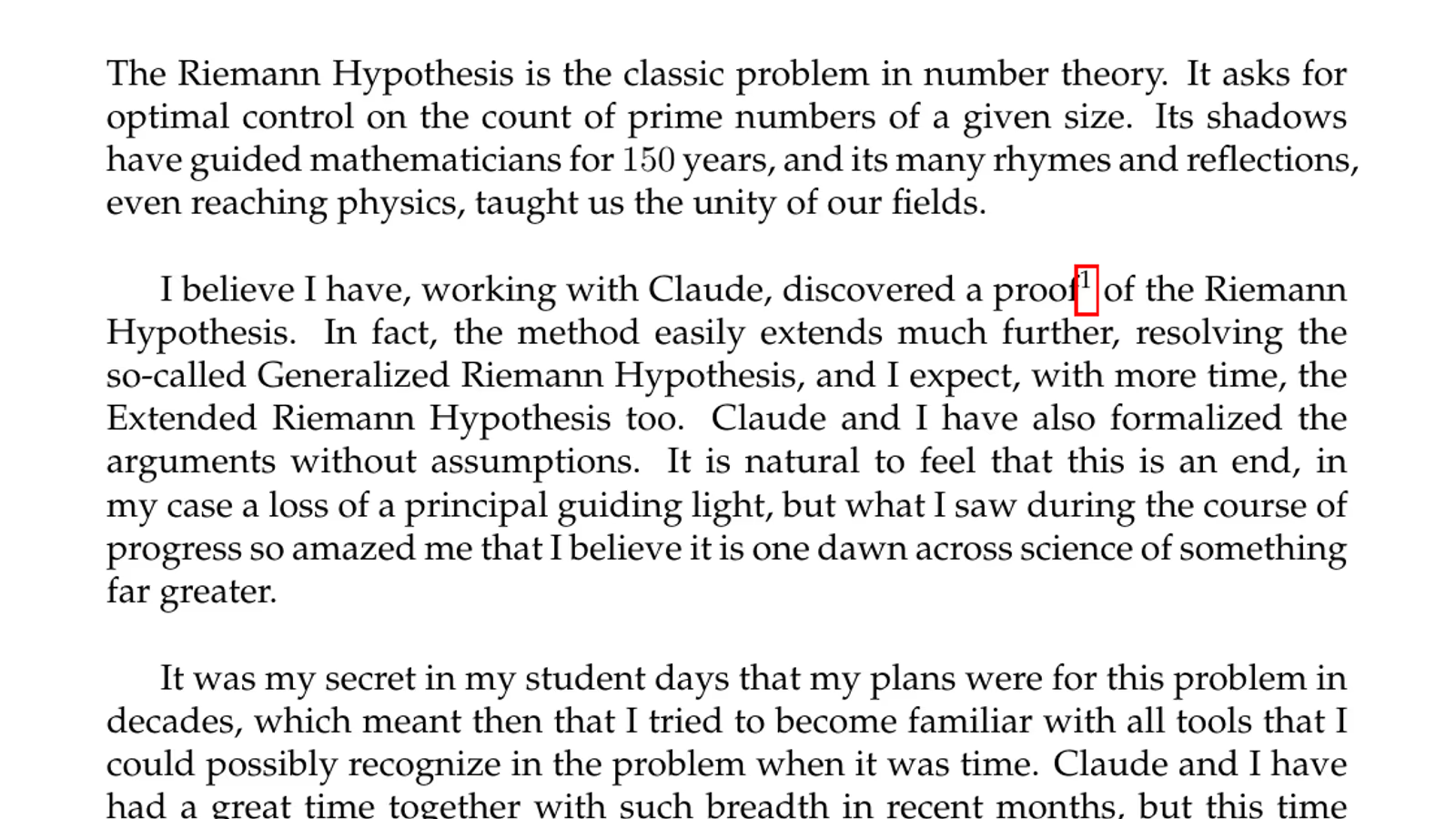
On 20/11/2026 Levent Alpöge, a mathematician at Anthropic, posted a four-page note saying he believes he has, working with Claude, found a proof of the Riemann Hypothesis, and released it only as a very large Lean 4 archive. This is a claim under review, not an accepted theorem. As of 21/11/2026, MIT's Andrew Sutherland reports that all 175,187 Lean modules compile, that the headline theorems use only Lean's three standard axioms, and that three independent checkers accept the proof; two further checks were still running. No human-readable proof exists, no expert has yet reviewed the mathematics itself, and the Clay Mathematics Institute still lists the problem as unsolved.
The most famous open problem in mathematics now has a claimed solution that no person has read. It exists as 17.4 million lines of computer-checkable code, written with an AI model, and announced the day after its author's employer floated on the stock market. Several of the mechanical checks have passed. The mathematical ones have barely begun. This article sets out exactly what has been claimed, what has been checked, and what has not.
We have based this piece on the primary documents: Alpöge's note, Andrew Sutherland's public verification report at MIT, the Lean community's verification notes, Terence Tao's blog, the Clay Mathematics Institute's rules, and Ravi Vakil's announcement of a separate human proof claim. We add reporting from Scientific American and TechCrunch where they quote named mathematicians. AI Tools Review has not built or checked the Lean archive itself, and we are not in a position to judge the mathematics. Where a number comes from one party, we say whose it is. For background on how AI maths claims have gone this year, see our pieces on OpenAI's Navier-Stokes result and the Astra maths manuscripts.
175,187
Lean 4 files in the archive
Counted by Lean community checkers
17.4M
Lines of Lean source
17,374,215, with no comments
4 pages
Length of the only prose
The note titled "Remark"
0
Human-readable proofs published
Expert review of the maths has not been reported
Source: leanprover-community/riemann-hypothesis verification notes; alpo.ge/remark.pdf. Status as of 21/11/2026
Wes Roth walks through Alpöge's note, the Lean archive and the early reaction. The video title overstates the position: the proof is claimed and partly machine-checked, not accepted as solved.
Executive Summary
- The claim: a note titled "Remark", dated 20/11/2026, in which Levent Alpöge writes that he believes he has, "working with Claude", discovered a proof of the Riemann Hypothesis, and that the method also resolves the Generalized Riemann Hypothesis (GRH).
- The evidence: a 14-part Lean 4 archive of 239,275,554 bytes. Lean community checkers count 175,187 files, 17,374,215 lines and 818,755 theorem or lemma declarations.
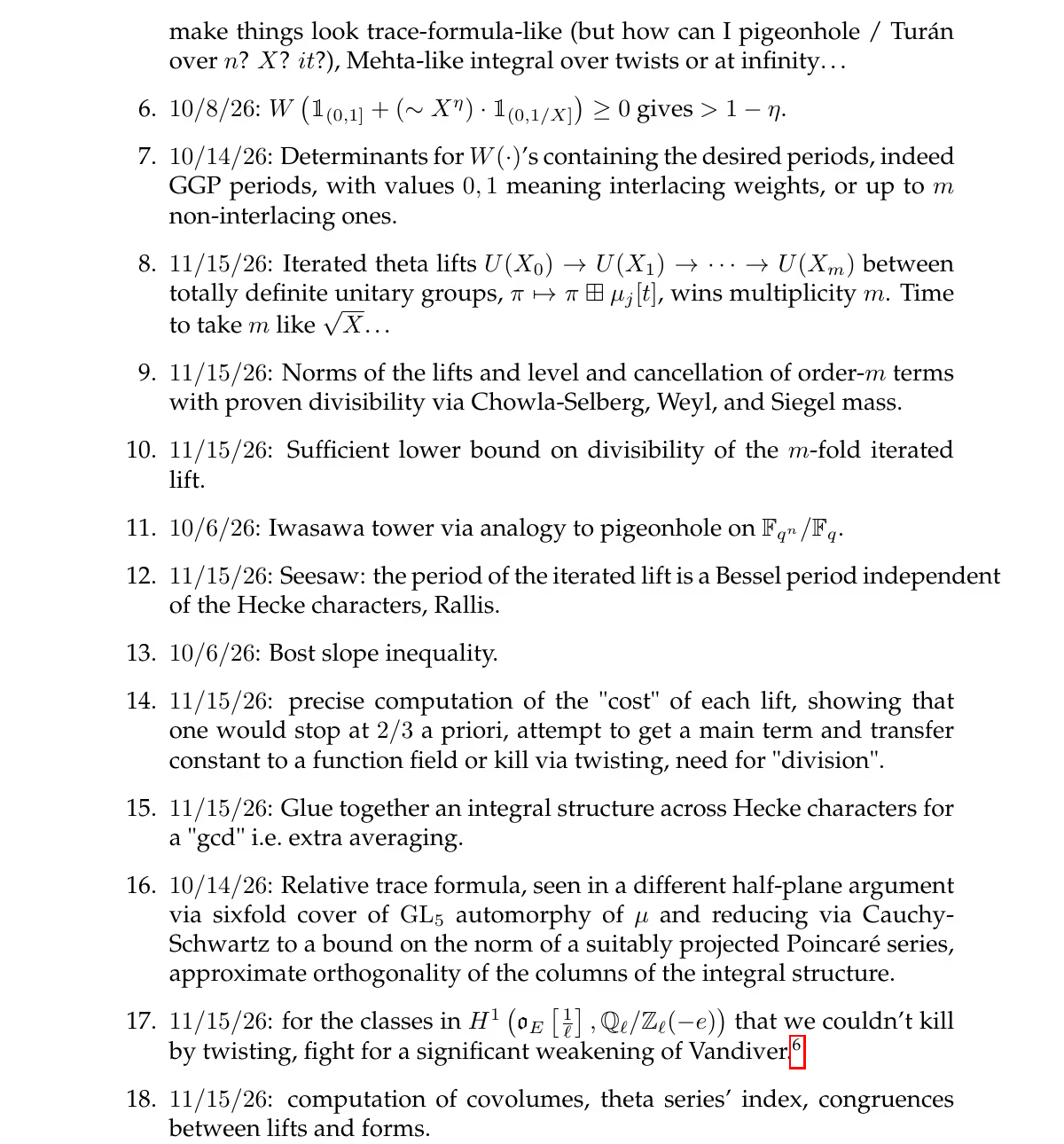
- No paper: there is no conventional written proof. Alpöge says a generated prose version passed 250,000 pages and he decided "to only present Lean".
- Machine checks passed: Andrew Sutherland (MIT) reports a clean compile of every module, an axiom audit showing only the three standard axioms, a full kernel replay, and acceptance by nanoda, con-leche and lean4lean.
- Machine checks pending: at 08:45 UTC on 21/11/2026 the end-to-end
lake comparatorrun and the Lean default and paranoid kernel replays of the exported proof were still running. A sandboxed rebuild had not yet been compared with Sutherland's. - Human checks: the formal statements have been read by hand and match Mathlib's definition. Nobody has yet published an explanation or review of why the argument works.
- Scope: "GRH" here means Dirichlet L-functions only. Dedekind zeta functions and other L-functions are not covered, according to the community notes.
- Official status: the Clay Mathematics Institute's page lists the Riemann Hypothesis as "Unsolved".
- Same day: Stanford's Ravi Vakil posted a separate, all-human, 940-page proposed proof of GRH by Alessandro Maria Masullo. About eight hours later Vakil reported that several people had found problems in it.
What Was Claimed, and by Whom?
The claim was made in a four-page PDF on Alpöge's personal website, not on Anthropic's blog and not on arXiv. Scientific American, which broke the story on 20/11/2026, describes him as a mathematician at Anthropic. The key sentence of the note reads: "I believe I have, working with Claude, discovered a proof of the Riemann Hypothesis." It continues: "In fact, the method easily extends much further, resolving the so-called Generalized Riemann Hypothesis, and I expect, with more time, the Extended Riemann Hypothesis too. Claude and I have also formalized the arguments without assumptions."
Three things about that wording matter. First, it opens with "I believe". Second, the Extended Riemann Hypothesis is an expectation, not a result. Third, the proof itself is given only as a footnote linking to 14 archive parts on his site.
The note is candid about its own limits. Alpöge writes that he is "presenting the world with a complete argument before having mastered a massive neighbourhood around its mathematics". He says he has "little mastery of automorphic forms on higher rank groups", that parts of his summary paraphrase Claude and "might make zero sense", and that "the Lean should suffice to clarify everything". He says he intends "to understand and impart understanding of this argument" and "to write it properly".
On the division of labour, the note says Alpöge steered the work towards a setting analogous to a simpler "toy" case, and that Claude then "far outpaced me near the finish line". He describes the argument as "a descendant of Stepanov's" method for the analogous problem over function fields. The one technical line he highlights is Claude's suggestion to chain theta lifts, with the chain length set to the square root of X for a von Mangoldt sum of length X. We report that as his account. We cannot assess it.
The note does not name a Claude model. Terence Tao describes it as "an internal AI model". Readers should not assume the work was done with a product they can buy, such as the models in our Fable 5.2 and Mythos 5.2 review or our Opus 5.5 review.
The note also addresses timing. Alpöge writes: "The precise timing is horrible." He says the result came together "late Sunday night", that he messaged "Dario" to ask about his ability to announce, and that "there was a constraint to respect". He adds that there is "an obvious cynical view, to do with the timing, but it is false". Scientific American notes the announcement came a day after Anthropic's stock market debut. Anthropic's own closing announcement says its shares began trading on Nasdaq on 19/11/2026. We found no formal Anthropic statement on the claim.
What Is the Riemann Hypothesis?
Prime numbers are the whole numbers divisible only by one and themselves: 2, 3, 5, 7, 11 and so on. They thin out as numbers grow, but irregularly. The Riemann Hypothesis is a precise statement about how regular that thinning is. Alpöge's note puts it in one line: it "asks for optimal control on the count of prime numbers of a given size".
The technical form concerns the Riemann zeta function, a function of a complex variable. The Clay Mathematics Institute states it as the assertion that all the "non-obvious" zeros of the zeta function are complex numbers with real part 1/2. Those zeros sit on what is called the critical line. Bernhard Riemann formulated the hypothesis in a paper of 1859, which is why headlines call it a 167-year-old problem.
Nobody doubts the numerical evidence. Clay's page says the hypothesis has been checked for the first 10,000,000,000,000 solutions. But checking ten trillion cases proves nothing about the infinitely many that remain. A proof must cover all of them.
It matters because a large body of number theory has been built on the assumption that it is true. Many theorems begin "assuming the Riemann Hypothesis", and a proof would turn those conditional results into unconditional ones. The generalised version extends the same statement to a family of related functions called Dirichlet L-functions, which govern how primes are spread among arithmetic progressions.
It is also one of the seven Millennium Prize Problems that Clay announced in Paris on 24/05/2000, each carrying $1 million (about £790,000). Only one, the Poincaré Conjecture, is listed by Clay as solved.
Before this week, the best proven result of this type was partial. On 10/08/2026 Anthropic reported that an unreleased research version of Claude had raised the proven lower bound on the share of zeta zeros lying on the critical line from 41.6% to 67.2%. The hypothesis says the true figure is 100%. Anthropic wrote at the time: "We don't expect that the techniques Claude used will lead to proving the Riemann hypothesis."
Proven share of zeta zeros on the critical line, before this week's claim
Lower bounds that were established before 20/11/2026. The Riemann Hypothesis asserts 100%; the new claim is not plotted because it is not yet accepted.
Previous best bound
Claude research model, August 2026 · Reviewed by Brian Conrey and Dan Goldston, per Anthropic
Show data table
| Benchmark | Proven lower bound |
|---|---|
| Previous best bound | 41.6% |
| Claude research model, August 2026 | 67.2% |
Source: Anthropic, 'riemann-zeta' research post, 10/08/2026 (vendor account of its own result)
What Is in the Lean Archive?
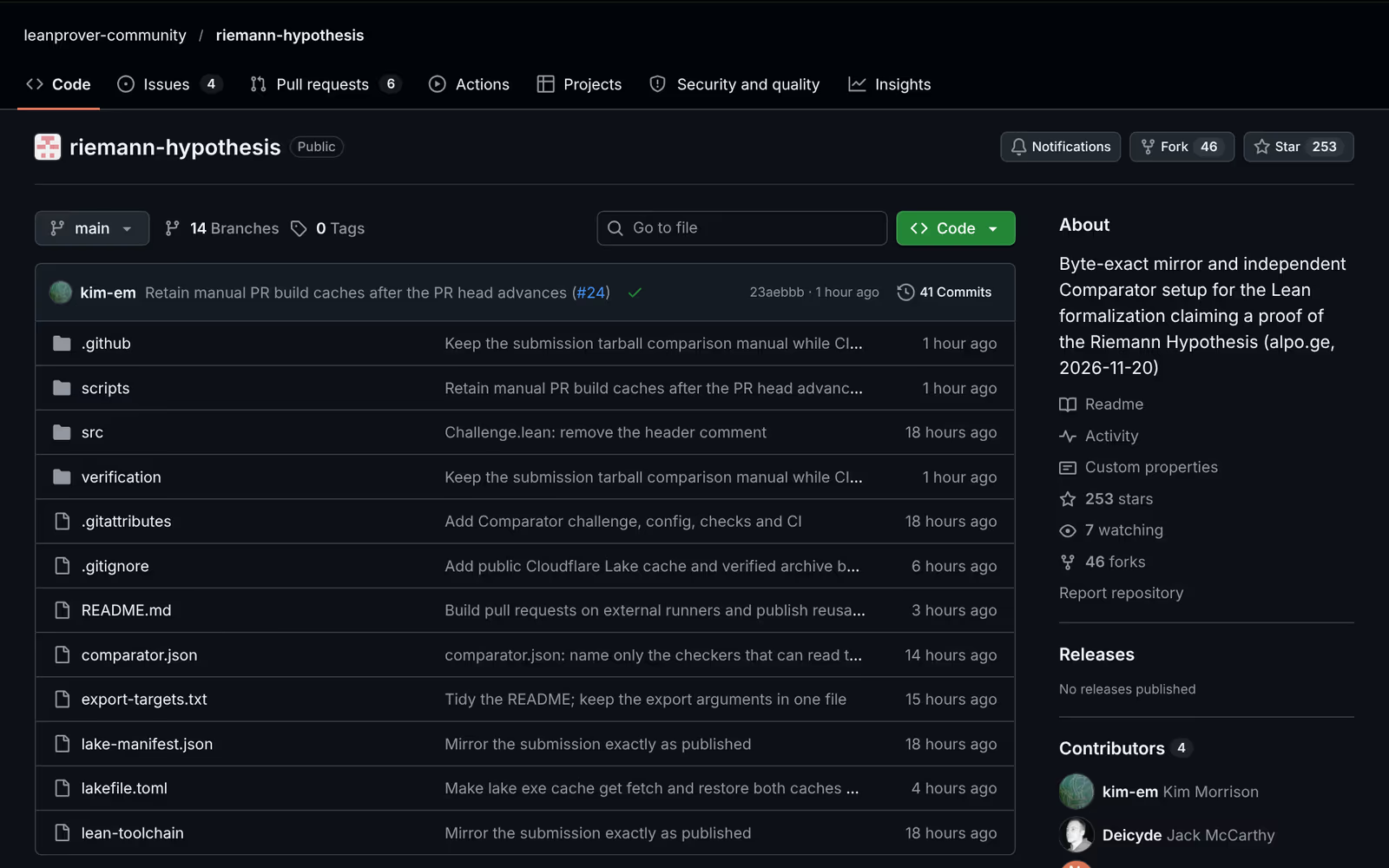
The archive is small to download and enormous to read. The 14 parts join into one file of 239,275,554 bytes, about 239 MB. Unpacked, the Lean community's notes count 175,187 .lean files holding 1,030,531,854 bytes of source: 17,374,215 lines, of which 15,531,759 are non-blank. The notes record that there are no comments anywhere in the source.
The same notes count 818,755 theorem or lemma declarations and 242,067 definitions and similar declarations. Every file is in the import closure of the top-level file, meaning nothing is unused padding as far as the import graph goes. When the proof is exported for independent checkers, Sutherland's report counts 1,468,418 declarations.
Almost all of it sits in one library. The notes break the source down as follows.
Where the 17.4 million lines sit, by library
Lines of Lean source per top-level library in the published archive. Ten further small files, including Main.lean and Statements.lean, total 70 lines.
Development · 141,928 files
Formalism · 18,254 files
GroundTheory · 8,507 files
ReciprocityTheory · 3,845 files
CompanionTheory · 2,027 files
PositivityTheory · 449 files
Lemmata · 167 files
Show data table
| Benchmark | Lines of Lean |
|---|---|
| Development | 12,232,663 |
| Formalism | 3,200,748 |
| GroundTheory | 1,119,138 |
| ReciprocityTheory | 563,016 |
| CompanionTheory | 194,218 |
| PositivityTheory | 55,130 |
| Lemmata | 9,232 |
Source: leanprover-community/riemann-hypothesis, verification/NOTES.md (independent count, not the author's)
Against that bulk, the part a reader needs to trust is tiny. The file Main.lean states five theorems. The first is one line: theorem riemannHypothesis : RiemannHypothesis := rhOfAll. The name RiemannHypothesis on the right of the colon is not defined in the archive. It is the definition already in Mathlib, the community-maintained mathematics library for Lean. That is important, because it means the author did not get to write his own version of the target.
| Theorem in Main.lean | What it states |
|---|---|
riemannHypothesis | Mathlib's own RiemannHypothesis |
riemannZeta_eq_zero_re | The same statement, written out in full |
LFunction_ne_zero_of_half_lt_re | L(χ, s) is non-zero for Re s > 1/2, for every modulus and every Dirichlet character, except the trivial character at s = 1 |
LFunction_eq_zero_re | Every zero of L(χ, s) with 0 < Re s < 1 has Re s = 1/2 |
LFunction_eq_zero_re_of_isPrimitive | The same, for primitive characters |
Source: README of leanprover-community/riemann-hypothesis.
The proof also leans on Mathlib rather than rebuilding it. Sutherland's report confirms that the 8,322 compiled Mathlib files and 378 other dependency files used in his build are byte-for-byte identical to the official cache. The submission adds 175,187 compiled files of its own on top.
Compiled files: the submission against the Mathlib it builds on
Counts of compiled .olean files in Andrew Sutherland's build. The submission is roughly 21 times the file count of the Mathlib version it imports.
Alpöge and Claude submission
Mathlib v4.33.1
Other dependencies
Show data table
| Benchmark | Compiled files |
|---|---|
| Alpöge and Claude submission | 175,187 |
| Mathlib v4.33.1 | 8,322 |
| Other dependencies | 378 |
Source: Andrew Sutherland (MIT), math.mit.edu/~drew/grh, page updated 21/11/2026 08:45 UTC
What Does a Lean 4 Proof Guarantee?
Lean is a proof assistant. You write definitions and proofs in a programming language, and a small trusted program called the kernel checks every logical step. If the kernel accepts a theorem, the theorem follows from the axioms, provided the kernel is correct. That turns the question "is this 17-million-line argument right?" into several smaller questions that people can actually answer.
1. Does the statement say what we think it says?
A proof of the wrong statement is worthless. Here the headline theorem uses Mathlib's existing definition, and the community notes say "the statements were read by hand". They record that the definition excludes the trivial zeros and the point s = 1, that the Dirichlet statements cover every modulus and every character, and that every 1/2 is real division. That last point is not pedantry: in Lean, 1/2 on whole numbers equals zero, a classic way for a formal statement to go quietly wrong.
2. Are there hidden assumptions?
Lean lets you write sorry to skip a proof, or declare a new axiom to assume anything you like. The community's text scan found none of these, and no native_decide, unsafe or similar escape hatches. A text scan is weak evidence, and the notes say so: "A text search is not a proof. The axiom check and kernel replay in Comparator are." The stronger check is the command #print axioms, which Sutherland ran on all five theorems. It reports only propext, Classical.choice and Quot.sound, the three axioms that ordinary Lean mathematics uses.
3. Can someone else reproduce the build?
Compiling the archive runs the author's code, so checkers treat it as untrusted. The community protocol builds inside a container with no network, exports the finished proof to a neutral file, and has separate programs judge that file. The scan did find custom tactics, named kexactB and kcopy, that hand terms to the kernel without the usual intermediate check. The notes judge this sound, "because the kernel checks every declaration", and give it as the reason they re-check with independent kernels.
4. Is the kernel itself trustworthy?
The archive is pinned to Lean v4.33.1, released on 21/08/2026. The community notes list kernel fixes that came later and are not in that version, including two that Lean's release notes say "could potentially be turned into a proof of False" with deliberately constructed input. For that reason the notes call a pass by the 4.33.1 kernel alone "limited evidence". The answer is to use several kernels written by different people in different languages, which is what has been done.
What Lean cannot tell you
Even a perfect pass has limits. Sutherland's report states them: a passing check "relies on those kernels and on Mathlib's definitions being what they are intended to be". And a kernel verdict is a yes or a no. It does not explain the idea, show which steps are essential, or let other mathematicians reuse the method. For that, people have to understand it.
Verification Status as of 21/11/2026
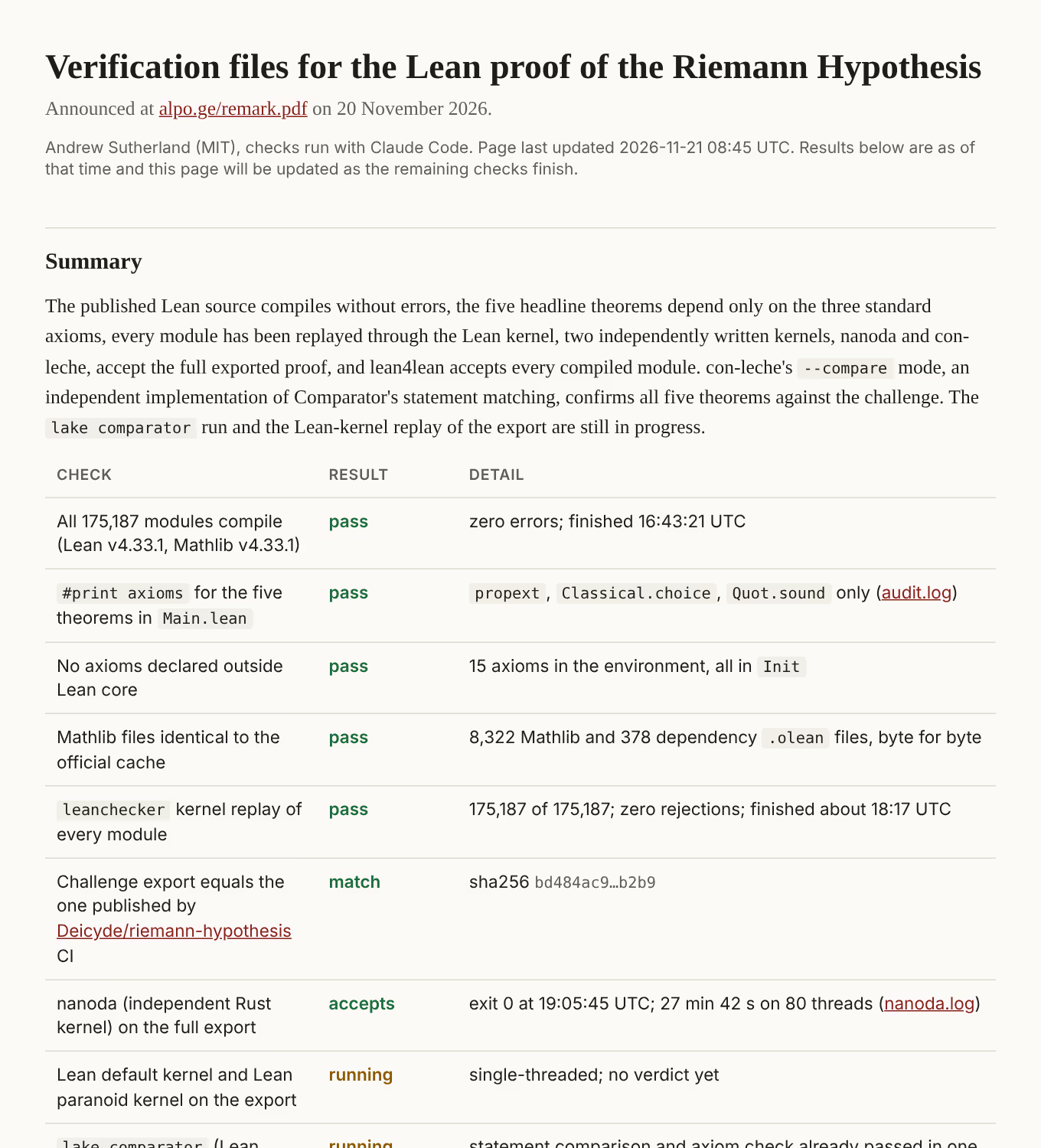
The fullest public record is a page maintained by Andrew Sutherland of MIT, who notes that his checks were "run with Claude Code". We read the version marked "last updated 2026-11-21 08:45 UTC". Everything in this section reflects that snapshot and may have changed since.
Checks That Have Passed
| Check | Result | Detail (Sutherland's report) |
|---|---|---|
| All 175,187 modules compile (Lean v4.33.1, Mathlib v4.33.1) | Pass | Zero errors; finished 16:43:21 UTC on 20/11/2026 |
| Axiom audit of the five theorems | Pass | Only propext, Classical.choice, Quot.sound |
| No axioms declared outside Lean core | Pass | 15 axioms in the environment, all in Lean's Init |
| Mathlib files identical to the official cache | Pass | 8,322 Mathlib and 378 dependency files, byte for byte |
leanchecker kernel replay of every module | Pass | 175,187 of 175,187; zero rejections; about 18:17 UTC |
| nanoda, an independent kernel written in Rust | Accepts | 27 min 42 s on 80 threads; finished 19:05:45 UTC |
| con-leche, a second independent kernel | Accepts | 1,468,418 declarations; 3 min 15 s on 64 threads |
| con-leche statement comparison | Accepts | All five theorems "justified by the solution" |
| lean4lean, module by module | Pass | 175,182 passed on default settings; five hit a step limit and passed when rerun with the limit raised |
| Lean default and paranoid kernels on the export | Running | Single-threaded; "no verdict yet" |
lake comparator (Lean v4.36.0) end to end | Running | Statement comparison and axiom check passed in one run; kernels in progress |
Sutherland added one check that does not depend on Mathlib's definition of the zeta function at all. The Riemann Hypothesis is known to be equivalent to certain elementary inequalities about the sum of a number's divisors, due to Robin and Lagarias. He combined the submission with a separate, independent formalisation of those equivalences and obtained two theorems about divisor sums "with no hypotheses and no mention of zeta". Both compile, both pass the axiom audit, and nanoda and con-leche accept the combined export. This narrows the room for a subtle mismatch in how zeta is defined.
Others have reported results too. Kingy.ai reports that a build by Aapo Lipponen on the LUMI supercomputer compiled all 175,187 modules and reproduced two key output hashes byte for byte, and that the independent Deicyde checking project compiled its own statements on 20/11/2026. We have not confirmed those runs from their own logs.
What Is Still Open
- The official judge has not finished. The
lake comparatorrun and the Lean kernel replays of the 62 GB export were still in progress. Sutherland expects them to take many hours. - The build was not sandboxed. His report says the build "ran on cloud machines without a sandbox" and called the compiler directly instead of using the standard build command. A 77-module sample matched a standard build; the full set has not been compared.
- Cross-build reproducibility. An export from a sandboxed build should have the same checksum. The report says "that comparison has not been made yet". The community's own notes still said "The build is in progress" when we read them.
- Trust in the foundations. Every result relies on the kernels used and on Mathlib's definitions being faithful.
- The mathematics. No human-readable proof exists. Nobody has published an account of why the argument works, and no referee has examined it. This is the largest open item by far.
- Scope. The Extended Riemann Hypothesis is not claimed. The GRH statements cover Dirichlet L-functions only.
Coverage disagrees on the headline word. Kingy.ai describes the proof as formally checked; Unite.AI and Superpower Daily, written earlier on 20/11/2026, call it unverified. Both are defensible at their time of writing. The accurate position is in between: the formal check is well advanced and so far clean, and the mathematical review has not started in any public form.
How big the artefacts are
Size in gigabytes of each published file. The download is small; the fully expanded proof that kernels must replay is about 257 times larger.
Source archive, 14 parts joined · 239,275,554 bytes
Lean source, unpacked · 1,030,531,854 bytes
Exported proof, compressed · 7,699,933,588 bytes
Exported proof, unpacked · 61,570,595,788 bytes
Show data table
| Benchmark | Size |
|---|---|
| Source archive, 14 parts joined | 0.24 GB |
| Lean source, unpacked | 1.03 GB |
| Exported proof, compressed | 7.70 GB |
| Exported proof, unpacked | 61.57 GB |
Source: Archive and export sizes from Andrew Sutherland's report; source size from the Lean community notes. Decimal gigabytes
Timeline
Dates in Alpöge's note come from what he calls "a rough timeline Claude provided after a thorough search". They are his account, not an independent record. Times are UTC.
| Date | Event | Source |
|---|---|---|
| 10/08/2026 | Anthropic reports Claude raised the critical-line bound from 41.6% to 67.2%, and says the full problem was not solved | Anthropic |
| 06/10/2026 | Earliest entry in the note's timeline ("Stepanov determinant") | Alpöge's note |
| 15/11/2026 | Eight timeline entries, including the iterated theta lifts; Alpöge says he messaged "Dario" late that Sunday night | Alpöge's note |
| 16/11/2026 | Final timeline entry: "GRH" | Alpöge's note |
| 19/11/2026 | Anthropic shares begin trading on Nasdaq | Anthropic |
| 20/11/2026 | "Remark" and the 14-part archive published; community mirror created | Community notes |
| 20/11/2026, 16:43 | Sutherland's build of all modules finishes with zero errors | Sutherland |
| 20/11/2026, 18:18 | Ravi Vakil posts Masullo's 940-page proposed GRH proof | Vakil's blog |
| 20/11/2026, 19:05 to 21:55 | nanoda, con-leche and lean4lean accept the proof | Sutherland |
| 21/11/2026, by 02:55 | Vakil's update: several people report problems in the Masullo draft | Vakil's blog |
| 21/11/2026, 08:45 | Sutherland's page: lake comparator and Lean kernel replays still running | Sutherland |
How Have Mathematicians Reacted?
With interest, effort and visible caution. We quote only from sources we fetched.
Terence Tao wrote on his blog on 20/11/2026 that Alpöge, "using an internal AI model, has generated an (enormous) Lean-only proof of the Generalized Riemann Hypothesis". He listed it as the least digested of three results announced that day. "From very initial analysis", he wrote, the strategy "appears to use the full power of modern developments on the Langlands program and arithmetic geometry". He added: "I imagine the digestion process will take some time, though in this case at least we have a human author to communicate with to assist with this task." He did not say whether he thinks the proof is correct.
Andrew Sutherland of MIT, after compiling the code, told Scientific American: "This is indeed an historic moment." He also said: "There is much work to be done to understand the mathematical details of the proof." The magazine quotes him adding: "An AI that can prove the Riemann hypothesis is not one I'd want to meet."
Hector Pasten of the Pontifical Catholic University of Chile, also in Scientific American, framed his comment conditionally: "If the proof is correct and understood, this completes a dictionary between different branches of math". Carlo Pagano of Concordia University said it was "very plausible" that "the new ideas in the proof will open up brand new avenues of thinking in number theory".
Chris Birkbeck, a number theorist at the University of East Anglia, gave TechCrunch an early technical reading of the code: "The cohomology bound is proved by what looks like an automorphy-lifting argument."
OfficeChai collected reactions posted on X. It reports that Elliot Glazer confirmed on release day that the formalised statement is GRH and put the chance of the result resting on a Lean bug at under 1%. It quotes Thomas Bloom of the University of Manchester: "Lean experts are currently investigating the validity of the claimed formalised proof." And it quotes Pierre Richemond: "We're now in a bizarre epistemic zone that barely existed before 2026." We could not load the original posts, so these come via OfficeChai.
The practical work is happening on the Lean community's Zulip chat. Tao notes that the moderators there have narrowed discussion to the Lean-related aspects of the proof.
WorldofAI's news round-up, 21/11/2026, includes a segment on the claim. Note the question mark in the title: 'cracks' is not established, and the round-up covers several unrelated stories.
The Parallel Human GRH Claim
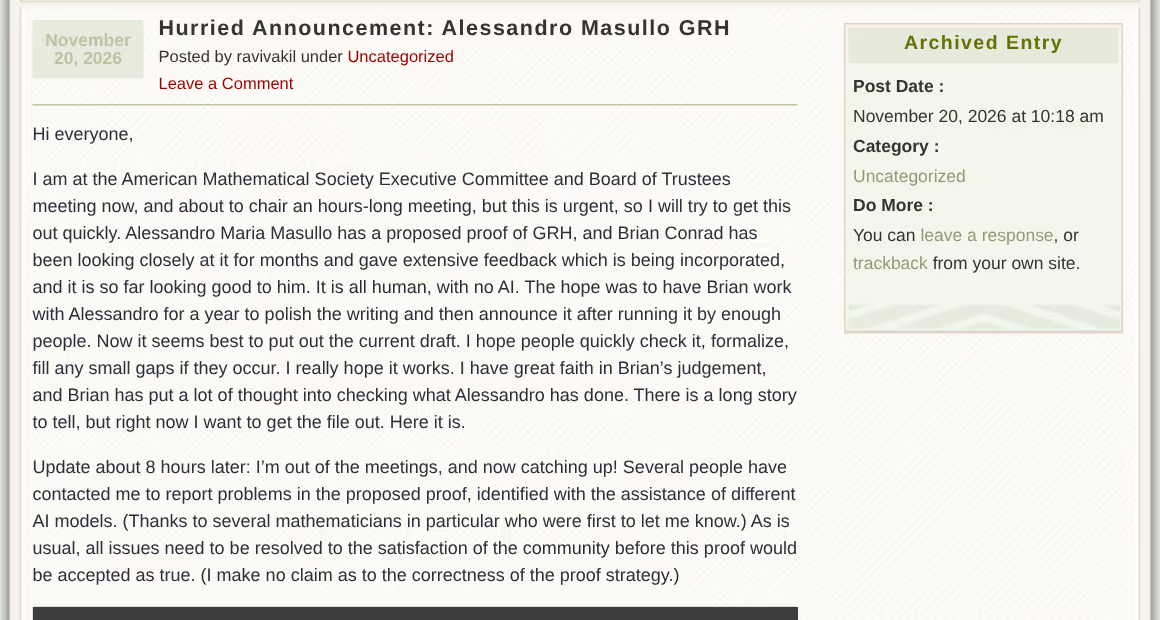
Hours after Alpöge's note, a second claim appeared. Ravi Vakil of Stanford posted on his blog under the title "Hurried Announcement". He wrote: "Alessandro Maria Masullo has a proposed proof of GRH, and Brian Conrad has been looking closely at it for months and gave extensive feedback which is being incorporated, and it is so far looking good to him. It is all human, with no AI."
Vakil said the original plan was for Conrad to work with Masullo "for a year to polish the writing" before announcing. "Now it seems best to put out the current draft." The attached manuscript, The Music of the Primes, runs to 940 pages; we downloaded it and confirmed the page count. TechCrunch reports that Masullo describes it as the result of 12 years of work.
The post changed within the day. In an update "about 8 hours later", Vakil wrote: "Several people have contacted me to report problems in the proposed proof, identified with the assistance of different AI models." He added that "all issues need to be resolved to the satisfaction of the community before this proof would be accepted as true", and: "I make no claim as to the correctness of the proof strategy." The post does not say what the problems are or how serious they are.
The two claims are being tested in opposite ways. Alpöge's has passed mechanical checks but cannot yet be read. Masullo's can be read, and reading has already turned up reported problems. Neither is accepted. Tao notes in a comment that Masullo's approach is "closer to Deninger's strategy", which is a different route from the one Alpöge describes.
Earlier AI Maths Results
This did not come from nowhere. 2026 has been a year of escalating claims from the AI labs, with mixed verification records.
- July 2026: Scientific American says Alpöge "tweeted a Claude-generated solution to the famous Jacobian conjecture".
- 10/08/2026: Anthropic's 67.2% result on zeta zeros, produced over two Claude Code sessions using about 31 million output tokens. Anthropic says outside experts Brian Conrey and Dan Goldston examined the paper, and that Claude's attempt at the full problem "didn't succeed".
- September 2026: OpenAI's forced Navier-Stokes result and the dispute with Tristan Buckmaster and Alpöge, covered in our Navier-Stokes explainer.
- Later in 2026: OpenAI's Astra manuscripts and disproof claims, which we assessed in ten claimed advances explained, the 722 manuscripts and the ETH disproof claim.
- 20/11/2026: the same day as the Riemann note, Tao lists two more results involving Alpöge: finite-time blow-up for the unforced 3D Euler equations (with Buckmaster and Matei Coiculescu) and for unforced 3D Navier-Stokes (with Buckmaster), both "with heavy AI" use and Lean formalisations. Of the Navier-Stokes paper he writes that "more work needs to be done to create a proper, professionally written proof".
The pattern across these is that formal verification has become the labs' preferred way to back a claim, and that human understanding lags behind. The Riemann claim is the extreme case: the gap between "checked" and "understood" is the entire proof.
What About the $1 Million Clay Prize?
The prize is $1 million (about £790,000), and it is a long way off. The Clay Mathematics Institute's rules page sets three conditions that all have to be met:
- "the proposed solution must be published in a Qualifying Outlet";
- "at least two years must have passed since publication";
- "the proposed solution must have received general acceptance in the global mathematics community".
The page also says: "CMI does not accept direct submission of proposed solutions." A PDF on a personal website and a tarball of Lean code are not, on any plain reading, publication in a qualifying outlet, though the detailed definition is in Clay's full rules document, which we did not review. The rules page we read does not mention AI or formal proofs.
So the earliest a prize could even be considered is two years after a qualifying publication that does not yet exist. Who would be eligible when an AI model did much of the work is a question the rules page does not address, and we will not guess. As of 21/11/2026 Clay's Riemann Hypothesis page carries the label "Unsolved" and no notice about either claim.
What It Means if It Holds, or Fails
If it holds
Mathematics would gain its most wanted theorem and a new problem: a result that is certified but not understood. Alpöge himself expects the argument to "be massively simplified, likely immediately", and the work of extracting a readable proof would occupy number theorists for some time. Conditional theorems that assume the hypothesis would become unconditional.
For AI, it would be the clearest evidence yet that a model can contribute original research at the highest level, in a domain where the output can be checked by machine. That bears directly on the arguments in our pieces on AI systems that improve themselves and Dario Amodei's "pace the frontier" essay. It would not show that the public Claude models can do this; the model is undisclosed.
For Anthropic, the commercial context is hard to ignore. The company says its IPO priced at $83.00 a share (about £65.57) and raised about $119.5 billion (about £94.4 billion) including a concurrent private placement. Our IPO prospectus analysis covers what it plans to spend that on. Alpöge's note insists the timing is coincidental and unwelcome. Readers can weigh that for themselves; we have no evidence either way.
If it fails
Failure at this stage would most likely mean one of three things: a soundness bug in a proof checker that several independent kernels share, a mismatch between Mathlib's definitions and the real mathematical objects, or a flaw in how the build was produced. Each would be an important finding about formal verification itself. The independent divisor-sum check and the use of multiple kernels were designed to make the first two less likely, which is why experienced observers are taking the claim seriously. A failure would also be very public for a newly listed company, even though the claim was made on a personal website.
Either way
The episode has already changed how a major claim gets tested. Within about a day, strangers had mirrored the archive, audited its dependencies, sandboxed a build and run it through several independent kernels, in public. The Masullo draft was read by AI models that reportedly found problems within hours. Verification is getting faster on both sides. Understanding is not.
How to Follow the Verification
- Sutherland's report at math.mit.edu/~drew/grh is timestamped and lists every check with logs. Watch for the two "running" rows to resolve.
- The community repository, leanprover-community/riemann-hypothesis, will post the sandboxed build's checksums and Comparator output in its verification folder.
- Terence Tao's blog post of 20/11/2026 and its comments are the best plain-language running commentary from a senior mathematician.
- The Lean Zulip thread is where the checking is coordinated.
- Clay's Riemann Hypothesis page is the one to watch for any official change of status. Do not expect one soon.
- A written proof. The most important future document is the one Alpöge has promised: a human-readable account. Until it exists, expert review cannot properly start.
If you want to check it yourself, Sutherland's page says you need Lean v4.36.0, roughly 100 GB of RAM and 70 GB of disk. The fastest independent check, con-leche built from source, took him under four minutes on 64 threads with about 50 GB of RAM.
A warning about headlines. Phrases such as "solved" and "cracks" are already in video titles and social posts. The sources closest to the work use "claimed", "proposed" and "claiming a proof". The verified-versus-claimed test we used in our Fable 5.5 leak check applies here with more force than usual.
The Bottom Line
As of 21/11/2026, the honest summary has two halves. The formal half is going well for the claim: the code compiles, the statement is Mathlib's own, the axioms are the standard three, and three independently written checkers accept it, with the final end-to-end runs still to report. That is far more than most claimed proofs of this problem have ever had.
The mathematical half has not begun. There is no paper, the author says he has not mastered much of the argument, and no expert has said they understand it. General acceptance, the standard that mathematics and the Clay prize both use, cannot be reached by a kernel. Treat the Riemann Hypothesis as an open problem with a serious, partly machine-checked claim against it, and expect the picture to change over days and weeks.
Last updated: 21/11/2026. Verification status reflects Andrew Sutherland's report as updated at 08:45 UTC on 21/11/2026 and the Lean community notes as read the same morning; both are being updated and may have moved on. Sterling conversions at approximately $1 = £0.79. AI Tools Review has not independently built or checked the Lean archive.
Sources
- Levent Alpöge: Remark (four-page note, 20/11/2026)
- Andrew Sutherland (MIT): Verification files for the Lean proof of the Riemann Hypothesis
- leanprover-community/riemann-hypothesis: mirror, README and Comparator setup
- Lean community verification notes (size, static scan, statements, Lean version)
- Terence Tao: Unforced Euler singularity, unforced Navier-Stokes singularity, and the Generalized Riemann Hypothesis
- Scientific American: Anthropic mathematician claims to prove Riemann hypothesis
- TechCrunch: AI claimed a solution to the 167-year-old Riemann hypothesis, and a human did, too
- Ravi Vakil: Hurried Announcement: Alessandro Masullo GRH
- Alessandro Maria Masullo: The Music of the Primes (940-page draft)
- Clay Mathematics Institute: Millennium Prize rules
- Clay Mathematics Institute: Riemann Hypothesis
- Clay Mathematics Institute: The Millennium Prize Problems
- Anthropic: research post on the zeta-zero bound (10/08/2026)
- Anthropic: IPO closing announcement (20/11/2026)
- OfficeChai: How mathematicians have reacted to the claimed proof
- Kingy.ai: Levent Alpöge claims a Riemann hypothesis proof with Claude
- Kingy.ai: Two Riemann proof claims in one day
- lean4.dev: Riemann Hypothesis claim (under review)
- CASRAI: 175,000-file Lean Riemann Hypothesis proof claim
- Superpower Daily: claim pending expert checks
- Unite.AI: Alpöge's unverified Riemann claim
- Wes Roth: video coverage of the claim
- WorldofAI: AI news round-up including the claim
More from AI Tools Review: OpenAI's Navier-Stokes proof, Astra's 722 manuscripts, ten claimed Astra advances, the Anthropic IPO prospectus, Anthropic's public benefit fund and Claude Fable 5.2 and Mythos 5.2.