 AI Tools Review Editorial Team
Quick answer:
Between 1 and 4 September 2026, Google shipped three separate products across its Gemini and DeepMind stack. Agentic video understanding lets Gemini 3.7 Flash, 3.6 Flash and 3.5 Flash-Lite dynamically navigate video timelines, cutting token use by up to 88% and cost by up to 66% on long-form video. WeatherNext 3 is Google DeepMind's new global forecasting model, delivering hourly forecasts at up to 5-kilometre resolution, roughly five times sharper than its predecessor, now live in Search, Maps and the Gemini app. And Lyria 3.5 brings full-length AI song generation with more expressive vocals to the Gemini app, API and Google Flow Music worldwide. None of the three were announced together, but the pace of the week says something real about how fast Google is now moving.
Most weeks in AI have one headline release. The first week of September 2026 had Gemini 3.8 Flash and 3.8 Flash Cyber, GPT-6 Astra, Claude Fable 5.1, and then, almost as an afterthought, three more distinct Google products landed within five days of each other: a video-understanding upgrade, a weather-forecasting model, and a music generator. Individually each is a solid, well-documented release. Together they are a useful snapshot of how broad Google's simultaneous AI push has become, spanning consumer creativity, enterprise video analysis and planet-scale scientific forecasting in the same week.
This article works through what each release actually does, using Google's own blog posts and technical documentation as the primary source, with independent coverage noted where it adds useful context.
A walkthrough of Gemini's early-September update wave, covering the new Flash models, Lyria's music generation and agentic video understanding.
Executive Summary
- Agentic video understanding (1 September): Gemini 3.7/3.6 Flash and 3.5 Flash-Lite now dynamically navigate video timelines rather than processing at a fixed frame rate, cutting tokens by up to 88% and cost by up to 66% on long-form content, with up to 7% higher accuracy.
- WeatherNext 3 (3 September): Google DeepMind's new global weather model forecasts hourly at up to 5km resolution, roughly 5x sharper than WeatherNext 2, with up to 60% better precipitation accuracy against satellite data, now integrated into Search, Maps, Earth Engine and the Gemini app.
- Lyria 3.5 (4 September): full-length song generation with more expressive vocals and richer arrangements, live globally in the Gemini app, mobile app, Google Flow Music, AI Studio and Workspace Vids.
- No coordinated launch: the three come from different Google teams (DeepMind/Research for the first two, the Gemini app and Labs org for Lyria) and simply landed in the same week.
- Consumer and enterprise reach in one week: a scientific forecasting model powering Google Search's weather panel, a token-efficiency upgrade for enterprise video-analysis pipelines, and a creative tool for anyone making a song in the Gemini app.
Agentic Video Understanding
The core problem agentic video understanding solves is waste. Static video processing, the previous default, samples frames at a fixed rate regardless of what is actually happening on screen, so a 90-minute lecture with five minutes of relevant content still costs tokens for the other 85 minutes. Google's fix, rolled out on 1 September to Gemini 3.7 Flash, 3.6 Flash and 3.5 Flash-Lite across the Interactions and GenerateContent APIs, replaces fixed sampling with an agentic loop: the model actively decides what to watch, at what speed, and through which modality, frames, audio or transcript, fetching only the moments it actually needs to answer the query.
Google's own benchmarking shows up to 88% fewer tokens consumed, up to 66% lower cost, and up to 7% higher accuracy across standard video-analysis benchmarks, with the efficiency gains growing sharply as video length increases, from 10-minute how-to guides through 90-plus-minute recordings. The API is priced identically to standard Gemini token rates, so the efficiency gain is a straightforward cost reduction rather than a new feature fee, and it supports both direct video uploads and YouTube videos.
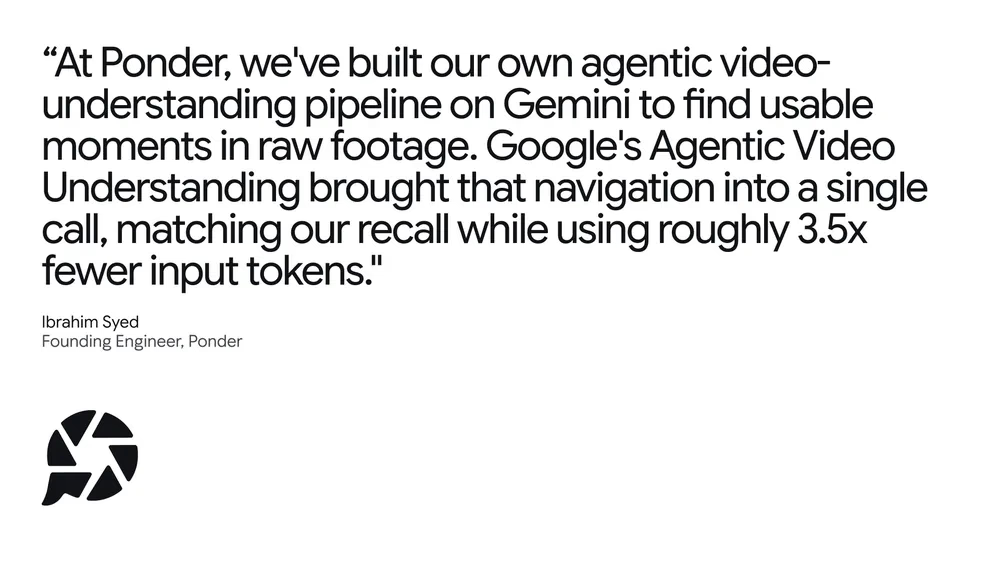
That quote is a useful data point precisely because it comes from a team that had already solved this problem themselves before Google shipped a built-in version. Ponder's founding engineer, Ibrahim Syed, said the company had "built our own agentic video-understanding pipeline on Gemini to find usable moments in raw footage", and that Google's native feature "brought that navigation into a single call, matching our recall while using roughly 3.5x fewer input tokens." Beyond raw efficiency, Google highlights sub-second moment retrieval for automated editing, needle-in-haystack search across multi-hour footage, better anomaly detection through dynamic resampling, and more accurate counting of repeated actions or objects, capabilities aimed squarely at media, security and content-moderation workloads. The feature is rolling out to Gemini app users and will power YouTube's "Ask YouTube" feature on video watch pages, putting a version of it in front of ordinary consumers rather than only API developers.
Independent early testing has flagged trade-offs alongside the efficiency gains: because the model chooses what to sample rather than processing everything uniformly, results can vary more between runs on ambiguous queries than fixed-rate processing did, and very short or highly compressed videos see less benefit than long-form content. Treat the headline efficiency numbers as best-case figures for long, sparse-content video rather than a uniform improvement across every use case.
WeatherNext 3: Forecasting at 5km, Hourly
WeatherNext 3, announced 3 September by Google DeepMind and Google Research, is a considerably sharper instrument than its predecessor. Surface variables like temperature and moisture now forecast at up to 5-kilometre resolution, other surface variables at 10km and atmospheric variables such as wind speed at 25km, against WeatherNext 2's flat 25km grid, roughly a fivefold improvement in spatial detail. Forecasts also update hourly rather than in 6-hour increments, a sixfold increase in temporal resolution.
The accuracy gains are most pronounced on precipitation, historically one of the hardest forecasting targets. Google reports up to 60% improvement against NASA's IMERG satellite precipitation data, up to 30% improvement against Multi-Radar Multi-Sensor ground observations, roughly 10% improvement against rain-gauge measurements at early lead times, and up to 50% more accurate long-range precipitation forecasts overall. Google published a direct visual comparison against WeatherNext 2 to make the case.
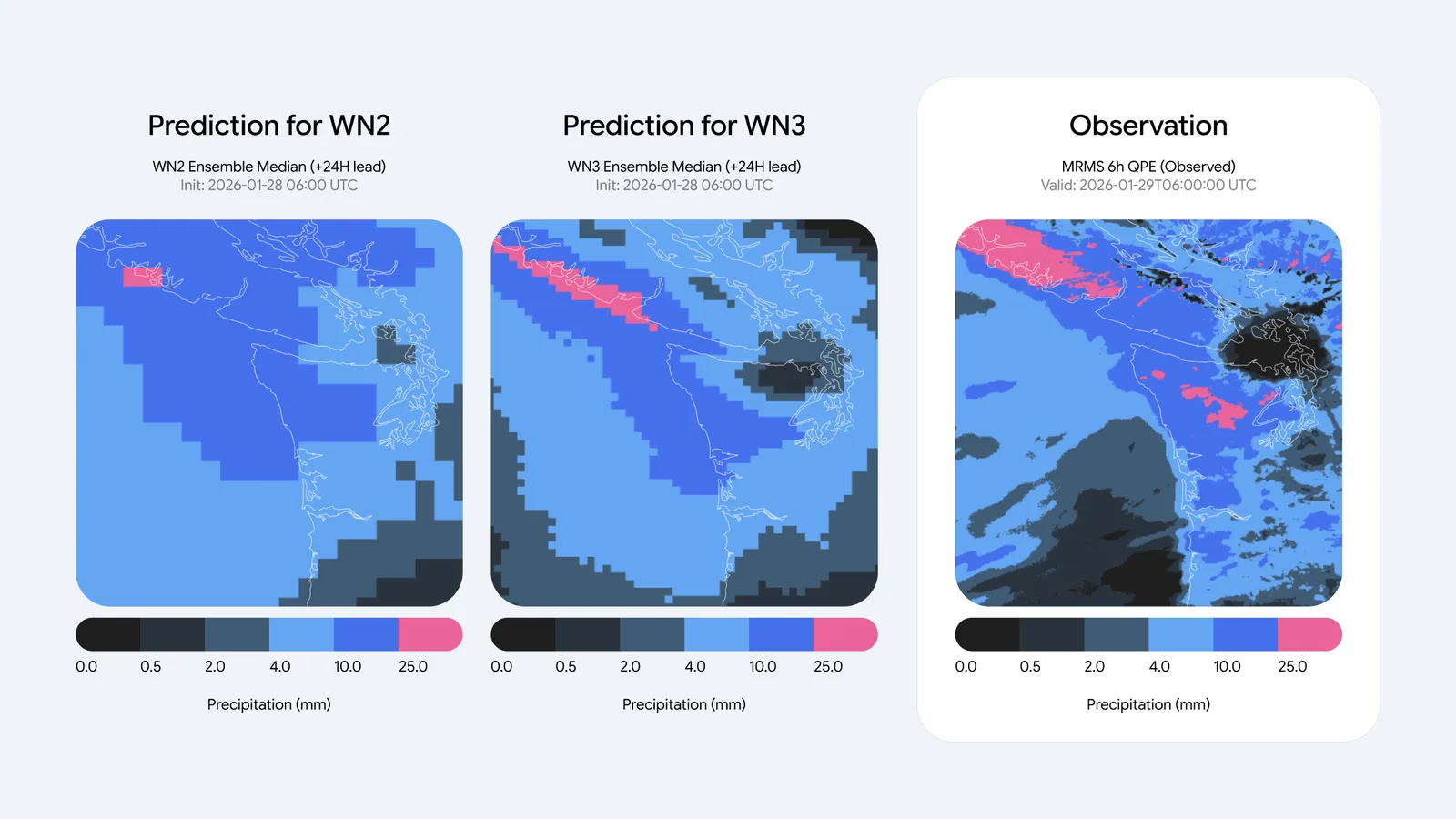
Reading the comparison chart directly: WeatherNext 2's prediction for this Pacific Northwest system shows a fairly uniform band of moderate precipitation with a single small high-intensity patch, while WeatherNext 3's prediction for the identical 24-hour window shows a sharper, more structured high-intensity band running diagonally across the region, a shape that visibly matches the actual MRMS-observed radar data far more closely than the older model's smoother, less differentiated forecast.
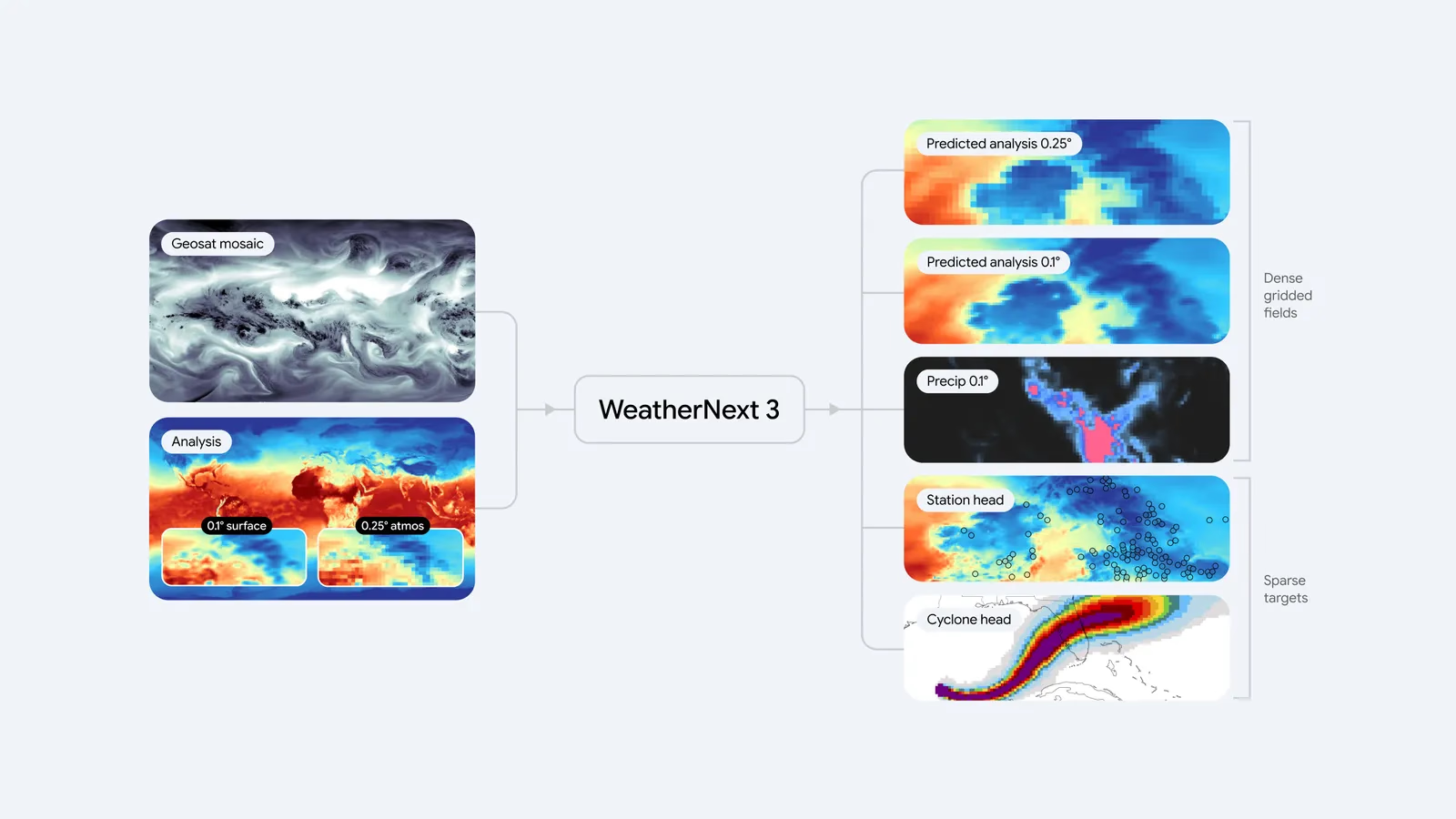
Training data is the other notable shift. Rather than relying purely on historical numerical weather prediction output, WeatherNext 3 learns from real-time geostationary satellite mosaics updated hourly, Google's own global precipitation reanalysis derived from satellite radar, and sparse weather-station observations layered in for localised accuracy, alongside NASA's IMERG dataset. New capability areas include 100-metre wind-speed predictions for turbine-height wind-energy forecasting, cloud-cover and solar-radiation forecasting for renewable-energy planning, and native cyclone-track prediction. The model is now integrated into Google Search's weather panel, the Gemini app, Google Maps, the Google Maps Platform Weather API, and Google Earth Engine, with bulk data access available through BigQuery and Cloud Storage.
A weekly AI news round-up that covers WeatherNext 3 and Gemini 3.8 Flash alongside the same week's other major model launches.
Lyria 3.5: Full Songs in the Gemini App
Lyria 3.5, Google's music-generation model, arrived in the Gemini app and API on 4 September with what Google describes as "more expressive vocals and richer musical arrangements", enabling higher-fidelity tracks than earlier Lyria versions. In the Gemini app specifically, users can now pick a genre and vocal or instrumental style, work from new creative templates, and choose between short clips and longer, full-length tracks rather than being limited to short loops.
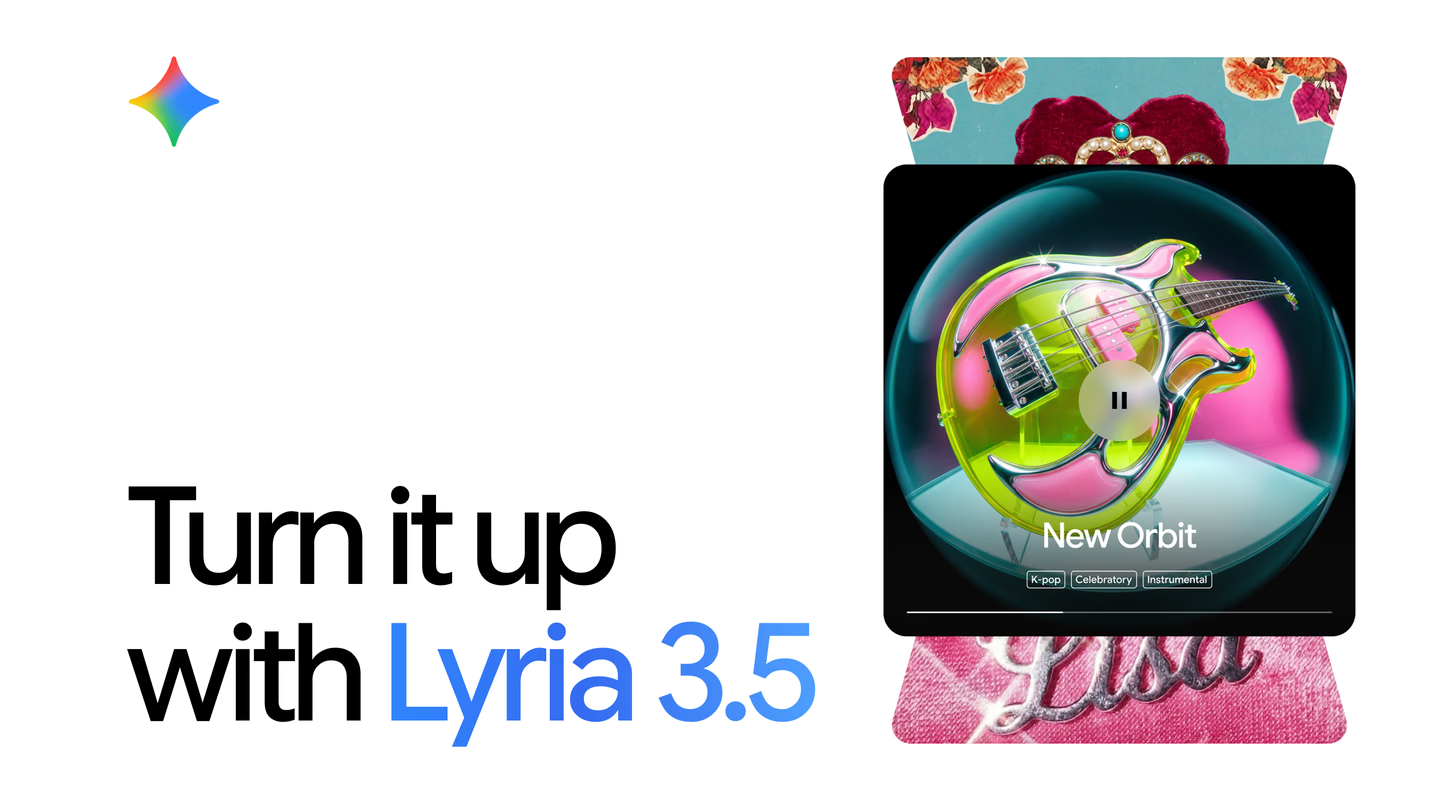
Availability is genuinely broad rather than staged: Lyria 3.5 is live globally on both the Gemini web app and mobile app, in Google Flow Music for artists and creative professionals, through the Gemini API in Google AI Studio for developers building it into their own products, and in Google Workspace Vids for soundtracking video projects. That is a wider simultaneous rollout than most generative-media launches manage, spanning consumer, creative-professional and developer surfaces on day one.
Google's announcement is light on hard technical specifics: no disclosed sample rate, exact maximum song length, or full list of supported languages, and no separate per-generation price for in-app use is published, with API access billed through standard Gemini API token pricing. Independent coverage has focused mainly on subjective listening comparisons against Lyria 3 and rival tools like Suno and Udio rather than technical benchmarks, since there is no standardised, widely accepted benchmark for AI music quality comparable to the evaluation suites used for text and code models.
Why Three Releases in One Week
There is no evidence the three launches were planned as a bundle. Agentic video understanding and WeatherNext 3 both originate from Google DeepMind and Google Research, sharing an engineering culture even if built by different teams, while Lyria 3.5 sits under the Gemini app and Google Labs organisation entirely separately. Each has its own release cadence: WeatherNext follows roughly annual major-version updates, agentic video understanding is a capability rollout to existing Flash models rather than a new model launch, and Lyria updates on a schedule closer to a consumer product than a research model.
What the clustering actually demonstrates is less a coordinated strategy than a sheer rate of output. In the same seven-day window, Google also shipped Gemini 3.8 Flash and 3.8 Flash Cyber, meaning the company put out five distinct AI product updates, two consumer model releases plus three feature and product launches, inside a single week. For a company routinely described as playing catch-up in the model race through 2025, that cadence across research, consumer and enterprise products simultaneously is itself the more interesting story than any single one of the three releases covered here.
Availability and Pricing
| Release | Date | Where available | Pricing |
|---|---|---|---|
| Agentic video understanding | 1 Sept 2026 | Gemini API (AI Studio, Enterprise Agent Platform), rolling out to Gemini app; powers YouTube's "Ask YouTube" | Standard Gemini token pricing, no extra fee |
| WeatherNext 3 | 3 Sept 2026 | Search, Gemini app, Maps, Maps Platform Weather API, Earth Engine, BigQuery | Free in consumer surfaces; usage-based for Maps Platform API and BigQuery |
| Lyria 3.5 | 4 Sept 2026 | Gemini web & mobile app, Google Flow Music, AI Studio API, Workspace Vids | Included with Gemini app; standard API token pricing for developers |
The pattern across all three is consumer-facing free access bundled into products people already use, Search, the Gemini app, Maps, paired with standard developer pricing for anyone building on the underlying API. None of the three introduces a new standalone subscription tier.
Limitations
- Agentic video understanding's efficiency gains are content-dependent. Long, sparse videos benefit the most; short or already-dense content sees a much smaller improvement, and the dynamic sampling approach can introduce more run-to-run variance on ambiguous queries.
- WeatherNext 3's figures are all Google's own. No independent meteorological body had published a comparative verification of the accuracy claims at the time of writing.
- Lyria 3.5 has no disclosed technical specification. No sample rate, maximum song length or language-support list is published, and there is no standardised benchmark for comparing AI music quality across vendors.
- No unified announcement or roadmap. The three releases must be tracked separately, each with its own blog post, release notes and support channel, since Google did not bundle them into one launch communication.
How These Compare
Agentic video understanding's closest comparison point is the broader industry shift toward agentic, tool-using inference loops rather than static one-shot processing, the same underlying idea behind agentic coding tools and, on this site, the kind of long-horizon agent work covered in our Google Antigravity Skills guide. WeatherNext 3 has no close consumer competitor at this resolution and update frequency; the more relevant comparison is against traditional numerical weather prediction systems like ECMWF's HRES, which Google and independent researchers have both argued AI weather models are now matching or exceeding on several key metrics, though a full head-to-head against HRES specifically was not published alongside this release. Lyria 3.5 competes directly with Suno and Udio in AI music generation, with Google's advantage being distribution, built into the Gemini app that hundreds of millions of people already use, rather than a standalone product they need to seek out.
Taken together, the three releases also reinforce a pattern visible across Gemini Notebook and Gemini Spark: Google increasingly ships new AI capability as a feature inside an existing product surface, Search, the Gemini app, Workspace, rather than as a new standalone app requiring its own download or sign-up.
Who Should Care
Video and media teams processing long-form content, security footage, lecture archives, podcast video, should test agentic video understanding immediately; the token savings compound quickly at scale, and the API pricing means there is no separate cost to evaluate against. Developers building weather-sensitive products, logistics, agriculture, renewable energy, insurance, should evaluate WeatherNext 3 through the Maps Platform Weather API or BigQuery, particularly for the new wind-speed and solar-radiation forecasts. Anyone making short-form video or social content gets an immediately useful, free upgrade in Lyria 3.5's full-length song generation directly inside the Gemini app, no separate account or tool required.
The Bottom Line
None of these three releases is individually a headline-grabbing frontier-model launch, and none needs to be judged as one. Agentic video understanding is a genuinely useful efficiency upgrade with real, Google-published numbers behind it. WeatherNext 3 is a legitimate scientific advance in a field, weather forecasting, where accuracy improvements translate directly into fewer surprised commuters and better-prepared emergency services. Lyria 3.5 is a solid, broadly available creative tool riding on Gemini's existing distribution.
What the week as a whole says is more interesting than any single release: Google is now shipping meaningful AI updates across research, enterprise and consumer surfaces simultaneously and continuously, rather than saving everything for occasional flagship events. Whether that cadence is sustainable, and whether independent verification of WeatherNext 3's accuracy claims and closer scrutiny of agentic video understanding's real-world variance hold up, are the two threads worth following as the rest of September plays out.
Google's official posts for agentic video understanding, WeatherNext 3 and Lyria 3.5 carry the full technical detail referenced throughout this article.
Last updated: 6 September 2026. This article will be revised if independent verification of WeatherNext 3's accuracy claims is published, or as agentic video understanding and Lyria 3.5 complete their rollout to additional Gemini surfaces.
Get the free guide: Claude vs ChatGPT, Gemini & Grok
A 20-page playbook covering everything you need to choose and use the big four AI models in 2026, full cost and feature comparisons, what each is best (and worst) at, and how-tos for images, vectors, building a website, Claude Code and more.