 AI Tools Review Editorial Team
Quick Answer:
Perplexity Frontier Research is a research initiative that Perplexity announced on 16/11/2026. Its goal is to build an "automatic research scientist": an AI system that can ask questions, form hypotheses, run experiments and update its beliefs on its own. The work covers six areas: multi-agent orchestration, pre-training, continual learning, reinforcement learning, systems, and frontier evaluations. Perplexity says the effort is backed by more than 10,000 GPUs, is led by NYU professor Andrew Gordon Wilson, and will publish papers, data, models and code openly. It is hiring in San Francisco, Palo Alto, New York and London. It is not a product: there is nothing new to switch on, no price and no release date for the automated scientist.
Perplexity built its name on answering questions with sources. Its new initiative aims at something much harder: software that works out which questions are worth asking, then goes and finds out. Here is what the company has actually committed to, what evidence exists so far, and what a UK business should do with the news.
This article is built from Perplexity's own launch post, the new Frontier Research website, the job and fellowship listings, and the research posts Perplexity cites as example work. Where something has not been published, we say so. Several YouTube videos have described the announcement as a "Perplexity update". That framing is misleading: nothing in your Perplexity account changed on 16/11/2026.
6
Research areas
One application covers all six
10,000+
GPUs backing the work
Perplexity's own figure
4
Hiring cities
SF, Palo Alto, New York, London
05/12/2026
Priority application deadline
Rolling review after that
Source: Perplexity launch post, research.perplexity.ai and Ashby job listing, 16-18/11/2026
Julian Goldie's walkthrough of the Frontier Research announcement and its six research areas, framed around business workflows.
Executive Summary
- It is a research programme. Perplexity describes Frontier Research as "a new initiative to advance the frontier of algorithms, models, and evaluations, in the open". The target is an automated scientist, not a new chat mode.
- Six areas, three at the core. Pre-training, continual learning and reinforcement learning are the main efforts. Multi-agent orchestration ties them together. Systems and frontier evaluations support them.
- One named leader. Andrew Gordon Wilson, an NYU professor, is listed as Research Lead. No team size, budget or other names have been published.
- The compute claim is large but unverified. "In excess of 10,000 GPUs" is Perplexity's statement. It has not said which chips, where they are, or who supplies them.
- There is real prior work. The site lists 33 example works across the six areas, plus open models and code. Three of those have numbers worth knowing, covered below.
- Perplexity's own benchmark is humbling. On WANDR, its test of wide research tasks, the best system (Perplexity's own) gets full credit for roughly one in seven of the items it submits.
- For UK firms: no action is needed on your subscription. The things to watch are open-weight releases you can run locally, London hiring, and how honestly research agents are measured.
What Perplexity Actually Announced
The launch post is short: five paragraphs, credited to "Perplexity Research" and dated 16/11/2026. Its central sentence is this: "We aim to build an automatic research scientist, an AI system that can conduct research on its own."
Perplexity then defines what it means by research. It calls it "a loop that involves asking the right questions, hypothesizing, designing experiments, analyzing results, navigating ambiguity, and updating beliefs". The key distinction it draws is between prediction and understanding. In the post's words, the effort is "designed to produce new interpretable knowledge", in contrast to "black-box predictions in narrowly defined settings".
The longer website makes the same point with an example. General relativity makes GPS possible, it says, but that is not what makes the theory interesting. What matters is the understanding that space, time and gravity are connected, and the testable predictions that follow. Perplexity's claim is that AI has become good at black-box prediction but "has barely scratched the surface of autonomous scientific discovery".
The site also gives the ambition a democratic framing: "Historically, the research loop has run inside a handful of institutions, at the speed of a few people. We think it can run inside software, for anyone." The stated mission is "creating an automated scientist that can perform insightful research, and putting it in the hands of everyone".
The three commitments
Strip away the vision and the post makes three concrete commitments:
- Openness. "We will release papers, blog posts, data, models, and code."
- Compute. The research "will also be supported by considerable computational resources, in excess of 10,000 GPUs".
- A route to product. "Our findings shape a product used by millions of curious people, the most challenging test of all."
What the post does not contain is just as important. There is no timeline, no named system, no benchmark target, no budget and no product announcement. The website describes a system that "knows what it doesn't know, seeks out a new understanding, and remembers what it learns". That is a description of where Perplexity wants to get to, not of something that exists.
One phrase deserves attention. The site says autonomous research "must happen as part of a recursive self-improving loop", with models that "generate their own training signal" and "keep learning after release". Self-improvement is the same capability that other labs now treat as a safety threshold. OpenAI rated its latest flagship High for AI self-improvement, and Anthropic says it deliberately held back two AI research skills in its newest model, as we covered in our GPT-6.2 Astra review and our Claude Fable 5.2 review. Perplexity's launch materials do not include a safety framework for this work. We return to that below.
The Six Research Areas
The "six core research areas" mentioned in video coverage are real and are listed on Perplexity's site. The launch post calls them "six pillars". The structure matters: Perplexity says it will be "particularly focused on pre-training, continual learning, and reinforcement learning", which are "integrated efforts, unified by multi-agent orchestration". Systems and evaluations sit alongside.
| Area | Perplexity's tagline | Themes listed | Example works cited |
|---|---|---|---|
| Multi-agent orchestration | Asking, gathering, collaborating | Multi-agent collaboration, co-training, agentic search, open and closed weights | 6 |
| Pre-training | Architectures that make every token count | Open weights, new architectures, synthetic data, scaling science | 9 |
| Continual learning | Finding the edge of the known | Curiosity, memory, persistence, personalisation | 5 |
| Reinforcement learning | Hypothesize, test | Verifiable and rubric rewards, post-training, environments from real usage | 4 |
| Systems | Inference, training, environments, and security | Inference and training, runtimes, security | 4 |
| Frontier evaluations | Measuring discovery | Model vs harness, memorisation vs reasoning, helpfulness, research ability | 5 |
Source: research.perplexity.ai, counted on 18/11/2026. "Example works" are the papers and posts Perplexity lists under each area; some predate the initiative and some were written by the research lead before he joined.
1. Multi-agent orchestration
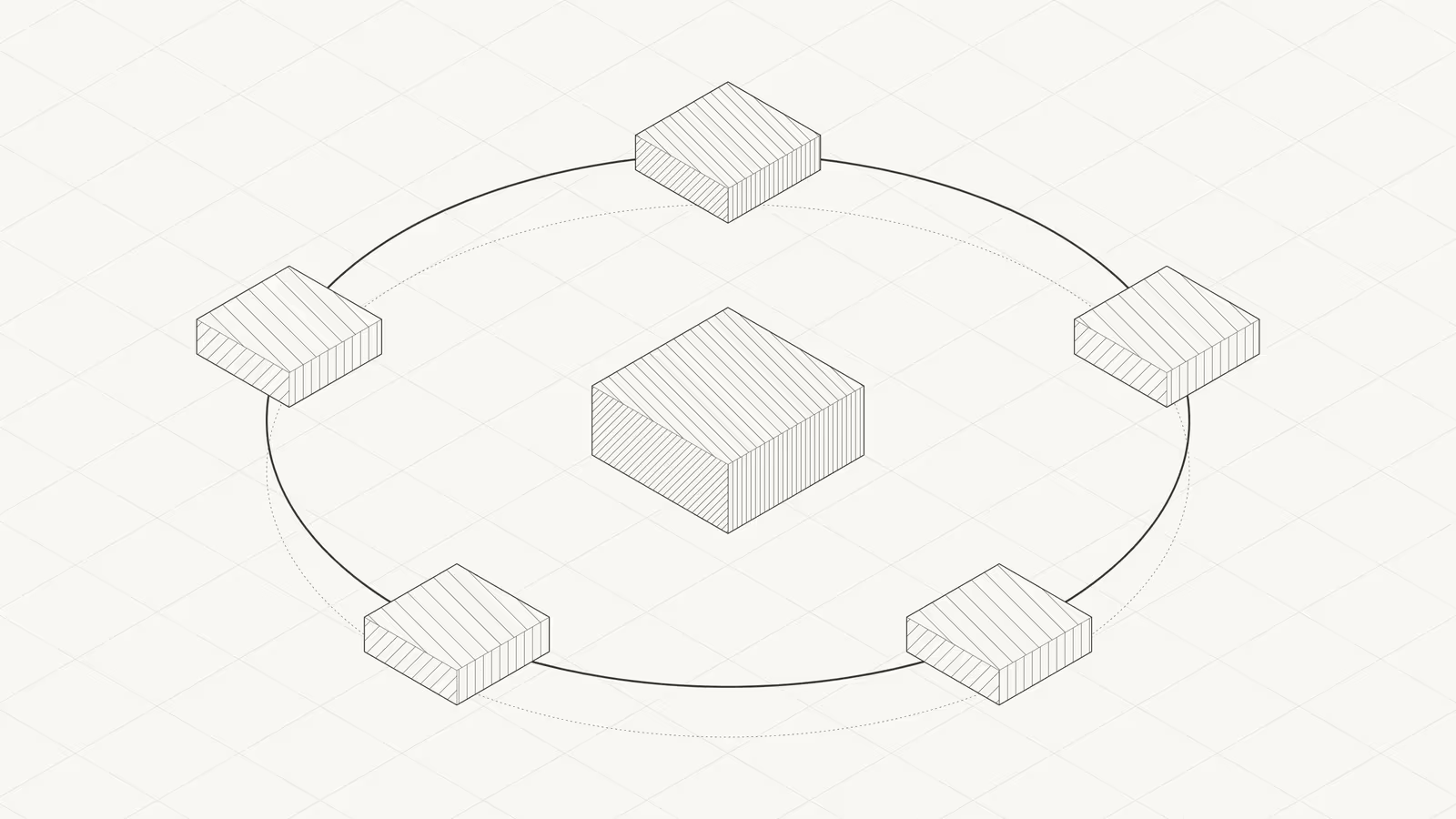
This is the part closest to what Perplexity already sells. The stated goal is "to provide output that is on the Pareto frontier of quality for any cost the user wishes to spend". In plain terms: for whatever you are willing to pay, you should get the best answer available at that price. Perplexity adds, "we wish to have the best quality LLM service available at the lowest cost".
The method is to combine many different models instead of relying on one. The site describes agents that "search wide across thousands of sources", others that "go deep on one thread", others that propose experiments, and others that critique. It gives one specific pattern, advisor escalation, where "a small on-device model can ask for help from a larger model only when advantageous". This is what video coverage means by "multi-model workflows". If the idea of many agents working together is new to you, our agent swarms explainer covers the basics.
2. Pre-training
Perplexity says: "We pre-train open-weight models that are efficient and specialized." The questions it lists are ambitious. Can synthetic data be made "more valuable than real data"? Can small experiments predict how a model behaves at full scale? Can small models be "state-of-the-art for specialized tasks"? The site even says, "This is an environment where you could propose the next transformer." Note what is missing: Perplexity does not say it is training a large general-purpose model to rival GPT, Claude or Gemini. The emphasis is on efficient, specialised models.
3. Continual learning
Here the aim is "systems that keep learning in deployment". Perplexity breaks it into three ideas. Curiosity is "seeking out what the model does not know rather than waiting to be asked". Memory is "using our experience for a head start on the next task". Persistence is "staying on a job through pauses and interruptions, so progress accumulates over days instead of resetting every session".
4. Reinforcement learning
Perplexity says its reinforcement learning "runs against live retrieval, real products, and infrastructure that moves trillion-parameter weights from training to inference in about a second". Models are trained with rewards that are "verifiable where possible and rubric-graded where not, in environments synthesized from how people actually use our systems". It is frank about one risk: "a reward which can be hacked eventually will be".
5. Systems
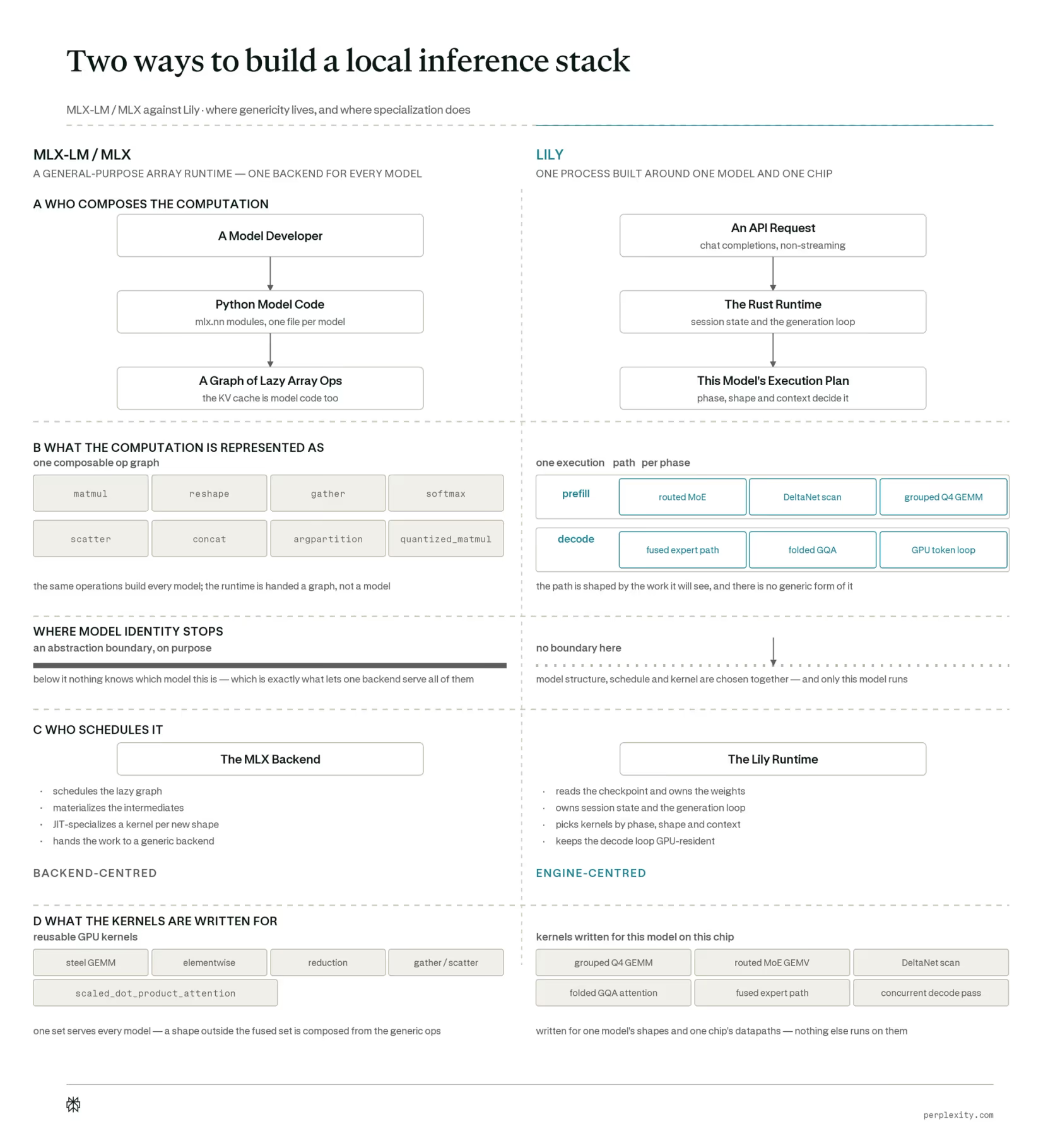
This area covers the plumbing: how models use memory, how GPUs talk to each other, and where agents run code. Three existing projects are named. fabric-lib handles communication between GPUs. The Apple silicon engine is Lily, which we reviewed in our Perplexity Lily article. SPACE provides "isolated environments that can preserve and resume an agent's work", with the aim of "keeping credentials and the host outside the agent's control".
6. Frontier evaluations
This is the most candid section of the site. Perplexity argues that today's benchmarks "were developed to work well as a proxy for general human ability, not for general model ability". A person who wins gold at the International Mathematical Olympiad is good at many other things; a model that does the same may "profoundly fail" elsewhere. Perplexity wants evaluations that separate "reasoning versus memorization" and that measure real understanding. Its example: a model can be trained to predict the path of a particle, but "it would unlikely be able to produce equations of motions, or a theory of physics".
Who Is Involved
Only one person is named on the Frontier Research site: Andrew Gordon Wilson, listed as "Research Lead, Perplexity Frontier Research".
According to his NYU biography, Wilson is a Professor at the Courant Institute of Mathematical Sciences and the Center for Data Science at New York University. He was previously a professor at Cornell and a postdoctoral researcher at Carnegie Mellon, and holds a PhD in machine learning from the University of Cambridge. His research covers deep neural networks, Gaussian processes, large language models and Bayesian methods. His awards include an NSF CAREER Award and an Amazon Research Award. At the time we checked, that page did not yet mention Perplexity.
Wilson announced the move on X on 24/08/2026, writing: "I am excited to announce that I am joining @perplexity_ai as research lead!" The post is archived on Digg's roundup of the announcement, alongside welcome posts from Perplexity co-founder and CEO Aravind Srinivas and co-founder Denis Yarats. Yarats wrote: "we've been building infra for large-scale RL systems, with some interesting projects on the way". The same roundup reports that Wilson reports to Yarats and is keeping his NYU research group. Runtime Wire reported the same on the day, saying Wilson "will keep his NYU group".
Wilson's fingerprints are on the research agenda. Several of the example works on the site are his academic papers, including "Deep Learning is Not So Mysterious" and "From Entropy to Epiplexity", a paper on a measure of information that his NYU biography says he co-developed. So the agenda is partly a continuation of his academic programme, now with Perplexity's compute and product data behind it.
Beyond Wilson, authorship is collective. Research posts are credited to "Perplexity Research", "Perplexity Engineering" or the "Perplexity Secure Intelligence Institute", the company's security research group. Perplexity has not published how many people work in Frontier Research, and we could not find a figure in any reliable source.
The Evidence So Far: Three Published Results
A research agenda is only as credible as the work behind it. Three of the example works Perplexity cites include hard numbers. All three are Perplexity's own tests of Perplexity's own systems, so treat them as vendor results. None has been independently reproduced as far as we can find.
1. WANDR: research agents are still far from reliable
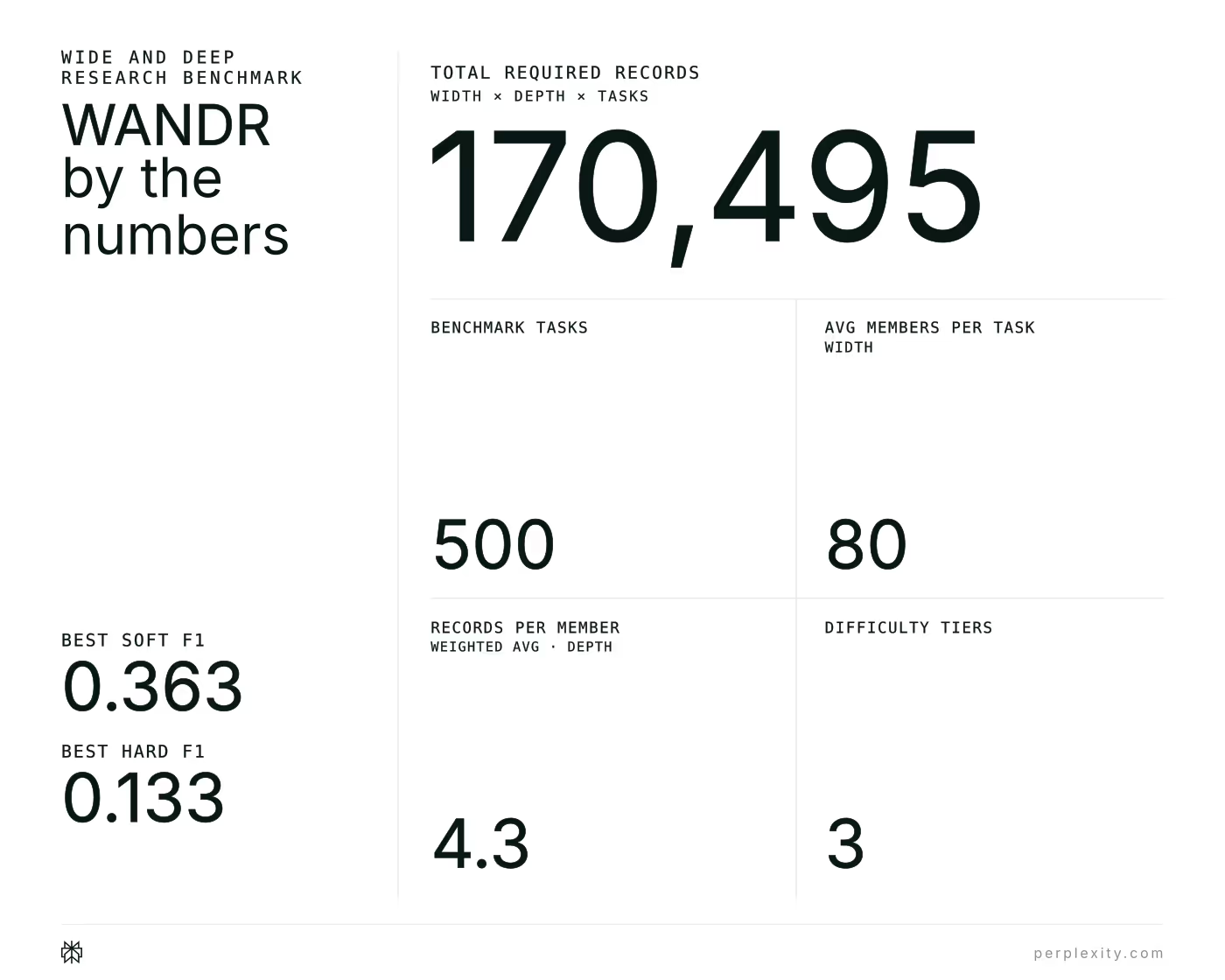
WANDR (Wide ANd Deep Research), published on 14/07/2026, is an open benchmark of 500 data-collection tasks. These are the jobs businesses already hand to research agents: competitor mapping, due diligence, market analysis, talent sourcing. One released task asks for at least 70 US companies that announced a new CEO or CFO in a two-month window, each with an authoritative source page. Together the 500 tasks call for 170,495 source-backed records.
Scoring is strict. The grader re-fetches every cited page and checks that the quoted excerpt is really there and supports the claim. "Soft" F1 gives partial credit. "Hard" F1 only counts an item if everything required for it is correct.
WANDR benchmark: F1 score by system
500 wide-and-deep research tasks, scored 0 to 1. Higher is better. Perplexity tested six systems and published exact figures for the top two and a ceiling for the other four.
- Soft F1 (partial credit)
- Hard F1 (fully correct only)
Perplexity Search as Code
Anthropic
Best of the other four · ceiling across OpenAI, Gemini, Exa and Parallel
Show data table
| Benchmark | Soft F1 (partial credit) | Hard F1 (fully correct only) |
|---|---|---|
| Perplexity Search as Code | 0.363 | 0.133 |
| Anthropic | 0.249 | 0.072 |
| Best of the other four | 0.121 | 0.035 |
Source: Perplexity Research, WANDR blog post, 14/07/2026 (vendor-run evaluation)
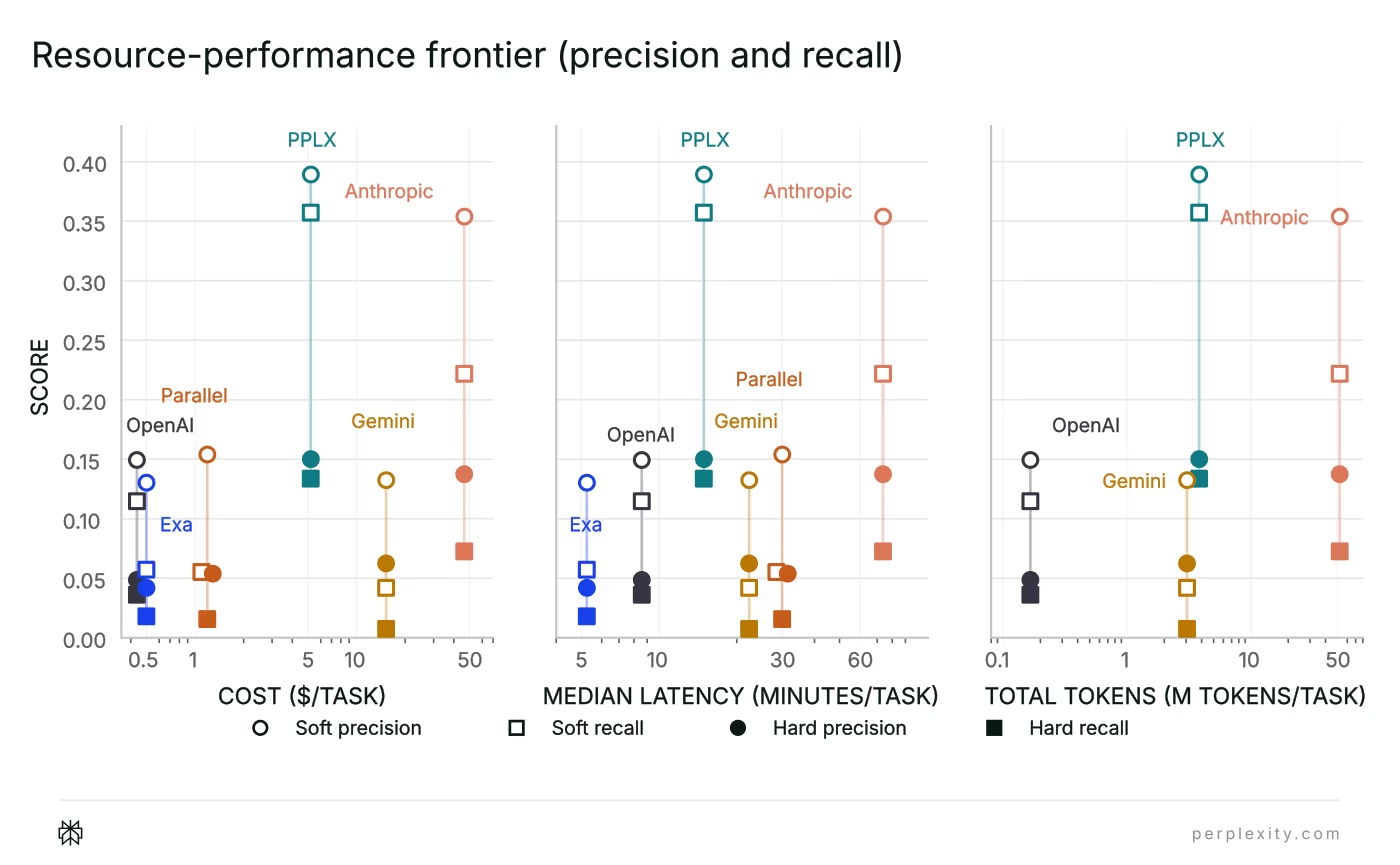
Perplexity's Search as Code system leads at 0.363 soft F1 and 0.133 hard F1. Anthropic's system is second at 0.249 and 0.072. Every other system tested tops out at 0.121 and 0.035. Perplexity's own summary is the honest one: "even the leader earns full credit for only about one in seven members it submits and one in seven members the task asks for". Its conclusion is that "wide-and-deep research is still a long way from solved".
Cost matters too. Perplexity's run cost about £4.11 ($5.20) per task, with a median time of 14.9 minutes and 3.82 million tokens. Across all effort settings on a 45-task subset, cost ranged from about £0.02 ($0.03) per task for Exa on low effort to about £257 ($324.83) for Gemini on maximum. Perplexity reached 0.447 soft F1 at its highest effort setting on that subset. Spending more helps, but nobody is close to a complete answer.
2. A local agent that asks a bigger model for help
The first work listed under multi-agent orchestration is "A Local-First Agent for Private and Cost-Effective Knowledge Work", published on 25/08/2026. It describes Perplexity Portable Computer, an agent where "the entire stack runs locally by default". Web search, connectors and calls to a stronger cloud model happen "only when necessary and always gated by the user".
Perplexity compared its harness (the software wrapped around the model) against two open-source harnesses, Pi and Hermes, all running the same open model, Qwen 3.8 27B, on an NVIDIA DGX Spark desktop machine. We have covered both the model and one of the rivals: see our Qwen3.8-27B review and our Hermes Agent explainer.
Same local model, three harnesses
Qwen 3.8 27B on an NVIDIA DGX Spark. Score by benchmark, %. Higher is better. Computer used Perplexity's search; Pi and Hermes used Brave.
- Perplexity Computer (local harness)
- Pi
- Hermes
BrowseComp (1,266 web research tasks)
ParseBench-100 (document understanding)
Terminal Bench 2.1 (89 coding tasks)
Show data table
| Benchmark | Perplexity Computer (local harness) | Pi | Hermes |
|---|---|---|---|
| BrowseComp (1,266 web research tasks) | 66.7% | 50.2% | 43.9% |
| ParseBench-100 (document understanding) | 65.1% | 13.9% | 34.6% |
| Terminal Bench 2.1 (89 coding tasks) | 59.6% | 59.6% | 58.4% |
Source: Perplexity Research, local-first agent post, 25/08/2026 (vendor-run evaluation)
Perplexity's harness wins clearly on web research and document reading, and ties on coding. One caveat on the web result: the harnesses did not use the same search engine, so some of that gap is Perplexity's search index, not the harness.
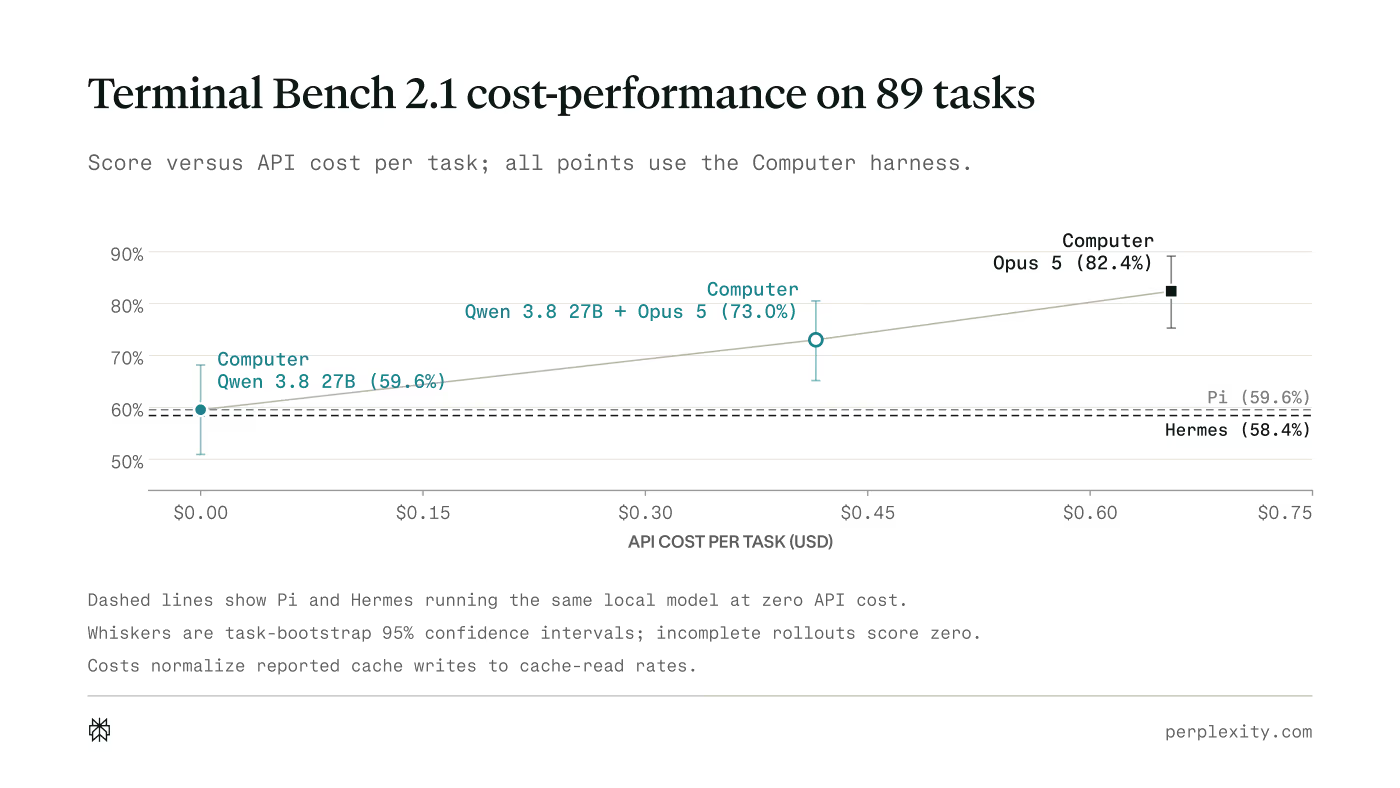
The more interesting result is advisor escalation, the pattern named in the Frontier Research agenda. On Terminal Bench 2.1, the local model alone scored 59.6%. Letting it consult Claude Opus 5 when stuck raised that to 73.0%, at an estimated API cost of about £0.33 ($0.415) per run. Running Claude Opus 5 for the whole task scored 82.4% at about £0.51 ($0.65). In Perplexity's words, escalation "recovers roughly three-fifths of the gap to the frontier at about two-thirds of the frontier's cost".
Perplexity then trained its own version of the model. On its internal Local Knowledge Work Bench (53 everyday tasks, three trials each), the stock model in Perplexity's harness scored 82.6%. Perplexity's post-trained model, PPLX 27B, scored 85.4%.
Local Knowledge Work Bench
53 day-to-day knowledge-work tasks, 3 trials each, on an NVIDIA DGX Spark. Score, %. Higher is better. Perplexity's internal benchmark.
Computer + PPLX 27B (post-trained)
Computer + Qwen 3.8 27B
Pi + Qwen 3.8 27B
Hermes + Qwen 3.8 27B
Show data table
| Benchmark | Score |
|---|---|
| Computer + PPLX 27B (post-trained) | 85.4% |
| Computer + Qwen 3.8 27B | 82.6% |
| Pi + Qwen 3.8 27B | 77.6% |
| Hermes + Qwen 3.8 27B | 74.0% |
Source: Perplexity Research, local-first agent post, 25/08/2026 (internal benchmark, not yet public)
The gaps here are small and the benchmark is Perplexity's own, built from its own usage data. Perplexity says it plans to open-source it. Until then, read this as a direction of travel, not proof.
3. Learning from real use
Under continual learning, Perplexity cites "Learning from Real-World Experience", published on 21/09/2026. The method trains models on real product sessions: successful steps are imitated, and avoidable mistakes are corrected using short hints. Perplexity reports that for the GLM-5.3 model, this post-training "reduced tool-call failures by 33.0% and the average estimated probability of medium-or-high user dissatisfaction by 17.2% relative to the stock model". A later GLM-5.2 checkpoint cut tool-call failures by 21.2% against an earlier one.
Two details matter for businesses. First, Perplexity says its pipeline excludes "sessions with personally identifiable information (PII) and from users who have opted out". Second, it says the trained model "then becomes a model option in Computer". This is continual learning in practice: your usage, unless you opt out, helps train the models you later use.
How It Connects to Perplexity's Products
Perplexity's only direct statement is that "our findings shape a product used by millions of curious people". It did not announce any product change with Frontier Research. But the example works it cites show specific links to products. Here is what each source actually confirms.
| Product | Confirmed link to the research | Source |
|---|---|---|
| Computer | Post-trained models become "a model option in Computer". Portable Computer is the local-first harness. Computer's memory system ("Brain") and shared Projects workspaces are cited under continual learning. | Perplexity research posts, 19/08, 25/08, 21/09 and 12/10/2026 |
| Deep Research | The DRACO benchmark is built from de-identified Perplexity Deep Research requests. WANDR is described as its "wide sibling". | DRACO paper; WANDR post |
| Search and API | Search as Code is the top system on WANDR. Decider models are available through the Perplexity Decisions API. | WANDR post; Decider post, 12/11/2026 |
| Comet | Security research (BrowseSafe++) uses injections flagged by Comet's detector. This sits with the Secure Intelligence Institute; it appears in the research journal but is not listed under the six areas. | BrowseSafe++ post, 02/11/2026 |
| Lily (Mac) | Listed by name under Systems and under open code releases. | research.perplexity.ai |
| Teammates | No direct link stated in the Frontier Research materials. | Not confirmed |
Computer is where most of the research lands. Three of the five continual-learning examples are about Computer: learning from real sessions, a memory system built for users whose work "spans months and hundreds of sessions", and shared Projects workspaces where "people and agents work together on long-running tasks".
Deep Research is the conceptual starting point. Crypto Briefing's report describes Deep Research and Computer as the predecessor products. The step from one to the other is the step from writing a report on what is known to working out what is not known and testing it. Perplexity has not said that Deep Research itself will change.
Comet, Perplexity's AI browser (see our Perplexity Comet listing), connects through security work. The BrowseSafe++ post says that between September 2025 and September 2026, Comet's detector flagged 1.15 million prompt injections on pages its agent read. That figure is a useful reminder of why agent security sits inside the Systems area. For wider context, see our guide to AI browser automation agents.
Teammates, the persistent agents we covered in our Perplexity Teammates review, are not mentioned in the Frontier Research post or research agenda. The themes overlap heavily: persistence, memory, and agents that hand work to each other. It is reasonable to expect the research to feed Teammates, but Perplexity has not said so, and we are not going to claim it.
Open by Default: What Is Already Released
The site's phrase is "science compounds when it's shared". Unlike most of the announcement, this part can be checked today, because the site links to releases that already exist:
- Models on Hugging Face: two pplx-embed-v2 embedding models (contextual and multimodal late-interaction, both labelled 9B) and Decider v1.2 (27B).
- Code on GitHub: SPACE (agent sandboxes), pplx-garden (including GPU communication kernels and Lily), and the WANDR benchmark harness.
- Benchmarks: WANDR and DRACO are public.
The newest example is Decider v1.3, released on 12/11/2026, four days before the Frontier Research launch. Decider is a "decision model": instead of writing text, it returns probabilities for yes/no, multiple-choice or scoring questions. Perplexity says both versions are "available on Hugging Face under Apache license, through OpenRouter, and the Perplexity Decisions API". The larger model is built on Qwen3.8-27B and the smaller one is distilled into a 4B model. Uses include routing requests to cheaper or larger models, judging outputs, and spotting prompt injection.
This matters because it shows what kind of open-weight lab Perplexity is. It builds on other people's open models (Qwen, GLM) and releases specialised tools on top. That places it in the same broad current as the open-weight releases we have covered from NVIDIA's Nemotron 3.5 Lightning and Alibaba's Qwen family, both of which Perplexity names in its local-first agent post as small models that "punch above their weight".
One caution. "Open by default" is a promise about the future, and promises about openness have a habit of narrowing as stakes rise. The commitment is worth holding Perplexity to, particularly if the work on self-improving systems makes progress.
Jobs, Fellowships and the London Angle
Much of the Frontier Research site is a recruitment page, and it is fair to read the launch partly as a hiring campaign. AI Weekly's coverage made a similar point in an editor's note, treating the 10,000-GPU figure as a recruiting pitch and not yet a demonstrated result.
| Route | Pay (published) | Where | Deadline |
|---|---|---|---|
| Member of Technical Staff, Frontier Research (permanent) | US base range $250,000 to $550,000 (about £197,500 to £434,500) plus equity. No UK range published. | San Francisco, Palo Alto, New York, London | Priority by 05/12/2026, then rolling |
| Research Fellowship, predoctoral (3 months) | $180,000 annualised (about £142,200) | San Francisco, Palo Alto or New York, in person | Rolling; priority date was 30/09/2026 |
| Research Fellowship, postdoctoral (3 months) | $220,000 annualised (about £173,800) | San Francisco, Palo Alto or New York, in person | Rolling; priority date was 30/09/2026 |
Sources: Perplexity's Ashby listing and the Research Fellowship page, read on 18/11/2026. Sterling figures converted at roughly £0.79 to the dollar.
For UK readers, the notable detail is that London is one of four locations for the permanent roles. The fellowship is different: it is in person in the US only, though Perplexity says it "provides immigration and visa sponsorship support based on individual circumstances". The fellowship page says top performers can convert to full-time roles.
The job listing describes the type of person wanted: "researchers who are proficient engineers, and engineers who are also researchers. Everyone here builds." A PhD is listed as "helpful, not required". There is one unusual rule. Applicants must write their application "without assistance from other humans or AI models", and submitting AI-written text "will result in permanent disqualification from employment at Perplexity". An AI company that sells research and writing tools wants to see how candidates think without them.
What Is Confirmed and What Is Not
| Claim | Status | Notes |
|---|---|---|
| Frontier Research launched 16/11/2026 | Confirmed | Dated launch post on perplexity.ai |
| Six research areas | Confirmed | Listed on post and website |
| Andrew Gordon Wilson is Research Lead | Confirmed | Named on research.perplexity.ai |
| More than 10,000 GPUs | Company claim | No chip type, location, supplier or independent check |
| Hiring in London | Confirmed | Listed on website; no UK salary published |
| Results will be open | Commitment | Some models, code and benchmarks already public |
| Team size and budget | Not published | No figure in any source we found |
| Release date for an automated scientist | Not published | No timeline given |
| A new feature in Perplexity plans | Not the case | No product change was announced |
| Safety policy for self-improving systems | Not published | Security of agent runtimes is covered; wider safety governance is not |
A note on our own limits. We could not load Perplexity's X post directly; search results show its opening lines, which match the blog post. We have relied on the blog and website as the primary record. We also have not verified the claims made in the source video beyond its published description, which correctly reports the six areas.
Perplexity is not alone in this race. Tencent has described a self-improving research agent, which we covered in our Hyra-1.0 article, and the large labs are all working on models that speed up AI research itself. What sets Perplexity's pitch apart is the combination of open release, a focus on small specialised models over one giant one, and evaluation built from real product usage. The safety side of multi-agent systems is its own research field; our explainer on Anthropic's multiagent safety research shows what that work looks like when a lab publishes it.
What It Means for UK Businesses
Most coverage of this launch promises that autonomous research will transform your business. The sources support something more modest and more useful.
1. Nothing changes in your subscription today
If you pay for Perplexity Pro, Max or Enterprise, you have exactly the same tools you had on 15/11/2026. Do not buy or upgrade on the strength of this announcement. If you are weighing up Max for agent features, judge it on what ships now, as set out in our Teammates review.
2. Keep a human checking research output
WANDR is the most practical thing in this whole story for a business. If you ask an AI agent to "find every competitor in our market with evidence for each", Perplexity's own data says the best system gets about one in seven items fully right. Partial credit is higher, but the pattern is clear: agents find plausible pages easily and struggle to turn them into complete evidence. Perplexity found that between 57.5% and 86.6% of submitted excerpts failed to support everything the record claimed.
So for due diligence, supplier lists, market sizing or anything going to a board or a client: use the agent for the first pass, then sample-check the sources. Ask for fewer items with stronger evidence. Scores fall as lists get longer and as each item needs more supporting facts.
3. Local-first AI is becoming a realistic option
For UK firms handling client data, patient records or legal files, the local-first work is the part to watch. A model that runs on a desk-side machine, with nothing leaving the device unless you approve it, changes the data protection conversation. Perplexity's design applies "a PII classifier to flag sensitive information" and "shows the user what would leave the device" before any cloud call. That is a sensible pattern whether or not you use Perplexity. If you are sizing hardware, our M6 Mac mini local AI guide and Lily review are the places to start.
The cost logic is also clear. In Perplexity's coding test, a free local model plus occasional paid advice cost about two-thirds of running the top model throughout. For a small team with steady, repetitive workloads, a hybrid setup could cut API bills without giving up much quality. Test it on your own tasks before committing.
4. Check your training-data settings
Perplexity is open about training on real product sessions, excluding those with personal data and those from users who have opted out. If your staff use Perplexity for client work, find out which plan they are on and what its data settings are. Enterprise plans typically carry different terms from consumer ones. Confirm this in your own contract instead of assuming.
5. Open releases are free building blocks
Decider is licensed under Apache, which permits commercial use. A UK developer team could use it today to route queries to cheaper models, score outputs or screen tool results for prompt injection. If Perplexity keeps its promise, more of these specialised models will follow.
6. London gets another frontier lab hiring
For UK researchers and engineers, a London base for Frontier Research roles is good news. For UK employers, it is one more well-funded competitor for the same small pool of machine-learning talent. Perplexity has not published UK salaries; its US base range runs up to about £434,500 ($550,000) plus equity.
Who should care, and how much
| If you are... | What to do |
|---|---|
| A small business using Perplexity for research | Nothing new. Keep checking sources on anything important. |
| A regulated firm (legal, finance, health) | Follow the local-first work. Review data and training settings now. |
| A developer or data team | Try Decider and the WANDR harness. Watch for new open-weight releases. |
| An agency selling AI research services | Use WANDR's numbers to set honest client expectations. |
| An ML researcher or engineer | London roles are open; priority deadline is 05/12/2026. |
| An R&D-led company hoping for an AI scientist | Wait. There is no system, no date and no benchmark target yet. |
The Bottom Line
Perplexity Frontier Research is a statement of intent with a credible person in charge and some solid work already behind it. It is not an "update" you can use. The goal, an automated scientist that produces understanding and not only predictions, is among the hardest in the field, and Perplexity has attached no date to it.
What makes it worth following is the honesty of the supporting evidence. A company that publishes a benchmark where its own best system gets one item in seven fully right is at least measuring the right thing. The approach is also distinct: small specialised models, orchestrated together, trained on real usage and released openly. Whether Perplexity can keep that openness as the work moves towards self-improving systems is the question to watch.
For UK businesses the advice is simple. Do not change your plans or your subscriptions because of this launch. Do take the lessons that are already published: check research agents' evidence, consider local-first setups for sensitive work, and review how your data is used for training.
Last updated: 18/11/2026. Based on Perplexity's published materials as of 16-18/11/2026. Benchmark figures are Perplexity's own and have not been independently reproduced.
Sources
- Perplexity: Introducing Perplexity Frontier Research (16/11/2026)
- Perplexity: Frontier Research website and research agenda
- Perplexity: Member of Technical Staff (Perplexity Frontier Research) job listing
- Perplexity: Research Fellowship
- Perplexity Research: WANDR benchmark (14/07/2026)
- Perplexity Research: A Local-First Agent for Private and Cost-Effective Knowledge Work (25/08/2026)
- Perplexity Research: Learning from Real-World Experience (21/09/2026)
- Perplexity Research: Perplexity Decider (12/11/2026)
- Perplexity Secure Intelligence Institute: BrowseSafe++ (02/11/2026)
- Perplexity Engineering: Building shared workspaces for people and agents (12/10/2026)
- Perplexity Engineering: Brain, agentic memory as a knowledge wiki (19/08/2026)
- arXiv: DRACO, a Cross-Domain Benchmark for Deep Research Accuracy, Completeness, and Objectivity
- NYU: Andrew Gordon Wilson biography
- Digg: Andrew Wilson Joins Perplexity AI as Research Lead (archived X posts)
- Runtime Wire: Perplexity hires NYU professor Andrew Gordon Wilson to lead research (24/08/2026)
- Crypto Briefing: Perplexity launches Frontier Research team to build an automated researcher
- AI Weekly: Perplexity launches Frontier Research with 10,000 GPUs
- Julian Goldie SEO: NEW Perplexity Update is AMAZING!