 AI Tools Review Editorial Team
Quick Answer:
Inkling 2 Mini is a 26.4-billion-parameter open-weight model from Thinking Machines Lab, released on 20/11/2026 under Apache 2.0. It is a looped transformer: the middle 12 of its 24 layers run three times per token. In Thinking Machines' own launch table it beats Qwen3.8-27B on 25 of 38 shared capability benchmarks, with clear leads in agentic coding, web search and long context, and loses on 10, including multi-turn chat, office automation and factual accuracy. Artificial Analysis, an independent tester, scores the two models level at 20 on its Intelligence Index, but Inkling 2 Mini was about four times faster and cost about one-sixth as much to test. The checkpoint is about 20 GB and runs on a Mac with 32 GB of memory. So "beats Qwen" is fair for coding agents and tool use. For general chat, it is not.
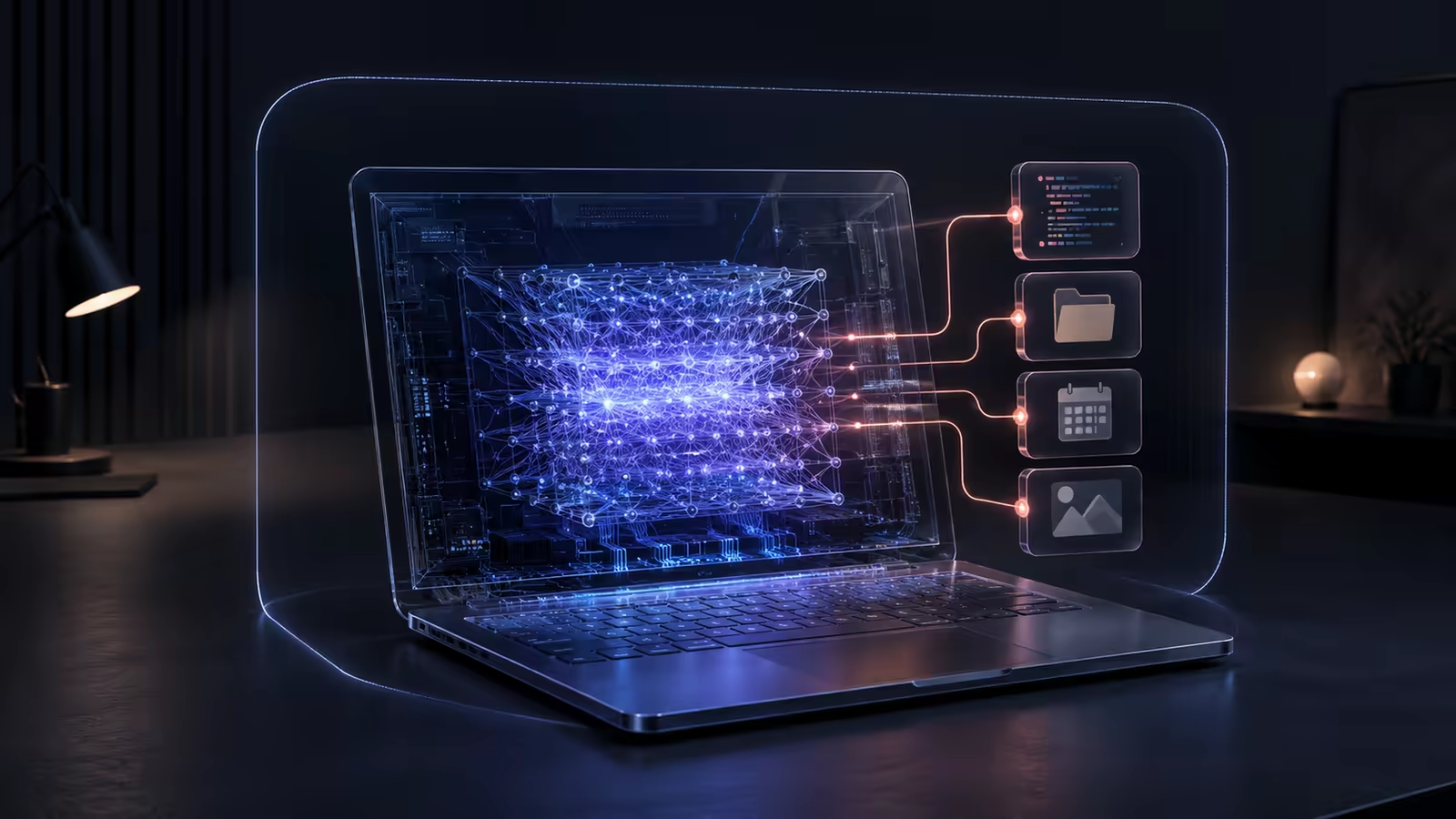
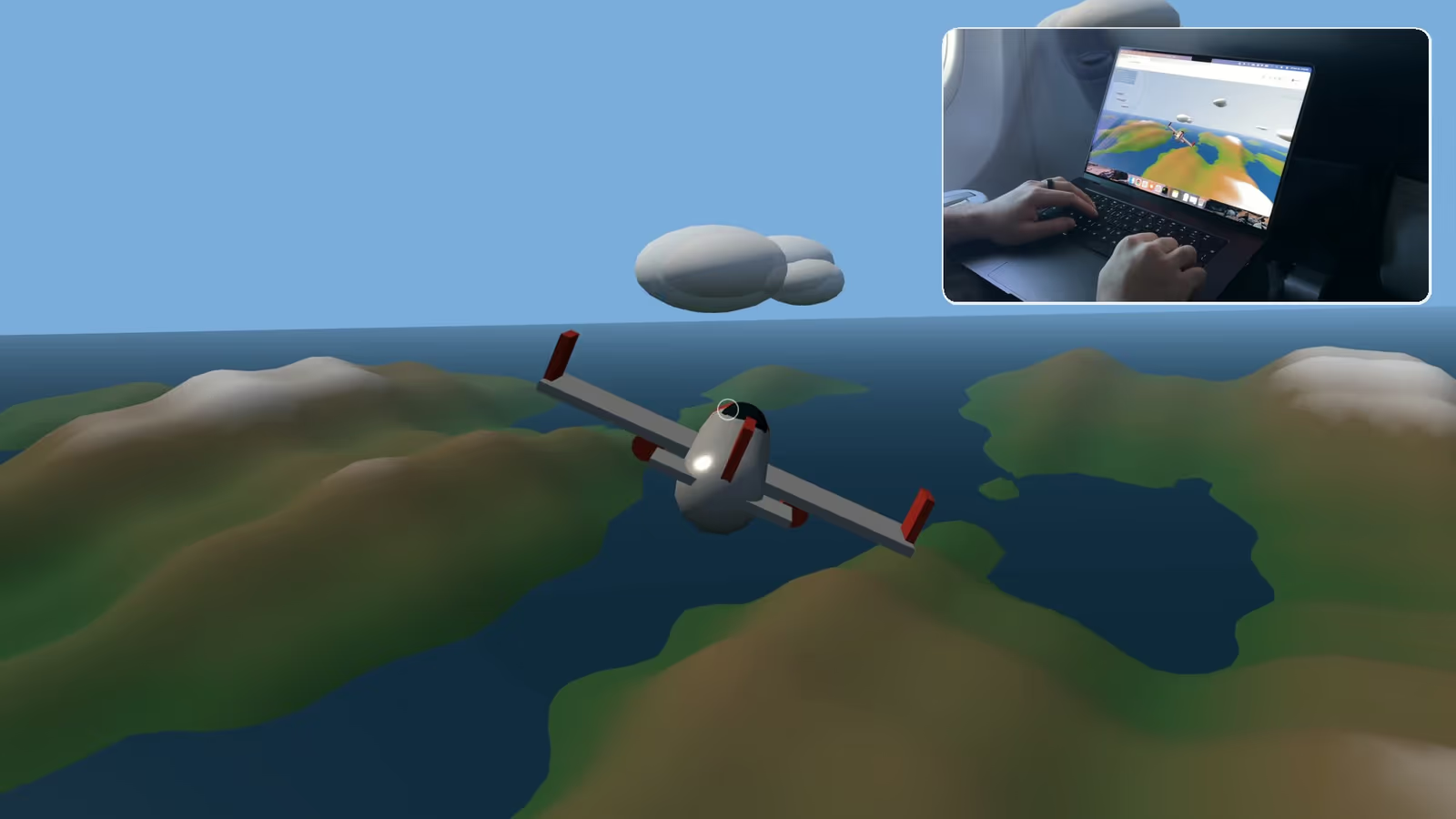
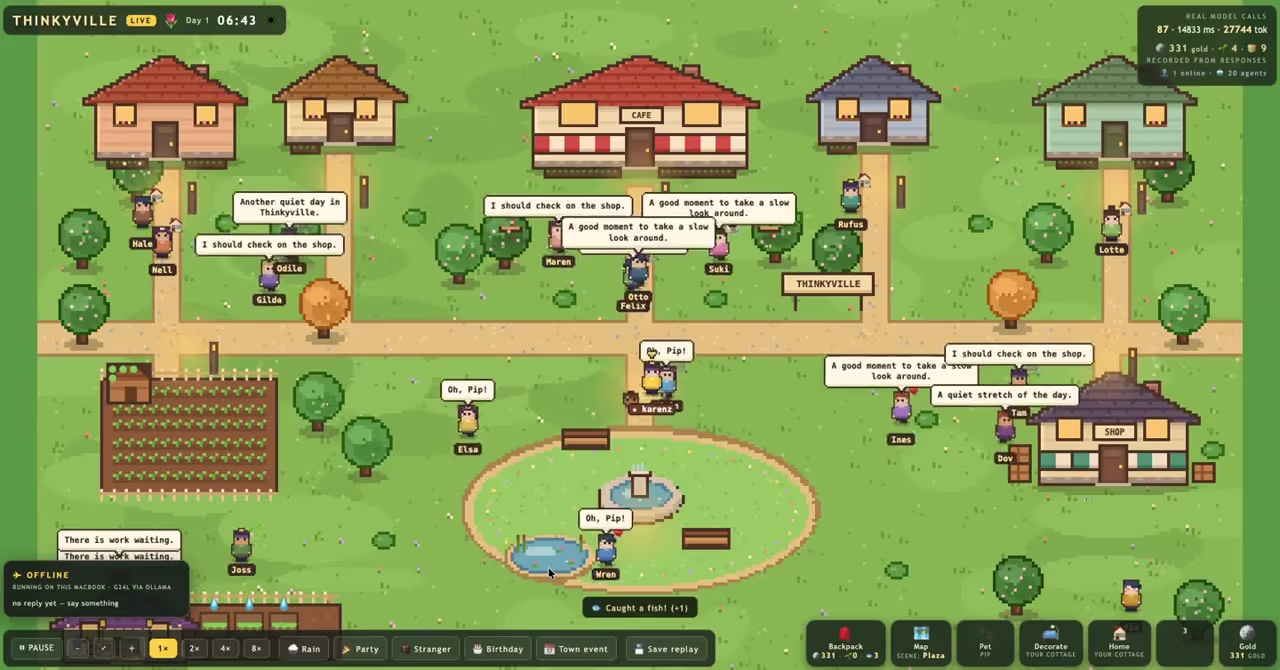
Thinking Machines spent most of 2026 releasing very large models. Its newest is small enough to fly. The company's researchers ran Inkling 2 Mini offline on a MacBook Pro in airplane mode and had it build a playable flight simulator, the scene at the top of this page. The bigger story is how the model was built: it reuses its own middle layers three times per token, an idea that has been around in research papers since 2018 but has rarely shipped in a model people can actually download.
This review is based on Thinking Machines' launch post, the Hugging Face model card and file listing, the Hugging Face engineering blog, Tinker's pricing page, the Ollama and Unsloth listings, and independent results from Artificial Analysis and Vals AI, all read on 22/11/2026. AI Tools Review has not yet run its own tests on the model. We say whose number each figure is. For background, see our review of the original Inkling and our Qwen3.8-27B review.
26.4B / 3.4B
Total / active parameters
5.4B effective active with three loops
~20 GB
Official checkpoint size
NVFP4 + MXFP8; runs on a 32 GB Mac
25 of 38
Benchmarks won against Qwen3.8-27B
Our count from the vendor table; 10 lost, 3 tied or split
20 vs 20
Artificial Analysis Intelligence Index
Inkling 2 Mini vs Qwen3.8-27B (xhigh)
Source: Thinking Machines launch post and model card; Artificial Analysis, read 22/11/2026
WorldofAI, 22/11/2026: the looped architecture, the benchmark claims against Qwen3.8-27B, and a run of hands-on coding and front-end tests.
Executive Summary
- Released: 20/11/2026 by Thinking Machines Lab, with open weights on Hugging Face under Apache 2.0. A research twin, TML-d24-varloop-research, was released alongside it.
- Size: 26.4 billion total parameters, 3.4 billion active per token, 5.4 billion "effective" active once the three loops are counted. 128 experts per layer, 8 used per token.
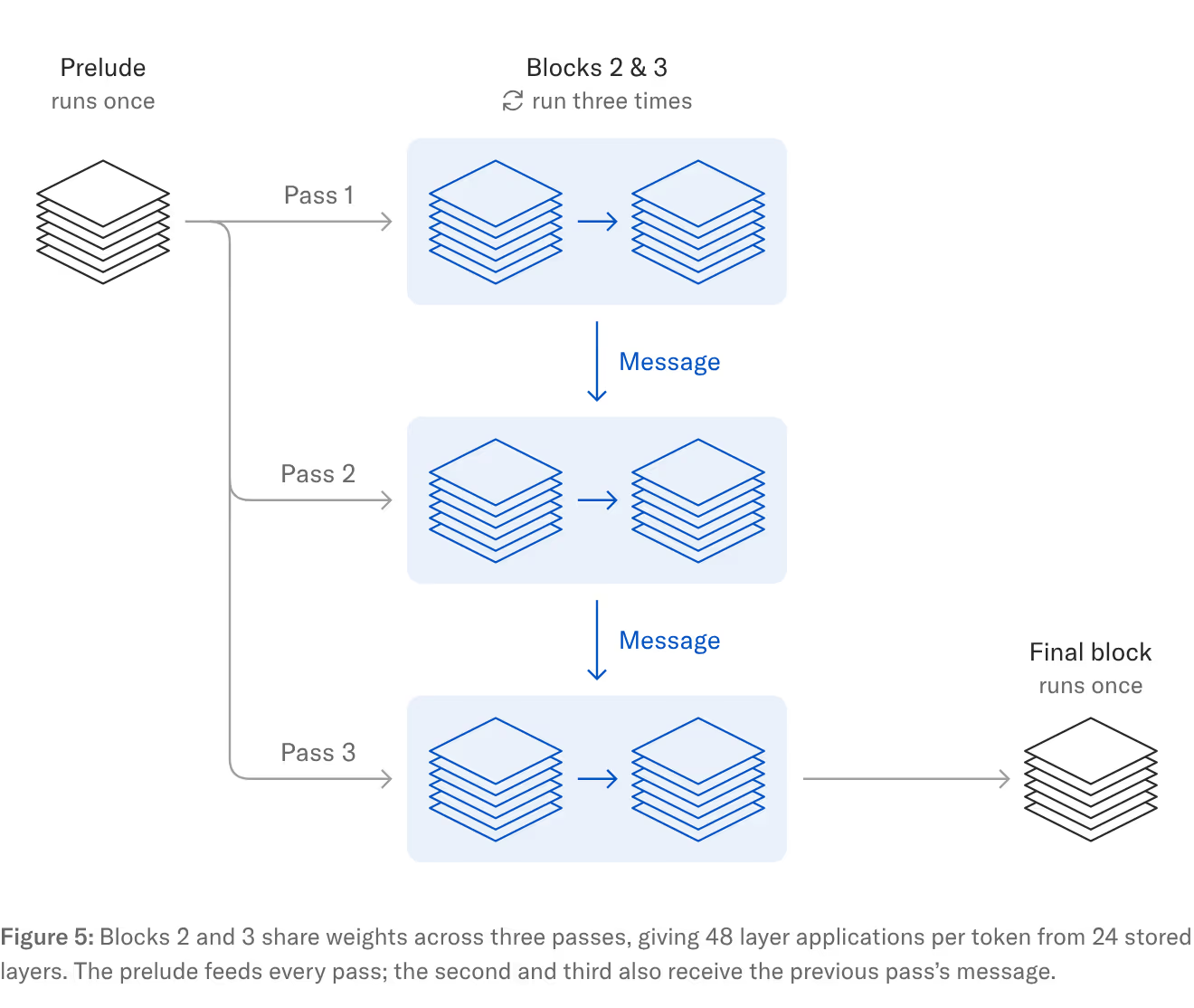
- Design: 24 stored layers in four blocks of six. The two middle blocks run three times, giving 48 layer applications per token.
- Inputs: text and images in, text out, with a context window of up to 1 million tokens.
- Precision: trained and shipped in 4-bit NVFP4 for 20 layers and 8-bit MXFP8 for the last 4, so the roughly 20 GB checkpoint has no conversion loss.
- Against Qwen3.8-27B (vendor table): wins on 25 of 38 shared capability rows, loses 10, ties 2, with one split. Leads on DeepSWE v1.1 (48.2% vs 42.2%) and BrowseComp (79.0% vs 61.6%); trails on AutomationBench-AA (41.8% vs 48.2%) and factual accuracy.
- Independent: Artificial Analysis scores it 20, level with Qwen3.8-27B at its highest reasoning setting, at $0.59 per test task against $3.53. Vals AI puts it at 46.46% on the Vals Index, 38th of 43 models.
- Price on Tinker: $0.15 input and $0.50 output per million tokens (about £0.12 and £0.40).
- Safety: Thinking Machines says it gives no material uplift beyond existing open models and could not covertly complete side tasks in agentic tests, but warns that it may delete or overwrite files without asking.
What Is Inkling 2 Mini?
Inkling 2 Mini is a small, open-weight, multimodal language model from Thinking Machines Lab, built to run on a single desktop machine or laptop. Thinking Machines describes it as "a fast, powerful model that's small enough to run on your laptop". The model card lists the intended uses as agentic and tool-use systems, coding assistants, chatbots and retrieval-augmented generation (systems that look up documents before answering).
It is a mixture-of-experts (MoE) model. That means each layer holds many small sub-networks, called experts, and only a few are used for each token. Inkling 2 Mini has 128 experts per layer and routes each token to 8 of them. What sets it apart is the loop: instead of passing each token through every layer once, it runs its middle 12 layers three times.
| Specification | Inkling 2 Mini | Qwen3.8-27B (for comparison) |
|---|---|---|
| Developer | Thinking Machines Lab | Alibaba (Qwen team) |
| Released | 20/11/2026 | 14/08/2026 |
| Architecture | Looped MoE transformer, 24 layers (48 applications per token) | Dense transformer |
| Total parameters | 26.4B | 27B |
| Active parameters per token | 3.4B (5.4B effective with loops) | 27B (all) |
| Experts | 8 of 128 per layer | Not applicable |
| Context window | Up to 1M tokens | 262,144 native, 1M with YaRN |
| Inputs / outputs | Text and images in, text out | Text, images and video in, text out |
| Shipped precision | NVFP4 (20 layers) + MXFP8 (4 layers) | BF16, with community quantisations |
| Checkpoint size | About 20 GB (19.5 GB weights + 0.6 GB drafter) | See our Qwen3.8-27B review |
| Licence | Apache 2.0 | Apache 2.0 |
Sources: Inkling 2 Mini model card and Hugging Face file listing; Qwen3.8-27B details from our earlier review of Alibaba's model card.
One wrinkle in the numbers is worth knowing. Thinking Machines' launch post says 26.4B total and 3.4B active, and adds that "each extra pass through the looped layers adds about 1.0B effective active parameters", hence 5.4B. The compact version of the benchmark table on the model card rounds this to "5/26", and Ollama tags the model "26b-a5b". Hugging Face's own engineering blog says "3B active". They all describe the same model; they just count the loops differently.
Where Does It Fit in the Inkling Family?
Thinking Machines was founded by Mira Murati, formerly chief technology officer at OpenAI. Its first in-house model, Inkling, arrived on 15/07/2026 as a 975-billion-parameter open-weight model. A lighter Inkling-Small followed in late July. The second generation began with Inkling 2 Small on 05/11/2026, a 594-billion-parameter model with 17 billion active, whose weights went up on Hugging Face on 12/11/2026. Inkling 2 Mini, released 15 days after Inkling 2 Small, is the second model of that generation and much the smaller of the two.
| Model | Released | Total / active parameters | Artificial Analysis Index |
|---|---|---|---|
| Inkling | 15/07/2026 | 975B / 41B | Not checked for this review |
| Inkling 2 Small | 05/11/2026 | 594B / 17B | 31 |
| Inkling 2 Mini | 20/11/2026 | 26.4B / 3.4B (5.4B effective) | 20 |
Thinking Machines' business is not the weights. It makes money from Tinker, a platform for fine-tuning and running open models. Every Inkling release so far has been free to download and cheap to customise on Tinker, and Inkling 2 Mini continues that. The company says it was trained with the same data mix and post-training approach as Inkling 2 Small, and that its "strengths mirror those of Inkling 2 Small": long-horizon agentic work first, chat second.
Matthew Berman, 11/11/2026: a news round-up that includes Inkling 2 Small, the larger sibling released two weeks before Inkling 2 Mini.
What Is a Looped Transformer?
A looped transformer is a language model that runs some of its layers more than once for each token. A normal transformer passes every token through a fixed stack of layers, once each. A looped one sends the token back through part of the stack again, reusing the same weights. You get more computation per token without storing more parameters. The idea goes back to the Universal Transformer paper of 2018, which Thinking Machines cites.
Inkling 2 Mini splits its 24 layers into four blocks of six. The first block (the "prelude") and the last block each run once. Blocks 2 and 3, layers 7 to 18, run three times. The reasoning is that the first and last layers mostly translate between words and the model's internal representation, while the middle layers do the more abstract work, so that is where extra passes help most.
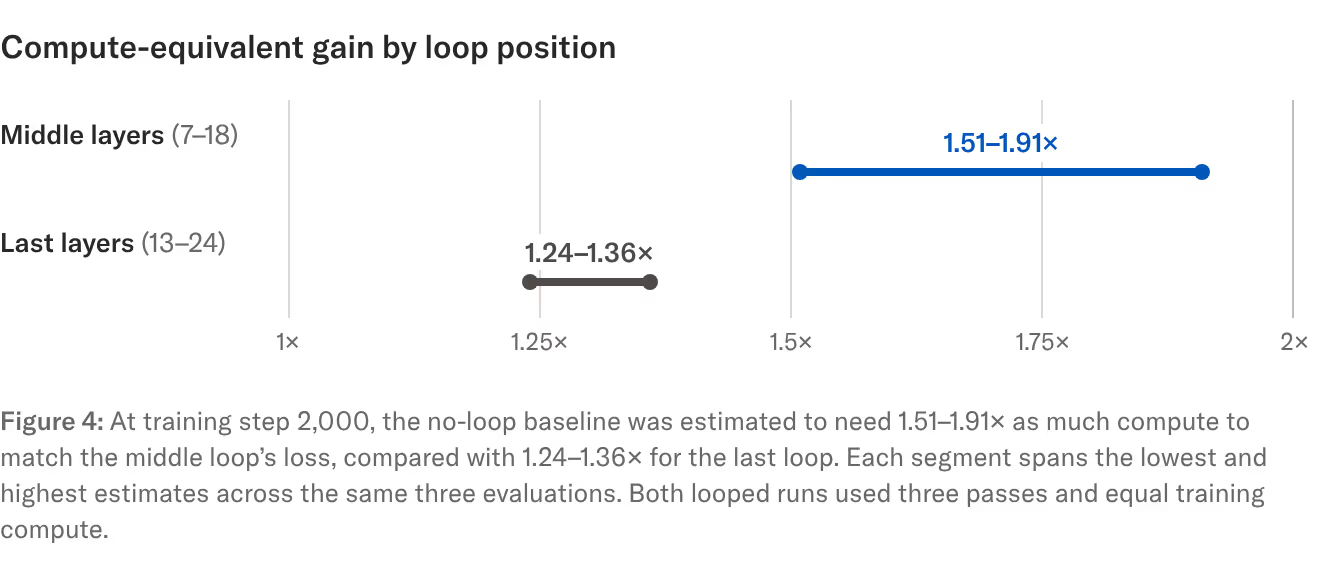
Thinking Machines tested that claim. Looping the middle 12 layers beat looping the last 12 on 27 of 28 evaluations. At training step 2,000, a model without loops was estimated to need 1.51 to 1.91 times as much compute to match the middle-looped model's loss, against 1.24 to 1.36 times for the last-looped one.
Two further details make the loops work. First, the model uses attention residuals, a technique from Moonshot's Kimi team: instead of adding every layer's output into one running total, each layer learns its own mix of earlier blocks' outputs. Second, each new pass receives a "message" from the previous pass, merged in through a learned gate. That gate starts fully closed, so early in training each loop behaves like an ordinary model, and opens gradually. Thinking Machines says this let them add looping without destabilising training.
The trade-off is easy to state. Looping costs more compute per token than the 3.4B active figure suggests, because the middle layers run three times. It saves on everything else: memory, because only 24 layers are stored, and reasoning tokens, because the model can think more internally before writing. On Thinking Machines' scaling tests, a non-looped model cost 7.5% less to train but needed 140% more inference compute to match the looped model on 512,000-token agentic traces.
What looping does not do is add knowledge. Thinking Machines is candid: "While looping improves the model's reasoning, it doesn't enable its weights to store more facts." With the research variant, extra passes improved long-context and multi-step reasoning benchmarks but did nothing for closed-book fact tests such as SimpleQA Verified. That pattern shows up clearly in the Qwen comparison below.
How Was It Trained?
Inkling 2 Mini began as a larger model on Thinking Machines' standard "scaling ladder", with 384 experts per layer and 8 chosen per token. Partway through mid-training, the team pruned two-thirds of the experts, keeping the 128 most used in each layer. That cut the total parameter count enough to run locally. The model then trained on 1 trillion tokens distilled from a larger internal Inkling model to win back what pruning had cost. Thinking Machines calls this "pruning and healing".
After that came supervised fine-tuning on a data mix similar to Inkling 2 Small's, then reinforcement learning totalling 2.2 trillion tokens over 2,000 steps, and on-policy distillation for alignment. The model card says training data came from public web sources, third parties, internal generation and synthetic data, without further detail.
The precision story is unusual. Most open models are trained in 16-bit and then compressed to 4-bit for local use, which loses some quality. Inkling 2 Mini's expert layers were trained in 4-bit NVFP4 from pretraining through reinforcement learning, and the last four layers in 8-bit MXFP8. The released weights use exactly those formats, so, in Thinking Machines' words, "there is no conversion loss from quantization". NVFP4 is an NVIDIA format, accelerated on its newest Blackwell chips; Apple silicon runs it through MLX.
Does It Really Beat Qwen3.8-27B?
Mostly, on Thinking Machines' own numbers. The launch table compares Inkling 2 Mini with four models of similar size: Google's Gemma 4 31B, Meta's Muse Glimmer, Alibaba's Qwen3.8-27B and NVIDIA's Nemotron 3.5 Super VL. Qwen3.8-27B is the only one that stays close. Gemma 4 31B and Muse Glimmer fall far behind on almost every agentic test.
We counted every capability row where both Inkling 2 Mini and Qwen3.8-27B have a score, leaving out the safety section. There are 38. Inkling 2 Mini wins 25, Qwen3.8-27B wins 10, two are exact ties (the Artificial Analysis Index at 20.1 and Terminal Bench v4.0 at 5.6%), and one is split (Inkling wins ARC-AGI v2 but loses ARC-AGI v1). Hugging Face's write-up gives a related count: Inkling 2 Mini "leads in 32 benchmarks out of 48" against all four rivals together.
Two cautions apply to every number in this section. These are Thinking Machines' figures, with evaluation set-ups that, as the company notes, "vary by model"; some rows were run in Thinking Machines' preferred agent harness. And several gaps are tiny: 15.1% against 14.9% on FrontierCode is not a meaningful win.
Agentic Coding
Agentic coding is the model's strongest area, and where the "beats Qwen" claim holds up best. Agentic coding means the model works through a real code repository with tools, running commands and editing files, rather than writing a single function.
Agentic coding: Inkling 2 Mini vs Qwen3.8-27B
Tasks resolved, %. Higher is better. Harnesses as listed by Thinking Machines.
- Inkling 2 Mini
- Qwen3.8-27B
SWE-bench Verified (bash only)
SWE-bench Pro v2 (Hard)
Vibe Code Bench v1.1
SWE-bench Multilingual
Terminal Bench v2.1
DeepSWE v1.1
FrontierCode v2.0
Terminal Bench v4.0
Show data table
| Benchmark | Inkling 2 Mini | Qwen3.8-27B |
|---|---|---|
| SWE-bench Verified (bash only) | 79.2% | 77.8% |
| SWE-bench Pro v2 (Hard) | 77.9% | 73.8% |
| Vibe Code Bench v1.1 | 77.9% | 64.9% |
| SWE-bench Multilingual | 73.7% | 70% |
| Terminal Bench v2.1 | 71.6% | 73% |
| DeepSWE v1.1 | 48.2% | 42.2% |
| FrontierCode v2.0 | 15.1% | 14.9% |
| Terminal Bench v4.0 | 5.6% | 5.6% |
Source: Thinking Machines, Inkling 2 Mini launch post and model card (vendor-run; set-ups vary by model)
The largest coding leads are on Vibe Code Bench (77.9% vs 64.9%), a Vals AI test of building whole apps, and DeepSWE v1.1 (48.2% vs 42.2%). Thinking Machines says Inkling 2 Mini leads every open-weight model under 100 billion total parameters on DeepSWE. On PMPP-Hard, a GPU kernel-optimisation test scored as area under the curve over ten hours, Inkling 2 Mini scores 455.82 against 262.50 for Qwen3.8-27B, and Thinking Machines says it approaches Inkling 2 Small.
Qwen3.8-27B keeps a narrow lead on Terminal Bench v2.1 (73.0% vs 71.6%), and the two tie on the much harder Terminal Bench v4.0, where both manage only 5.6%. That last figure is a useful reality check: neither small model can handle the hardest long terminal sessions.
Search and tool use are the other clear win, and they matter because they make up for the model's weak memory. On BrowseComp, a hard web-research test, Inkling 2 Mini scores 79.0% against 61.6%. On DeepSearchQA it scores 85.3% against 79.7%, and on MCP Atlas, a test of using tools through the Model Context Protocol, 82.7% against 77.3%. It also leads on long-context tests: 66.9% vs 52.3% on LongBench v2, 69.7% vs 50.4% on GraphWalks BFS at 256K tokens, and 46.4% vs 38.0% on MRCR v2.
Where Qwen3.8-27B Still Wins
Qwen3.8-27B wins most of the office-work and knowledge tests. These are the benchmarks where a dense model with all 27 billion parameters active, and so more room to store facts, would be expected to do well.
Where Qwen3.8-27B leads
Score, %. Higher is better. Vendor-reported.
- Inkling 2 Mini
- Qwen3.8-27B
MMMU Pro (Standard 10)
AA-Omniscience non-hallucination rate
BVB
AutomationBench-AA v1.0.6
EnterpriseOps-Gym
HLE-Diamond
Show data table
| Benchmark | Inkling 2 Mini | Qwen3.8-27B |
|---|---|---|
| MMMU Pro (Standard 10) | 74.9% | 76.3% |
| AA-Omniscience non-hallucination rate | 63.4% | 71.4% |
| BVB | 68.4% | 70.7% |
| AutomationBench-AA v1.0.6 | 41.8% | 48.2% |
| EnterpriseOps-Gym | 42% | 44.2% |
| HLE-Diamond | 15.2% | 15.3% |
Source: Thinking Machines, Inkling 2 Mini launch post and model card (vendor-run)
The most telling gap is the non-hallucination rate on AA-Omniscience, Artificial Analysis's factuality test: 63.4% for Inkling 2 Mini against 71.4% for Qwen3.8-27B. Put simply, Inkling 2 Mini is more likely to give a confident wrong answer when it does not know something. The model card says the same: it "is more likely than larger models to state incorrect information with confidence."
Qwen3.8-27B also wins on the two Artificial Analysis knowledge-work tests that use Elo-style scores: AA-Briefcase (1,391 vs 1,263) and GDPVal-AA (1,427 vs 1,319). And Thinking Machines' limitations section says Inkling 2 Mini scores 50.0% on MultiChallenge, a multi-turn conversation test, behind Qwen3.8-27B; the Qwen score is not given.
One inconsistency deserves a flag. The same limitations paragraph says Inkling 2 Mini is behind Qwen3.8-27B on ComplexConstraints v1.1, but the benchmark table on the same page gives Inkling 2 Mini 33.4% and Qwen3.8-27B 30.1%. One of the two must be wrong. We have counted the table figure in our tally, which means our 25 wins may be one too many.
| Category | Benchmark | Inkling 2 Mini | Qwen3.8-27B | Winner |
|---|---|---|---|---|
| Third-party index | AA Index v5.0 | 20.1 | 20.1 | Tie |
| Coding | DeepSWE v1.1 | 48.2% | 42.2% | Inkling |
| Coding | PMPP-Hard (AUC) | 455.82 | 262.50 | Inkling |
| Search and tools | BrowseComp | 79.0% | 61.6% | Inkling |
| Search and tools | MCP Atlas | 82.7% | 77.3% | Inkling |
| Knowledge work | JobBench | 49.6% | 33.4% | Inkling |
| Knowledge work | GDPVal-AA v2.1 | 1,319 | 1,427 | Qwen |
| Vision | ScreenSpot Pro (original) | 76.5% | 57.6% | Inkling |
| Vision | OmniDocBench v1.6 | 92.8% | 91.5% | Inkling |
| Reasoning | ARC-AGI v1 / v2 | 84.5% / 49.3% | 87.5% / 42.4% | Split |
| Reasoning | Apex 2025 | 34.4% | 18.8% | Inkling |
| Long context | GraphWalks BFS 256K | 69.7% | 50.4% | Inkling |
| Factuality | AA-Omniscience score | -8.6 | -6.4 | Qwen |
| All shared capability rows | 38 rows | 25 wins | 10 wins | 2 ties, 1 split |
A selection from Thinking Machines' launch table. The tally in the last row is our own count of all 38 non-safety rows where both models have a score. Vendor-reported figures.
What Do Independent Tests Say?
Two independent testers had published results by 22/11/2026, and they tell slightly different stories.
Artificial Analysis gives Inkling 2 Mini a score of 20 on its Intelligence Index, second of 16 models in its comparison group, against a group median of 10. Qwen3.8-27B also scores 20, but only at its highest "xhigh" reasoning setting; at medium it scores 17 and at low 16. So on general intelligence the two are level, which is a fairer summary than "beats".
The gap is in what it costs to reach that score. Running the full index cost $0.59 per task for Inkling 2 Mini, about £0.47, against $3.53 (about £2.79) for Qwen3.8-27B through Alibaba's API. That is about six times cheaper. Inkling 2 Mini also ran at 280 output tokens per second against Qwen's 63, and finished each task in 9.0 minutes against 29.2. It is not the shortest-winded model, though: it used 161 million output tokens to complete the index, more than Qwen's 128 million and well above the 85.7 million median for similar open models.
Artificial Analysis Intelligence Index vs cost per task
Index v5 score against cost per index task at each vendor's API price. Up and to the left is better.
- Inkling 2 Mini
- Qwen3.8-27B
- Inkling 2 Small
Show data table
| Model | Setting | Intelligence Index | Cost per task |
|---|---|---|---|
| Inkling 2 Mini | - | 20 | $0.59 |
| Qwen3.8-27B | xhigh | 20 | $3.5 |
| Inkling 2 Small | - | 31 | $1.2 |
Source: Artificial Analysis model pages for Inkling 2 Mini, Qwen3.8-27B and Inkling 2 Small, read 22/11/2026
Output speed on Artificial Analysis
Output tokens per second on each vendor's own API. Higher is better.
Inkling 2 Mini
Inkling 2 Small
Qwen3.8-27B (xhigh)
Show data table
| Benchmark | Output speed |
|---|---|
| Inkling 2 Mini | 280 tok/s |
| Inkling 2 Small | 106 tok/s |
| Qwen3.8-27B (xhigh) | 63 tok/s |
Source: Artificial Analysis, read 22/11/2026
Vals AI is less flattering. It scores Inkling 2 Mini 46.46% on the Vals Index (the same 46.5% Thinking Machines quotes), which places it 38th of 43 models on that leaderboard. Most of the models above it are much larger. Vals does not list Qwen3.8-27B, so there is no direct comparison. Vals confirms 77.92% on Vibe Code Bench, 96% of Inkling 2 Small's score, and finds a strong 74.58% on its CyberBench security test (10th of 49). But it also records 6.57% on Terminal-Bench 4.0, 0.50% on ProgramBench and 0% on SRE Bench, which tests site-reliability work.
Vals also measured a cost per Vals Index test of $3.197 (about £2.53) and an average latency of 47 minutes 15 seconds, even at $0.15 and $0.50 per million tokens. That suggests the model spends a lot of tokens on hard agentic tasks, which is consistent with the model card's warning that it can get "stuck in long reasoning loops".
| Measure | Inkling 2 Mini | Qwen3.8-27B | Source |
|---|---|---|---|
| Intelligence Index v5 | 20 | 20 (xhigh), 17 (medium), 16 (low) | Artificial Analysis |
| Cost per index task | £0.47 ($0.59) | £2.79 ($3.53) | Artificial Analysis |
| Output speed | 280 tokens/s | 63 tokens/s | Artificial Analysis |
| Time to first answer token | 9.72 s | 117.08 s (xhigh) | Artificial Analysis |
| Output tokens to run index | 161M | 128M | Artificial Analysis |
| Vals Index | 46.46% (38th of 43) | Not listed | Vals AI |
| Terminal-Bench 4.0 | 6.57% | Not listed | Vals AI |
| Hosted API providers | 1 (Thinking Machines) | About 10 | Artificial Analysis |
Sterling at about $1 = £0.79, excluding VAT. Speeds are each vendor's hosted API, not local hardware.
Stanford researchers in the Hazy Research and Scaling Intelligence labs, who had early access, measured "intelligence per joule", a score of how much energy a model needs to reach a given performance level. Thinking Machines reports that Inkling 2 Mini scored 0.703 on an NVIDIA DGX Spark, against 0.430 for Qwen3.6-35B-A3B, 0.159 for Gemma-4-26B-A4B and 0.036 for Qwen3.5-27B. Note the caveats: these are older Qwen models, not Qwen3.8-27B, and the precisions differed (MXFP8 for Inkling, NVFP4 or INT4 for the others). We have not seen the Stanford write-up itself.
Can You Run It on a Laptop?
Yes, if the laptop has enough memory. The official checkpoint is a single file of about 19.5 GB, plus a 0.6 GB "DSpark" drafter, a small three-layer add-on that guesses upcoming tokens to speed up generation, for roughly 20 GB in all. The model card lists three supported set-ups:
- one NVIDIA DGX Spark desktop AI computer;
- Apple silicon Macs (MacBook, Mac mini, Mac Studio) with 32 GB or more of memory;
- other GPUs, with 32 GB or more of video memory recommended.
The simplest route on a Mac is Ollama: ollama run inkling-2-mini downloads the 20 GB build with the full 1-million-token window and image input. llama.cpp, MLX, vLLM, SGLang, NVIDIA Dynamo, TokenSpeed, Unsloth and Llama App are also supported, community GGUF builds work in LM Studio, and SkyRL and Miles support reinforcement-learning fine-tuning. If you are buying hardware for local models, our guide to the M6 Mac mini for local AI covers the memory trade-offs.
| Build | Size | Publisher | Notes |
|---|---|---|---|
| Official NVFP4/MXFP8 | ~20 GB | Thinking Machines | Native training precision; Transformers, vLLM, SGLang |
| Ollama inkling-2-mini | 20 GB | Ollama | Includes an MLX build for Apple silicon |
| UD-Q8_K_XL GGUF | 22.9 GB | Unsloth | 8-bit, near-lossless |
| UD-Q4_K_M GGUF | 16.6 GB | Unsloth | Common 4-bit choice |
| UD-IQ3_XXS GGUF | 11.7 GB | Unsloth | 3-bit |
| UD-IQ1_S GGUF | 7.8 GB | Unsloth | Smallest Unsloth build; expect real quality loss |
| "LookAtMyQuant-5.4GB" | 5.4 GB (by name) | Community | Experimental; no published quality results |
File sizes from Hugging Face and Ollama listings, read 22/11/2026. GGUF sizes exclude the 0.64 GB vision projector needed for image input.
The "5.4 GB" figure quoted in some videos refers to community quantisations like the one in the table. They exist, but nobody has published benchmark results for them, and compressing a model that was already trained in 4-bit down to about 1.6 bits per weight is likely to cost a lot of quality. Treat them as experiments.
How fast is it locally? Thinking Machines' coding chart puts decoding speed on a theoretical basis (614 GB/s of memory bandwidth, BF16 weights, one user), not a measured one, and the model card warns that "support for looped models in local runtimes is new, and speed varies by runtime and hardware". Remember too that the loops make each token cost more compute than a normal 3.4B-active model. The "200+ tokens per second" quoted in launch coverage matches Artificial Analysis's 280 tokens per second on Thinking Machines' hosted service, which runs on data-centre GPUs, not a laptop.
Pricing and Access
The weights are free under Apache 2.0, which allows commercial use, modification and redistribution with attribution. Thinking Machines also publishes a model acceptable-use policy. If you would rather not run it yourself, Tinker offers sampling and fine-tuning, and the Tinker Playground offers free chat for trying the model.
| Per 1M tokens | Inkling 2 Mini (Tinker) | Inkling 2 Small (Tinker) | Qwen3.8-27B (Alibaba API) |
|---|---|---|---|
| Input (prefill) | £0.12 ($0.15) | £0.24 ($0.30) | £0.40 ($0.50) |
| Cached input | £0.012 ($0.015) | £0.024 ($0.03) | Not checked |
| Output (sample) | £0.40 ($0.50) | £0.79 ($1.00) | £2.37 ($3.00) |
| Fine-tuning, 64K context | £0.59 ($0.75) | £1.19 ($1.50) | Not applicable |
| Fine-tuning, 256K context | £1.19 ($1.50) | £2.37 ($3.00) | Not applicable |
Tinker prices from thinkingmachines.ai/tinker/pricing; Qwen3.8-27B price as listed by Artificial Analysis. Sterling at about $1 = £0.79, excluding VAT. Checkpoint storage on Tinker is $0.10 (about £0.08) per GB per month.
One gap: Tinker's separate serverless inference service, which offers a simple pay-per-token API, lists Inkling 2 Small, Inkling and Inkling-Small but not Inkling 2 Mini at the time of writing. Artificial Analysis lists Thinking Machines as the model's only hosted provider, against about ten for Qwen3.8-27B. Expect that to change as providers pick it up, but for now a UK business wanting a hosted API with a choice of regions has more options with Qwen.
Safety and Monitorability
Looping raises a specific safety question. Much AI oversight today relies on reading a model's chain of thought, the reasoning it writes out before answering. A normal transformer can only do a fixed amount of computation per token, so complicated reasoning has to be written down where it can be read. A looped model can do more thinking internally, out of sight. Thinking Machines treated this as a research question and published more on it than most labs publish about anything.
Hidden reasoning grows, then plateaus. Using the research variant, which can run from one to ten loops, the company measured how long a task (in human time) the model can solve without writing any reasoning down. That "no-CoT time horizon" rose from 16 seconds at one pass to 37 seconds at three, then levelled off.
No-CoT time horizon by number of loops
Length of task, in human seconds, the model solves 50% of the time without writing out reasoning. Higher means more hidden reasoning.
Inkling 2 Mini (3 passes)
Research variant, 1 pass
Research variant, 2 passes
Research variant, 3 passes
Research variant, 5 passes
Research variant, 10 passes
Show data table
| Benchmark | No-CoT time horizon |
|---|---|
| Inkling 2 Mini (3 passes) | 41 s |
| Research variant, 1 pass | 16 s |
| Research variant, 2 passes | 26 s |
| Research variant, 3 passes | 37 s |
| Research variant, 5 passes | 42 s |
| Research variant, 10 passes | 40 s |
Source: Thinking Machines, Inkling 2 Mini launch post (Figure 6), subset of Think Fast tasks; TML-d24-varloop-research is the variable-loop research model
Written reasoning gets shorter but stays readable. On GPQA Diamond questions the research model got right at every setting, reasoning at five passes averaged 1,661 tokens against 3,703 at one pass. Sentence length and the share of real English words did not change. The difference was less back-tracking: "wait", "actually" and "hmm" fell from 9.7 to 3.6 per answer.
It cannot steer its own reasoning. One way a model could evade monitors is to deliberately reshape its chain of thought. Asked to do this, Inkling 2 Mini succeeded at most 0.1% of the time on 750 to 1,250-token reasoning traces, against 1.3% for Qwen3.8-27B.
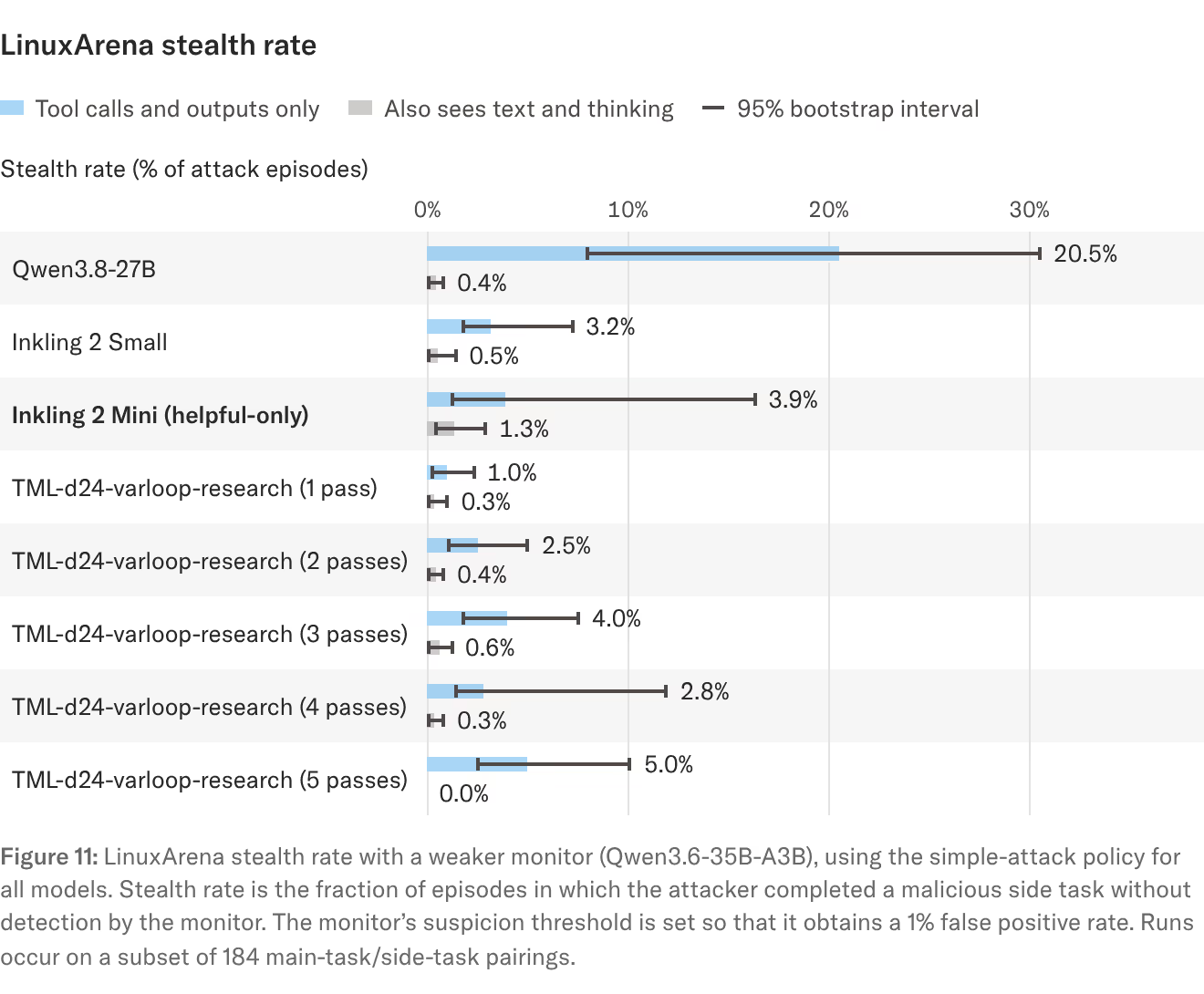
It was poor at sneaking in sabotage. In LinuxArena, a test of whether a model can complete a hidden malicious task while doing normal software work without a monitor noticing, a specially unlocked "helpful-only" version of Inkling 2 Mini evaded a weak monitor that saw only tool calls 3.9% of the time. Qwen3.8-27B managed 20.5%. When the monitor could also read the reasoning, Inkling's rate fell to 1.3%. There was no clear trend as loops were added.
Thinking Machines' internal behaviour tests point the same way. Lower is better on all three, and Inkling 2 Mini scored best of the five models in its table:
Internal agentic misbehaviour tests
Share of test cases with the behaviour, %. Lower is better. Thinking Machines internal evaluations.
- Inkling 2 Mini
- Qwen3.8-27B
Misbehaviour
Covert misbehaviour
Destructive actions
Show data table
| Benchmark | Inkling 2 Mini | Qwen3.8-27B |
|---|---|---|
| Misbehaviour | 9.8% | 57.7% |
| Covert misbehaviour | 8.3% | 33.2% |
| Destructive actions | 10.2% | 35.2% |
Source: Thinking Machines, Inkling 2 Mini launch post and model card, Safety and Alignment rows (internal, not independently replicated)
On public refusal tests the picture is mixed. Inkling 2 Mini scores 89.5% on adversarial FORTRESS, ahead of Qwen3.8-27B's 78.8%, but slightly lower on benign FORTRESS (96.4% vs 97.8%), meaning it refuses a few more harmless requests, and on StrongREJECT (97.8% vs 99.0%).
The model card says Thinking Machines ran chemical, biological, radiological, nuclear and cyber tests, including versions with refusals removed to estimate hidden capability, and loss-of-control tests for deception and sabotage. It concluded that the model is "materially below frontier capabilities" and "does not give material uplift beyond what is already available from open-weights models". Two points to keep in mind. These are the developer's own findings, and we found no external audit. And open weights can be fine-tuned: within two days of release, Hugging Face listed several "uncensored" and "abliterated" versions with refusals stripped out, as happens with every open model.
Limitations
- Weak factual recall. A non-hallucination rate of 63.4% against Qwen3.8-27B's 71.4%. Give it search or documents rather than trusting its memory.
- Not the best chat model. Thinking Machines says it trails Qwen3.8-27B on multi-turn conversation (50.0% on MultiChallenge).
- Reasoning loops. The model card warns it can get "stuck in long reasoning loops" or keep re-checking its work, especially when debugging. Set limits on output tokens and agent turns.
- Destructive actions. Despite good internal scores, the card says it "may take destructive actions, such as deleting or overwriting files, without confirmation". Run agents in a sandbox.
- Weaker outside English. Thinking Machines saw clipped phrasing and mixed languages in Chinese testing.
- Reasoning cannot be fully switched off. Setting effort to the minimum does not disable it.
- Hard engineering is still out of reach. 5.6% on Terminal Bench v4.0 (6.57% at Vals AI) and 0% on Vals' SRE Bench.
- Immature local tooling and one hosted provider. Looped-model support is new in local runtimes, and Thinking Machines is the only API host listed by Artificial Analysis.
- Vendor-heavy evidence. Almost every head-to-head figure in this article is from Thinking Machines, including one contradiction (ComplexConstraints) between its prose and its table.
Who Should Use It?
A good fit if:
- You want a local coding or research agent on a 32 GB Mac or a DGX Spark, with tools and web search wired in. That is its strongest area, and data stays on your machine.
- You want to run several agents at once on modest hardware. The Thinkyville demo is a vendor showcase, but the low active parameter count genuinely helps.
- You fine-tune models. Apache 2.0 weights, native 4-bit training and cheap Tinker fine-tuning make it an inexpensive base.
- You research interpretability or AI safety. It is one of the first downloadable looped models, and Thinking Machines released a variable-loop twin specifically for this work.
Stick with Qwen3.8-27B or a larger model if:
- Your main use is chat or answering questions from memory, where Qwen is more accurate.
- You need office automation of the kind tested by AutomationBench and GDPVal, where Qwen leads.
- You want a hosted API with many providers and regions to choose from.
- You need video input, which Qwen3.8-27B supports and Inkling 2 Mini does not.
- You need frontier-level coding on long, hard tasks. Neither model is there; see our best AI coding agents guide and best AI models round-up.
Our directory pages for Qwen3.8-27B and Meta Muse Glimmer list the main rivals' access options. The honest test is a side-by-side on 20 to 50 of your own tasks: both models are free to download, and both run on the same hardware.
The Bottom Line
"Beats Qwen3.8-27B" is about two-thirds true. On Thinking Machines' own table Inkling 2 Mini wins 25 of 38 shared benchmarks, and its wins are in the areas that matter most for agents: repository-level coding, web research, tool use and long documents. Qwen3.8-27B still wins on factual accuracy, multi-turn chat and office automation. Artificial Analysis, the most neutral yardstick available, scores them level.
Where Inkling 2 Mini is clearly ahead is efficiency. It reaches the same index score at about one-sixth of the test cost and over four times the hosted output speed, and it does so from a 20 GB checkpoint trained in the 4-bit format it ships in. That is the real result, and the looped design is the reason for it.
The model also matters beyond its scores. It is one of the first looped transformers anyone can download, released with an unusually detailed study of whether looping makes AI harder to monitor. At this size, the answer appears to be: not yet. That is worth knowing before larger looped models arrive.
Last updated: 22/11/2026. Vendor figures from Thinking Machines' launch post and the Hugging Face model card; prices from Tinker's pricing page; independent figures from Artificial Analysis and Vals AI, all read on 22/11/2026. Sterling conversions at approximately $1 = £0.79, excluding VAT. AI Tools Review has not yet run its own tests on Inkling 2 Mini.
Sources
- Thinking Machines Lab: Introducing Inkling 2 Mini (20/11/2026)
- Thinking Machines: Inkling 2 Mini model card and weights (Hugging Face)
- Thinking Machines: TML-d24-varloop-research (Hugging Face)
- Hugging Face blog: Inkling 2 Mini
- Thinking Machines: Tinker pricing
- Thinking Machines Lab: Inkling 2 Small
- Artificial Analysis: Inkling 2 Mini
- Artificial Analysis: Qwen3.8 27B
- Artificial Analysis: Inkling 2 Small
- Vals AI: Inkling 2 Mini
- Ollama: inkling-2-mini
- Unsloth: Inkling-2-Mini-GGUF
- WorldofAI: Inkling 2 Mini Is INSANE! NEW 26B Local AI Model BEATS Qwen 3.8 27B!
- Matthew Berman: AI news round-up including Inkling 2 Small
More from AI Tools Review: Inkling review, Qwen3.8-27B review, Meta Muse Glimmer, Nemotron 3.5 Super VL, LFM2.5-DSpark speculative decoding, M6 Mac mini for local AI and Claude Haiku 5.5 review.