
 AI Tools Review Editorial Team
Quick Answer:
Anthropic became a public company on 19/11/2026. Its shares, ticker ANT on Nasdaq, were sold at $83 (about £63), opened at $111.50 and closed the first day at $97.17, a fully diluted value of roughly $1.75 to $1.8 trillion. On Friday 20/11/2026 they fell nearly 8.5% to just under $89, still about 7% above the offer price. The same week Nvidia lost nearly $900 billion (about £687bn) of market value after reports of an SEC probe into its disclosures and accounting, Donald Trump threatened a "tremendous tax" on US companies that build AI data centres abroad, and his Treasury Secretary said Trump and Xi Jinping had agreed humans must stay in charge of military AI. Whether this is an AI bubble bursting is not something one week can prove. This article is news analysis, not financial advice.
In a single week the AI industry produced the largest stock market listing on record and Nvidia's worst week since October 2008. Anthropic raised more money than any company had before by selling shares to the public, protesters outside its offices chanted "ban AI that builds AI", and Nvidia, once the world's most valuable company, slipped to fourth place in the US. Here is what actually happened, with dates and sourced numbers, and what it does and does not tell us.
We have built this piece from primary and first-hand sources: Anthropic's own closing announcement, CNBC's and NBC News's live coverage of the listing day, Yahoo Finance's market reports, Reuters reporting on the Trump–Xi meeting and the SEC, NBC News on the data centre tax threat, and METR's published assessment of AI research acceleration at Anthropic. Where outlets disagree, we show both figures and say why they differ. Sterling conversions use about $1.31 to the pound, the level Trading Economics reported on 19–20/11/2026, and are approximate. For the background to the listing, read our earlier explainer on Anthropic's IPO prospectus and its compute commitments.
Not financial advice: AI Tools Review writes about AI products and the companies behind them. Nothing here is a recommendation to buy, sell or hold any security. Share prices move quickly and the figures below are a snapshot as of 22/11/2026.
$83
IPO price per share
About £63; ticker ANT, Nasdaq
$111.50
First trade, 19/11/2026
34% above the offer price
<$89
Close, Friday 20/11/2026
Down nearly 8.5% on the day
~$900bn
Nvidia value lost in the week
Worst week since October 2008
Source: Anthropic (ipo-close); CNBC live updates 19/11/2026; Yahoo Finance 20/11/2026 and 21/11/2026
AI Revolution X runs through the week: Anthropic's near-$2tn open, the protests, Nvidia's record weekly loss, Trump's data centre tax threat and the Trump-Xi military AI agreement. The title is the channel's framing; whether a bubble has 'cracked' is not established.
Executive Summary
- The listing: Anthropic sold 1,127,000,000 Class A shares at $83.00, including the underwriters' full option of 147,000,000 extra shares. Gross proceeds were about $93.5 billion (about £71bn), of which Anthropic received about $91.6 billion. A separate $26.0 billion private placement went to AMD, Broadcom, Google, Micron, Microsoft, Nvidia and TSMC Partners at the same price.
- The first two days: ANT opened at $111.50 on 19/11/2026, closed at $97.17 (up 17%), then fell nearly 8.5% on 20/11/2026 to just below $89.
- The valuation: "Nearly $2 trillion" was the fully diluted value at the opening trade. On shares actually outstanding, Yahoo Finance put the value at about $1.28 trillion at Thursday's close and $1.17 trillion at Friday's.
- Nvidia: after a Wall Street Journal report on 17/11/2026 of an SEC probe into whether its disclosures misled investors, and a later Reuters report that the SEC was examining potential accounting problems, Nvidia fell 14% on Friday and lost nearly $900 billion over the week. Since its record close on 06/10/2026 it has lost about $2.7 trillion.
- Politics: on 20/11/2026 Trump said US companies would face "tremendous penalties" for building data centres abroad, with no detail on how. The same day Scott Bessent said Trump and Xi had agreed that humans should always be involved in military decisions that use AI.
- Protest and dissent: more than 100 demonstrators in San Francisco chanted "ban AI that builds AI"; police in New York arrested protesters blocking the Nasdaq MarketSite doors. A day earlier the Center for AI Safety published the "MisAnthropic Statement" calling Anthropic "not a safe AI company".
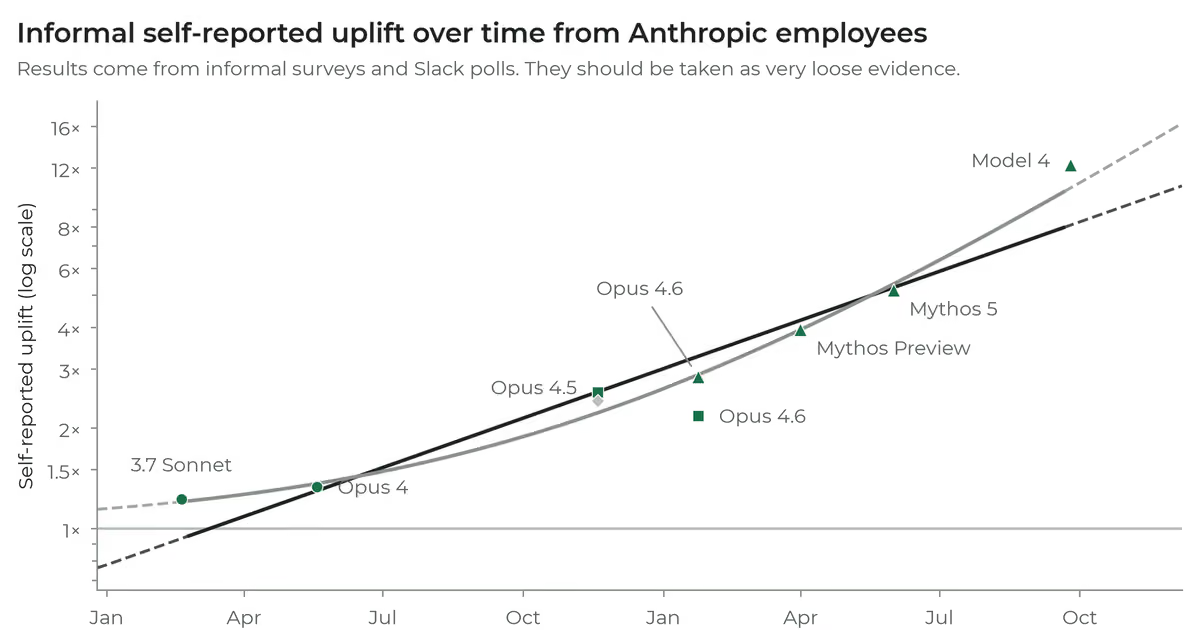
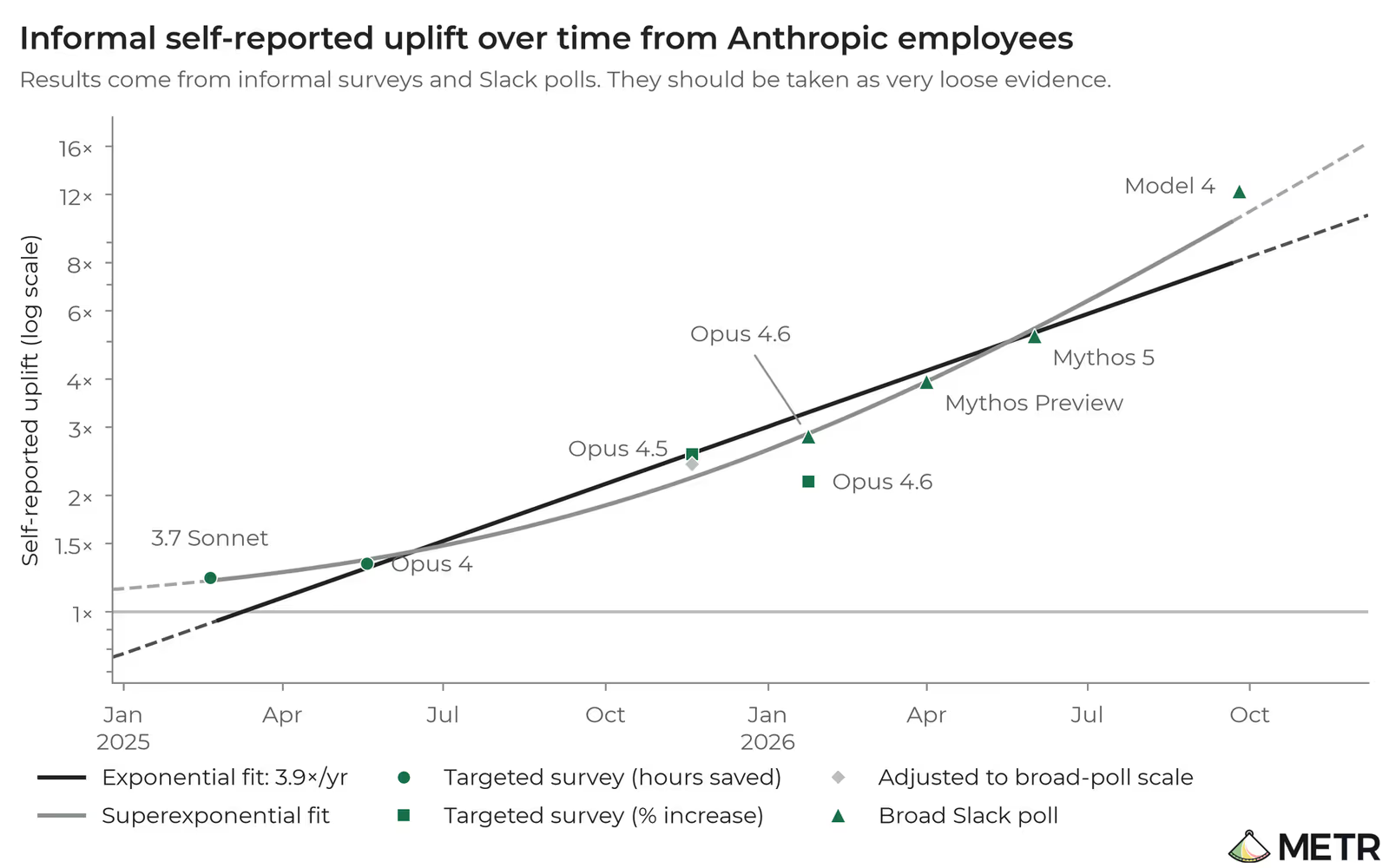
- The research backdrop: METR's independent assessment, published on 05/11/2026, estimates that Anthropic's benchmark progress is running at about 1.9 times its pre-October 2025 rate, and guesses that about 80% of the recent acceleration is due to AI itself.
- Bubble or not: the evidence points both ways. Spending is enormous and partly circular; revenue is also growing faster than almost any precedent. One bad week is not proof either way.
What Happened, Day by Day
The "AI bubble week" is shorthand for a cluster of events between Monday 16/11/2026 and Friday 20/11/2026. Several had roots in the weeks before, so the timeline starts earlier. Times are US Eastern where given.
| Date | Event | Source |
|---|---|---|
| 06/10/2026 | Nvidia sets its record closing price; the later sell-off is measured from here | Yahoo Finance |
| 05/11/2026 | METR publishes its assessment of AI R&D acceleration at Anthropic | METR |
| 10/11/2026 | Anthropic files an amended IPO registration statement | The Next Web |
| 11–12/11/2026 | Jensen Huang resigns as Nvidia chief executive; CFO Colette Kress becomes interim CEO | Nvidia, via our earlier report |
| Week to 13/11/2026 | Nvidia loses $573bn, at the time the largest one-week drop for any company on record | Dow Jones Market Data, via Yahoo Finance |
| 16/11/2026 | US Commerce Department moves to tighten Chinese access to advanced AI chips, including via overseas data centres | Reuters |
| 17/11/2026 | WSJ reports an SEC probe of Nvidia; Nvidia reports quarterly revenue of $115.8bn and says its 10-Q will follow "in the coming weeks" | Reuters; Yahoo Finance |
| 18/11/2026 | SEC declares Anthropic's registration effective; CAIS publishes the MisAnthropic Statement; Nvidia closes 36% below its record | Anthropic; The Next Web; Reuters via Yahoo Finance |
| 19/11/2026, 09:42 | Anthropic executives ring the Nasdaq opening bell | CNBC |
| 19/11/2026, late morning | ANT opens at $111.50; value briefly tops $2tn fully diluted | CNBC; NBC News |
| 19/11/2026 | Trump and Xi meet at APEC in Shenzhen; California's attorney general subpoenas Nvidia | Reuters; Yahoo Finance |
| 19/11/2026, close | ANT closes at $97.17; S&P 500, Nasdaq and Dow all close more than 2% lower | CNBC; NBC News |
| 20/11/2026 | Anthropic announces the IPO has closed, with the full greenshoe exercised | Anthropic |
| 20/11/2026 | Trump threatens a tax on US firms that build data centres abroad; Bessent describes the Trump–Xi military AI agreement | NBC News; Reuters |
| 20/11/2026 | Reuters reports the SEC is examining potential accounting problems at Nvidia; Nvidia falls 14%; ANT falls nearly 8.5% | Yahoo Finance |
| 20/11/2026 | Anthropic mathematician Levent Alpöge publishes a claimed Claude-assisted proof of the Riemann Hypothesis | Our separate report |
Two of those threads have their own coverage on this site: Jensen Huang's resignation and the Megaspeed and H200 export story. The Riemann claim, which arrived the day after the listing, is covered in our verification tracker; it is relevant here only as part of the week's mood, and it remains a claim under review.
WorldofAI's weekly round-up includes a segment on Anthropic's listing, the launch-day numbers and the post-IPO share price (from about 10:00 in the video).
The IPO in Numbers
An initial public offering (IPO) is the first sale of a company's shares to the general public, after which those shares trade on a stock exchange. Anthropic's offering was priced on 18/11/2026, began trading on 19/11/2026 and formally closed on 20/11/2026, when the company published the final figures.
Two different proceeds figures circulated during the week, and both are right for what they measure. CNBC and Yahoo Finance reported $81.3 billion on listing day, which is the 980 million base shares at $83. Anthropic's closing announcement gives about $93.5 billion, because the underwriters exercised their option to buy another 147 million shares. CNBC noted that $93.5 billion beats SpaceX's $85.7 billion, previously the largest. Add the $26.0 billion private placement to strategic investors and the combined total is about $119.5 billion (about £91bn).
| Item | Figure | Source |
|---|---|---|
| Exchange and ticker | Nasdaq Global Select Market, "ANT" | Anthropic |
| Offer price | $83.00 per Class A share (about £63) | Anthropic |
| Shares in the IPO | 1,127,000,000, incl. 147,000,000 option shares | Anthropic |
| Sold by Anthropic / by existing holders | 1,103,351,354 / 23,648,646 | Anthropic |
| Gross IPO proceeds | About $93.5bn (about £71bn) | Anthropic |
| Net to Anthropic, before expenses | About $91.6bn | Anthropic |
| Concurrent private placement | 313,253,007 Class N shares, about $26.0bn | Anthropic |
| Of which Nvidia | About $10bn | CNBC |
| Fees agreed with banks | $550m | CNBC |
| Lead managers | Goldman Sachs and Morgan Stanley, with about 20 other banks | Anthropic; CNBC |
| Retail allocation | About 15%, against a target of about 20% | CNBC |
| First-day volume | More than 846 million shares | CNBC |
| Nasdaq-100 inclusion | 18/12/2026 | CNBC |
Anthropic (ANT) share price in its first two sessions
US dollars per Class A share. Friday's close was reported as 'just below $89'.
IPO price (18/11)
First trade (19/11)
Close (19/11)
Close (20/11) · reported as just below $89
Show data table
| Benchmark | ANT share price (US$) |
|---|---|
| IPO price (18/11) | $83.00 |
| First trade (19/11) | $111.50 |
| Close (19/11) | $97.17 |
| Close (20/11) | ~$89.00 |
Source: Anthropic ipo-close (offer price); CNBC and NBC News (open, Thursday close); Yahoo Finance 20/11/2026 (Friday close)
The financial picture behind the price comes from the prospectus as summarised by CNBC. Revenue for the nine months to 30/09/2026 was about $33.24 billion (about £25bn), up roughly 1,200% year on year. The net loss for the same period was about $104 billion, but about $94.3 billion of that came from changes in the fair value of convertible notes, derivatives and SAFEs, which are accounting charges rather than cash spent. CNBC also reported a run-rate revenue of about $81 billion at the end of October, up about $10 billion on the month before. NBC News added that revenue was $41 million in 2023, which shows how compressed the growth curve is.
Control did not change hands. According to CNBC, Amazon owns 14.7% and Google 13.7%; a vehicle for the seven co-founders, Founder LLC, holds 50.1% of the voting power, and the co-founders' combined expected voting power is 61.3%. Anthropic remains a public benefit corporation, and its Long-Term Benefit Trust elects and removes most board members. The share pledge to a charitable vehicle, explained in our Public Benefit Fund piece, sits alongside this structure.
Was It Really a $2 Trillion Company?
The headline "Anthropic opens near $2 trillion" is accurate but depends on the counting method. A company's market capitalisation is its share price multiplied by a number of shares. "Basic" capitalisation uses shares already issued; "fully diluted" capitalisation also counts restricted shares and options that could become shares, which matters a great deal for a young company that has paid staff in equity. CNBC reported 1.77 billion employee options, for instance.
| Moment | Price | Value reported | Basis | Source |
|---|---|---|---|---|
| First trade, 19/11 | $111.50 | Nearly $2.01tn | Not specified by CNBC; consistent with fully diluted | CNBC |
| Close, 19/11 | $97.17 | About $1.28tn | Shares outstanding | Yahoo Finance |
| Close, 19/11 | $97.17 | About $1.75tn | Fully diluted | Yahoo Finance |
| Close, 19/11 | $97.17 | About $1.76tn | Traded and restricted shares plus options | NBC News |
| Close, 19/11 | $97.17 | Roughly $1.8tn | Fully diluted | CNBC |
| Close, 20/11 | Just under $89 | $1.17tn | Shares outstanding | Yahoo Finance |
We did not find a reported fully diluted figure for Friday's close, so we do not give one. Senator Mark Warner's post on the day referred to "a company worth $1.5 trillion", a number that does not match any of the closing figures above; CNBC flagged the mismatch itself.
The comparison that went viral was Anthropic's rank. On CNBC's figures, using Wednesday 18/11/2026 closing values for the others, Anthropic's roughly $1.8 trillion first-day close made it the seventh most valuable US company. The chart below mixes one day's values for the incumbents with Anthropic's Thursday close, and Nvidia has since fallen sharply, so treat it as a snapshot of listing day rather than a current league table.
Largest US companies by market value on Anthropic's listing day
US$ trillions. Others at Wednesday 18/11/2026 close; Anthropic at Thursday 19/11/2026 close, fully diluted.
Apple
Microsoft
Nvidia
Alphabet
Amazon
SpaceX
Anthropic · roughly $1.8tn fully diluted
Show data table
| Benchmark | Market value (US$tn) |
|---|---|
| Apple | 5.1tn |
| Microsoft | 3.8tn |
| Nvidia | 3.6tn |
| Alphabet | 3.4tn |
| Amazon | 2.9tn |
| SpaceX | 1.9tn |
| Anthropic | ~1.8tn |
Source: CNBC Anthropic IPO live updates, 19/11/2026
"Sliding toward its IPO price" also needs care. Friday's close of just under $89 was still roughly 7% above the $83 offer price on our arithmetic. Anyone who bought at the opening trade, however, was about 20% down by Friday evening. Brokers including Fidelity told clients that selling within 15 days could bar them from future IPO allocations, CNBC reported, which may have limited early selling by retail holders.
Nvidia's $900bn Week and the SEC Probe
Nvidia is the main supplier of the graphics processors used to train and run large AI models, which is why its share price is treated as a barometer for the whole AI trade. Its week was the worst since October 2008, according to Yahoo Finance's Jared Blikre. On Friday 20/11/2026 the stock fell 14%, its worst day since the DeepSeek sell-off of January 2025 and its seventh straight loss, wiping out about $490 billion of value in a day. Over the week it lost nearly $900 billion (about £687bn). The week before, it had lost $573 billion, which Dow Jones Market Data called the biggest one-week drop for any company on record. Since its record close on 06/10/2026, the loss is about $2.7 trillion.
Nvidia market value lost in November 2026
US$ billions. Approximate where the source says 'about' or 'nearly'.
Week to 13/11/2026
Friday 20/11/2026 alone
Week to 20/11/2026 · nearly $900bn
Show data table
| Benchmark | Nvidia market value lost (US$bn) |
|---|---|
| Week to 13/11/2026 | 573bn |
| Friday 20/11/2026 alone | ~490bn |
| Week to 20/11/2026 | ~900bn |
Source: Yahoo Finance, 21/11/2026 (citing Dow Jones Market Data for the week to 13/11)
What the SEC probe is, and is not
On 17/11/2026 the Wall Street Journal reported, citing people familiar with the matter, that the US Securities and Exchange Commission had opened a civil probe into whether Nvidia's disclosures misled investors. Reuters, which carried the report, said the full scope was not clear. On 20/11/2026 Reuters reported that the SEC was examining potential accounting problems. The SEC declined to comment, and as of 22/11/2026 neither it nor Nvidia had confirmed an investigation. No enforcement action has been announced.
Reports point to several possible areas of interest, without anyone yet saying which, if any, the SEC is focused on:
- Singapore revenue. The Financial Times reported that Nvidia booked about $104 billion of 2025 revenue through its Singapore unit, roughly half its sales. Nvidia stopped breaking out Singapore after changing how it assigns revenue to regions; the WSJ says it moved from customer billing address to customer headquarters. Nvidia's own earlier filings show Singapore at 22% of revenue in one quarter of fiscal 2026. In August 2025 Colette Kress said "over 99% of Data Center compute revenue billed to Singapore was for US-based customers".
- Megaspeed. The WSJ says the disclosure questions include Megaspeed, a Singapore customer that US officials suspect of rerouting chips to China. A joint Commerce and Justice Department statement on 16/11/2026 said Nvidia put Megaspeed on its "no sell" list in June 2025.
- Receivables. Customer bills were outstanding for 64 days of sales, the most since 2022, Yahoo Finance reported.
- Circular deals. Baird's Ted Mortonson said every Nvidia circular-finance deal will face scrutiny. A circular deal is one where a supplier invests in a customer that then spends the money on the supplier's products. Nvidia's roughly $10 billion purchase of Anthropic shares in the private placement is the kind of arrangement critics have in mind, although nobody has alleged wrongdoing in that deal.
Other pressure arrived in the same days. Treasury Secretary Scott Bessent said answers were needed from Nvidia's board and outside counsel "in the next 10 days". California Attorney General Rob Bonta subpoenaed the company, saying: "Companies cannot mislead their investors." Nvidia's latest results release said its 10-Q would come "in the coming weeks" rather than the same evening, and referred to an investigation by an independent board committee.
The numbers that make this a bubble question rather than simply a scandal are the operating ones. For the quarter reported on 17/11/2026 Nvidia's revenue was $115.8 billion, up 103%, and its fiscal 2026 free cash flow was $96.7 billion. On 18/11/2026 its forward price-to-earnings ratio was about 13, against a five-year average of 36. Analyst Gene Munster told CNBC: "I think it's very difficult for me to imagine that the company somehow misled investors." Markets were pricing the risk that the revenue is less solid than it looks, not that it has fallen.
Trump, Xi and the Data Centre Tax Threat
The data centre threat
On Friday 20/11/2026, back in Washington after his Asia trip, Donald Trump told reporters in the White House briefing room: "We're not going to allow our companies to build data centers outside of our country. We're going to put tremendous penalties on companies that try and do it." NBC News reported that he had not told his own staff ("I haven't even said that to my people") and that the White House did not immediately explain how it would work. The Associated Press quoted him as saying: "If they do that, they can. But we're going to put a tremendous tax on them," and "We want them to build it here."
No rate, legal mechanism or start date has been given. It is a verbal threat, not a policy. NBC News noted that the S&P 500 had fallen about 9% since 04/11/2026 and that the day's sell-off had several causes. For context on why data centres have become a political issue in the US, see our analysis of the local ballot backlash against data centres.
The Trump–Xi military AI agreement
The same day, Reuters reported that Bessent told CNBC that Trump and Xi Jinping had agreed humans should always be involved in military decisions that use AI. The two leaders met at the APEC meeting in Shenzhen on 19/11/2026. Bessent's words were that "no major military operation should be launched without a human being involved" and that "the SI should not be allowed to be autonomous for major military actions", using what he said is the administration's term for super intelligence. He called it one of the major achievements of the trip.
This is one official's account of a verbal agreement. We have not seen a joint text, a Chinese government readout confirming the wording, or any verification mechanism. It does not limit commercial AI development. Its significance is symbolic: it is a rare point of agreement between the two governments on AI, in a week when Washington was also tightening chip export rules. Our earlier piece on the US–China "race" framing covers why that framing matters.
"Ban AI That Builds AI": The Protests
CNBC reported more than 100 demonstrators outside Anthropic's San Francisco offices on listing day, chanting "ban AI that builds AI". Former Anthropic researcher Jacob Coxon was due to speak; his "Ban RSI" site carried the line "Their IPO. Our Lives." RSI stands for recursive self-improvement, meaning AI systems that substantially build their successors. In New York a rally organised by NYC DSA gathered at the Nasdaq, and police arrested protesters blocking the MarketSite doors. Background on Coxon is in our account of his resignation.
The more consequential criticism came in writing. On 18/11/2026 the Center for AI Safety published the "MisAnthropic Statement", whose central claim is that "Anthropic is not a safe AI company". Signatories reported by The Next Web include Steven Pinker, Nobel economist Oliver Hart, Turing Award winner Judea Pearl, Fields medallists Peter Scholze and James Maynard, Hugging Face co-founder Thomas Wolf and xAI co-founder Igor Babuschkin. Reported signatory counts differ (CNBC said more than 90 academics and experts). The statement accuses Anthropic of presenting recursive self-improvement to investors as an advantage while warning about it publicly, of weakening its Responsible Scaling Policy in February, and of lobbying against state AI safety bills. Anthropic had not responded publicly by the morning of the listing.
Three Democratic lawmakers also commented. Representative Pramila Jayapal said she was "alarmed that Anthropic is barreling ahead with its IPO today despite a series of outages". Senator Chris Van Hollen said the listing "will be great for the billionaires". Inside, Dario Amodei told the Nasdaq audience: "We will not bend to either business nor political pressure," and that Anthropic would "pace the training and deployment of AI systems". Daniela Amodei's message to sceptics was: "The end of this story isn't written yet."
Matthew Berman asks how Anthropic's warnings about AI risk square with its pitch to public-market investors, and discusses METR's findings on AI accelerating Anthropic's own research.
What METR Found Inside Anthropic
The phrase "AI that builds AI" was not invented by protesters. It describes the subject of an independent study published two weeks before the listing. METR is a non-profit that evaluates frontier AI systems. Between 12/08/2026 and 29/10/2026 it assessed whether AI is speeding up AI research at Anthropic, using internal benchmark scores, efficiency metrics, code metrics, headcount data and about 15 staff interviews. It did not have query access to unreleased models. Our full write-up is here; the parts relevant to the IPO are below.
- Anthropic's AECI, its version of the Epoch Capabilities Index, has grown at about 1.9 times its historical rate since October 2025 (95% confidence interval 1.5 to 2.8): about 29 points a year against 15.
- Most METR staff believe Anthropic is improving capabilities on well-specified tasks at about twice its March 2024 to October 2025 rate, and would not be surprised by 1.3x or 3x.
- METR guesses about 80% of the October 2026 acceleration is due to AI, calling this subjective and highly uncertain. It is "confident" faster growth in training compute was not the cause.
- AI cannot yet make highly significant, fully autonomous contributions to the most important parts of training, but METR saw "signs of life".
- Anthropic had unilateral redaction rights and removed "a majority" of the evidence METR found most informative, and cancelled a planned check of compute allocation between capabilities and safety.
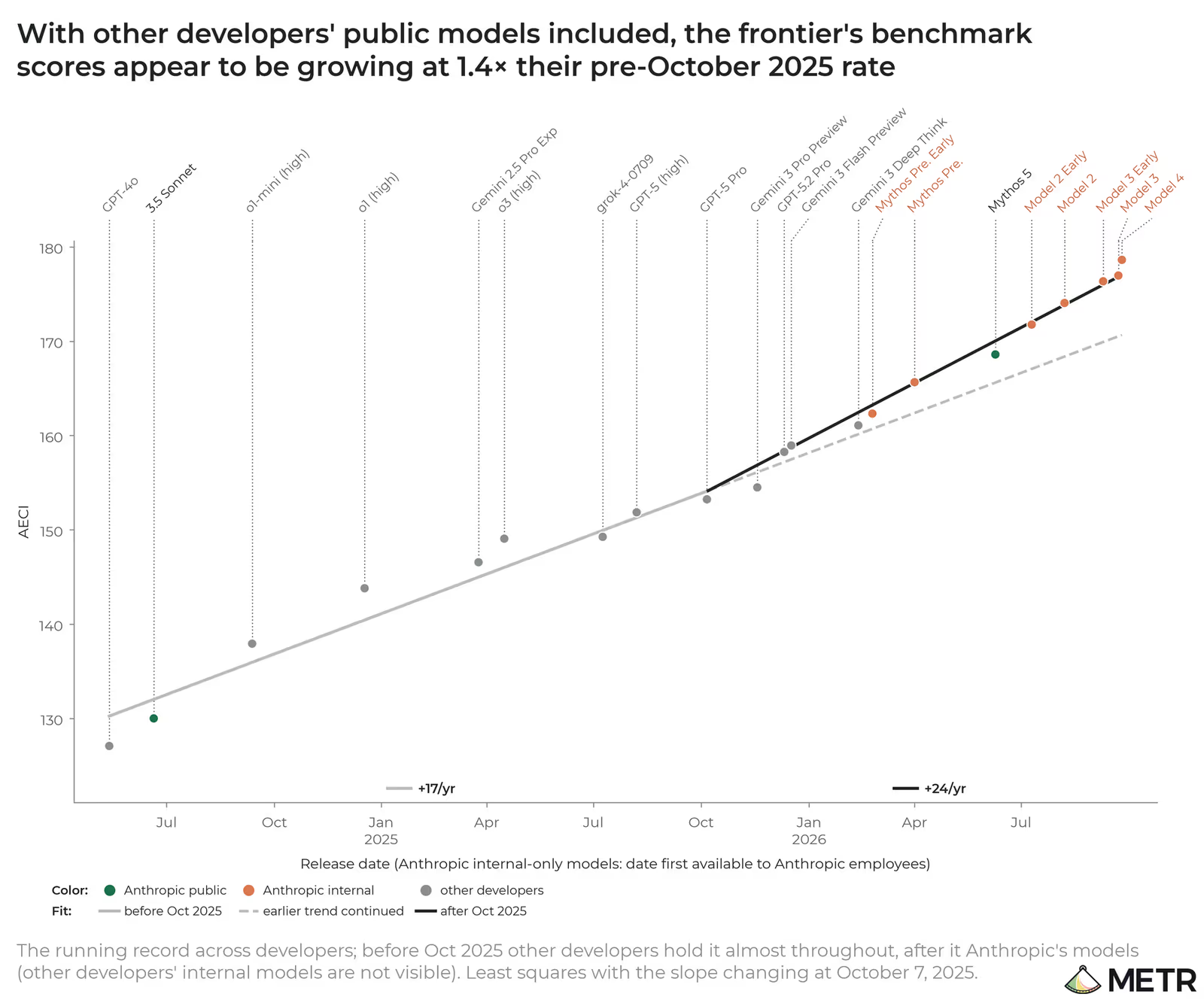
How much faster is AI capability growing? Published estimates
Multiple of the pre-October 2025 growth rate. Different methods, not a ranking.
METR main AECI estimate
METR staff overall view · plausible 1.3x to 3x
Haiku 5.5 system card
All-developer frontier
Probit link
Cauchit link
Complementary log-log link
Log-log link
Show data table
| Benchmark | Acceleration vs pre-Oct 2025 rate |
|---|---|
| METR main AECI estimate | 1.9× |
| METR staff overall view | ~2.0× |
| Haiku 5.5 system card | 1.7× |
| All-developer frontier | 1.4× |
| Probit link | 1.8× |
| Cauchit link | 2.8× |
| Complementary log-log link | 1.1× |
| Log-log link | 2.9× |
Source: METR, 05/11/2026 (main estimate, link-function sensitivity, all-developer frontier; Haiku 5.5 system card figure as cited by METR)
Why it matters for the share price: The Next Web reported that Anthropic's amended IPO filing of 10/11/2026 says it considers it has met its own threshold for AI-accelerated research, and that it does not expect to safely let Claude fully build its successors without "meaningful human supervision". That is the tension Matthew Berman and the MisAnthropic signatories point at. To investors, accelerating research is a competitive moat; to safety critics, it is the risk itself. Anthropic's own position, laid out in its essay on AI that builds itself and its earlier call for a coordinated slowdown, is that both are true and that pacing is the answer. Amodei's Nasdaq version: "We could drive at 200 miles an hour. Maybe let's only drive at 90 miles an hour."
Is This an AI Bubble?
An asset bubble is a period in which prices rise far above what the underlying cash flows can justify, sustained by the expectation that prices will keep rising, and usually followed by a sharp fall. The difficulty is that bubbles can only be identified with confidence afterwards; at the time, very fast genuine growth and speculative excess look similar. This week supplied evidence for both readings.
The case for a bubble
- Spending is running ahead of revenue. UBS estimates hyperscaler capital expenditure of about $492 billion in 2025 and about $1.009 trillion (about £770bn) in 2026, and estimates that Amazon, Alphabet and Microsoft together will spend about 102% of their cloud revenue on capex in 2026 (24/7 Wall St., via Yahoo Finance, 22/08/2026).
- Commitments are huge relative to income. Our earlier analysis of press reports on Anthropic's draft prospectus counted $518 billion of cloud and infrastructure commitments; on listing day CNBC quoted Amodei discussing about $900 billion of compute commitments, saying "those commitments don't seem so large". CNBC also reported a SpaceX compute deal of up to $120.5 billion through 2029.
- Money is going round in circles. Nvidia, AMD, Broadcom, Google, Micron, Microsoft and TSMC Partners bought $26 billion of Anthropic stock, while Anthropic is a large buyer of their chips and cloud capacity. Regulators are now looking at how Nvidia accounts for such relationships.
- The losses are large even after adjustments. Excluding the $94.3 billion fair-value charge from the $104 billion nine-month net loss still leaves roughly $10 billion on our arithmetic, though that residual is not an official operating figure.
- The price paid is rich. A fully diluted value of about $1.8 trillion against an $81 billion run-rate is roughly 22 times annualised revenue, by our calculation.
- The market reacted like a crowded trade. Chip stocks had their worst week since 2001, and the S&P 500 was down about 9% from 04/11/2026 by 20/11/2026.
UBS estimate of hyperscaler capital expenditure
US$ billions per year. 2026 onwards are forecasts published in August 2026.
2025
2026 (est.)
2027 (est.)
2028 (est.)
Show data table
| Benchmark | Hyperscaler capex (US$bn, UBS) |
|---|---|
| 2025 | ~492bn |
| 2026 (est.) | ~1,009bn |
| 2027 (est.) | ~1,447bn |
| 2028 (est.) | ~1,619bn |
Source: UBS estimates, reported by 24/7 Wall St. on Yahoo Finance, 22/08/2026
The case against
- Revenue is real and accelerating. Anthropic's nine-month revenue of about $33.24 billion was up about 1,200%, and the run-rate rose about $10 billion in a single month. Classic bubble companies typically had little revenue at all.
- The chip maker is cheap on its own numbers. Nvidia's revenue grew 103% in its latest quarter, and a forward P/E of about 13 is the lowest in five years. Wall Street consensus cited by Yahoo Finance is $419 billion of revenue in fiscal 2027.
- Demand for the listing was not just retail froth. CNBC reported that about half of institutional firms that placed orders got no shares; Melius set a $155 target with a Buy rating; Altimeter's Brad Gerstner said "this isn't a get-rich-quick scheme".
- The sell-off has specific triggers. Nvidia's fall coincides with an SEC probe, a CEO's resignation, export controls and a delayed 10-Q. Those are company-specific risks, not evidence that AI demand has disappeared.
- Capex is not all speculative. UBS itself notes the 102% ratio does not mean hyperscalers are spending more cash than they generate, because their businesses are much larger than cloud alone.
Our reading: the week showed that AI valuations are now sensitive to trust in the numbers, particularly where supplier and customer are financially entangled. It did not show that AI revenue has stalled; the reported figures say the opposite. A first-week share price is a poor guide to a company's worth, in either direction. If the SEC finds that Nvidia's reported sales were materially overstated, or if Anthropic's first audited results as a public company show growth slowing sharply, the bubble case gets much stronger. Neither has happened.
What It Means for Claude Users
For anyone who uses Claude at work or at home, nothing changed on 19/11/2026. Anthropic's IPO announcements say nothing about Claude prices, plans or usage limits, and we have seen no change announced alongside the listing. The changes are structural and will show over months:
- Disclosure. As a listed company Anthropic now publishes audited financial results. NBC News reported fiscal-year earnings are expected before the end of March 2027. That will give users a clearer view of how much is spent on compute, and of outages and capacity problems like those Jayapal raised.
- Pressure to grow. Public shareholders reward growth quarter by quarter. The governance structure (founder voting control and the Long-Term Benefit Trust) is designed to resist that pressure, and Amodei's "pace the training and deployment" pledge is now on record in front of investors. Users can test it against release cadence and system cards.
- Faster models. If METR's estimate is right, model improvements are arriving at roughly twice the earlier pace, which means more frequent upgrades and more frequent changes to behaviour in tools built on Claude.
- Supplier risk. Claude runs on chips from Nvidia, Google and others. Problems at Nvidia do not affect Claude's availability directly, but a tighter supply chain or export rules can affect capacity and price over time.
- Staff retention. CNBC reported the average employee is worth over $40 million on paper and more than 400 are worth $100 million or more. Employees may sell 10% of their shares now, according to NBC News. Whether that leads to departures is an open question.
What It Means for UK Readers
- Currency. ANT is priced in dollars. At about $1.31 to the pound, the $83 offer price is about £63 and Friday's close about £68. Sterling holders carry exchange-rate risk on top of the share price.
- Index funds. CNBC reported Anthropic is due to join the Nasdaq-100 on 18/12/2026 and the Morningstar US Total Market Index after five trading days; S&P 500 inclusion is at least a year away. UK investors in funds that track those indices would gain exposure automatically. Check your fund's factsheet rather than assume.
- Pensions. Many UK workplace pensions hold large US technology stocks through global index funds, so Nvidia's fall affects them whether or not savers own Anthropic.
- Data centres. Trump's threat was directed at US companies building data centres outside the US. The reports we read did not mention the UK. If such a policy were ever made binding, it could affect US-owned AI data centre investment in Britain, but no mechanism, rate or timetable exists, and we found no UK government response.
Again: none of this is investment advice. If you are considering buying shares in a newly listed company, speak to a regulated financial adviser.
What We Could Not Verify
- Friday's exact close for ANT. Yahoo Finance reported "just below $89"; we did not find an exchange-published figure, so the chart marks it as approximate.
- A fully diluted value after Friday. Not reported in the sources we read.
- The SEC probe. Neither the SEC nor Nvidia has confirmed it; the scope comes from WSJ and Reuters reports citing unnamed sources.
- The Trump–Xi agreement. Based on Bessent's account to CNBC as reported by Reuters; we did not find a joint text or Chinese readout.
- Nvidia's exact Friday close. Yahoo Finance's article says the stock fell 14%; the price widget captured on the same page showed a smaller fall at that moment. We use the article figure.
- Protest numbers and the MisAnthropic signatory count. Sources differ; we give the range reported.
The Bottom Line
Anthropic's first week as a public company was a record-setting listing that met a market losing its nerve. The offer was the largest on record, the first trade valued the company near $2 trillion on a fully diluted basis, and two days later the shares were about 20% below that first trade but still above the price institutions paid. Around it, Nvidia's worst week since 2008, a reported SEC inquiry, an unexplained presidential threat against overseas data centres and a protest movement focused on AI that builds AI all landed at once.
Is it a bubble? The honest answer is that the spending is extraordinary, some of it is circular, and trust in the numbers has become the market's main worry; but the revenue figures are also extraordinary and still rising. Watch three things: what the SEC and Nvidia's delayed 10-Q reveal, Anthropic's first audited results as a public company, and whether Anthropic's promise to pace development survives the pressure of a share price.
Last updated: 22/11/2026. Market data reflects reports published up to 21/11/2026. Sterling conversions at approximately $1.31 = £1 (Trading Economics, 19–20/11/2026). This article is news analysis and is not financial advice.
Sources
- Anthropic: closing of initial public offering and concurrent private placement (20/11/2026)
- CNBC: Anthropic IPO live updates (19/11/2026)
- NBC News: Anthropic's record-setting IPO can't halt broader market slide (live blog)
- Yahoo Finance: Anthropic stock drops 8% after rip-roaring IPO (20/11/2026)
- Forbes: Anthropic IPO live, stock closes day at $97
- Yahoo Finance: Nvidia stock extends rout as SEC probe reportedly investigates its accounting (21/11/2026)
- Yahoo Finance: Nvidia's SEC probe isn't going away (20/11/2026)
- Reuters via The Star: Nvidia facing SEC probe after Huang's resignation, WSJ reports (17/11/2026)
- Seoul Economic Daily: SEC opens accounting probe into Nvidia (21/11/2026)
- Reuters via Yahoo: Trump, Xi agreed that military AI decisions should involve humans, Bessent says (20/11/2026)
- NBC News: Trump threatens 'tremendous penalties' on companies that build AI data centers overseas (20/11/2026)
- Associated Press via WRTV: Trump threatens 'tremendous tax' on US companies building data centers abroad (20/11/2026)
- METR: Independent assessment of AI R&D acceleration at Anthropic (05/11/2026)
- The Next Web: Nobel and Turing winners sign statement calling Anthropic unsafe before IPO
- 24/7 Wall St. via Yahoo Finance: Hyperscalers are spending 102% of cloud revenue on capex (22/08/2026)
- Trading Economics: sterling exchange rate news stream (November 2026)
- AI Revolution X: It Happened... The AI Bubble Just Cracked
- Matthew Berman: I'm Crashing Out About Anthropic
- WorldofAI: AI news round-up including Anthropic's IPO
More from AI Tools Review: the Anthropic IPO prospectus, METR's acceleration assessment, Jensen Huang's resignation, the Megaspeed probe, Anthropic's Public Benefit Fund and the Claude Riemann Hypothesis claim.