 AI Tools Review Editorial Team
Quick Answer:
Devin Bots are persistent manager agents from Cognition, launched on 17/11/2026. You give a Bot an outcome to own instead of a single task. It plans the work, starts a separate Devin coding session for each piece on its own cloud machine, remembers what it learns, and brings you only the decisions it cannot make alone, in the Devin app, Slack or iMessage. Bots are live now on Cognition's Max ($200 a month, about £158), Teams ($80 a month, about £63) and Enterprise plans, with no separate Bot price. Cognition says one Bot built its Android app in 44 days by merging 1,134 pull requests, but every productivity figure so far is Cognition's own and none has been independently checked.
Coding agents finish tasks. Somebody still has to decide what the next task is, check that the last one worked and chase the ones that stalled. Cognition's answer is to hand that job to another agent. A Devin Bot is a manager that runs a team of Devin coding agents for days or weeks, and Cognition says one of them built a whole Android app while its engineer said nothing at all on half the days. This guide sets out what is confirmed, what is only claimed, and what a UK engineering team should check before giving a Bot the keys.
This article is based on Cognition's launch post ("Introducing Devin Bots: from tasks to outcomes", 17/11/2026), the devin.ai/bots product page, Cognition's pricing page, its Devin Bots documentation and Fortune's launch-day report. We read all of them on 21/11/2026. AI Tools Review has not run a Bot on a production codebase, so this is an explainer and a buyer's guide, not a hands-on test. For background on the product underneath, see our Devin review from July 2026.
1,134
pull requests merged by the Android Bot
Cognition claim, over 44 days
183
messages from the one engineer directing it
None on 22 of the 44 days
344,651
lines of Kotlin
Cognition claim
$80
a month: cheapest plan with Bots (Teams)
About £63; usage billed on top
Source: Cognition launch post, 17/11/2026 (vendor-reported, not independently verified); Cognition pricing page, 21/11/2026.
Julian Goldie explains Devin Bots: persistent AI engineers that lead teams of Devin agents for days or weeks, the cloud setup, the claimed 4.5x pull request figure and who can use them.
Executive Summary
- What it is: a persistent agent "with its own memory and tools that can lead multiple Devins in parallel" (Cognition). You give it a responsibility, not a ticket.
- Launch: 17/11/2026. Cognition's post says Bots are "available today". The pricing page lists them on Max, Teams and Enterprise, not on Free or Pro.
- How it runs: each piece of work is a child Devin session on its own virtual machine. The Bot holds its own connections and secrets, separate from the people who message it.
- Where you talk to it: the Devin web app, a dedicated Slack app per Bot, or iMessage (iMessage is not available on Enterprise plans).
- Headline claim: an Android Bot merged 1,134 pull requests and closed 1,217 tickets in 44 days with 183 human messages. This is Cognition's own project, measured by Cognition.
- Other claims: a Layout Bot with 159 merged pull requests in three weeks; a game studio that went from about 50 to 1,900 pull requests a week; Bilt reporting about 1,600 merged in one week.
- Missing evidence: no revert rates, defect rates, review time, cost per pull request or outside audit.
- Price: no standalone Bot price. Usage draws on plan quota, then on-demand credits. Admins can cap each Bot.
- Biggest governance risk: anyone who can use a shared Bot can use every sign-in and secret the Bot holds, and can read its memory. Cognition's own documentation says so plainly.
- Rivals: Fortune frames Bots as a challenge to OpenAI's Dots and Anthropic's Duet, which are general-purpose agents that also work with coding tools.
What Are Devin Bots?
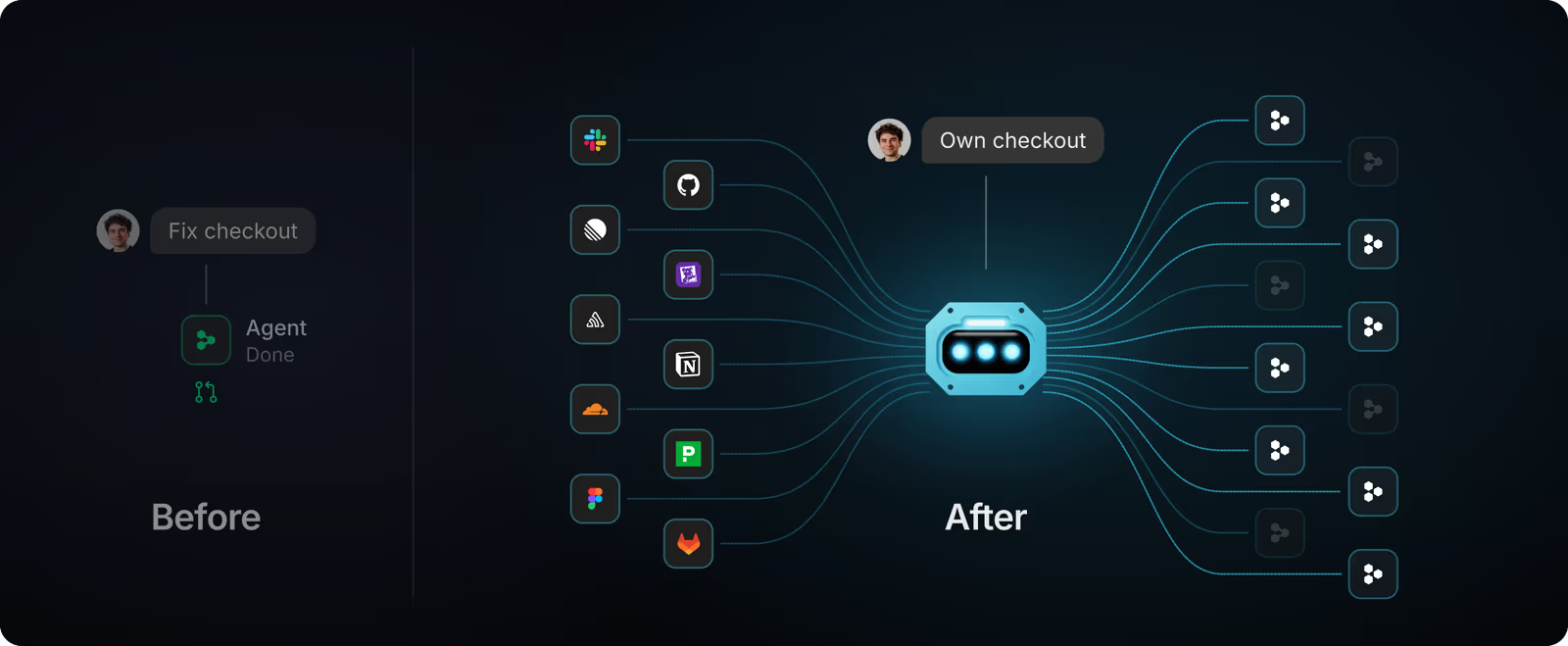
Cognition's own definition is short: a Bot is "a persistent agent with its own memory and tools that can lead multiple Devins in parallel". It "investigates, delegates work, and evaluates the results to decide what to pursue next", keeps context between sessions and "brings you only the decisions that need your judgment".
The idea is easiest to see in how you write the assignment. Cognition gives three pairs.
| A task (ordinary Devin session) | A responsibility (Devin Bot) |
|---|---|
| Port this feature to Android. | Keep Android at parity with iOS. |
| Fix the layout shift. | Keep the web app smooth as it changes. |
| Fix this onboarding error. | Get new users through setup successfully. |
Source: Cognition launch post, 17/11/2026.
A task has an end. A responsibility does not. The Bot is meant to keep watching the thing it owns, find work nobody assigned and carry on until told to stop. Cognition's documentation puts the advice to users in one line: say "own checkout", not "fix the checkout button".
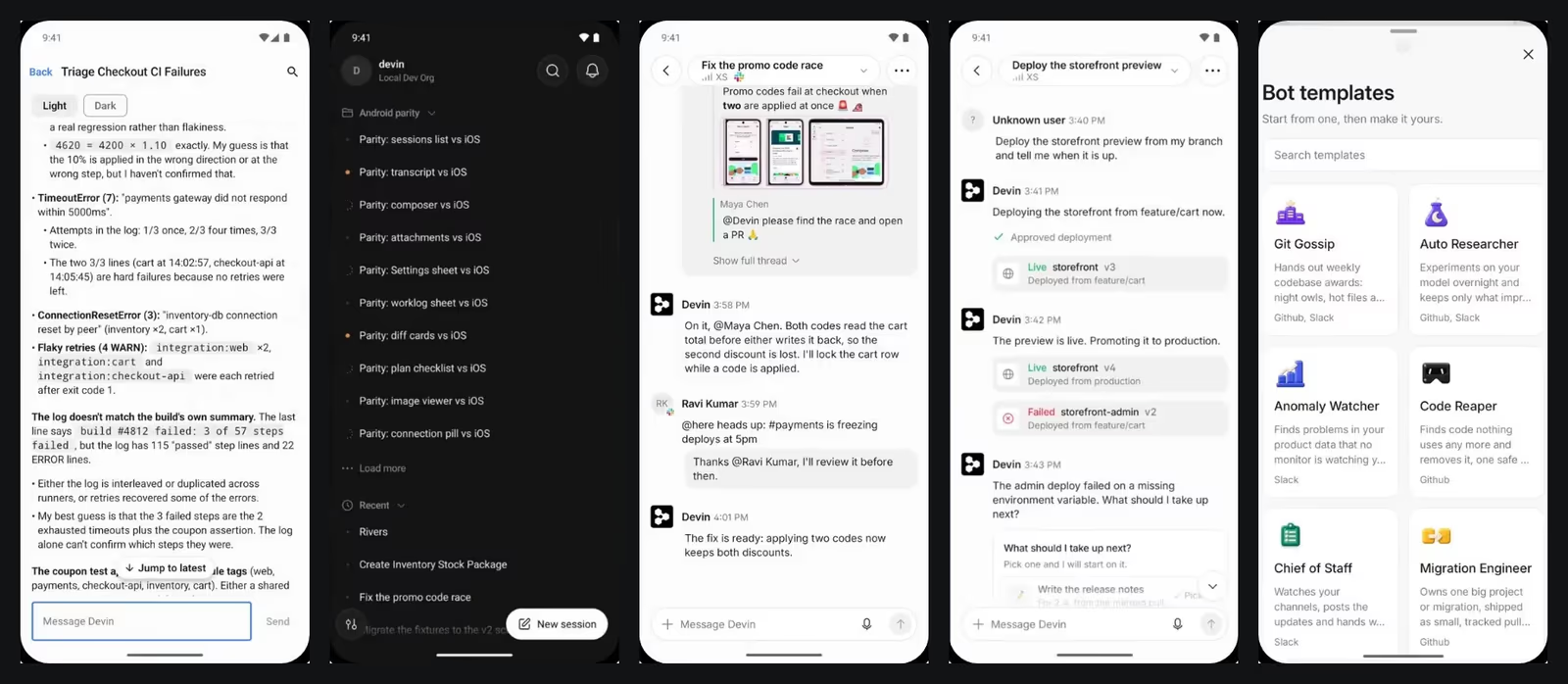
Cognition ships templates so that a Bot starts with a job it already understands. The product page lists Software Factory, Android Engineer, Chief of Staff, Latency Optimizer, Product Engineer and QA Engineer. The template pages also mention an iOS Engineer and a Migration Engineer, and the documentation mentions a Data Analyst. Teams can share their own Bot's instructions as a template.
How Is a Bot Different from a Devin Session?
An ordinary Devin session is one agent, one machine and one job. You write the prompt, it works, it opens a pull request, and the session is over. Devin has been able to start and schedule other Devins for some time. A Bot adds four things on top.
| Devin session | Devin Bot | |
|---|---|---|
| Unit of work | One task you wrote | An outcome it owns; it writes its own tickets |
| Lifetime | Ends when the task is done | Persistent; one chat for everything it owns |
| Parallelism | One machine | Starts and monitors many child sessions, each on its own machine |
| Memory | Session context | Saves preferences, corrections and project details to memory files used in later sessions |
| Triggers | A message from you | Messages, schedules and events in your tools (automations) |
| Identity and access | Runs for the person who started it | Holds its own connections, secrets and optional Slack app |
| Human contact | You check the session | A "Needs you" list of decisions, approvals and pull requests |
Source: Cognition Devin Bots documentation, read 21/11/2026.
This is the same shift we described in Anthropic's guide to always-on agents: an agent that is mostly asleep, wakes when something happens, does the work and saves its state. Cognition has packaged that pattern for one job, software engineering.
How Devin Bots Work
Manager and Workers
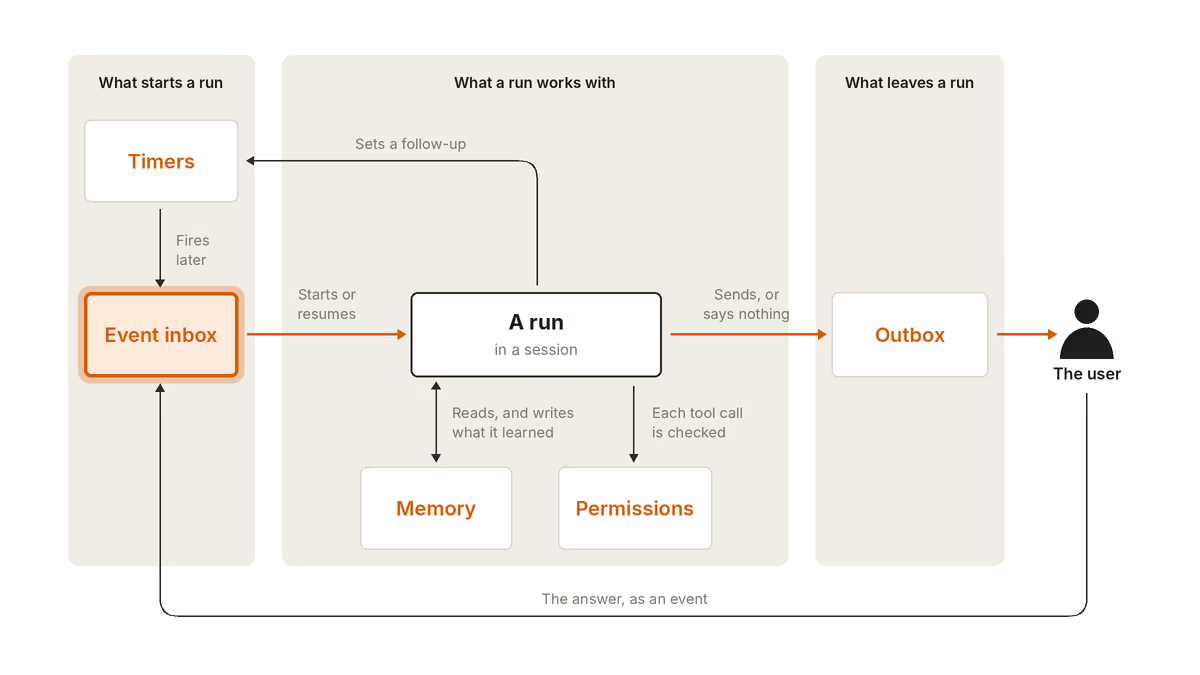
The design is a two-level hierarchy. The Bot is the manager. It has one chat, a set of instructions, a memory and a list of automations. It does not write most of the code itself. For each piece of work it starts a child session, which the documentation describes as running "with its own machine, the same as a session you start yourself". The product page adds that "every session runs in its own VM".
In the Android project, Cognition says the Bot "filed tickets, started a Devin session for each one, and merged the pull requests that passed CI and Devin Review". That sentence contains the whole loop: plan, delegate, verify by automated checks, merge, report.
Bots can also be stacked. One Bot can be given access to another, so it can read the other's conversation and sessions and send it messages. Cognition's product page shows a QA Bot finding a bug, asking a Developer Bot to fix it and retesting, with a PM Bot reporting the result. In the game studio example in the launch post, about 20 Bots each own one job and a single "Super Jenny Bot" sits above them and is the only one the human talks to.
It is worth remembering that Cognition once published a widely read essay titled "Don't Build Multi-Agents", which is still on its blog. The Bots design is consistent with the cautious reading of that essay: there is a strict hierarchy, each worker has an isolated machine and a narrow job, and one manager holds the shared context. It is not a free-for-all swarm. Our agent swarms explainer covers the looser alternatives, and Anthropic's multi-agent safety research covers how they can go wrong.
Cognition has not explained how a Bot stops two parallel sessions from making conflicting changes to the same code. The only public hint is that work is split into many small pull requests which each have to pass CI.
Instructions and Memory
A Bot works from two kinds of stored text. Instructions are written by people and read at the start of every session. Memory is written by the Bot itself as it works: "your preferences, corrections, and project details", in the documentation's words. The Memory page in a Bot's settings lists the files it wrote, and people who can configure the Bot can delete one.
Two details matter. First, memory is how the Bot is supposed to stay coherent over weeks, which is the hard part of long-running agents. Second, memory is shared: "Everyone who can use a Bot can read what it remembers." If one engineer tells a shared Bot something sensitive, every other user of that Bot can read it.
A Bot can also be "recycled", which ends its current session and starts a fresh one. Its instructions and memory carry over. This is the same file-based approach to persistence that open-source agents use, as we describe in our Hermes Agent explainer.
Slack, iMessage and the Needs You Inbox
Fortune reports that a Bot "joins a team's Slack as a member". The documentation shows how. Each Bot can have its own Slack app with its own handle, created by Devin. Your team mentions it in a channel or messages it directly, and it replies in the thread. Until a Bot has its own app, it uses the shared Devin app.
Two settings control it. Who can message ranges from "People with access" up to "Anyone in Slack, including Slack Connect". Allowed channels can be none, the channels Devin is already in, or any public channel. If your workspace requires admin approval for apps, a Slack admin has to approve each Bot's app, or allow the Devin app to install "managed agent apps" automatically.
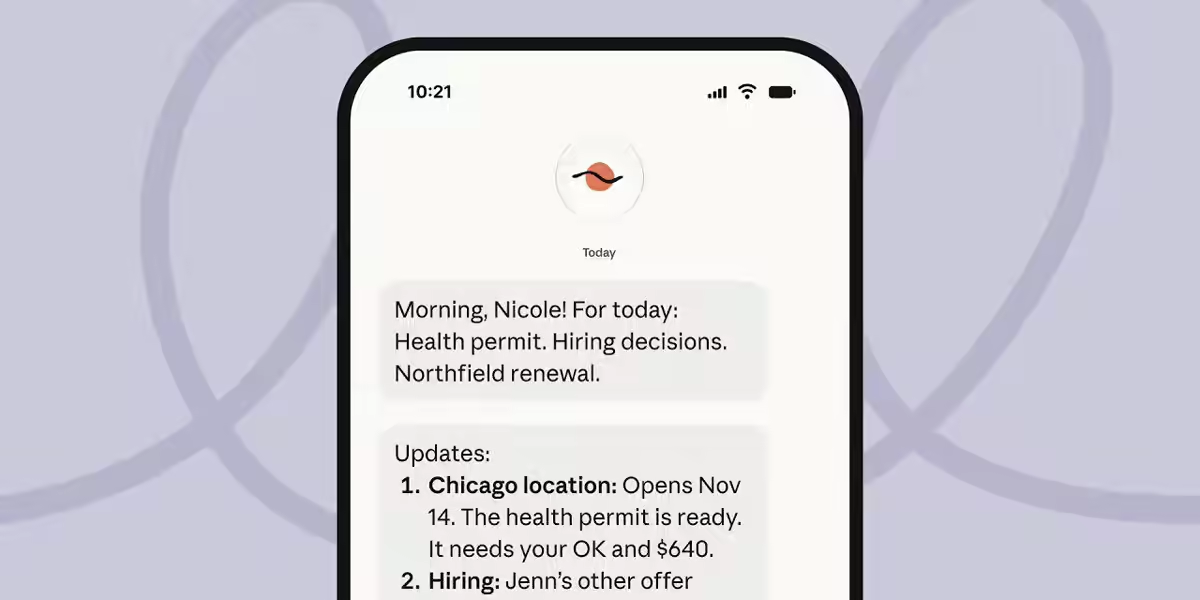
Bots can also be reached by iMessage, a product of Cognition's purchase of The Interaction Company in July, which Fortune notes. The documentation says iMessage is not available on Enterprise plans. The product page also advertises phone calls and group chats.
The part that matters most is the Needs you list. Everything the Bot cannot settle alone lands there as one of four item types: a decision with options (the Bot marks its recommendation), a pull request to review or merge, a permission request (new access, an automation, a network host or a higher usage limit), or a report. This is what lets one person supervise a lot of parallel work. It is also the control point. What you allow the Bot to do without asking decides how safe the whole system is.
Models and Budgets
Devin is not tied to one lab. Fortune reports that a Bot picks stronger models for planning, design and computer use, and faster, cheaper ones for routine code. Cognition's pricing page lists models from OpenAI, Anthropic, Google and SpaceXAI alongside its own SWE-2, which is free to use on paid plans.
In the product this shows up as modes. A Bot has one mode for itself and a separate "Child Capability" setting for the sessions it starts, for example Normal for the manager and Ultra for the workers. You can also ask the Bot to use a different mode for a single session.
Cognition's chief executive, Scott Wu, told Fortune that "developers will especially want to optimize cost as they use products like Devin Bots that do way more work than before". That is a fair warning. A Bot that starts sessions around the clock spends money around the clock. We look at the budget controls in the pricing section below.
The Android Case Study
The centrepiece of the launch is Cognition's own Android app. Devin had an iOS app and a team of iOS engineers. Cognition says it "had no Android engineers and no plan for Android". On 28/09/2026 an engineer on the Bots team, named only as Samyok, created an "Android Bot" and told it to "product manage the android app", starting by working out what would block it from building the whole thing.
According to Cognition, the Bot first raised blockers: where the code would live, how to test an Android build and how changes would merge. Samyok set direction and constraints. The Bot then filed tickets, started a session per ticket and merged the pull requests that passed CI and Devin Review. Each day it posted a report in Slack with a screen recording of what had changed.
| Measure | Figure | Whose number |
|---|---|---|
| Duration | 44 days from 28/09/2026 | Cognition |
| Pull requests merged | 1,134 | Cognition |
| Lines of Kotlin | 344,651 | Cognition |
| Screenshot tests | 2,841 | Cognition |
| Tickets closed | 1,217 | Cognition |
| Messages from the engineer | 183 ("about one for every six pull requests") | Cognition |
| Days with no human message | 22 of 44 | Cognition |
| Average pull requests merged per day | About 26 | Our arithmetic (1,134 ÷ 44) |
| Current status | Open testing on Google Play | Cognition |
| Cost, revert rate, defects, human review hours | Not published | - |
Cognition says most of Samyok's messages dealt with something that needed a human decision, "like a PR that needed a security review". Others just set direction, such as "be more ambitious". The Bot now owns the app: it updates Android whenever a feature lands on iOS and handles issues found in beta.
Cognition's Android Bot: what it says 44 days produced
Counts reported by Cognition for its own project. Not independently verified.
Screenshot tests
Tickets closed
Pull requests merged
Messages from the human engineer
Show data table
| Benchmark | Count over 44 days |
|---|---|
| Screenshot tests | 2,841 |
| Tickets closed | 1,217 |
| Pull requests merged | 1,134 |
| Messages from the human engineer | 183 |
Source: Cognition, Introducing Devin Bots: from tasks to outcomes, 17/11/2026.
How to read it
It is a favourable case. The Bot was porting a product that already existed. The iOS app served as a full specification, and "parity" is a goal a machine can check. The code was new, so there was no legacy to break and no other team to collide with. The human in the loop worked on the Bots team and knew exactly how to steer it. Greenfield ports with a reference implementation are close to the best case for coding agents.
Merged does not mean reviewed by a person. Cognition says pull requests merged when they passed CI and Devin Review. Devin Review is Cognition's own automated reviewer. One human sent 183 messages across 1,134 pull requests, so the great majority were merged without a person reading them. That may be a reasonable choice for an app in open testing. It is not how most UK teams merge code into a product that handles money or personal data.
Lines of code are a weak measure. 344,651 lines of Kotlin in 44 days is a lot of code. Cognition does not say how much of it is tests, generated code or duplication, and a large codebase is a cost as well as an achievement, because somebody has to maintain it. The 2,841 screenshot tests are a better sign, since they show the Bot built a way to check its own work.
The result is real but early. The app is in open testing, not general release. There is no public data yet on crash rates or store ratings.
The Other Claims: Layout Bot, Game Studio, 4.5x
Cognition's post gives two more internal examples, and customers and secondary coverage add others.
- Layout Bot. Every three hours this Bot builds the production version of Devin's web app, records page loads under different conditions and looks for elements that jump as content arrives. When a check fails it reruns it to rule out noise, traces the regression to the pull request that caused it, and opens a fix with before-and-after video. Cognition says it has merged 159 of the Layout Bot's pull requests in three weeks, "cutting lag by 70%". It does not define how lag was measured.
- A game studio. Jenny Xu, a Cognition colleague who runs a mobile game studio, is described as its "only human employee", with about 20 Bots. Four times a day a top-level Bot gathers the decisions the others need into one Slack thread. Cognition says the studio "went from about 50 pull requests a week to 1,900" and ships a release every week.
- Bilt. Will Laughlin, VP Engineering, is quoted on Cognition's site: "Last week, our Devin Bots merged about 1,600 PRs." No earlier figure is given for comparison.
- Fireworks AI. Tommy Yu is quoted saying Bots "tripled my productivity overnight". That is one engineer's impression, not a measurement.
- Tenfold usage growth. Fortune reports, citing the company, that usage across dozens of early-access customers including Decagon, Fireworks AI and Reducto grew tenfold in two weeks.
- 4.5x pull requests per message. AlphaSignal and other secondary outlets report a Cognition claim that beta testers merged about 4.5 times more pull requests per message with Bots than with direct Devin sessions. We could not find this figure in Cognition's launch post, product page or documentation, so we treat it as unverified. AlphaSignal notes that no sample size, method or baseline was given.
Weekly pull requests: Cognition's before-and-after claims
Pull requests per week. Vendor and customer statements; null where no baseline was published.
- Before Bots
- With Bots
Jenny Xu's game studio (about 20 Bots, one human)
Bilt (one week, merged)
Show data table
| Benchmark | Before Bots | With Bots |
|---|---|---|
| Jenny Xu's game studio (about 20 Bots, one human) | ~50 | 1,900 |
| Bilt (one week, merged) | n/a | ~1,600 |
Source: Cognition launch post and devin.ai/bots, 17/11/2026. Game studio figures are stated as 'about 50' and '1,900'; Bilt's as 'about 1,600' merged in one week.
Julian Goldie covers the four parts of an agent harness from Google Cloud's crash course: memory, tools, sandboxing and evals. Bots supply the first three; the evals are your job.
What Would Make These Numbers Trustworthy?
A count of merged pull requests tells you about activity. It does not tell you about value. An agent that splits work into very small changes will produce a very large count. Cognition's own Software Factory template is described as opening "one small pull request for each" fix, which is good engineering practice and also inflates the number. A jump from 50 to 1,900 a week is a 38-fold rise in pull requests. It is not evidence of a 38-fold rise in shipped product.
Before treating any of these figures as a forecast for your own team, you would want to see the following. Cognition has published none of them for Bots.
| Evidence | Why it matters | Published? |
|---|---|---|
| Pull request size (median lines changed) | Shows whether 1,134 pull requests are features or one-line edits | No |
| Share reviewed by a human | Separates supervised from unsupervised merges | No. Merges passed CI and Devin Review |
| Revert and follow-up fix rate | Fixing your own regressions adds to the count twice | No |
| Defects reaching users | The outcome that matters | No. Android app is in open testing |
| Cost per merged pull request | Compute and model spend against the value delivered | No |
| Human review hours | Review can become the new bottleneck | No. Only message counts |
| Baseline and sample for averages | Needed to judge the 4.5x and tenfold claims | No |
| Independent replication | Every figure so far comes from Cognition or its customers | No |
There is a reason to be careful here. Independent studies of coding agents have often found smaller gains than vendors report, and sometimes none at all once review and rework are counted. We go through that evidence in Do AI Coding Agents Improve Productivity?. To Cognition's credit, it does maintain a benchmark, FrontierCode, in which open-source maintainers grade whether agent output is actually mergeable. That is the right kind of test. It has not yet published a comparable result for Bots.
Cognition is honest about one thing that matters: the engineer still has to build the feedback. Its post says a Bot "needs a way to evaluate its work, and engineers are responsible for building this feedback", through tests, benchmarks and production signals. The Android Bot had the iOS app to copy and thousands of screenshot tests. The Layout Bot had a measurable check every three hours. A Bot given a vague goal and no way to measure progress will still produce pull requests. They just may not be useful ones.
Nate B Jones on what keeps long-running agents on track, drawing on OpenAI and Anthropic reports of multi-day runs: current decisions, examples and instructions matter more than a smarter model.
Safety and Governance for UK Teams
A Bot is a standing account with access to your code, your tickets and your chat, that acts when nobody is watching. Treat it as you would a new contractor with a service account. Here is what Cognition says it provides, and where the gaps are.
Isolation from engineers' credentials
Fortune reports that Bots "run on separate cloud computers, kept away from passwords and keys stored on engineers' laptops". Cognition's product page says every session runs in its own VM. This is a real advantage over agents that run on a developer's laptop with that developer's full access. Fortune also reports network controls meant to block unauthorised data transfers, even if a model follows malicious instructions hidden in content it reads. Wu told Fortune the aim is to build safeguards "rather than relying on models themselves being smart enough to recognize a risky or malicious prompt". In the product, adding a new network host is one of the things a Bot must ask permission for.
That matters because prompt injection and poisoned dependencies are live threats for any agent that reads the web and installs packages. See our pieces on hallusquatting and on AI cyber evaluations reaching real systems for how these attacks work in practice.
Least privilege: better than a laptop, but read the small print
Fortune says administrators set which repositories and tools each Bot can reach. The documentation gives more detail, and some of it should make a security lead pause.
- A Bot acts with its own access, not the access of whoever messages it. Cognition states the consequence directly: "when you share a Bot, everyone you add can use every sign-in, secret, and session the Bot holds, by asking it." A junior engineer who can message a Bot can act through a senior engineer's sign-in if that sign-in was given to the Bot.
- Organisation-wide access is on by default. "Every Bot can use your organization's secrets and the connections installed for the whole organization or enterprise." An organisation-wide MCP server can be turned off for one Bot, but the starting point is broad.
- Grants are bounded by the giver. A grant "never exceeds the giver", and a sign-in stops working if the person who gave it leaves or loses access. That is a sensible rule.
- Service accounts are the recommended route. Cognition says giving a Bot "its own account", like a service account, is "the better choice for a Bot that several people use". We agree. It is the only way to scope a shared Bot properly.
- Access passes through Bots. If Bot A can reach Bot B, everyone who can use A can read B's work. Cognition shows a confirmation before this happens, but a chain of Bots can expose work to people it was never shared with.
- Three separate access levels. Can use, Can configure and Can share are independent, so the person who maintains a Bot need not be able to read its conversations.
Audit and attribution
The product page lists "comprehensive audit logs", RBAC, SSO, SCIM and OIDC, with private networking available. By default a Bot opens pull requests as itself, each ending with a note saying which Bot opened it and who it works for. Users can choose to have pull requests opened in their own name instead, and people who can configure the Bot can switch the note off. For audit purposes we would leave the default alone. If AI-written changes appear under a human's name with no note, you lose the ability to count them, review them differently or trace an incident.
Code review
Fortune reports that Bots run their code through the same tests as human-written code and that teams decide which changes need human review, with low-risk edits such as a button colour able to merge automatically. That puts the decision where it belongs, with you. The risk is drift: a team under pressure widens the auto-merge rules a little each week. Use branch protection and code-owner rules in your Git host, not just settings inside Devin, so that a Bot cannot approve its own work on sensitive paths.
UK GDPR and data residency
We looked for a Cognition statement on UK or EU data residency for Bots and did not find one. What Cognition does publish:
- The Bots page says inputs and outputs "are always your IP" and that zero data retention is "enforced with model providers".
- Its enterprise security documentation says data is encrypted in transit and at rest, that Cognition runs on AWS, that it has been SOC 2 Type II certified since September 2024, and that "by default, Cognition does not train its models on customer data or code". Customer data is retained for the length of the customer relationship unless agreed otherwise.
- Enterprise plans offer a dedicated deployment option, deployment in your own virtual private cloud and customer-managed encryption keys.
- Teams customers can request a standard Business Associate Agreement. That is a US healthcare instrument and has no force under UK law.
- Cognition has a London office and says its UK team grew by more than 200% in six months.
We could not load Cognition's trust centre, which may say more. So the position for a UK data controller is: ask. Before a Bot touches a repository, ticket system or Slack channel that contains personal data, get the data processing agreement, the list of sub-processors (which will include several model providers), the hosting region and the international transfer mechanism in writing. Remember that a Bot in Slack with broad channel access will read whatever people post there, including customer details pasted into a support thread.
Pricing and Access
Launch-week coverage disagreed about whether Bots were generally available. Fortune mentioned only early-access customers, and AlphaSignal said the announcement did not cover Bot pricing or eligibility. Cognition's own pages are clearer. The launch post ends: "Devin Bots are available today at devin.ai/bots." The pricing page lists "Access to Devin Bots" under Max and Teams and includes Bots in Enterprise. The documentation has billing rules for exactly those three plans. So Bots are live for paying customers. There is no free trial of Bots on the Free or Pro plans.
| Plan | Price per month | Devin Bots | How a Bot is billed |
|---|---|---|---|
| Free | £0 ($0) | No | - |
| Pro | £15.80 ($20) | No | - |
| Max | £158 ($200) | Yes | Your included quota, then your on-demand credits. No separate Bot limit |
| Teams | £63.20 ($80), up to 100 members | Yes | Creator's included quota, then the team's on-demand credits. Optional dollar cap per Bot |
| Enterprise | On request | Yes | Counts towards the creator's limit. Optional ACU or spending limit per Bot |
Source: devin.ai/pricing and Devin Bot usage limits documentation, read 21/11/2026. Sterling at about $1 = £0.79, excluding VAT. Cognition describes Teams as "self-serve at a flat $80/month" with shared on-demand credits.
Monthly price of Devin's self-serve plans
US dollars per month. Bots are included on Max and Teams only. Usage beyond the allowance costs extra.
Max · includes Bots
Teams · includes Bots, up to 100 members
Pro · no Bots
Enterprise · includes Bots
Show data table
| Benchmark | List price per month |
|---|---|
| Max | $200 |
| Teams | $80 |
| Pro | $20 |
| Enterprise | n/a |
Source: Cognition, devin.ai/pricing, read 21/11/2026. Enterprise pricing is not published.
The list price is not the real cost. A Bot's usage is "its chat plus every session it starts", and Cognition says extra usage on paid plans "is consumed at API pricing". Cognition has not said what the Android project cost. With about 26 merged pull requests a day, each from its own session on its own machine, it will not have been small. This is the same problem we examined in our analysis of always-on agent economics: an agent that never stops has no natural spending limit.
The controls are reasonable. On Teams, the creator or an admin can set an on-demand cap in dollars for each Bot, and an admin can move a Bot onto its own separate limit so that it stops dead at the cap. On Enterprise, a Bot can have an ACU or spending limit, and admins see a Bots page listing every Bot with its creator, usage and limit. Teams and Enterprise show usage for the billing cycle with a projection to the end of it. One caveat from the documentation: on Enterprise, a Bot's limit only stops the Bot if budgets and user limits are switched on for your account, which you have to ask your account team to do. On Max there is no per-Bot limit at all.
Devin Bots vs OpenAI Dots vs Claude Duet
Fortune framed the launch as a challenge to two products from the model labs. OpenAI's Dots is, in Fortune's words, an always-on proactive agent that integrates with Codex to run teams of agents on software tasks. Anthropic's Duet is a similar product that integrates with Claude Code. We have covered both: see OpenAI Dots explained and Claude Duet explained. The table uses only facts from those launch materials, Fortune and Cognition's pages.
| Devin Bots | OpenAI Dots | Claude Duet | |
|---|---|---|---|
| Maker | Cognition | OpenAI | Anthropic |
| Launched | 17/11/2026 | 29/09/2026 | 21/10/2026 (research preview) |
| Purpose | Software engineering only | General professional work | General personal and professional work |
| Coding link | Manages teams of Devin sessions | Integrates with Codex (Fortune) | Integrates with Claude Code (Fortune) |
| Models | Several labs plus Cognition's SWE-2 | GPT-6 Astra | Claude Opus 5.5 (per launch coverage) |
| Where you reach it | Devin app, own Slack app, iMessage | ChatGPT, Slack, Microsoft Teams | Web and iOS app |
| Access | Max, Teams, Enterprise plans | ChatGPT Pro and Business Premium; UK Pro users excluded at launch | US waitlist for Claude Pro and Max |
| Separate price | None; plan usage | First dot included; extras unpriced at launch | None; draws on plan limits |
| UK availability | No regional restriction stated by Cognition | Business Premium yes; Pro not at launch | Not at launch |
Dots and Duet rows reflect what was announced at their launches, as reported in our earlier articles. Both may have changed since. Check the vendors' pages before buying.
The real difference is scope. Dots and Duet are personal assistants that can also direct coding tools. A Devin Bot is closer to a team lead that does nothing else. Reducto's co-founder, Raunak Chowdhuri, makes that point in Cognition's testimonial: it "defaults to real engineering work, instead of just summarizing my calendar and emails".
Cognition's strategic risk is the one Wu acknowledged to Fortune. The labs are both its suppliers and its competitors. Every improvement to Codex and Claude Code weakens the reason to pay for a separate layer. Wu's answer is that Cognition is "happy when the frontier capabilities continue to improve, not sad", because Devin uses those models too. Cognition's position is strong for now: Fortune reports a $48 billion valuation (about £38 billion), and Cognition said in September that its annualised revenue run rate had passed $1 billion (about £790 million).
You can also build something like this yourself. Claude Code's cross-session messaging, OpenAI's cloud-hosted Agents API and open-source tools such as OpenCode 2.0 all provide parts of a manager-and-workers setup. What Cognition is selling is the assembled product: memory, isolation, an approvals inbox, Slack identity and budget controls in one place. Our guide to the best AI coding agents compares the underlying tools.
Limitations
- All evidence is from the vendor. The three main case studies are Cognition projects or a Cognition colleague's studio. Customer quotes are testimonials on Cognition's site.
- No quality data. No revert rates, defect counts, review time or cost per pull request.
- Best-case examples. A greenfield port with a reference app, and a narrow, measurable performance check. Neither is a large legacy codebase with many human teams.
- You must supply the yardstick. Cognition says engineers are responsible for building the feedback a Bot uses to judge its work. Without it, a Bot optimises for activity.
- Review becomes the bottleneck, or disappears. Hundreds of pull requests a week cannot be read by a few people. Either review is automated, which moves the trust to Devin Review and CI, or the queue backs up.
- Shared Bots share everything. Sign-ins, secrets, sessions and memory are open to every user of the Bot.
- Broad defaults. Every Bot can use organisation-wide secrets and connections unless you change that.
- Unbounded spend on Max. There is no per-Bot limit on the Max plan.
- Conflict handling is unexplained. Cognition has not said how parallel sessions avoid stepping on each other.
- No published UK or EU data residency statement that we could find.
- Lock-in. A Bot's instructions, memory, automations and Slack identity live in Devin. Moving to another platform means rebuilding them.
Who Should Use Devin Bots?
- Good fit: teams already on Devin Teams or Enterprise with strong CI, good test coverage and clear branch protection. You already have the feedback loop a Bot needs.
- Good fit: work with a reference to copy or a number to move. Platform parity, migrations, dependency upgrades, flaky-test clean-up, performance regressions, test coverage.
- Good fit: chores that keep losing priority. Cognition's best argument is that work nobody has time to own can now have an owner.
- Test first: small product teams and solo founders on Max. The appeal is obvious, but there is no per-Bot spending limit, so watch usage daily.
- Be careful: regulated UK firms in finance, health and the public sector. Get the data processing terms and hosting details first, and keep human review on anything that touches customer data, payments or authentication.
- Look elsewhere: teams with weak tests or no CI. A Bot will multiply whatever your pipeline lets through.
- Look elsewhere: anyone who wants a general assistant for email and calendars. That is what Dots and Duet are for.
If you are weighing this against other tools, our directory has entries for Devin and Claude Code.
How to Pilot Devin Bots
A sensible pilot takes four to six weeks and is designed to produce the numbers Cognition has not published. Here is the plan we would follow.
- Pick one bounded responsibility with a measurable outcome. For example: "keep the nightly end-to-end suite green", "move service X off the old payments client" or "hold p95 search latency under a set figure". Avoid "improve the product".
- Build the yardstick first. Write down what success means and which checks must stay. If you cannot measure it, the Bot cannot either.
- Start from a template, on one repository. Software Factory, QA Engineer or Latency Optimizer are narrower than Product Engineer. Use a low-risk repository or a single service.
- Give the Bot its own service accounts. Do not hand it personal sign-ins. Turn off organisation-wide connections it does not need. Check the "What it can access" tab before you share it with anyone.
- Keep it private or tightly shared. Remember that every user of a shared Bot can use its access and read its memory.
- Enforce review in your Git host. Require a human approval on every Bot pull request for the first fortnight. Use code-owner rules so that sensitive paths always need a named person. Leave the pull request signature on.
- Limit Slack. Set "Who can message" to people with access, and "Allowed channels" to none or a single pilot channel. Keep the Bot out of channels where customer data is posted.
- Set a spending cap before day one. On Teams, use the on-demand cap or a separate usage limit. On Enterprise, confirm that budgets are enabled so that the limit actually stops the Bot.
- Record your own figures weekly: pull requests opened, merged and closed unmerged; median lines changed; reverts and follow-up fixes within seven days; human review minutes; items in Needs you and how long they waited; total spend. Compare with the same team's previous month.
- Review the memory files. Read what the Bot has saved about your project and preferences. Delete anything wrong or sensitive.
- Decide on evidence. Widen auto-merge only for categories with a clean record, such as copy changes or test additions. If the revert rate is high or review time swamps the team, narrow the scope or stop.
Two questions to put to Cognition's sales team during the pilot: where is our data processed and which sub-processors see it, and how do parallel sessions avoid conflicting changes?
The Bottom Line
Devin Bots are a sensible next step for coding agents. The bottleneck was never typing code. It was deciding what to do next, checking the result and following up. Giving that job to a persistent manager with memory, isolated workers and an approvals inbox is a coherent design, and Cognition has shipped it as a finished product on plans you can buy today, with better access and budget controls than most rivals have published.
The evidence has not caught up with the pitch. 1,134 merged pull requests in 44 days is a striking number, and it comes from the vendor's own best-case project, merged largely on the say-so of the vendor's own reviewer, with no data on reverts, defects or cost. Pull request counts measure activity. Until Cognition or an independent party publishes quality and cost figures, treat the productivity claims as a demonstration of what is possible.
Our advice to UK teams: if you already use Devin and have solid CI, run a tightly scoped pilot with service accounts, a spending cap and human review, and collect your own numbers. If you handle regulated or personal data, settle the data processing questions first. And if your tests are thin, fix that before you hire a manager that never sleeps.
Last updated: 21/11/2026. Product details, prices and documentation as published by Cognition on that date. All productivity figures are Cognition's or its customers' own claims and have not been independently verified. Sterling conversions at approximately $1 = £0.79, excluding VAT.
Sources
- Cognition: Introducing Devin Bots: from tasks to outcomes (17/11/2026)
- Cognition: Devin Bots product page
- Cognition: Devin Bot templates
- Cognition: Devin plans and pricing
- Devin documentation: Devin Bots overview
- Devin documentation: Devin Bot access and security
- Devin documentation: Devin Bot connections and secrets
- Devin documentation: Use a Devin Bot in Slack
- Devin documentation: Devin Bot usage limits
- Devin documentation: Enterprise security
- Cognition: Devin's new Teams plan (12/11/2026)
- Cognition: blog index (FrontierCode 2.0, $1B run-rate and earlier multi-agent posts)
- Cognition: Building in London (22/10/2026)
- Fortune: Cognition bets on "Devin Bots" coding agents in challenge to Anthropic's Duet and OpenAI's Dots (17/11/2026)
- AlphaSignal: Cognition's Devin Bots now run parallel coding sessions (17/11/2026)
- Julian Goldie SEO: Devin Bots: The End of Coding Alone?!
More from AI Tools Review: Devin review, July 2026, OpenAI Dots explained, Claude Duet explained, how to build always-on agents, the rogue agent fleet on Tencent Cloud and coding agents as robot brains.