 AI Tools Review Editorial Team
Quick Answer:
Hy4 flash is Tencent's low-cost open-weight model, launched on 16/11/2026. The "18x cheaper than Claude" claim is the ratio of two per-task costs in Tencent's own blind test: RMB 4.73 for Claude Haiku 5.5 against RMB 0.26 for Hy4 flash, with user satisfaction of 2.81 and 2.79 out of 4. It is not a price-list comparison. Per token, Haiku 5.5 costs about 1.4 times more for input and 1.8 times more for output on prompts up to 100,000 tokens. The test used 85 Tencent staff on 259 tasks chosen by Tencent, and nobody has repeated it. Independent tester Vals AI does confirm that Hy4 flash is far cheaper to run, but also scores it about eight points below Haiku 5.5 overall and less than half as high on Terminal-Bench 4.0.
Tencent's pitch for Hy4 flash fits on one line: the same satisfaction as Claude Haiku 5.5 for everyday office work, at one-eighteenth of the cost. That line has travelled a long way in five days. It deserves a proper check, because the number is real, the test behind it is narrow, and the price list tells a different story from the headline.
This piece is based on Tencent's Hugging Face model card for Hy4 flash and its licence file, Tencent Cloud's TokenHub pricing and data-processing documents, Anthropic's pricing page, Vals AI's independent results, and reporting from TechNode and Neurohive. Tencent's own launch page would not load for us, so we have not quoted it directly. AI Tools Review has not run its own tests on the model. Every figure below is labelled with whose number it is. For background on the family, read our Hy4 preview review and our Claude Haiku 5.5 review.
18x
Lower cost per task than Claude Haiku 5.5
RMB 4.73 divided by RMB 0.26, Tencent blind test
2.79 vs 2.81
User satisfaction out of 4
Hy4 flash vs Haiku 5.5; 85 Tencent users, 259 tasks
1.4x to 1.8x
List-price gap per token
Haiku 5.5 input and output vs Hy4 flash, prompts up to 100,000 tokens
50.8% vs 58.7%
Vals Index (independent)
Hy4 flash vs Haiku 5.5
Source: Tencent Hy4 flash model card; Tencent Cloud TokenHub and Anthropic pricing pages; Vals AI, read 21/11/2026
Julian Goldie SEO, 20/11/2026: a walk through Tencent's blind-test claim, where the model keeps up and where its coding benchmarks fall behind.
Executive Summary
- Launch: 16/11/2026, according to TechNode and Vals AI. The open weights followed on Hugging Face, ModelScope and GitCode; OrcaRouter's write-up times the Hugging Face upload at 17/11/2026.
- Size: the model card says 220 billion total parameters, of which about 64 billion are "Engram" lookup tables, with roughly 12 billion active per token. TechNode's launch report says 224 billion. The card's own breakdown adds up to about 220.3 billion.
- Context and inputs: 1,048,576 tokens, with text and image input and text output.
- Price (Tencent Cloud TokenHub): $0.07 input, $0.281 output and $0.003 cached input per million tokens (about £0.055, £0.22 and £0.0024), billed at half that until 30/11/2026.
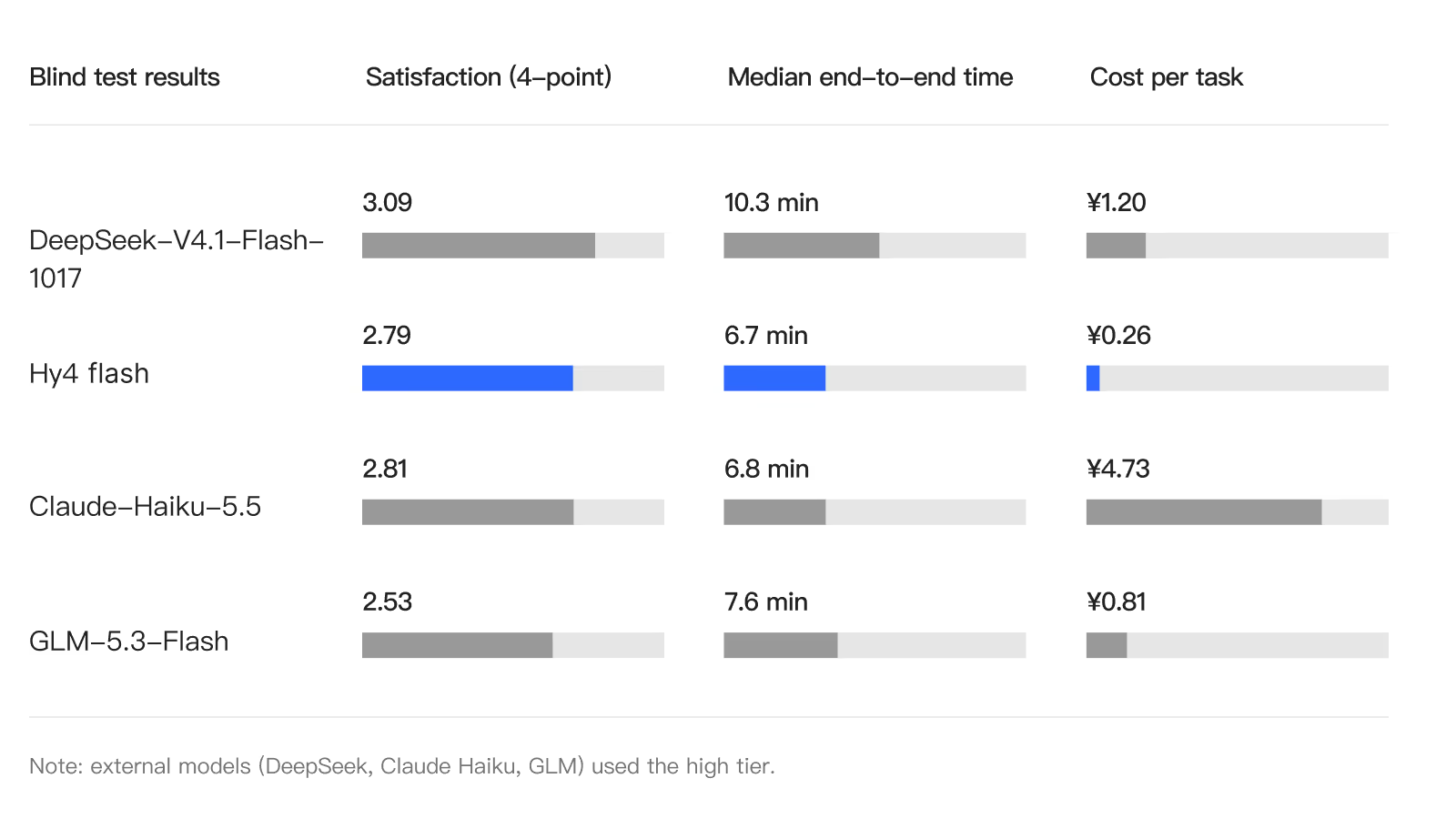
- The headline claim (Tencent): satisfaction of 2.79 out of 4 against 2.81 for Claude Haiku 5.5, at RMB 0.26 per task against RMB 4.73, in a blind test of 85 internal WorkBuddy users over 259 tasks.
- The detail the headline skips: DeepSeek-V4.1-Flash-1017 won the same test on satisfaction with 3.09, at RMB 1.20 per task.
- Independent view (Vals AI): Vals Index 50.78% for Hy4 flash against 58.73% for Haiku 5.5, at $0.07 against $3.17 per test. Terminal-Bench 4.0: 15.15% against 36.36%.
- Licence: Tencent Hy License 1.0, an Apache 2.0 derivative with extra terms for large model-as-a-service businesses. This is tighter than the plain Apache 2.0 licence on Hy4 preview.
- Self-hosting: 287 GB of FP8 weights and an eight-GPU recipe, or 126 to 157 GiB GGUF builds for 128 GB machines.
What Is Hy4 flash?
Hy4 flash is the small, cheap member of Tencent's Hy4 family (Hy is short for Hunyuan). The family began with Hy4 preview on 28/08/2026, a 770-billion-parameter open model, and was followed by the full Hy4. Tencent writes the name with a lower-case "f", and we follow that here. The model card calls it "our most cost-effective Hy model to date".
It is a mixture-of-experts model. That means only a small part of the network runs for each token: about 11.3 billion text parameters plus a 0.43 billion vision encoder, out of roughly 220 billion in total. Tencent lists three design changes against Hy4:
- Hybrid attention. Of the 42 layers, 12 use sparse attention that picks up to 2,048 relevant tokens from anywhere in the context, and 30 use a sliding window that only looks at the last 512 tokens. This is what makes a one-million-token window cheap to serve.
- LatentMoE. Each token activates 16 of 512 routed experts, plus one shared expert, and the experts work in a smaller internal space.
- N-gram embeddings ("Engram"). About 63.5 billion parameters are lookup tables for common two- and three-token patterns. They add capacity for little compute, which is why the total parameter count looks large next to the active count. Alibaba took a similar route in Qwen4-Max.
Tencent says these changes cut the memory needed to hold a long conversation (the KV cache) to one-sixth of Hy4's and one twenty-fourth of Hy3's. It also says reinforcement learning cut the average number of output tokens per task by 50%, and that a small built-in "drafter" model called DFly2, with 4-bit quantisation, pushes decoding past 150 tokens per second. These are Tencent's figures. Neurohive reports that OpenRouter measured about 70 tokens per second in the first days, which we have not checked ourselves.
| Specification | Hy4 flash | Source |
|---|---|---|
| Total parameters | About 220 billion (155.5B backbone, 63.5B Engram, 0.43B vision, 0.85B DFly2) | Model card. TechNode reports 224 billion |
| Active parameters per token | 11.3B text + 0.43B vision | Model card |
| Context window | 1,048,576 tokens | Model card |
| Maximum output | 65,536 tokens | Vals AI test settings |
| Inputs / outputs | Text and images in, text out | Model card |
| Reasoning modes | "high" (default, thinking on) and "no_think" | Model card |
| Weights | Hy4 flash (440 GB), Hy4 flash-FP8 (287 GB), Hy4 flash-base | Hugging Face file listings |
| Licence | Tencent Hy License 1.0 | Licence file |
Tencent is clear about what the model is for. The card recommends it for "deep search, document processing, slide creation, simple frontend demos, and computer use", and says that for "complex tasks such as long-horizon software engineering, we recommend Hy4 for its higher intelligence ceiling". That framing matters for everything that follows. Tencent tuned and tested this model on office work inside its own WorkBuddy assistant, the product behind the agent tools we covered in our pieces on Hyra-1.0, WorldClaw and Tencent's agent fleet.
What Did Tencent's Blind Test Measure?
The image at the top of this page is Tencent's own results table. The model card describes the method in one sentence: a "blind evaluation with 85 internal WorkBuddy users across 259 tasks spanning 27 categories". A footnote adds that the three outside models (DeepSeek, Claude Haiku and GLM) "used the high tier". Four models were compared on three measures.
| Model | Satisfaction (out of 4) | Median end-to-end time | Cost per task |
|---|---|---|---|
| DeepSeek-V4.1-Flash-1017 | 3.09 | 10.3 min | ¥1.20 |
| Hy4 flash | 2.79 | 6.7 min | ¥0.26 |
| Claude Haiku 5.5 | 2.81 | 6.8 min | ¥4.73 |
| GLM-5.3-Flash | 2.53 | 7.6 min | ¥0.81 |
Source: Tencent Hy team, Hy4 flash model card, Figure 3. Bold marks the best figure in each column. All four rows are Tencent's measurements.
Three things stand out before we get to the cost.
Hy4 flash did not win on quality. It came third of four. DeepSeek-V4.1-Flash-1017 scored 3.09, which is 0.30 points above Hy4 flash and 0.28 above Haiku 5.5. Tencent's claim is carefully worded: satisfaction "close to Claude Haiku 5.5", with "the lowest cost per task and shortest median end-to-end completion time among the evaluated models". Both halves are true of the table. Neither says it was the best.
The 0.02-point gap to Haiku 5.5 has no error bars. Tencent publishes no confidence intervals, no breakdown by task type and no count of how many users rated each model. With 259 tasks on a four-point scale, a 0.02 difference is almost certainly within the noise, so "about the same" is a fair reading. But it cuts both ways: we cannot tell whether Haiku 5.5 or Hy4 flash would be ahead on a rerun.
We do not know what the tasks were. The card gives 27 categories but does not list them. Tencent's internal WorkIndex benchmark, which it built from "typical WorkBuddy tasks", covers slide creation and editing, Markdown and Word editing, spreadsheet repair, audio and video processing and image questions. It is reasonable to assume the blind test looked similar, but that is our assumption, not a published fact.
Blind test: user satisfaction
Mean rating on a four-point scale. Higher is better. 85 internal WorkBuddy users, 259 tasks.
DeepSeek-V4.1-Flash-1017
Claude Haiku 5.5
Hy4 flash
GLM-5.3-Flash
Show data table
| Benchmark | Satisfaction (out of 4) |
|---|---|
| DeepSeek-V4.1-Flash-1017 | 3.09 |
| Claude Haiku 5.5 | 2.81 |
| Hy4 flash | 2.79 |
| GLM-5.3-Flash | 2.53 |
Source: Tencent Hy team, Hy4 flash model card, Figure 3 (vendor test, not independently replicated)
Where Does the 18x Figure Come From?
Tencent does not print "18x" anywhere on the model card. The number comes from dividing two cells in the table above: ¥4.73 per task for Claude Haiku 5.5 by ¥0.26 for Hy4 flash, which gives 18.2. Commentators and video titles then rounded it to "18x cheaper than Claude".
A note under Tencent's benchmark table explains how the costs were worked out: "We compute costs based on each model's official API price, converting USD to CNY at a fixed rate of 1 USD = 7.2 CNY." At that rate ¥4.73 is about $0.66 (£0.52) per task for Haiku 5.5, and ¥0.26 is about $0.036 (£0.03) for Hy4 flash. So the claim, stated plainly, is that a typical WorkBuddy task cost about 52p on Haiku 5.5 and about 3p on Hy4 flash.
Blind test: cost per task
Tencent's calculation from each vendor's official API price, in RMB. Lower is better.
Hy4 flash
GLM-5.3-Flash
DeepSeek-V4.1-Flash-1017 · costed at peak-hour pricing
Claude Haiku 5.5
Show data table
| Benchmark | Cost per task |
|---|---|
| Hy4 flash | 0.26 RMB |
| GLM-5.3-Flash | 0.81 RMB |
| DeepSeek-V4.1-Flash-1017 | 1.20 RMB |
| Claude Haiku 5.5 | 4.73 RMB |
Source: Tencent Hy team, Hy4 flash model card, Figure 3 and benchmark notes (vendor test)
List Price per Token: A Much Smaller Gap
Now compare the price lists. Tencent Cloud's TokenHub page lists Hy4 flash at $0.07 per million input tokens and $0.281 per million output tokens. Anthropic's pricing page lists Claude Haiku 5.5 at $0.10 and $0.50 for prompts up to 100,000 tokens. On that basis Haiku 5.5 costs about 1.4 times as much for input and 1.8 times as much for output. That is a real saving, but it is nowhere near 18 times.
Haiku 5.5 has a second price band that matters here. Anthropic charges $0.50 input and $2.50 output per million tokens on any request whose prompt is over 100,000 tokens. Against those rates Hy4 flash is about 7 times cheaper on input and 9 times cheaper on output. Hy4 flash has a single price across its whole one-million-token window.
| Per 1M tokens | Hy4 flash | Haiku 5.5 (prompt up to 100k) | Ratio | Haiku 5.5 (prompt over 100k) | Ratio |
|---|---|---|---|---|---|
| Input | £0.055 ($0.07) | £0.079 ($0.10) | 1.4x | £0.40 ($0.50) | 7.1x |
| Output | £0.22 ($0.281) | £0.40 ($0.50) | 1.8x | £1.98 ($2.50) | 8.9x |
| Cached input | £0.0024 ($0.003) | £0.008 ($0.01) | 3.3x | £0.04 ($0.05) | 16.7x |
| Tencent blind test, cost per task | ¥0.26 | ¥4.73 (price band not stated) | 18.2x | ||
Hy4 flash prices from Tencent Cloud TokenHub; Haiku 5.5 prices from Anthropic's pricing page, both read on 21/11/2026. Ratios are our arithmetic. Sterling at about $1 = £0.79, excluding VAT.
List price per million tokens: budget models
US dollars, standard list prices before promotions. Lower is better.
- Input
- Output
Hy4 flash · Tencent Cloud TokenHub
Claude Haiku 5.5 (prompt up to 100k tokens) · Anthropic
GLM-5.3-Flash · as listed on TokenHub
DeepSeek-V4.1-Flash-1017 (off-peak) · as listed on TokenHub
DeepSeek-V4.1-Flash-1017 (peak) · as listed on TokenHub
Claude Haiku 5.5 (prompt over 100k tokens) · Anthropic
Show data table
| Benchmark | Input | Output |
|---|---|---|
| Hy4 flash | $0.070 | $0.281 |
| Claude Haiku 5.5 (prompt up to 100k tokens) | $0.100 | $0.500 |
| GLM-5.3-Flash | $0.150 | $0.500 |
| DeepSeek-V4.1-Flash-1017 (off-peak) | $0.150 | $0.600 |
| DeepSeek-V4.1-Flash-1017 (peak) | $0.300 | $1.200 |
| Claude Haiku 5.5 (prompt over 100k tokens) | $0.500 | $2.500 |
Source: Tencent Cloud TokenHub pricing page and Anthropic pricing page, read 21/11/2026. TokenHub shows different GLM prices on another region tab
Why the Two Ratios Differ
A task costs price multiplied by tokens. If the prices differ by less than two times and the bill differs by 18 times, the remainder has to come from how many tokens each model used, and at which price band. Tencent has not published token counts, so nobody outside the company can split the 18x into its parts. FourWeekMBA, which looked at the same figures, reached the same conclusion. What we can do is list the things that would push the ratio up.
- Output length. Tencent says it trained Hy4 flash specifically to halve its output tokens, and its evaluation focused on "single-turn output length". Haiku 5.5 was run at its "high tier", which means more thinking tokens, and those are billed as output.
- Long prompts. Agent tasks send the whole growing conversation back to the model on every step. If WorkBuddy's prompts regularly passed 100,000 tokens, Haiku 5.5 would have been billed at its higher band, where the price gap alone is 7 to 9 times. Tencent does not say whether this happened. We flag it as a possibility, not a finding.
- Caching. A cache hit on Hy4 flash costs about 4% of its normal input price. On Haiku 5.5 it costs 10%. Whether Tencent's harness cached Claude requests as well as it cached its own model is not stated.
- Home advantage. WorkBuddy is Tencent's product. Hy4 flash was tuned on WorkBuddy tasks and tested in WorkBuddy by WorkBuddy users. Other models may take more steps in a harness they were not built for.
None of this means the number is false. Cost per finished task is the right thing to measure, and we have argued as much in our analysis of agent economics. It means the 18x is a result from one workload in one harness, not a property of the two models. Your own ratio could be 2x or 40x, and you will only find out by testing your own tasks.
Has Anyone Independent Checked It?
Nobody has repeated the blind test. We found no independent replication of the 2.79 against 2.81 satisfaction result, and it would be hard to produce one, because the tasks and the 85 raters are internal to Tencent.
There is, though, one useful outside data point. Vals AI, an independent evaluation company, has run Hy4 flash through its own benchmark suite and publishes a cost per test alongside each score. Its numbers support half of Tencent's story and undercut the other half.
Vals Index score (independent)
Vals AI's composite of finance, legal, coding and other professional tasks. Higher is better.
DeepSeek-V4.1-Flash-1017
Hy4
Claude Haiku 5.5
Hy4 preview
GPT-6 Luna
GLM-5.3-Flash
Hy4 flash
Show data table
| Benchmark | Vals Index |
|---|---|
| DeepSeek-V4.1-Flash-1017 | 61.3% |
| Hy4 | 59.4% |
| Claude Haiku 5.5 | 58.7% |
| Hy4 preview | 53.2% |
| GPT-6 Luna | 52.3% |
| GLM-5.3-Flash | 50.9% |
| Hy4 flash | 50.8% |
Source: Vals AI, Vals Index leaderboard, read 21/11/2026
Cost per Vals Index test (independent)
Vals AI's measured cost to run one test, in US dollars. Lower is better.
Hy4 flash
GPT-6 Luna
DeepSeek-V4.1-Flash-1017
Hy4 preview
Hy4
GLM-5.3-Flash
Claude Haiku 5.5 · run at maximum effort
Show data table
| Benchmark | Cost per Vals Index test |
|---|---|
| Hy4 flash | $0.07 |
| GPT-6 Luna | $0.45 |
| DeepSeek-V4.1-Flash-1017 | $0.66 |
| Hy4 preview | $1.57 |
| Hy4 | $1.72 |
| GLM-5.3-Flash | $2.05 |
| Claude Haiku 5.5 | $3.17 |
Source: Vals AI, Vals Index leaderboard, read 21/11/2026
The cost gap is real. Vals measured $0.07 (about £0.055) per test for Hy4 flash and $3.17 (about £2.50) for Haiku 5.5. That is a ratio of about 45 times, larger than Tencent's 18. One reason is that Vals ran Haiku 5.5 at its maximum effort setting, which uses many more thinking tokens than the "high tier" Tencent used. Vals also clocked Hy4 flash at about 17 minutes per test against about 50 minutes for Haiku 5.5. So an outside party agrees that Hy4 flash is very cheap and quick to run.
The quality match is not confirmed. On the Vals Index, Hy4 flash scores 50.78% and Haiku 5.5 scores 58.73%, a gap of about eight points and the difference between 36th and 22nd place out of 43 models. Hy4 flash finishes last of the seven budget and family models in our chart, a whisker behind GLM-5.3-Flash. On individual Vals tests it trails Haiku 5.5 on Vibe Code Bench v1.1 (74.84% against 90.44%), Finance Agent v2.1 (60.81% against 65.37%) and the Vals Legal Index (68.30% against 70.29%), and edges ahead only on HLAB-Vals-1.1 legal agent work (5.42% against 4.17%), where both scores are very low.
These two tests measure different things. Tencent asked people whether they were happy with a slide deck or an edited document. Vals grades answers against fixed rubrics on finance, legal and coding tasks. It is quite possible for a model to be "good enough" for a first-draft presentation and still be measurably weaker on harder professional work. That is the most likely reading of the two results together. One caution on the Vals side: the Vals page for Haiku 5.5 shows different figures in its results table and in its October launch note, so treat its numbers as a snapshot.
Artificial Analysis, the other tracker we normally cite, had no page for Hy4 flash when we checked on 21/11/2026.
Benchmarks: Where Hy4 flash Falls Behind
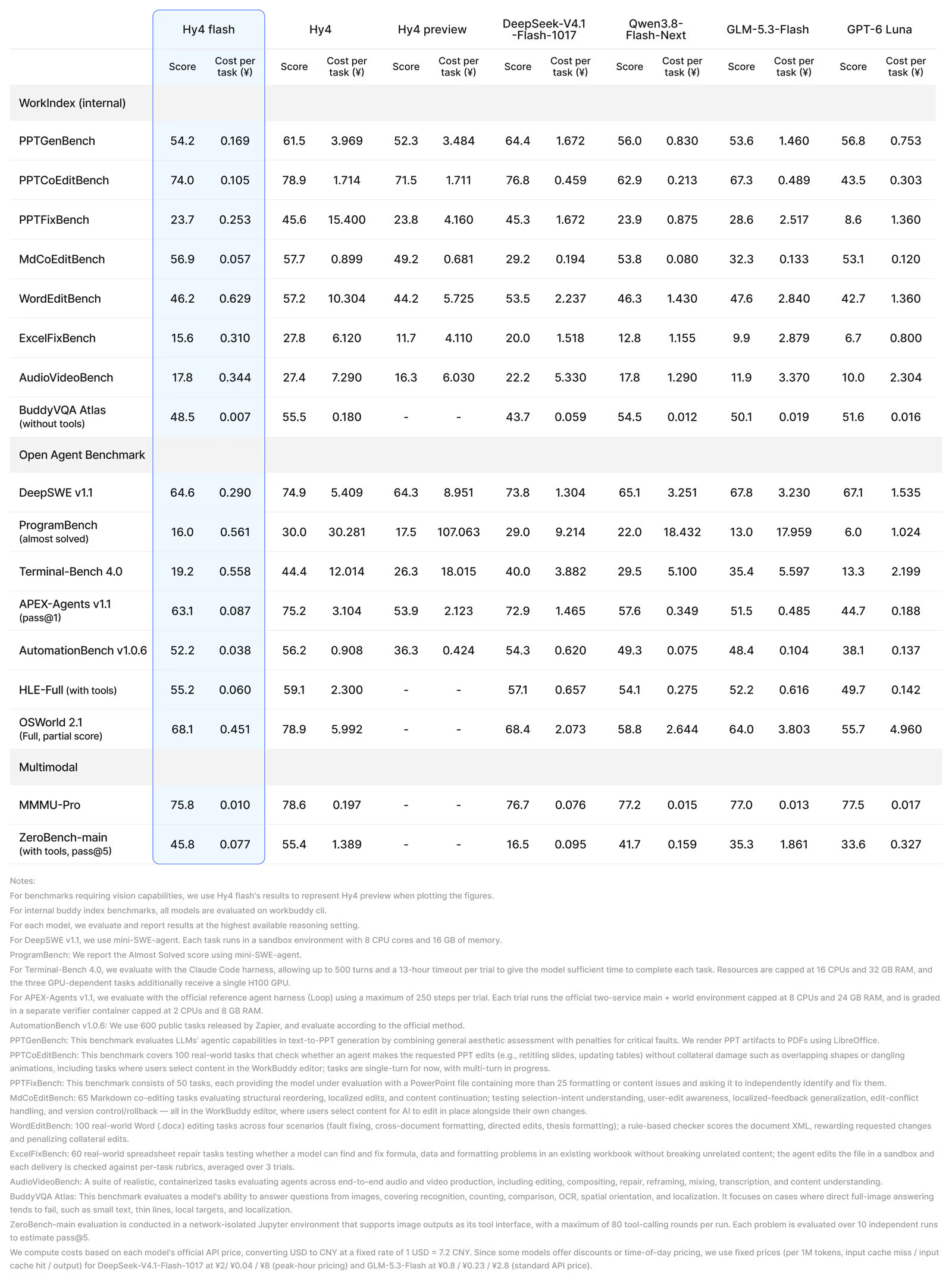
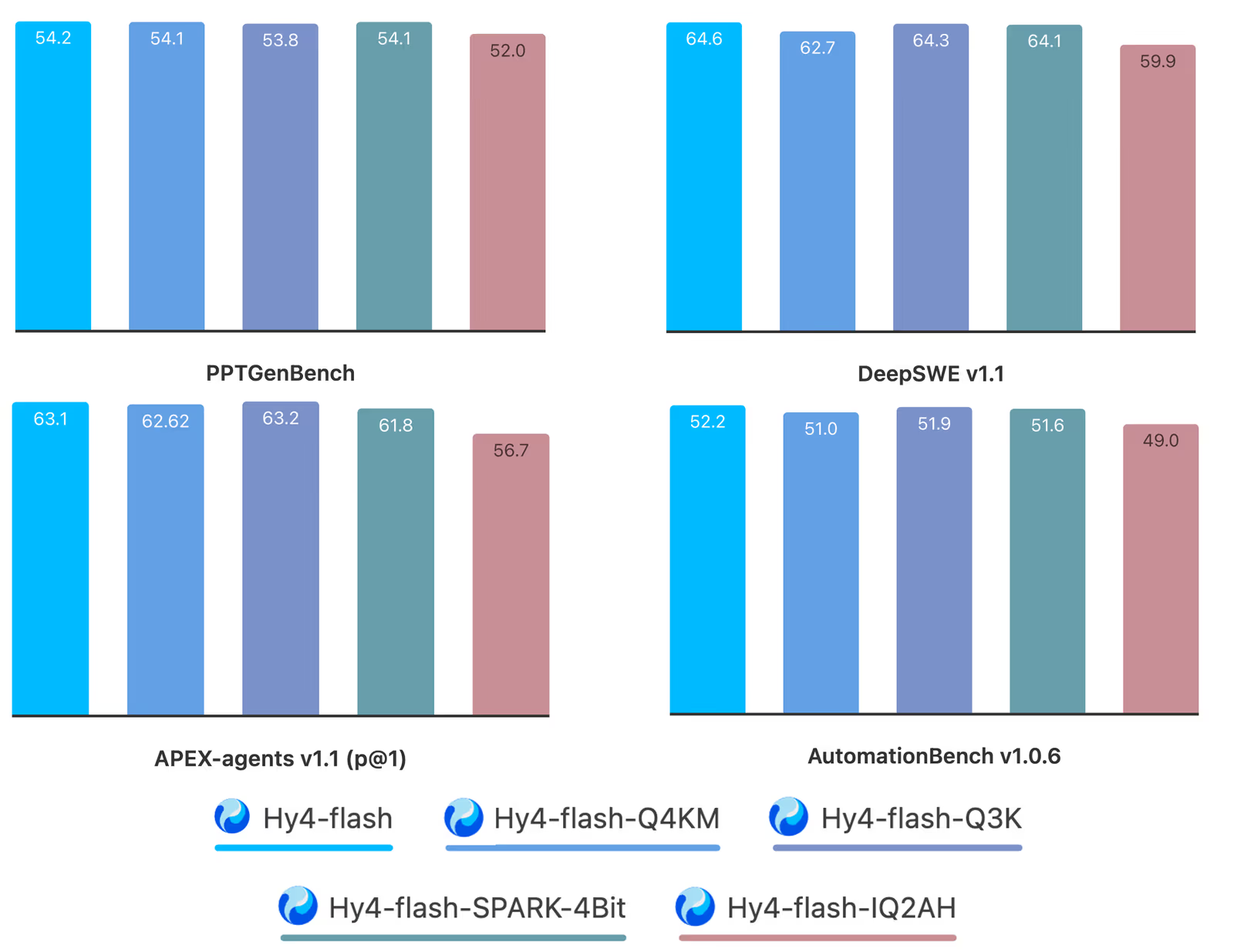
Tencent's own appendix is more candid than the headline. It compares Hy4 flash with Hy4, Hy4 preview, DeepSeek-V4.1-Flash-1017, Qwen3.8-Flash-Next, GLM-5.3-Flash and GPT-6 Luna. One absence is worth noting: Claude Haiku 5.5, the model in the headline claim, is not in this table at all. The only place Tencent compares the two directly is the blind test.
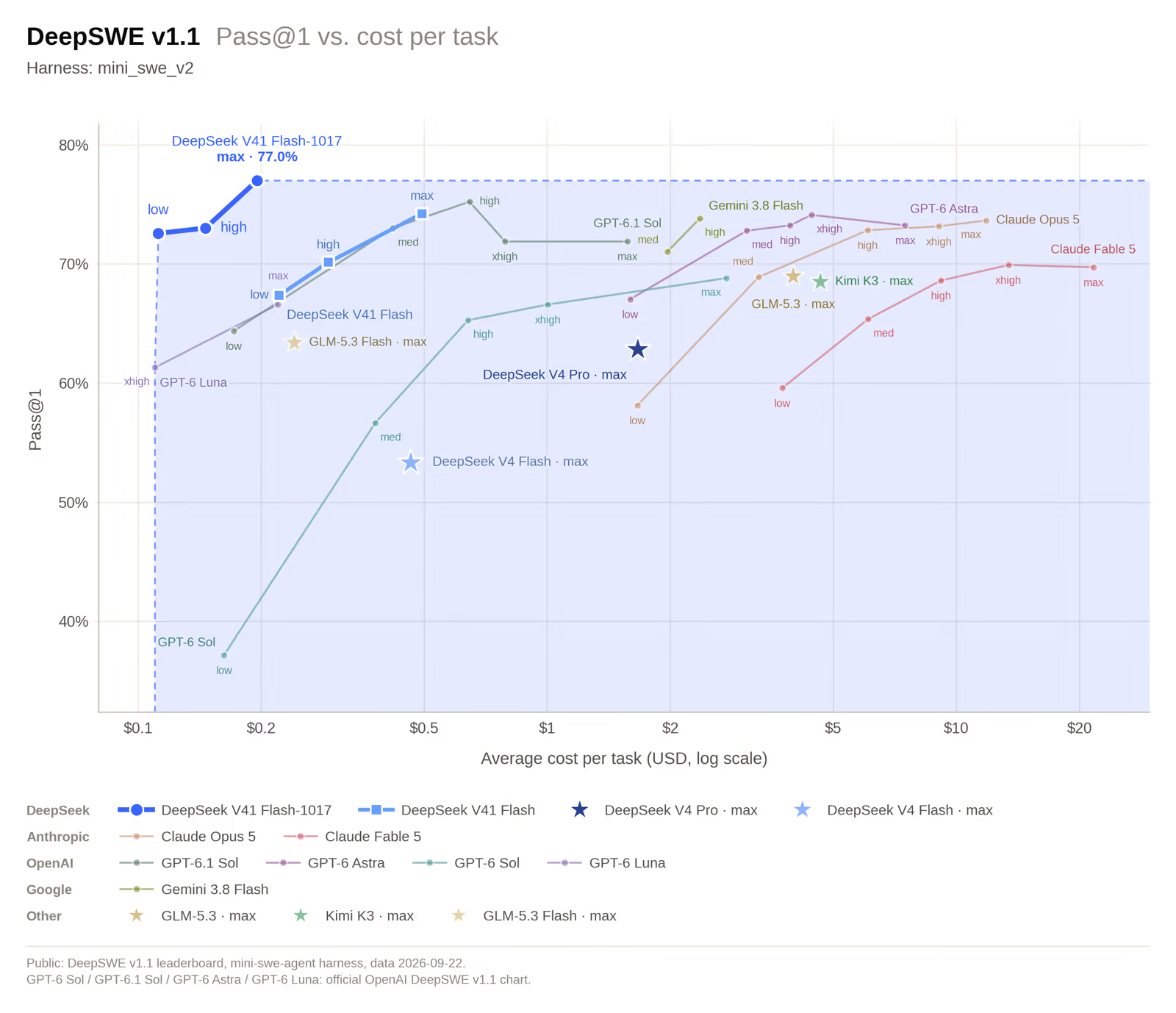
Here are the seven public agent benchmarks from that table for Hy4 flash, its larger sibling and its closest open-weight rival. Each model was run at its highest reasoning setting.
Open agent benchmarks, Tencent's own runs
Score in %, each model at its highest reasoning setting. Higher is better.
- Hy4 flash
- DeepSeek-V4.1-Flash-1017
- Hy4
DeepSWE v1.1
ProgramBench (almost solved)
Terminal-Bench 4.0
APEX-Agents v1.1 (pass@1)
AutomationBench v1.0.6
HLE-Full (with tools)
OSWorld 2.1 (full, partial score)
Show data table
| Benchmark | Hy4 flash | DeepSeek-V4.1-Flash-1017 | Hy4 |
|---|---|---|---|
| DeepSWE v1.1 | 64.6% | 73.8% | 74.9% |
| ProgramBench (almost solved) | 16.0% | 29.0% | 30.0% |
| Terminal-Bench 4.0 | 19.2% | 40.0% | 44.4% |
| APEX-Agents v1.1 (pass@1) | 63.1% | 72.9% | 75.2% |
| AutomationBench v1.0.6 | 52.2% | 54.3% | 56.2% |
| HLE-Full (with tools) | 55.2% | 57.1% | 59.1% |
| OSWorld 2.1 (full, partial score) | 68.1% | 68.4% | 78.9% |
Source: Tencent Hy team, Hy4 flash model card, appendix benchmark table (vendor runs)
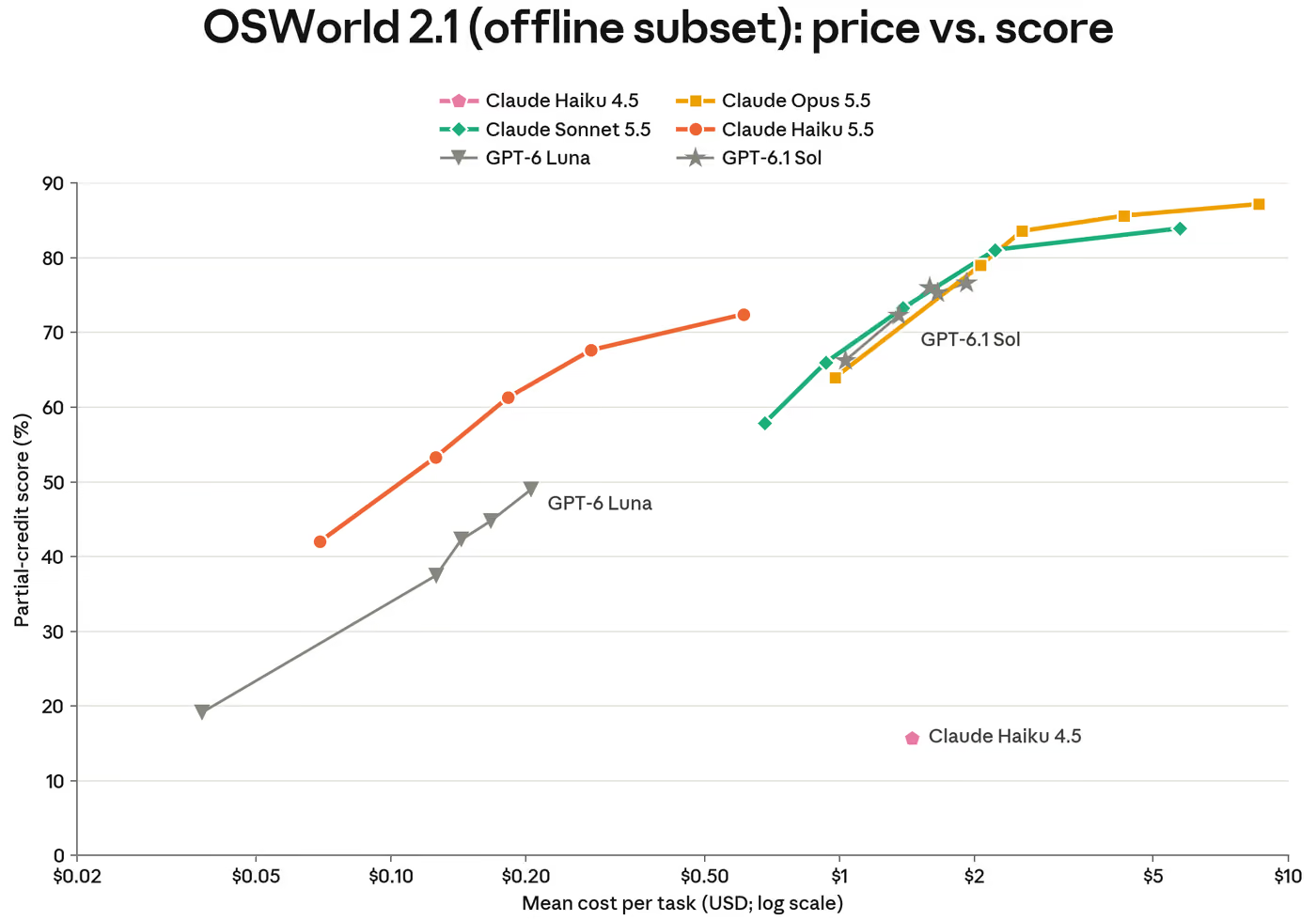
Hy4 flash is behind both models on all seven. Averaged across them, it scores 48.3 against 56.5 for DeepSeek-V4.1-Flash-1017 and 59.8 for Hy4 (our arithmetic from Tencent's table, matching the plotted positions in Tencent's chart). The gap is small on computer use and automation: it is within 0.3 points of DeepSeek on OSWorld 2.1 and about two points behind on AutomationBench. It is large on anything that looks like sustained engineering. On Terminal-Bench 4.0 it scores less than half of either rival, and on ProgramBench barely more than half.
The independent picture agrees. Vals AI measured Hy4 flash at 15.15% on Terminal-Bench 4.0 and Claude Haiku 5.5 at 36.36%, which is 2.4 times higher. Neurohive, citing Vals, puts Hy4 at 39.4% and DeepSeek-V4.1-Flash at 31.8%. Anthropic's own figure for Haiku 5.5 on that benchmark is 39.2%, as we reported in our Haiku 5.5 review. Different labs use different harnesses, so do not mix the columns, but every source puts Hy4 flash at well under half of Haiku 5.5's score.
The trade is also visible in what you pay. In Tencent's table Hy4 flash costs ¥0.558 per Terminal-Bench task against ¥3.882 for DeepSeek and ¥12.014 for Hy4. A cheap attempt that fails is not a saving if a person then has to do the work.
Office work: closer, but still mixed
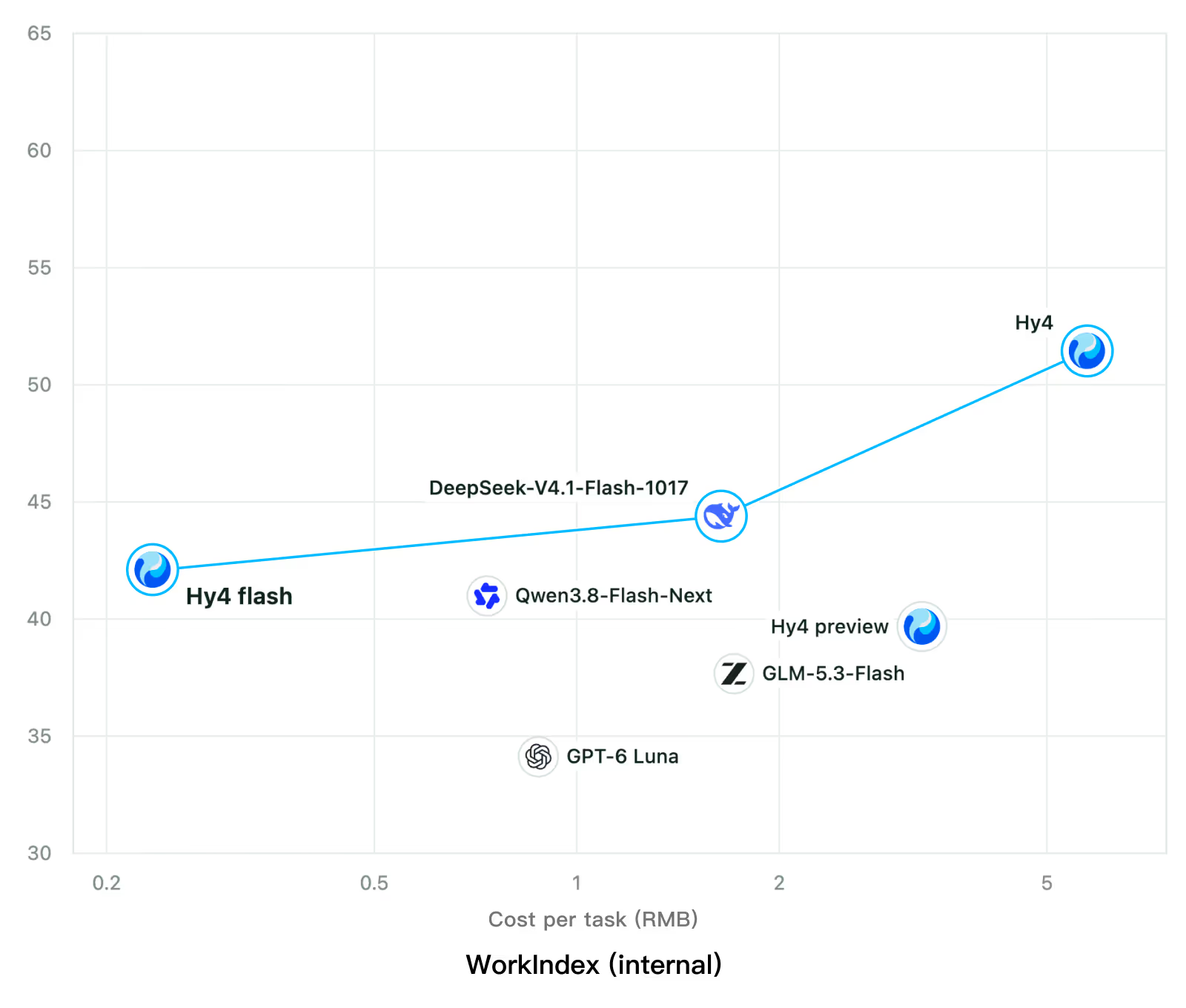
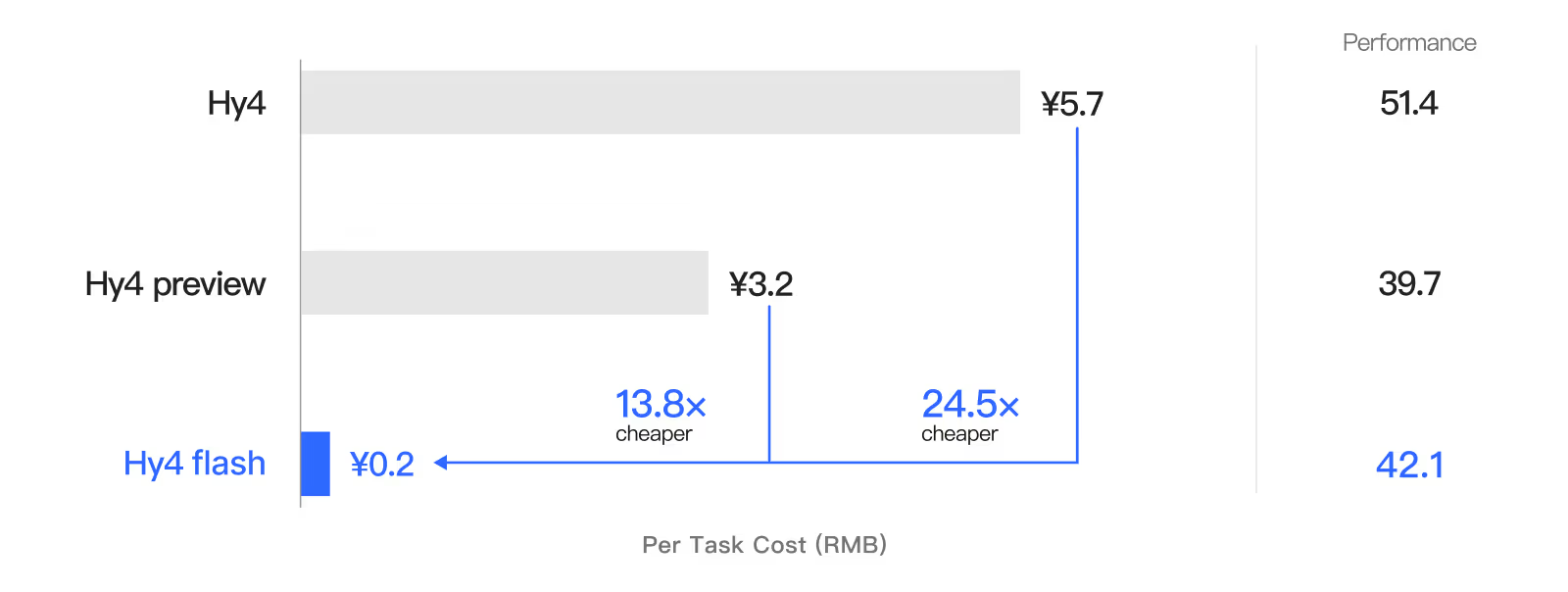
On WorkIndex, Tencent's internal set of eight office-task tests, Hy4 flash scores 42.1. That beats Hy4 preview (39.7) at one-thirteenth of the cost, which is the comparison Tencent leads with. But the same table gives DeepSeek-V4.1-Flash-1017 a mean of 44.4 and Hy4 a mean of 51.4.
| WorkIndex test (Tencent internal) | Hy4 flash | DeepSeek-V4.1-Flash-1017 | GLM-5.3-Flash | GPT-6 Luna | Hy4 |
|---|---|---|---|---|---|
| PPTGenBench (slide creation) | 54.2 | 64.4 | 53.6 | 56.8 | 61.5 |
| PPTCoEditBench (slide editing) | 74.0 | 76.8 | 67.3 | 43.5 | 78.9 |
| PPTFixBench (slide repair) | 23.7 | 45.3 | 28.6 | 8.6 | 45.6 |
| MdCoEditBench (Markdown co-editing) | 56.9 | 29.2 | 32.3 | 53.1 | 57.7 |
| WordEditBench (document editing) | 46.2 | 53.5 | 47.6 | 42.7 | 57.2 |
| ExcelFixBench (spreadsheet repair) | 15.6 | 20.0 | 9.9 | 6.7 | 27.8 |
| AudioVideoBench | 17.8 | 22.2 | 11.9 | 10.0 | 27.4 |
| BuddyVQA Atlas (image questions) | 48.5 | 43.7 | 50.1 | 51.6 | 55.5 |
Source: Tencent Hy team, Hy4 flash model card, appendix table. All models were run in the WorkBuddy command-line tool. Bold marks the best score among the five models shown.
Two things are worth taking from this. First, the absolute scores are low for every model. Even the best result on spreadsheet repair is 27.8, and Hy4 flash manages 15.6. No model here is a reliable hands-off spreadsheet fixer. Second, Hy4 flash's best showing is in co-editing a document with a person, where it nearly matches Hy4 and is far ahead of DeepSeek. That fits a model tuned for short, quick turns inside an editor.
Pricing and Access
Tencent Cloud's international TokenHub price list gives the following for Hy4 flash. The same figures appear in TechNode's launch report.
| Per 1M tokens | List price | Promotional price to 30/11/2026 |
|---|---|---|
| Input (cache miss) | £0.055 ($0.07) | £0.028 ($0.035) |
| Output | £0.22 ($0.281) | £0.11 ($0.1405) |
| Input (cache hit) | £0.0024 ($0.003) | £0.0012 ($0.0015) |
Source: Tencent Cloud TokenHub pricing page and promotion notice, read 21/11/2026. Promotional figures are 50% of list, our arithmetic. Sterling at about $1 = £0.79, excluding VAT.
Tencent's notice says that until 12:00 Beijing time on 30/11/2026, Hy4 flash usage is "settled at 50% of the list price". OpenRouter was showing $0.035 input and $0.1405 output when we checked, which matches the half-price rate, with Tencent Cloud as the only provider. Budget on the list price, not the promotion. Third-party write-ups give the mainland China list price as ¥0.5, ¥2 and ¥0.02 per million tokens; we could not load Tencent's own Chinese page to confirm that.
You can reach the model in four ways:
- Tencent Cloud TokenHub API, model ID
hy4-flash. Tencent's documents say the service is compatible with both the OpenAI and Anthropic API formats, so most existing tools can point at it with a changed base URL. - TokenHub Token Plan, a credit-based subscription. Tencent's terms say the personal plan's key may only be used inside supported AI tools, not in your own back-end scripts.
- WorkBuddy and Yuanbao, Tencent's assistant apps. TechNode reports that WorkBuddy users can use Hy4 flash free until 30/11/2026.
- OpenRouter, routed to Tencent Cloud.
For context, the full Hy4 is listed on the same page at $0.834 input and $2.501 output per million tokens (about £0.66 and £1.98), roughly twelve times the input price and nine times the output price of Hy4 flash.
Open Weights and the Tencent Hy License
Tencent has published three sets of weights: the instruction-tuned Hy4 flash, an FP8-quantised version for production serving, and the pre-trained base model. A fine-tuning pipeline is included. That makes Hy4 flash one of very few models in this price class that you can also run yourself, alongside DeepSeek V4.1 Flash and GLM-5.3-Flash. Claude Haiku 5.5 is closed.
The licence is not a standard open-source one. The Tencent Hy License 1.0 describes itself as "derived from the Apache License, Version 2.0, with modifications, mainly the additional commercial terms for large Model-as-a-Service ('MaaS') businesses in Section 10". In plain terms:
- You may use, modify, fine-tune and redistribute the weights, including commercially, as under Apache 2.0.
- If you run a business that gives third parties remote access to the model (for example, selling API access) and your worldwide gross revenue is over US$50 million (about £39.5 million) in any 12-month period, you need a separate written licence from Tencent first. The revenue test counts all your revenue, not just revenue from the model.
- The same applies before you use it in any product with more than 100 million monthly active users.
- Internal use is exempt, provided neither the model nor its outputs are made available to third parties.
- Products that use the model only inside specific features, without offering general-purpose model access, are not treated as model-as-a-service.
For almost every UK small or mid-sized business this changes nothing: you can self-host for internal work or build it into a product feature. It matters to large cloud and API providers, and it is a step back from Hy4 preview, which shipped under plain Apache 2.0. The wider argument about how open these releases really are is covered in our piece on the open-weights debate. This is our reading of the licence, not legal advice.
Can You Self-Host It?
Yes, with serious hardware. "12 billion active parameters" describes the compute per token, not the memory you need. All 220 billion parameters have to be loaded, or at least be reachable on fast storage.
Server route: eight GPUs
The Hugging Face repositories hold about 440 GB for the full-precision model and about 287 GB for Hy4 flash-FP8. Tencent's deployment recipes for vLLM and SGLang both serve the FP8 version across eight GPUs (a tensor-parallel size of 8), with the DFly2 drafter switched on. Tencent does not name the GPU model, so we cannot give a cost. As a rough guide, 287 GB of weights plus working memory will not fit on fewer than several data-centre cards. Both recipes rely on special builds of the serving software, and support in the main Transformers library was still an open pull request when we checked.
Workstation route: 128 GB machines
Tencent's AngelSlim team has published five compressed GGUF builds "for end-to-end testing purposes", from 125.7 GiB to 156.8 GiB. Their own speed tests, on WorkBuddy tasks, report:
| Machine | Build | Size | Decode speed (4K / 16K / 32K context) |
|---|---|---|---|
| Mac, M5 Max, 128 GB | Q4_K_M | 156.8 GiB | 48.1 / 45.2 / 44.2 tokens per second |
| Mac, M5 Max, 128 GB | Q3_K | 144.7 GiB | 50.3 / 49.5 / 47.4 tokens per second |
| RTX Spark, 128 GB | SPARK-4Bit-Fast | 148.6 GiB | 32.0 / 33.1 / 33.4 tokens per second |
| RTX Spark, 128 GB | SPARK-4Bit | 151.3 GiB | 25.8 / 28.2 / 30.3 tokens per second |
Source: Tencent AngelSlim, Hy4-flash-GGUF model card. Vendor measurements; we have not reproduced them.
How does a 157 GiB file run in 128 GB of memory? Tencent's Mac guide says the roughly 59 GiB Engram table is read from the SSD on demand, so about 97 GiB of weights sit in memory. The guide also shows how tight this is: one four-user configuration ran out of memory at 113.3 GiB. Support in llama.cpp was an unmerged pull request at the time of writing, so you have to build from a branch. This is a route for a capable technical team, not a download-and-go install. If you want a model that runs on a single ordinary GPU, look at smaller releases such as those in our Qwen 3.8 27B guide.
UK Guidance: Data Residency and Hosting
For a UK organisation the cheap price is the easy part. Where your data goes is the harder question. Here is what Tencent publishes, and what it does not.
There is no UK endpoint. Tencent Cloud's TokenHub documentation lists three API sites: Singapore, with a "global" resource scheduling scope; Guangzhou, serving the Chinese mainland; and Silicon Valley, serving the United States. The Token Plan documentation adds that "cross-region and cross-site service calls are not supported", so you choose a site when you activate the service. Tencent's data-processing document also refers to Frankfurt as a resource region, but the endpoint list we read does not include a Frankfurt address. Ask Tencent before assuming an EU option exists for this model. OpenRouter's page says the model is not available through its EU in-region routing.
Retention is up to 30 days unless you turn on Zero Data Retention. Tencent's TokenHub Data Processing and Security Protocol, last updated on 11/09/2026, says prompts and outputs are generally kept for up to 30 days after a request. If you choose Singapore, Frankfurt or Silicon Valley as your region and activate Zero Data Retention, Tencent says it "will not store such information". The document does not say whether that option exists for Guangzhou.
Two questions are not answered in what we read. The protocol does not say whether customer content is used to train or improve models, and it leaves the list of sub-processors to a separate agreement. It also notes that customers agree to provisions on "using computing resources from different countries or regions based on resource availability". Put those questions to Tencent in writing and get the answers into your contract.
What this means under UK GDPR. Singapore, the United States and China are all outside the UK. If you send personal data to the hosted API you are making an international transfer and will need the usual safeguards and a transfer risk assessment, plus a data-processing agreement with Tencent Cloud. Regulated firms should check their sector rules as well. None of this is unique to Tencent; similar questions apply to any overseas API. But Anthropic, by comparison, publishes a documented data-residency control for Claude and sells through AWS, Google Cloud and Microsoft, which most UK compliance teams already know how to assess.
Self-hosting is the clean alternative. Because the weights are open, you can run Hy4 flash on servers you control, in a UK data centre or a UK cloud region, and send nothing to Tencent. The licence permits internal use without conditions. You take on the hardware cost and the engineering work described above, and you lose the per-token bargain: at these prices the hosted API will be cheaper than your own GPUs unless you have very high, steady volume. The reason to self-host is control, not savings. Our Kimi K3.1 Pro open-weights guide walks through the same decision for a larger model.
Limitations
- The headline test is internal. Tencent's staff, Tencent's tasks, Tencent's product, Tencent's cost accounting. No error bars, no task list, no replication.
- It was not the best model in its own test. DeepSeek-V4.1-Flash-1017 scored 3.09 to its 2.79.
- Weak at hard coding. 15.15% on Terminal-Bench 4.0 at Vals AI and 16.0% on ProgramBench in Tencent's table.
- Lower independent scores than Haiku 5.5. About eight points behind on the Vals Index, and behind on finance, legal and coding sub-tests.
- Low absolute scores on real office repair tasks. 15.6 on spreadsheet repair and 23.7 on slide repair in Tencent's own benchmark.
- No safety documentation that we could find. The model card has no safety section, and we found no system card of the kind Anthropic publishes for Haiku 5.5.
- Tooling is not settled. Transformers and llama.cpp support were unmerged pull requests, and the serving recipes use pinned special builds.
- One hosted provider. Tencent Cloud is the only host we found, with no UK region.
- The base-model scores carry a warning. Tencent's card says its few-shot results for the base model may be distorted because it sometimes fails to follow the answer format.
When a UK Business Should and Should Not Use It
Worth testing if:
- You run high volumes of routine, low-risk text work: first drafts of slides, document tidying, summarising public material, bulk classification or tagging, internal search.
- The data involved is not personal or confidential, or you are prepared to self-host.
- A person reviews the output before it is used, so an occasional weak answer costs minutes, not money.
- You already use an OpenAI- or Anthropic-compatible client and can swap the endpoint for a side-by-side trial on 50 to 100 of your own tasks.
- You want an open-weight model with a one-million-token window and image input that you can fine-tune.
Look elsewhere if:
- You need a coding agent for real repositories or long terminal sessions. Use Haiku 5.5 as a floor and see our best AI coding agents guide.
- You handle client personal data, health, legal or financial records and cannot self-host. The lack of a UK region and the unanswered training-use question are reasons to pause.
- You need vendor safety documentation, UK or EU hosting, or enterprise support through a cloud you already buy from.
- Your work is finance or legal analysis where the eight-point Vals gap to Haiku 5.5 would show up as errors.
- Your total model bill is small. If you spend £50 a month on Haiku 5.5, even a genuine 18x saving is worth about £47. That will not cover an hour of the compliance and testing work needed to switch.
If you do run a trial, measure three things per task on both models: whether the result was usable without rework, total tokens billed, and time to finish. That is exactly the comparison Tencent ran, on your work instead of theirs. Try DeepSeek V4.1 Flash in the same trial; on Tencent's own numbers it was the better model at about a quarter of Haiku 5.5's cost. Our directory pages for Claude Haiku and DeepSeek V4 list current access options.
The Bottom Line
The 18x figure is honest arithmetic on a narrow test. Tencent's staff rated Hy4 flash and Claude Haiku 5.5 about equally on WorkBuddy tasks, and Tencent's accounts put the cost at ¥0.26 against ¥4.73. Divide one by the other and you get 18. What the figure is not is a statement about price lists, where the gap is 1.4 to 1.8 times on ordinary prompts, or about general capability, where independent testing puts Hy4 flash clearly behind.
The cost advantage itself looks real. Vals AI, with no stake in the result, measured an even bigger gap in running cost. The better way to say it is this: Hy4 flash is a very cheap, fast, open-weight model that is good enough for a lot of routine document work and weak at hard engineering. Whether it "matches Claude" depends entirely on what you ask it to do.
For UK teams the practical advice is short. Test it on low-risk, high-volume work where a person checks the result. Do not send it personal or confidential data through the hosted API until Tencent has answered the residency and training questions in writing. If control matters more than cost, the open weights give you a self-hosted route that Haiku 5.5 cannot offer, at the price of some serious hardware.
Last updated: 21/11/2026. Tencent figures from the Hy4 flash model card on Hugging Face; prices from Tencent Cloud TokenHub and Anthropic, read on 21/11/2026; independent scores from Vals AI, read the same day. Sterling conversions at approximately $1 = £0.79, excluding VAT. Tencent converts at 1 USD = 7.2 CNY in its own cost figures. AI Tools Review has not run its own tests on Hy4 flash.
Sources
- Tencent Hy team: Hy4 flash model card (Hugging Face)
- Tencent Hy License, Version 1.0
- Tencent Hy team: Hy4 flash-FP8 repository
- Tencent AngelSlim: Hy4-flash GGUF builds and speed tests
- Tencent Cloud TokenHub: model pricing and promotion notice
- Tencent Cloud TokenHub: model IDs and API endpoints
- Tencent Cloud TokenHub: Token Plan regions and promotion
- Tencent Cloud TokenHub: Data Processing and Security Protocol (updated 11/09/2026)
- Anthropic: Claude pricing
- Vals AI: Hy4 Flash results
- Vals AI: Claude Haiku 5.5 results
- Vals AI: Vals Index leaderboard
- TechNode: Tencent launches Hy4 flash, cutting AI task costs by 95% in internal tests (16/11/2026)
- Neurohive: Hy4 flash: Tencent Releases Open Weights (18/11/2026)
- FourWeekMBA: Tencent's Hy4 Flash Nears Haiku 5.5 at 1/18th the Task Cost
- OrcaRouter: Hy4 flash Is Open Weight Now (18/11/2026)
- OpenRouter: Tencent Hy4 flash
- Julian Goldie SEO: Tencent's NEW Hy4 Flash Is 18X CHEAPER Than Claude?!
More from AI Tools Review: Hy4 preview review, Claude Haiku 5.5 review, DeepSeek V4.1 Flash 1017, GLM-5.3-Flash review, GLM 5.3 review, Qwen 4 guide, Kimi K3.1 Pro review and GPT-6 Sol and Luna review.