 AI Tools Review Editorial Team
Quick Answer:
On 17/11/2026 at Ignite, Microsoft AI released MAI Code 2 and MAI Code 2 Flash (coding) and MAI Image 2.7 and 2.7 Flash (image generation and editing), as part of a seven-model launch. In Microsoft's own tests MAI Code 2 averaged a 63.2% pass rate across four coding benchmarks, against 64.1% for GPT-6.1 Sol and 65.3% for Claude Opus 5.5, at an average cost per task of $0.309 versus $0.761 and $6.306. It costs £0.38 / £1.90 ($0.50 / $2.50) per million input / output tokens in GitHub Copilot until 17/05/2027, then doubles. MAI Image 2.7 topped the Artificial Analysis image editing leaderboard by four Elo points at about £26.60 ($35) per 1,000 images. These are cheaper, nearly-as-good models for routine work, not new frontier leaders, and Microsoft did not test them against GPT-6.2, Claude Fable 5.2 or Gemini 4.
Microsoft has spent three years selling other companies' models. This week it made its clearest argument yet that, for the ordinary coding and image work that fills most enterprise bills, its own models are good enough and far cheaper. The claims are specific: 98% of GPT-6.1 Sol for 40% of the cost, 96% of Claude Opus 5.5 for 5%, and the top spot in image editing at a fraction of OpenAI's price. This article goes through what Microsoft actually published, where the numbers hold up, where the footnotes matter, and what it means for anyone choosing a model in GitHub Copilot or Foundry.
63.2%
MAI Code 2 average pass rate
GPT-6.1 Sol 64.1%, Claude Opus 5.5 65.3% (four benchmarks)
$0.309
MAI Code 2 average cost per task
At 50% promotional price; Sol $0.761, Opus 5.5 $6.306
1,215
MAI Image 2.7 editing Elo
First on AA-Image-Editing v2.1 on 16/11/2026, 5,478 votes
~$35
MAI Image 2.7 per 1,000 images
About £26.60; Flash about $10 (about £7.60)
Source: Microsoft AI announcement posts, 17/11/2026. Benchmark figures are Microsoft-run unless stated.
WorldofAI's news round-up of 18/11/2026 covers MAI Code 2 from 30:10 and MAI-Image-2.7 from 30:52, alongside GPT-6.2 and Gemini 4 Neon.
Executive Summary
- What launched: Microsoft AI announced what it calls seven new models on 17/11/2026. The two that matter most to developers and creators are MAI Code 2 (with a Flash variant) and MAI Image 2.7 (with a Flash variant).
- Coding claim: Averaged across DeepSWE 1.1, Terminal-Bench 2.1, SWE Atlas and FrontierCode v1.1, MAI Code 2 scored 63.2%, GPT-6.1 Sol 64.1% and Claude Opus 5.5 65.3%. MAI Code 2 was not first on any single test.
- Cost claim: Average cost per task was $0.309 for MAI Code 2, $0.761 for GPT-6.1 Sol and $6.306 for Opus 5.5. Microsoft's figure uses MAI Code 2's 50% promotional price, which ends on 17/05/2027.
- Image claim: MAI Image 2.7 scored 1,215 Elo on Artificial Analysis's image editing leaderboard, four points ahead of GPT Image 2.6 Sunburst, at roughly one-sixth of its listed price. On text-to-image it is fourth.
- Availability: MAI Code 2 and Code 2 Flash are in GitHub Copilot now. Code 2 Flash is in limited-access preview on Microsoft Foundry. MAI Image 2.7 and Flash are in public preview on Foundry and can be tried in MAI Labs.
- Strategy: Microsoft is replacing third-party models with its own for routine workloads inside Microsoft 365, Bing and Copilot, while continuing to ship OpenAI, Anthropic and Google models alongside them.
- Main caveat: Almost every figure is vendor-run, and the comparison set stops at GPT-6.1 Sol and Opus 5.5. Newer models released the same week were not tested.
What Did Microsoft Announce at Ignite 2026?
Microsoft AI (MAI) is the Microsoft division, led by Mustafa Suleyman, that builds the company's in-house AI models. In its Ignite 2026 announcement, the division said it was releasing "a family of seven new world class models at a truly exceptional price-performance". The theme was cost. Microsoft's framing is that token spending is rising quickly and that customers want models cheap enough to "run agents 24/7 doing real engineering work".
According to Thurrott's report from the keynote, Suleyman put it this way on stage: "We don't just hill-climb on frontier quality alone. We co-optimize quality and price together." That sentence is the most useful summary of the launch. None of these models claims to be the single most capable in its field on every measure. Each claims to be close to the leader for much less money.
| Model | What it does | Microsoft's headline claim | Where to get it |
|---|---|---|---|
| MAI Code 2 | Everyday enterprise coding | 98% of GPT-6.1 Sol at 40% of the cost; 96% of Claude Opus 5.5 at 5% | GitHub Copilot (paid plans) |
| MAI Code 2 Flash | High-volume routine coding | Comparable to GPT-6 Luna at 65% of the cost and Claude Haiku 5.5 at 20% | GitHub Copilot (all plans); Foundry limited preview |
| MAI Image 2.7 and 2.7 Flash | Image generation and editing | First on Artificial Analysis image editing at about one-fifth of GPT Image 2.6 Sunburst's cost | Foundry public preview; MAI Labs |
| MAI Cyber 2 Flash | Security vulnerability discovery | 92.3% on CyberGym-E2E versus 91.5% for GPT-6 Astra at under 2% of the cost per task | Microsoft security products only |
| MAI Realtime 1 | Live speech-to-speech | Outperforms GPT-Realtime 2.1 in Microsoft's evaluations; from $0.01 per audio minute | MAI Labs; register interest |
| Dragon Copilot Transcribe | Clinical transcription, built on MAI Transcribe 2 | 10 million patient encounters a month | Dragon Copilot |
| Decision 1.1 | Model routing and fast decisions | 50 times faster and 79 times cheaper than GPT-6.1 Sol; 4,000 customers | Generally available |
Two side announcements matter for context. First, MAI Licensed Weights will let enterprises customise an MAI model with their own data and run it inside their own Azure environment; Microsoft says it is "coming soon" through its Frontier Company engagements. Second, Interesting Engineering reports that Microsoft's second-generation Maia 200 accelerator is now in production running its largest models.
This article concentrates on the coding and image models. We covered the first version of the routing model in Microsoft-Decision-1 explained, and Microsoft's agent work in Copilot Autopilot and Fara 1.5.
Lineage: How Did Microsoft Get to MAI Code 2?
MAI models are AI models trained in-house by Microsoft AI, as opposed to the OpenAI models it licenses. The family is younger than most people assume. A short timeline, drawn from Microsoft's posts and contemporary reporting:
- 19/03/2024: Microsoft AI is founded, with DeepMind and Inflection co-founder Mustafa Suleyman as chief executive.
- 28/08/2025: The first in-house models appear: MAI-Voice-1 and MAI-1-preview. MAI-Image-1, a text-to-image model, follows on 13/10/2025.
- 06/11/2025: Microsoft forms a superintelligence team under Suleyman. The Next Web reported in April 2026 that a renegotiated OpenAI agreement had removed an earlier restriction on Microsoft pursuing its own general AI development.
- April 2026: MAI-Transcribe-1, MAI-Voice-1 and MAI-Image-2 reach Microsoft Foundry. The Next Web noted that MAI-Image-2 had debuted third on Arena's text-to-image leaderboard.
- 02/06/2026 (Build): Seven models launch together, including MAI-Thinking-1, Microsoft's first reasoning model, MAI-Code-1-Flash for GitHub Copilot, and MAI-Image-2.5. Microsoft said they were built "on a shared foundation, hill-climbing from the bottom with zero distillation", a line quoted by Windows Central. Distillation means training a model to imitate a larger one, so the claim is that these models are not copies of OpenAI's.
- 23/07/2026: Microsoft publishes production data on MAI Code 1 Flash: an approximately 10% higher code accept rate than GPT-5.4 mini and Claude Haiku 4.5 in VS Code, and 10% lower median token usage. It also says the same checkpoint was retrained for Excel.
- September to October 2026: MAI-Image-2.6 (04/09/2026), MAI-Code-1.1-Flash (07/10/2026) and the MAI-Base-2 foundation model (15/10/2026) follow, according to Layer3Labs' catalogue of MAI releases.
- 17/11/2026 (Ignite): MAI Code 2, Code 2 Flash, Image 2.7 and the rest of this week's launch.
Two things stand out. The first is pace: the image line has gone from 2.5 to 2.7 in under six months, and the coding line from a single small Flash model to a two-tier family. The second is the jump in ambition. Until this week Microsoft's only coding model was a lightweight one. In GitHub's words, MAI Code 2 expands the family "from lightweight coding assistance to complex, agentic software engineering". Microsoft has not said which base model MAI Code 2 is built on, so any link to MAI-Base-2 is an assumption, not a published fact.
What Is MAI Code 2?
MAI Code 2 is a general-purpose coding model that Microsoft has tuned for the work developers do most often inside GitHub Copilot. The announcement post lists its strengths as "taking code to production, deep debugging, multi-file implementation, repo-wide reasoning, and UI", and says it delivers "changes code maintainers would merge".
Microsoft is unusually direct about what the model is not for. The post says both models are "explicitly not yet tuned for harder problems, like fundamental science research and very long-horizon agentic work". That is a fair description of where the benchmark results are weakest, as the next section shows, and it should set expectations: this is a workhorse for tickets and pull requests, not a model for multi-day autonomous projects.
Front-end and visual coding
Microsoft says MAI Code 2 is "tuned for producing great dashboards and visualizations". In blind side-by-side tests covering user interfaces, games, data visualisations, 3D scenes and SVG graphics, developers preferred its output to GPT-6 Sol's 64% of the time. The footnote says 258 annotators took part and that the preference covers both appearance and function. Note the comparator: GPT-6 Sol, not the newer GPT-6.1 Sol used for the coding benchmarks, and not GPT-6.2 Sol, which OpenAI released the same day.
Two tiers
MAI Code 2 Flash is the smaller, cheaper model for "code explanations, targeted edits, routine fixes, and rapid iterations". GitHub's changelog entry describes both as "designed for agentic coding workflows" and mentions vision support. It does not replace MAI-Code-1.1-Flash, which is still listed in Copilot.
What Microsoft has not published in the announcement or on the model page is a context window, a maximum output length or a knowledge cutoff for either model. The model page links to a model card PDF that we have not reviewed, so treat those specifications as unconfirmed here.
MAI Code 2 Benchmarks, Read Carefully
Microsoft's headline is that MAI Code 2 "gives you 98% of the performance of GPT-6.1 Sol at 40% of the cost, and 96% of Claude Opus 5.5's performance at just 5% of the cost". The interactive charts in the post contain the underlying numbers, which are more informative than the percentages.
Pass rate by benchmark: MAI Code 2 vs GPT-6.1 Sol vs Claude Opus 5.5
All models at maximum reasoning effort. Higher is better.
- MAI Code 2
- GPT-6.1 Sol
- Claude Opus 5.5
DeepSWE 1.1
Terminal-Bench 2.1
SWE Atlas
FrontierCode v1.1
Average of the four
Show data table
| Benchmark | MAI Code 2 | GPT-6.1 Sol | Claude Opus 5.5 |
|---|---|---|---|
| DeepSWE 1.1 | 73.2% | 74.6% | 69.0% |
| Terminal-Bench 2.1 | 84.6% | 85.0% | 78.7% |
| SWE Atlas | 43.1% | 47.4% | 57.5% |
| FrontierCode v1.1 | 52.0% | 49.4% | 56.0% |
| Average of the four | 63.2% | 64.1% | 65.3% |
Source: Microsoft AI, MAI Code 2 announcement (17/11/2026). DeepSWE, Terminal-Bench and SWE Atlas run by Microsoft on MSBench; FrontierCode from Artificial Analysis.
The averages check out: 63.2 divided by 64.1 is 98.6%, and 63.2 divided by 65.3 is 96.8%. But the per-benchmark picture is less tidy than a single percentage suggests.
- MAI Code 2 is first on none of the four tests. GPT-6.1 Sol leads DeepSWE 1.1 and Terminal-Bench 2.1; Claude Opus 5.5 leads SWE Atlas and FrontierCode v1.1.
- It beats Opus 5.5 on two tests and loses badly on one. MAI Code 2 is ahead of Opus on DeepSWE (73.2% vs 69.0%) and Terminal-Bench (84.6% vs 78.7%), but 14.4 points behind on SWE Atlas (43.1% vs 57.5%).
- It beats GPT-6.1 Sol on one test. FrontierCode v1.1, at 52.0% vs 49.4%. On the other three it trails by between 0.4 and 4.3 points.
So "96% of Opus" is an average of two wins and two losses, one of them large. If your work looks like SWE Atlas, the gap to Opus 5.5 is much wider than 4%.
How big is the cost gap?
Average pass rate against average cost per task
Mean of four coding benchmarks. Up and to the left is better. MAI Code 2 at its 50% promotional price.
- MAI Code 2
- GPT-6.1 Sol
- Claude Opus 5.5
Show data table
| Model | Setting | Average pass rate | Cost per task |
|---|---|---|---|
| MAI Code 2 | max effort | 63.2% | $0.31 |
| GPT-6.1 Sol | max effort | 64.1% | $0.76 |
| Claude Opus 5.5 | max effort | 65.3% | $6.3 |
Source: Microsoft AI, MAI Code 2 announcement (17/11/2026). Vendor-run.
| Cost per task (US$) | MAI Code 2 | GPT-6.1 Sol | Claude Opus 5.5 |
|---|---|---|---|
| DeepSWE 1.1 | $0.618 | $1.212 | $10.717 |
| Terminal-Bench 2.1 | $0.081 | $0.265 | $1.842 |
| SWE Atlas | $0.228 | $0.605 | $4.234 |
| FrontierCode v1.1 | $0.31 | $0.96 | $8.43 |
| Average | $0.309 (about £0.23) | $0.761 (about £0.58) | $6.306 (about £4.79) |
On these figures the cost gap to Opus 5.5 is real and very large: roughly 20 times cheaper per task on average. The gap to GPT-6.1 Sol is about 2.5 times. Four caveats apply.
- The MAI price is promotional. Microsoft's footnote says "MAI Code 2 cost is shown at its 50% promotional price". GitHub's pricing page says that price ends on 17/05/2027. If token usage stays the same, doubling the token price doubles the cost per task to about $0.62 (about £0.47). That would be roughly 81% of GPT-6.1 Sol's cost, not 40%, and about 10% of Opus 5.5's, not 5%. That is our arithmetic, not a Microsoft figure.
- Microsoft ran most of the tests itself. Three of the four benchmarks ran on MSBench, "Microsoft's internal eval platform", using the GitHub Copilot CLI without subagents. Only the FrontierCode v1.1 scores and costs come from Artificial Analysis. Rival models may do better in their own harnesses, such as Claude Code for Opus.
- Everything ran at maximum reasoning effort. That is the most expensive way to run Opus 5.5 and GPT-6.1 Sol. Most teams do not run those models at maximum effort for routine work, so the real-world cost gap is likely to be narrower than the chart shows.
- The comparison set is already a generation old. There is no GPT-6.2 Sol, GPT-6.2 Astra, Claude Fable 5.2 or Gemini 4 model in the charts.
Microsoft adds its own disclaimer: "Performance and cost comparisons vary by workload, model configuration, reasoning effort, and pricing assumptions."
How Good Is MAI Code 2 Flash?
The Flash results are, on paper, the stronger of the two. Across three benchmarks, MAI Code 2 Flash did not just match the small models from OpenAI and Anthropic; in Microsoft's runs it beat both on average.
Pass rate by benchmark: MAI Code 2 Flash vs GPT-6 Luna vs Claude Haiku 5.5
All models at maximum reasoning effort. Higher is better.
- MAI Code 2 Flash
- GPT-6 Luna
- Claude Haiku 5.5
DeepSWE 1.1
Terminal-Bench 2.1
SWE Atlas
Average of the three
Show data table
| Benchmark | MAI Code 2 Flash | GPT-6 Luna | Claude Haiku 5.5 |
|---|---|---|---|
| DeepSWE 1.1 | 59.9% | 59.6% | 46.0% |
| Terminal-Bench 2.1 | 78.3% | 69.3% | 73.4% |
| SWE Atlas | 44.8% | 36.4% | 42.1% |
| Average of the three | 61.0% | 55.1% | 53.9% |
Source: Microsoft AI, MAI Code 2 announcement (17/11/2026). Run by Microsoft on MSBench with the GitHub Copilot CLI.
Average cost per task was $0.052 for MAI Code 2 Flash, $0.080 for GPT-6 Luna and $0.319 for Claude Haiku 5.5. Two details are worth noticing. MAI Code 2 Flash scored higher than the full MAI Code 2 on SWE Atlas (44.8% vs 43.1%), which is odd for a smaller model and hints at how noisy that benchmark is for this family. And the same promotional-price caveat applies: at the standard rate of $0.10 / $0.50 per million tokens from 17/05/2027, Flash will cost the same per token as Luna and Haiku 5.5. On unchanged token usage its cost per task would be about $0.10, which is more than Luna's $0.080 in the same test. Again, that is our calculation.
MAI Work Flash: The Model Inside Microsoft 365
The most strategically important paragraph in the Code 2 post is not about coding. Microsoft says that from Code 2 Flash it "further optimized a single model, MAI Work Flash, to serve multiple Microsoft products across Microsoft 365 and FabricIQ". MAI Work Flash is a derivative of MAI Code 2 Flash that Microsoft has trained for office tasks. The published results, all from Microsoft's internal evaluations:
- Excel: a best pass rate of 63.3% against 60.8% for GPT-6 Luna, at similar or shorter solution lengths.
- PowerPoint: quality scores level with GPT-6 Luna at comparable token counts (for example 84.0 for both at about 15,500 tokens).
- Word: slightly behind GPT-6.1 Sol on four of the five benchmarks shown (for example 81.3% vs 84.0% on QA Daily and 80.4% vs 86.6% on QA Compete), while using about 42% fewer input tokens per call.
- Teams: ahead of GPT-6 Luna on decision tracking (84.6% vs 78.4%), with up to 28% fewer tokens on instruction following and tool calling.
- FabricIQ: 0.77 on natural-language-to-DAX query generation, against 0.54 for GPT-6 Astra, 0.45 for GPT-5.6 Sol and 0.30 for Claude Opus 5.5.
Read these as evidence of direction, not as a league table. The Word chart shows "5 of 9 key internal benchmarks", so four were left out. And "performs similarly" in Word means a few points behind a much larger model. But the commercial logic is plain. A small model that Microsoft owns, that is roughly as good as GPT-6 Luna on spreadsheet and slide tasks, can replace a model Microsoft has to pay for every time a Microsoft 365 user asks for help.
What Is MAI Image 2.7?
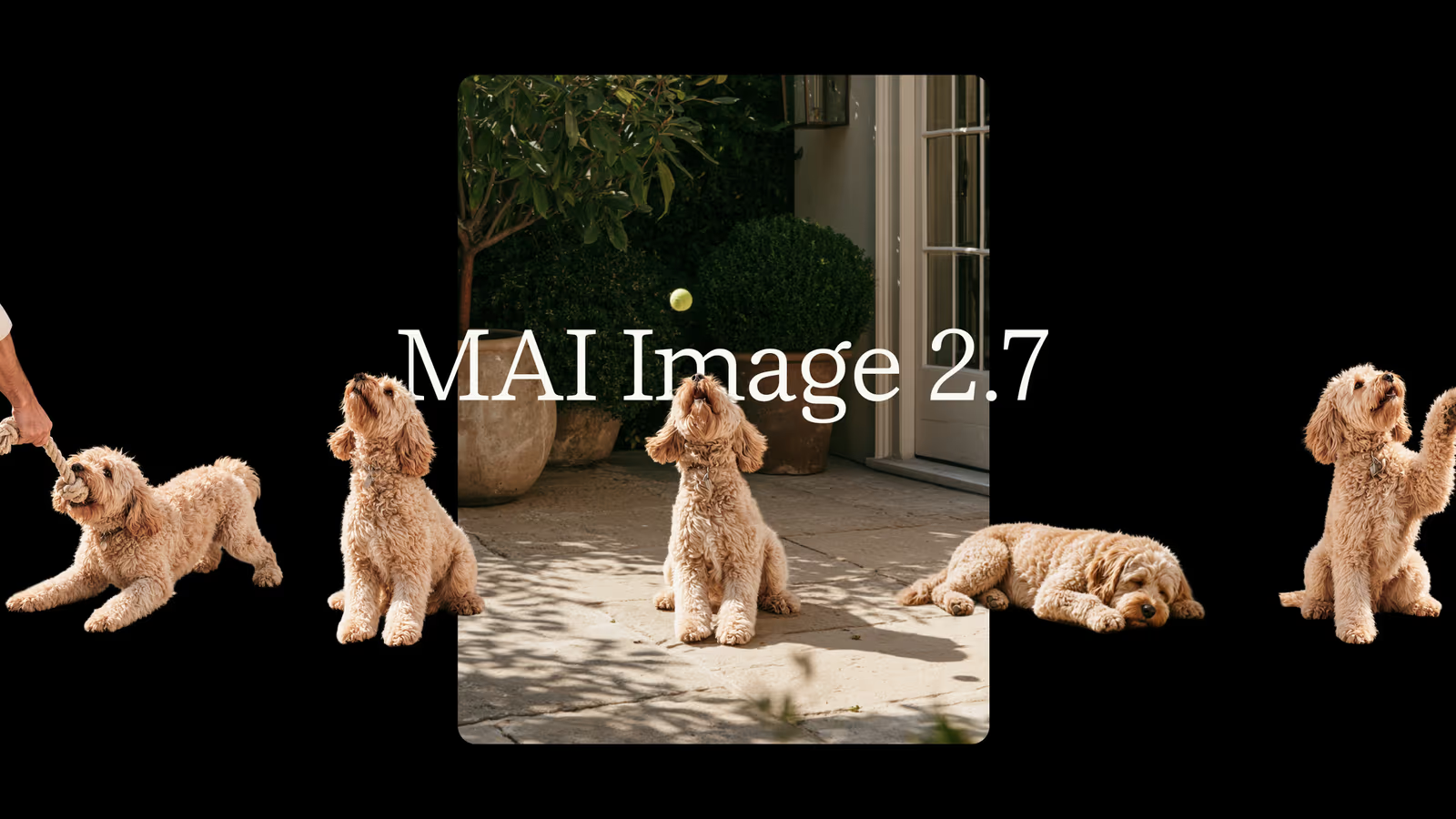
MAI Image 2.7 is Microsoft AI's current image model, able to both generate images from text and edit existing ones. It was released with MAI Image 2.7 Flash, a faster and cheaper variant, and replaces MAI-Image-2.6 from September. The announcement focuses on editing more than generation.
Fine-grained edit control
Microsoft says you can "change an object's color, material, or position without disrupting the rest of an image", and that the model "preserves visual consistency across successive edits". Its demo shows one product photo turned into nine colour and material variants. In the two samples below, only the upper body of the bag changes; the arm, label, pocket, straps and sea are held constant.


A second demo localises a poster into six markets while keeping the layout and artwork fixed. Text rendering inside images, especially in non-Latin scripts, has long been a weak point for image models, so this is a meaningful thing to show. These are vendor-selected samples, of course, and we have not tested the model ourselves.


Transparent backgrounds and Canvas
Both models support transparent backgrounds, which Microsoft pitches for "product images, logos, icons, and illustrations without manual cutouts or cleanup". ByteDance made the same feature a selling point of Seedream 5.5 a week earlier, so this is quickly becoming standard. Microsoft also launched Canvas, an interactive workspace in MAI Labs powered by the Flash model, where you start from a prompt or sketch and then select parts of an image to replace, move or restyle.
Who is using it
Microsoft says MAI Image is now the default model family behind Bing Image Creator, with usage growing at a compound weekly rate of 14.7% since June. It names Adobe, Figma Weave, Minute (Sports Illustrated), Wirestock and Manus as partners. Adobe's Matt Chotin is quoted saying MAI Image 2.7 in Firefly "will give creators another option to tailor their images with strong prompt adherence".
Is MAI Image 2.7 Really Number One?
In one category, on one leaderboard, on one day: yes. Microsoft's footnote says that "as of November 16, 2026, MAI Image 2.7 ranks #1 on AA-Image-Editing v2.1, scoring 1,215 Elo across 5,478 votes, ahead of GPT Image 2.6 Sunburst (max) by 4 Elo". The data behind Microsoft's chart, which it attributes to Artificial Analysis, gives a fuller picture.
| Model | Image editing Elo | Text-to-image Elo | Editing price per 1,000 images |
|---|---|---|---|
| MAI Image 2.7 | 1,215 | 1,214 | £26.45 ($34.80) |
| GPT Image 2.6 Sunburst | 1,211 | 1,261 | £160.15 ($210.72) |
| GPT Image 2.6 Flare | 1,205 | 1,227 | £160.15 ($210.72) |
| GPT Image 2.5 Sunburst | 1,202 | 1,229 | £160.15 ($210.72) |
| MAI Image 2.7 Flash | 1,179 | 1,158 | £7.78 ($10.24) |
| Seedream 5.5 | 1,160 | 1,134 | £21.28 ($28.00) |
| Nano Banana 2.1 | 1,152 | 1,176 | £25.54 ($33.60) |
| MAI-Image-2.6 (previous) | 1,150 | 1,168 | £29.57 ($38.91) |
Source: Microsoft AI chart data citing Artificial Analysis AA-Image-Editing v2.1 and AA-Image-T2I v2.1, retrieved 16/11/2026. Prices at 1024 by 1024 pixels.
Image editing: listed price per 1,000 images
US dollars at 1024 by 1024 pixels. Lower is better.
MAI Image 2.7 Flash · Elo 1,179
Seedream 5.5 · Elo 1,160
Nano Banana 2.1 · Elo 1,152
MAI Image 2.7 · Elo 1,215
Krea 3 (Ultra) · Elo 1,154
GPT Image 2.6 Sunburst · Elo 1,211
Show data table
| Benchmark | Price per 1,000 images |
|---|---|
| MAI Image 2.7 Flash | $10.24 |
| Seedream 5.5 | $28.00 |
| Nano Banana 2.1 | $33.60 |
| MAI Image 2.7 | $34.80 |
| Krea 3 (Ultra) | $100.00 |
| GPT Image 2.6 Sunburst | $210.72 |
Source: Microsoft AI chart data citing Artificial Analysis AA-Image-Editing v2.1, retrieved 16/11/2026.
Four honest readings of this data:
- The editing lead is a statistical tie. Four Elo points across 5,478 votes is a very small margin. Elo leaderboards built on human votes move by more than that from week to week. "Level with the best OpenAI model at editing" is the safer claim.
- On text-to-image it is fourth. MAI Image 2.7 scores 1,214, behind GPT Image 2.6 Sunburst (1,261), GPT Image 2.5 Sunburst (1,229) and GPT Image 2.6 Flare (1,227). A 47-point gap to the leader is not a tie. If you mainly generate from scratch, OpenAI's models still rate higher.
- The price gap is the real story. $34.80 against $210.72 is about one-sixth, slightly better than the "one-fifth" in Microsoft's prose. Against Google's Nano Banana 2.1 the price is nearly identical ($34.80 vs $33.60), but MAI Image 2.7 rates 63 Elo points higher for editing.
- Flash may be the better buy. At about $10 per 1,000 images, MAI Image 2.7 Flash outscores Seedream 5.5 and Nano Banana 2.1 on editing while costing roughly a third as much.
A second leaderboard gives a slightly different result. TestingCatalog quotes Arena as placing Microsoft AI second among labs across its three image leaderboards, with MAI-Image-2.7 third on multi-image editing and fourth on single-image editing. Microsoft's own wording for Arena is "a top-two lab", which is a claim about the lab, not about the model being first. Both things can be true, but they are not the same as "the world's best image editing model", the phrase used in the keynote.
Pricing and Availability
Microsoft's own posts give relative prices for the coding models. The actual token prices are on GitHub's Copilot models and pricing page. Sterling figures below use $1 = £0.76, the approximate mid-market rate on 16/11/2026.
| Model | Input (per 1M tokens) | Cached input | Output (per 1M tokens) | Status |
|---|---|---|---|---|
| MAI Code 2 (to 17/05/2027) | £0.38 ($0.50) | £0.019 ($0.025) | £1.90 ($2.50) | GA in GitHub Copilot |
| MAI Code 2 (from 17/05/2027) | £0.76 ($1.00) | £0.038 ($0.05) | £3.80 ($5.00) | Standard rate |
| MAI Code 2 Flash (to 17/05/2027) | £0.038 ($0.05) | £0.0038 ($0.005) | £0.19 ($0.25) | GA in Copilot; Foundry limited preview |
| MAI Code 2 Flash (from 17/05/2027) | £0.076 ($0.10) | £0.0076 ($0.01) | £0.38 ($0.50) | Standard rate |
| MAI-Code-1.1-Flash | £0.15 ($0.20) | £0.015 ($0.02) | £0.91 ($1.20) | GA in Copilot |
| MAI Image 2.7 | About £26.60 ($35) per 1,000 images | Foundry public preview | ||
| MAI Image 2.7 Flash | About £7.60 ($10) per 1,000 images | Foundry public preview | ||
Where can you use MAI Code 2?
- GitHub Copilot: MAI Code 2 is on Copilot Pro, Pro+, Max, Business and Enterprise. MAI Code 2 Flash is on those plus Free and Student. Both are billed under usage-based billing and appear in the model picker in VS Code, Visual Studio, Copilot CLI, the Copilot cloud agent, the Copilot app, github.com, GitHub Mobile, JetBrains, Xcode and Eclipse.
- Microsoft Foundry: only Code 2 Flash, in limited-access preview. The full MAI Code 2 is not listed for Foundry in the announcement.
- Coming soon: Microsoft says both will be released on OpenRouter, Vercel, Hermes, OpenCode and Kilo, without a date.
Where can you use MAI Image 2.7?
- Microsoft Foundry: public preview for both models.
- MAI Labs: a limited preview site for trying the models and Canvas. The model page describes it as for personal, non-commercial use, with a Microsoft account required.
- Bing Image Creator: Microsoft says the MAI Image family is the default there. It does not say explicitly that 2.7 has already replaced 2.6 for all users.
- Partners: TestingCatalog lists fal, Genspark, OpenRouter and Vercel as partner routes. We have not verified each listing.
We found no statement that MAI Code 2 is selectable in the consumer Copilot app or in Microsoft 365 Copilot chat. Inside Microsoft 365 the related MAI Work Flash model runs behind the scenes; users do not pick it.
What Does This Mean for Microsoft and OpenAI?
The short version: Microsoft is reducing how much of its own product traffic runs on OpenAI models, without ending the partnership. Every comparison in this launch is framed against an OpenAI or Anthropic model, and several describe a direct substitution inside a Microsoft product.
Consider what the posts actually say. MAI Work Flash is measured against GPT-6 Luna in Excel, PowerPoint and Teams and against GPT-6.1 Sol in Word, "using ~42% fewer input tokens per call than GPT-6.1 Sol in production". The phrase "in production" indicates these OpenAI models are what those features have been running on. MAI Cyber 2 Flash is priced against GPT-6 Astra on Azure OpenAI. The MAI Image family has displaced OpenAI's image models as the default in Bing Image Creator. And in July, Microsoft said its Excel model could run on older Nvidia H100 and A100 chips "rather than requiring only the latest-generation accelerators". Each of these is a cost line moving from a supplier to an in-house team.
The contractual background makes this possible. The Next Web reported in April 2026 that the renegotiated agreement between the two companies left Microsoft with licensing rights to OpenAI technology through 2032 and $250 billion in new Azure commitments from OpenAI, and gave Microsoft the freedom to build competing models. The same report paraphrased Suleyman as saying frontier-class language models from his team were one to two years away. Those are a single outlet's account of the terms, and we have not seen the contract.
The pitch to customers has also sharpened. The Ignite post says: "no one wants to pour their IQ into someone else's model." Licensed Weights, where a customer runs and adapts an MAI model in its own Azure tenant and Microsoft only trains on the adaptations "with your express agreement", is something Microsoft cannot offer with OpenAI's closed models. It is positioned against both closed frontier labs and open-weight models, whose provenance the post openly questions.
But this is diversification, not divorce. On the same day that MAI Code 2 arrived in Copilot, GitHub's changelog also announced "OpenAI's GPT-6.2 Astra and GPT-6.2 Sol now available", and Gemini 4 Neon followed a day later. Copilot's price list carries more than 30 models from OpenAI, Anthropic, Google, xAI and Moonshot.
For OpenAI and Anthropic, the pressure is on the middle and bottom of their ranges. Microsoft is not claiming to beat GPT-6.2 Astra or Claude Fable 5.2 at the frontier. It is saying that most enterprise coding does not need them.
How Do the MAI Models Compare With Rivals?
The table below uses GitHub Copilot's published per-token prices, which puts every model on the same billing basis. Default-tier prices are shown.
| Model (Copilot price per 1M tokens) | Input | Output | Tested against MAI Code 2? |
|---|---|---|---|
| MAI Code 2 (promotional) | £0.38 ($0.50) | £1.90 ($2.50) | n/a |
| GPT-6.1 Sol | £1.52 ($2.00) | £7.60 ($10.00) | Yes |
| GPT-6.2 Sol | £1.52 ($2.00) | £7.60 ($10.00) | No |
| GPT-6.2 Astra | £6.08 ($8.00) | £30.40 ($40.00) | No |
| Claude Opus 5.5 | £3.04 ($4.00) | £15.20 ($20.00) | Yes |
| Claude Fable 5.2 | £6.08 ($8.00) | £30.40 ($40.00) | No |
| Gemini 4 Hydrogen | £1.14 ($1.50) | £5.70 ($7.50) | No |
| Gemini 4 Carbon (to 01/12/2026, then double) | £1.52 ($2.00) | £7.60 ($10.00) | No |
| Gemini 4 Neon | £2.28 ($3.00) | £11.40 ($15.00) | No |
| MAI Code 2 Flash (promotional) | £0.038 ($0.05) | £0.19 ($0.25) | n/a |
| GPT-6 Luna / Claude Haiku 5.5 | £0.076 ($0.10) | £0.38 ($0.50) | Yes (vs Flash) |
MAI Code 2 vs Claude Opus 5.5
On token price MAI Code 2 is an eighth of Claude Opus 5.5 during the promotion and a quarter afterwards. In Microsoft's tests it beat Opus on DeepSWE and Terminal-Bench and lost on SWE Atlas and FrontierCode. Opus 5.5 is no longer Anthropic's top model, though: Fable 5.2 sits above it, as our Fable 5.2 vs Opus 5.5 comparison explains. For long, hard, multi-step engineering, which Microsoft says MAI Code 2 is not tuned for, the Anthropic models remain the safer choice. For routine pull requests where an Opus-class model is overkill, MAI Code 2 is a credible way to cut the bill. You can also see Opus 5.5 in our tools directory.
MAI Code 2 vs GPT-6.1 Sol and GPT-6.2 Sol
This is the closer contest. GPT-6.1 Sol scored higher on three of four benchmarks and cost about 2.5 times more per task at MAI's promotional price. At MAI's standard price the gap, on our arithmetic, shrinks to roughly 20%. Meanwhile OpenAI has moved on: GPT-6.2 Sol launched on 17/11/2026 at the same $2 / $10 price, and OpenAI's main claim for it is better results with fewer tokens. Microsoft has published nothing comparing MAI Code 2 with GPT-6.2. Until someone independent does, the "98% of Sol" figure describes last month's Sol.
MAI Code 2 vs the Gemini 4 family
There is no Microsoft data here at all. On price, MAI Code 2 undercuts every Gemini 4 model in Copilot, including Gemini 4 Hydrogen at $1.50 / $7.50 and Gemini 4 Carbon, whose Copilot price doubles to $4 / $20 on 01/12/2026. Hydrogen is the natural comparison, as Google also pitches it as a fast execution model for agentic coding. Anyone choosing between them will have to run their own tests.
MAI Image 2.7 vs the leading image models
Against OpenAI's GPT Image 2.6 Sunburst, MAI Image 2.7 is level on editing and clearly behind on text-to-image, at about a sixth of the listed price. Our ChatGPT Images 2.5 review covers how the Flare and Sunburst tiers work. Against Google's Nano Banana 2.1 it costs about the same and rates higher on both leaderboards in Microsoft's data. Against Seedream 5.5 it rates 55 points higher on editing for about $7 more per 1,000 images. xAI's Grok Imagine Image 2.0 scores 1,167 on text-to-image at $60 per 1,000, so MAI Image 2.7 is both higher-rated and cheaper there. Open models such as FLUX remain far cheaper at the low end (FLUX 3 Image Klein is listed at $9) but rate well below.
For a wider view of which model suits which job, see our best AI models guide and best AI coding agents comparison.
Limitations and Open Questions
- Vendor-run benchmarks. Three of four coding tests ran on Microsoft's internal platform in Microsoft's own harness. No independent lab has yet published a full evaluation of MAI Code 2.
- Promotional pricing flatters the cost claims. Both the 40% and 5% figures depend on a half-price offer that ends on 17/05/2027.
- Stale comparators. GPT-6.2, Claude Fable 5.2 and Gemini 4 are absent. The front-end preference test used GPT-6 Sol, which is two versions old.
- Missing specifications. The announcement gives no context window, output limit or knowledge cutoff. Speed is not quantified either, despite the "Flash" name.
- Not for long-horizon work. Microsoft says so itself. SWE Atlas, where MAI Code 2 trailed Opus 5.5 by 14 points, is the visible sign of it.
- Little safety detail. The coding and image posts contain no safety, alignment or misuse evaluation results. Model cards are linked from the model pages, but the launch posts do not summarise them. For image models in particular, we found no statement about content credentials or watermarking in the announcement.
One point in Microsoft's favour on transparency: in the Cyber 2 Flash post it disclosed that 92 of the 905 CyberGym-E2E tasks overlapped with projects in its training data, and excluded those tasks for every model. That kind of disclosure is still rare, and it lends some credibility to the rest of the numbers. It does not replace independent testing.
On the source video: WorldofAI's round-up describes these as "powerful new MAI coding and image models". That is the creator's characterisation. The data supports "cost-efficient" more firmly than "powerful".
Who Should Use Them
- GitHub Copilot teams on usage-based billing: try MAI Code 2 as the default for routine tickets and keep a frontier model for hard problems. At an eighth of Opus 5.5's token price, even a modest share of traffic moved across is a visible saving. Measure cost per merged pull request, not cost per token.
- High-volume, simple edits: MAI Code 2 Flash is the cheapest capable option in Copilot today and is available on the Free and Student plans.
- Front-end and dashboard work: worth a trial, given the 64% preference result, with the caveat that the comparator was an older OpenAI model.
- Long autonomous agents, research code, complex refactors: stay with Opus 5.5, Fable 5.2 or GPT-6.2 for now. Microsoft itself says MAI Code 2 is not tuned for this.
- Product and marketing teams doing image edits at scale: MAI Image 2.7 is a strong candidate, and Flash is probably the first thing to test. Colour, material and localisation variants are exactly the demonstrated use case.
- Budget planners: model both the promotional and the standard MAI prices. A business case that only works at half price has a six-month shelf life.
The Bottom Line
MAI Code 2 and MAI Image 2.7 are the first Microsoft-built models that a cost-conscious team could reasonably choose over an OpenAI or Anthropic model on merit for everyday work. That is a real change from a year ago, when Microsoft's in-house line-up was a preview chat model and a voice model. The numbers Microsoft published are detailed, internally consistent and, in places, candid about weaknesses.
They are also Microsoft's numbers, measured at a promotional price, at maximum effort, against rivals that were superseded the same day. MAI Code 2 is a little behind GPT-6.1 Sol and Claude Opus 5.5 on average and well behind Opus on the hardest test. MAI Image 2.7 ties the best editor and trails the best generator. The honest headline is not that Microsoft has caught the frontier. It is that Microsoft has made the frontier optional for a large share of routine work, and has started proving it inside its own products first. Whether that holds up will depend on independent benchmarks over the coming weeks and on what the bill looks like after 17/05/2027.
Last updated: 19/11/2026. Prices in US dollars as published by Microsoft and GitHub; sterling conversions are approximate at $1 = £0.76 (mid-market rate observed 16/11/2026). Benchmark figures are vendor-reported unless stated. We have not run hands-on tests of these models.
Sources
- Microsoft AI: Seven new world-class models at scalable price-performance (17/11/2026)
- Microsoft AI: MAI Code 2 and Code 2 Flash (17/11/2026)
- Microsoft AI: MAI Image 2.7 (17/11/2026)
- Microsoft AI: MAI Cyber 2 Flash (17/11/2026)
- Microsoft AI: MAI Licensed Weights (17/11/2026)
- Microsoft AI: Hill-climbing MAI models for GitHub Copilot and Excel (23/07/2026)
- GitHub Changelog: MAI Code 2 and MAI Code 2 Flash in GitHub Copilot (17/11/2026)
- GitHub Docs: Models and pricing for GitHub Copilot
- TestingCatalog: Microsoft launches seven MAI models at Ignite 2026
- Thurrott: Ignite 2026, Microsoft AI announces 7 new models
- Interesting Engineering: Microsoft takes on Claude with seven models
- Layer3Labs: Every Microsoft MAI model with its price and access route
- The Next Web: Microsoft is building an AI empire without OpenAI (03/04/2026)
- Windows Central: Microsoft launches seven in-house AI models (Build 2026)
- Wikipedia: Microsoft AI (history and dates)