 AI Tools Review Editorial Team
Quick Answer:
Google AI Studio currently offers six Gemini audio models: Gemini 3.8 Flash TTS and 3.8 Flash-Lite TTS (text-to-speech, including two-speaker dialogue), Gemini 3.8 Live and 3.8 Live Extended Thinking (real-time voice agents), Gemini 3.5 Transcribe (speech-to-text) and Gemini 3.5 Live Translate (speech-to-speech translation, still in preview). All six are free to try on the free tier. Paid audio is billed at 25 tokens per second: text-to-speech output costs $6.00 to $9.00 per million audio tokens until 31/12/2026 and doubles on 01/01/2027, transcription works out at about $0.005 per minute, and live translation at about $0.0368 per minute. November's additions are voice remixing (04/11/2026) and voice editing in Transcribe (17/11/2026).
A YouTube video published today calls Google AI Studio's audio update "absurd" and counts six audio models. The count is right, but the models did not arrive in one update. They shipped between June and September, and this month added two features and a pricing deadline that most coverage has missed.
We went through Google's Gemini API model pages, pricing page, release notes and the three launch posts on blog.google to establish what each model is called, what it costs, what it can and cannot do, and where Google's own pages disagree with each other. Every number below traces to one of those pages, linked inline. Where we have done arithmetic on Google's figures, we say so.
6
Current audio model cards
7 endpoints, 1 still in preview
25
Audio tokens per second
The basis for all audio billing
130
Languages, 3.8 Flash TTS
101 on Flash-Lite TTS
2x
TTS price rise on 01/01/2027
Introductory rates end 31/12/2026
Source: Google Gemini API models, pricing and speech generation documentation, read 18/11/2026
Julian Goldie walks through Google AI Studio's audio models: text-to-speech, two-speaker conversations, Gemini Live, transcription and live translation.
Executive Summary
- Six models, four jobs. Two text-to-speech models, two real-time voice models, one transcription model with a streaming variant, and one live translation model.
- Five are generally available. Gemini 3.5 Live Translate is the only one still carrying a preview label, five months after its 09/06/2026 launch.
- This month's real news is small but useful. Voice remixing on 04/11/2026 and voice editing in Transcribe on 17/11/2026.
- Text-to-speech is on introductory pricing. Google's pricing page says every Gemini 3.8 TTS rate doubles on 01/01/2027.
- Two-speaker means two. A single request supports two speakers, with prebuilt voices only.
- Google's pages contradict each other on language counts, voice counts and two Live API features. We list each conflict below.
If you have been following the text side of Google's autumn, with Gemini 4 Argon, Carbon and Hydrogen, note that none of the audio models are Gemini 4 models. The audio family still sits on the Gemini 3.5 and 3.8 generation.
The Six Audio Models, Identified
The video's description promises "6 Google AI audio models" and has chapters for two-speaker text-to-speech, Gemini Live, transcription and live translation. No transcript was available to us, so we cannot confirm exactly which six the presenter lists. What we can confirm is that Google's Gemini API models page shows six current audio model cards that match those chapters one for one.
| Model | Model ID | Job | Status | Released |
|---|---|---|---|---|
| Gemini 3.8 Flash TTS | gemini-3.8-flash-tts | Studio-grade text-to-speech | GA | 22/09/2026 |
| Gemini 3.8 Flash-Lite TTS | gemini-3.8-flash-lite-tts | High-volume text-to-speech | GA | 22/09/2026 |
| Gemini 3.8 Live | gemini-3.8-live | Low-latency voice agents | GA | 15/09/2026 |
| Gemini 3.8 Live Extended Thinking | gemini-3.8-live-extended-thinking | Voice agents with deeper reasoning | GA | 15/09/2026 |
| Gemini 3.5 Transcribe | gemini-3.5-transcribegemini-3.5-transcribe-live | Speech-to-text, file and streaming | GA | 26/08/2026 |
| Gemini 3.5 Live Translate | gemini-3.5-live-translate-preview | Speech-to-speech translation | Preview | 09/06/2026 |
Release dates from the Gemini API release notes, except Live Translate, which is dated from Google's launch post. Google's blog dates the TTS announcement 23/09/2026, a day after the release-note entry.
By endpoint the count is seven, because Transcribe has a separate WebSocket model. The models page also still lists older audio models: Gemini 3.1 Flash Live and Gemini 3.1 Flash TTS, both marked as legacy previews with a recommendation to move to the 3.8 models, plus Gemini 2.5 Live and TTS previews. Music generation is a separate product: Lyria 3.5 is priced per song, and we covered it in Google's September Gemini update. Video with native audio belongs to Gemini Omni Flash.
In AI Studio itself, the models are split across two surfaces. Text-to-speech and voice creation live in the Generate speech playground, which Google describes as a voice design workspace with a dual-speaker screenplay editor. The Live and Live Translate models open in the Live view.
Languages listed per model
Count of supported languages in Google's developer documentation. Transcribe and Live Translate are stated as '85+' and '70+', so those bars are minimums.
Gemini 3.8 Flash TTS
Gemini 3.8 Flash-Lite TTS
Gemini 3.8 Live (Live API) · Google's launch post says 97
Gemini 3.5 Transcribe · stated as 85+
Gemini 3.5 Live Translate · stated as 70+
Show data table
| Benchmark | Languages listed |
|---|---|
| Gemini 3.8 Flash TTS | 130 |
| Gemini 3.8 Flash-Lite TTS | 101 |
| Gemini 3.8 Live (Live API) | 99 |
| Gemini 3.5 Transcribe | 85 |
| Gemini 3.5 Live Translate | 70 |
Source: Google Gemini API docs: TTS model pages, Live API capabilities, Transcribe model page, Live Translate guide (18/11/2026)
What Changed This Month
The Gemini API release notes show two audio entries in November, plus a few changes that touch audio indirectly.
04/11/2026: voice remixing
When the TTS models launched, Google's announcement listed one feature as "coming soon": picking a library voice and adjusting it with a prompt. That is now live as voice remixing. You name a base voice, describe the change in plain language, and Google stores the result as a new, independent voice ID. The docs give examples such as making the prebuilt Puck voice "sound 20 years older" or switching Kore to an Australian accent. Remixing is created with gemini-3.8-flash-tts, but the resulting voice works with both TTS models. It requires a paid Tier 1 or higher project.
17/11/2026: voice editing in Transcribe
Yesterday's entry is the freshest change. Both Transcribe endpoints now accept spoken editing instructions. In Smart mode, you can dictate text and then say "delete the second sentence" or "format the action items as a numbered list", and the model applies the edit instead of typing out your words. You can also pass existing text of up to 64 KiB in a source_text field and edit that by voice. This turns Transcribe from a transcription model into a dictation engine.
Also in November
- 05/11/2026: tools can now return audio and video files to a model in function responses.
- 11/11/2026: Gemini Decision 1 launched and accepts audio as an input for its yes/no and rubric decisions.
- 12/11/2026: Gemini 4 Hydrogen went GA. It lists audio among its supported modalities, but speech generation stays with the dedicated models above.
- The clock on TTS pricing. Not a November change, but November and December are the last two months of the introductory rates.
Text-to-Speech: Gemini 3.8 Flash TTS and Flash-Lite
The two TTS models share one API schema, so switching between them is a one-parameter change. Google positions Gemini 3.8 Flash TTS as the flagship for audiobooks, studio narration, complex dialogue and regional dialects, and Flash-Lite TTS as the cheaper workhorse for bulk production, read-aloud features and the speech stage of voice agents.
| Spec | 3.8 Flash TTS | 3.8 Flash-Lite TTS |
|---|---|---|
| Input / output | Text in, audio out | Text in, audio out |
| Input token limit | 8,192 | 8,192 |
| Output token limit | 16,384 | 16,384 |
| Languages | 130 | 101 |
| Prebuilt studio voices | 30 | 30 |
| Default output | WAV, 24 kHz mono 16-bit (unary); raw PCM when streaming | |
| Other formats | Raw PCM, G.711 μ-law and A-law; 24, 16 or 8 kHz | |
| Batch, Flex, Priority | Supported | Supported |
| Function calling, search, thinking | Not supported | Not supported |
Source: Google Gemini API model pages and text-to-speech guide.
One practical consequence of those limits: at 25 audio tokens per second, a 16,384-token output cap is roughly 655 seconds, or just under 11 minutes of audio per request. That is our arithmetic, not a figure Google publishes, but it means an audiobook chapter needs chunking. Google's launch post talks about stable quality "across hours of continuous audio", which describes consistency across many requests, not a single call.
A new prompting model
The biggest behavioural change from older Gemini TTS is that the text field is now treated as a verbatim script. With the 3.1 preview you could write "Say cheerfully: Hello!". Do that now and the model may read the instruction aloud. Direction is split in two:
- Turn-level style goes in a structured
speech_metadata.stylefield, for example "whispered urgently" or "speaking slowly". - Point-in-time sounds go inline in angle brackets:
<laugh>,<sigh>,<cough>,<short pause>,<long pause>and about 30 more listed in the guide.
Google's own advice is to use less direction, not more. The guide says most requests need no style string at all, and that long persona descriptions carried over from older models are "the most common cause of voice drift". The 3.8 models also need the v1beta API version, while the latest SDKs default to v1, which will catch people out on day one.
Two-Speaker Conversations
This is the feature behind the podcast-style demos. You define two speakers, assign each a voice, and send the script as a list of turns, each tagged with its speaker and an optional style. The model returns one audio file with natural turn-taking between the two voices.
Two additions make the result sound less like alternating monologues. First, the vocal tags above. Second, backchannels: wrapping a listener's reaction in pipe characters inside the other speaker's line, such as So the launch is Thursday |oh hmm| are we actually ready?, produces overlapping speech without a separate turn. Google says full overlap works best on Flash TTS.
The limits are strict and worth knowing before you plan a show around it:
- Maximum two speakers in a single request.
- Prebuilt voices only. Designed, remixed and replicated voices cannot be used in a multi-speaker request.
- Every turn needs a speaker label. Old-style "Speaker 1:" prefixes in the text may be read aloud.
- Three or more characters, or custom voices, mean generating each turn separately as raw PCM and joining the audio yourself.
So the common claim that you can clone your voice and drop it straight into a two-host podcast is not accurate for a single API call. It is possible, but it is a stitching job. Outside the API, Google's launch post names Gemini Notebook (formerly NotebookLM) as the consumer product where Flash TTS is rolling out, and Google Vids for Flash-Lite TTS. It does not say which features inside those products use the models.
Voice Design, Replication and Remixing
The 3.8 TTS models introduced a Voices endpoint, and with November's remixing release there are now five ways to pick or make a voice.
| Route | What it does | Key limits |
|---|---|---|
| Prebuilt studio voices | 30 named voices (Kore, Puck, Zephyr and so on) | The only voices allowed in two-speaker requests |
| Extended Voice Library | Catalogue filterable by language, region, accent, gender, pitch, persona and context | Docs say "hundreds"; launch post says 2,000+ |
| Voice design | Creates a new voice from a text description | 200 stored voices per project |
| Voice replication | Copies a real voice from a 10 to 30 second clip plus a spoken consent statement | Paid tier only; adult speaker; consent phrase in one of 30 locales |
| Voice remixing (new) | Edits a prebuilt or designed voice with an instruction | Paid tier only; counts towards the 200 |
Stored voices expire one year after their last use, and the timer resets each time you use them. Replication also offers a stateless mode where Google does not store the voice and you hold a key that lasts seven days.
The safeguards on replication are specific. The consent recording must be the same speaker reciting a fixed sentence (in English: "I am the owner of this voice and I consent to Google using this voice to create a synthetic voice model"). Reference audio must be a genuine human recording, and the docs say audio that already carries a SynthID or C2PA watermark is rejected, which blocks cloning a synthetic voice. All output is watermarked with SynthID. For UK readers, the replication guide states it is available in all supported regions "including the European Economic Area (EEA/EU), the United Kingdom, and Switzerland".
Gemini Live: Real-Time Voice Agents
The Live models are a different kind of thing from TTS. They take streaming audio (and optionally images or video frames) in and speak back, with no separate speech-to-text and text-to-speech stages. Google released two on 15/09/2026:
- Gemini 3.8 Live is the default. Reasoning is built in and interleaved with speech, and there is no thinking setting to tune.
- Gemini 3.8 Live Extended Thinking adds configurable background reasoning at low, medium or high, with thought summaries. Google's launch post says it "reasons and speaks simultaneously", filling the gap with cues like "Let me check that…".
Both share the same published limits and the same price.
| Live API spec | Value |
|---|---|
| Inputs / output | Text, images and audio in; audio out (text via transcription) |
| Token limits | 131,072 input, 65,536 output |
| Session length | 15 minutes audio-only, 2 minutes with video, unless compression is enabled |
| Connection lifetime | About 10 minutes; resume tokens valid for 2 hours |
| Audio format | 16-bit PCM; 16 kHz native input, 24 kHz output |
| Video input | Individual frames, maximum 1 per second |
| Tools | Function calling and Google Search; no code execution, file search or URL context |
| Batch, Flex, Priority, caching | Not supported |
Source: Google Gemini API model pages, Live API capabilities and session management guides.
The headline engineering change is that function calls are asynchronous by default. The model can start a tool call, keep talking, and report back when the result arrives. That matters for anything that touches a slow back end, such as a booking system. It also changes client code: with Extended Thinking, a "turn complete" signal no longer means the session is idle.
Migration from the 3.1 preview is not a drop-in swap. Proactive audio is permanently on and returns an error if you try to disable it. The affective dialogue setting has been removed from the API. Audio is the only response type, and video frames are now included in each turn by default, which Google warns will raise context use and cost unless you send frames only when needed.
Beyond AI Studio, Google says these models run Gemini Live in the Gemini app, Search Live, and Docs, Gmail and Keep Live in Workspace. If you are comparing real-time voice stacks, our explainers on OpenAI's GPT-Live and Mistral Voxtral 3 cover the two closest rivals.
Transcription: Gemini 3.5 Transcribe
Gemini 3.5 Transcribe is the dedicated speech-to-text model. Google is explicit that it is for transcription only: for questions about an audio file you use a general Gemini model. It has two endpoints with different feature sets, and the differences decide which one you need.
| Feature | File (gemini-3.5-transcribe) | Streaming (-live) |
|---|---|---|
| Maximum audio | 1 hour (30 minutes with diarisation or timestamps) | 10 minutes per session |
| Language auto-detection | 85+ languages, with code-switching | 85+ languages |
| Speaker diarisation | Up to 8 speakers (3+ experimental) | Not supported |
| Word-level timestamps | Supported | Not supported |
| Custom vocabulary | Up to 1,000 terms | Up to 1,000 terms |
| Smart mode and voice editing | Supported | Supported |
Source: Google Gemini 3.5 Transcribe model page and audio transcription guide.
There are two modes. Verbatim, the default, keeps every "um" and false start. Smart removes fillers, structures speech into paragraphs and lists, and normalises numbers, so "twenty six million dollars" becomes "$26M". Smart mode is where this month's voice editing lives.
The feature combinations are more restrictive than the feature list suggests:
- Custom vocabulary cannot be combined with diarisation or timestamps. The API rejects the request.
- Smart mode cannot be combined with diarisation or timestamps either.
- Google says turning on word timestamps "may degrade overall transcription accuracy".
- Audio over the limit is silently truncated and the request still reports as completed. For long recordings with speaker labels, split into chunks of 30 minutes or less.
- Google recommends keeping custom vocabulary to about 100 terms for best results, even though 1,000 are allowed.
Google has not published a word error rate for Transcribe on any page we read, so we cannot rank it on accuracy against open models such as NVIDIA's Nemotron 3.5 Transcribe. For meeting capture inside a chat assistant instead of an API, see our guide to ChatGPT's meeting recorder.
Live Translation: Gemini 3.5 Live Translate
Gemini 3.5 Live Translate is the oldest of the six and the only one still in preview. It is a speech-to-speech interpreter: audio in one language goes in, translated speech comes out continuously, without waiting for the speaker to finish. Google's launch post says it detects more than 70 languages automatically, preserves the speaker's "intonation, pacing and pitch", and "stays just a few seconds behind the speaker".
Configuration is deliberately minimal. You set a target language code (it defaults to English) and choose whether speech already in the target language should be repeated or met with silence. A system instruction can supply a glossary, a formality level or context about who is speaking.
It is not a general voice agent, and the docs draw the line clearly:
- Audio input only. Text cannot be sent for translation.
- No tools, no function calling, no search.
- System instructions are fixed at session start and can only guide translation.
- Voice matching "can be inconsistent": Google says voices may shift after long pauses, pick the wrong gender, or stick to one voice in fast multi-speaker conversations.
Google also reminds developers that they are responsible for obtaining consent from all parties where required. The same model sits behind Live translate in the Google Translate app and, per the launch post, is replacing the five-language speech translation in Google Meet with 70+ languages and more than 2,000 language combinations, starting in private preview for business customers.
Pricing: Every Published Rate
All figures below are from Google's Gemini API pricing page as read on 18/11/2026. Google prices in US dollars per million tokens and counts audio at 25 tokens per second, which is 1,500 tokens per minute. Sterling figures are our approximate conversions at $1 = £0.79, excluding VAT.
Every model is listed as free of charge on the free tier, with the usual trade: free-tier data is used to improve Google's products, paid-tier data is not.
| Model | Input, per 1M tokens | Output, per 1M tokens | Google's per-time rate |
|---|---|---|---|
| 3.8 Flash TTS | $0.50 text (£0.40) | $9.00 audio (£7.11) | $0.00225 per 10 seconds |
| 3.8 Flash-Lite TTS | $0.50 text (£0.40) | $6.00 audio (£4.74) | $0.0015 per 10 seconds |
| 3.8 Live and Live Extended Thinking | $0.75 text (£0.59) $3.00 audio (£2.37) $1.00 image/video (£0.79) | $4.50 text (£3.56) $12.00 audio (£9.48) | $0.005/min audio in $0.018/min audio out |
| 3.5 Transcribe | $2.00 audio (£1.58) | $12.00 text (£9.48) | About $0.005/min blended |
| 3.5 Transcribe Live | $3.50 audio (£2.77) | $21.00 text (£16.59) | About $0.009/min blended |
| 3.5 Live Translate (preview) | $3.50 audio (£2.77) | $21.00 audio (£16.59) | About $0.0368/min in + out |
Standard paid tier. TTS rates shown are those in force until 31/12/2026. Source: Google Gemini API pricing page.
The January price rise
The pricing page gives two rates for both TTS models: one "through December 31, 2026" and one "starting January 1, 2027". Every line doubles. Flash TTS audio goes from about £7.11 ($9.00) to £14.22 ($18.00) per million tokens, Flash-Lite from £4.74 ($6.00) to £9.48 ($12.00), and text input from £0.40 ($0.50) to £0.79 ($1.00). The Live, Transcribe and Translate prices carry no end date.
Audio output price per 1M tokens
US dollars, standard paid tier. Lower is better. The two Gemini 3.8 TTS models double in price on 01/01/2027; the others have a single published rate.
- Until 31/12/2026
- From 01/01/2027
Gemini 3.8 Flash-Lite TTS
Gemini 3.8 Flash TTS
Gemini 3.8 Live (both models) · no change announced
Gemini 3.1 Flash TTS Preview (legacy) · no change announced
Gemini 3.5 Live Translate · no change announced
Show data table
| Benchmark | Until 31/12/2026 | From 01/01/2027 |
|---|---|---|
| Gemini 3.8 Flash-Lite TTS | $6.00 | $12.00 |
| Gemini 3.8 Flash TTS | $9.00 | $18.00 |
| Gemini 3.8 Live (both models) | $12.00 | $12.00 |
| Gemini 3.1 Flash TTS Preview (legacy) | $20.00 | $20.00 |
| Gemini 3.5 Live Translate | $21.00 | $21.00 |
Source: Google Gemini API pricing page, 18/11/2026
Even after doubling, Flash TTS at $18.00 will sit below the $20.00 Google still charges for the legacy 3.1 Flash TTS preview. Until January, the new flagship is less than half the price of the model it replaces.
What a minute costs
Per-token prices are hard to picture, so the next chart puts everything in dollars per minute. The Live, Transcribe and Translate figures are Google's own. The two TTS bars are our multiplication of Google's per-10-second rate by six.
Cost per minute of audio
US dollars per minute, standard paid tier, current rates. Lower is better. Transcribe figures are Google's blended estimates (audio in plus text out); Live Translate is audio in plus audio out; the others are one direction only.
3.5 Transcribe (blended)
3.8 Live, audio input
3.5 Transcribe Live (blended)
3.8 Flash-Lite TTS, audio output · our calculation from $0.0015 per 10s
3.8 Flash TTS, audio output · our calculation from $0.00225 per 10s
3.8 Live, audio output
3.5 Live Translate (in + out)
Show data table
| Benchmark | US$ per minute |
|---|---|
| 3.5 Transcribe (blended) | ~$0.0050 |
| 3.8 Live, audio input | $0.0050 |
| 3.5 Transcribe Live (blended) | ~$0.0090 |
| 3.8 Flash-Lite TTS, audio output | $0.0090 |
| 3.8 Flash TTS, audio output | $0.0135 |
| 3.8 Live, audio output | $0.0180 |
| 3.5 Live Translate (in + out) | ~$0.0368 |
Source: Google Gemini API pricing page, 18/11/2026; TTS per-minute values derived by AI Tools Review
Scaled to an hour, again by our arithmetic on Google's rates:
- Transcribing an hour of audio: about £0.24 ($0.30).
- Generating an hour of narration: about £0.64 ($0.81) on Flash TTS or £0.43 ($0.54) on Flash-Lite, rising to £1.28 ($1.62) and £0.85 ($1.08) in January.
- An hour of live translation: about £1.74 ($2.21).
- A Live voice agent: about £0.21 ($0.27) per hour of listening and £0.85 ($1.08) per hour of speaking, before any text, video or search charges.
Discounts, surcharges and extras
- Batch and Flex halve both TTS models: Flash TTS audio falls to $4.50 and Flash-Lite to $3.00 per million tokens until year end. Neither is on the free tier.
- Priority raises them to $16.20 and $10.80.
- Live, Transcribe and Translate have no Batch, Flex or Priority options.
- Search grounding on Live draws on a shared 5,000 free requests a month, then $14 per 1,000 (about £11.06), with a 1,500-a-day cap.
- Voice design, replication and remixing: we found no separate creation fee on the pricing page. Replication and remixing need a paid project.
Google does not publish per-model rate limits for these six in the docs. The rate limits page points to the live figures inside AI Studio, which vary by usage tier. For the text models' rates, see our AI API pricing comparison.
Benchmarks Google Published
Everything in this section comes from Google's launch posts. The benchmarks are run by third parties (Artificial Analysis, Hume AI, Sierra, Voice Arena), but Google chose which to show, so treat them as a vendor's selection. We have not verified them against the leaderboards directly, and those leaderboards move.
Live models
Google says Gemini 3.8 Live Extended Thinking took first place on the Artificial Analysis Speech to Speech index at 82.6, narrowly ahead of OpenAI's GPT-Live-1 Astra and xAI's Grok Voice.
Artificial Analysis Speech to Speech Index
Higher is better. As published by Google on 15/09/2026; reasoning setting shown in brackets.
Gemini 3.8 Live Extended Thinking (High)
GPT-Live-1 Astra (Medium)
Grok Voice Think Fast 2.0 (High)
Gemini 3.8 Live
Gemini 3.1 Flash Live (High)
Gemini 3.1 Flash Live (Minimal)
Show data table
| Benchmark | Speech to Speech Index |
|---|---|
| Gemini 3.8 Live Extended Thinking (High) | 82.6% |
| GPT-Live-1 Astra (Medium) | 81.5% |
| Grok Voice Think Fast 2.0 (High) | 81.3% |
| Gemini 3.8 Live | 76.0% |
| Gemini 3.1 Flash Live (High) | 71.5% |
| Gemini 3.1 Flash Live (Minimal) | 63.9% |
Source: Google, 'Introducing Gemini 3.8 Live and 3.8 Live Extended Thinking', citing Artificial Analysis
Google also reports 97.7% on Big Bench Audio and 35.1% on Sierra's τ-Voice-banking benchmark for Extended Thinking, and says the standard 3.8 Live model placed second in Speech Agent Arena's user-preference ranking.
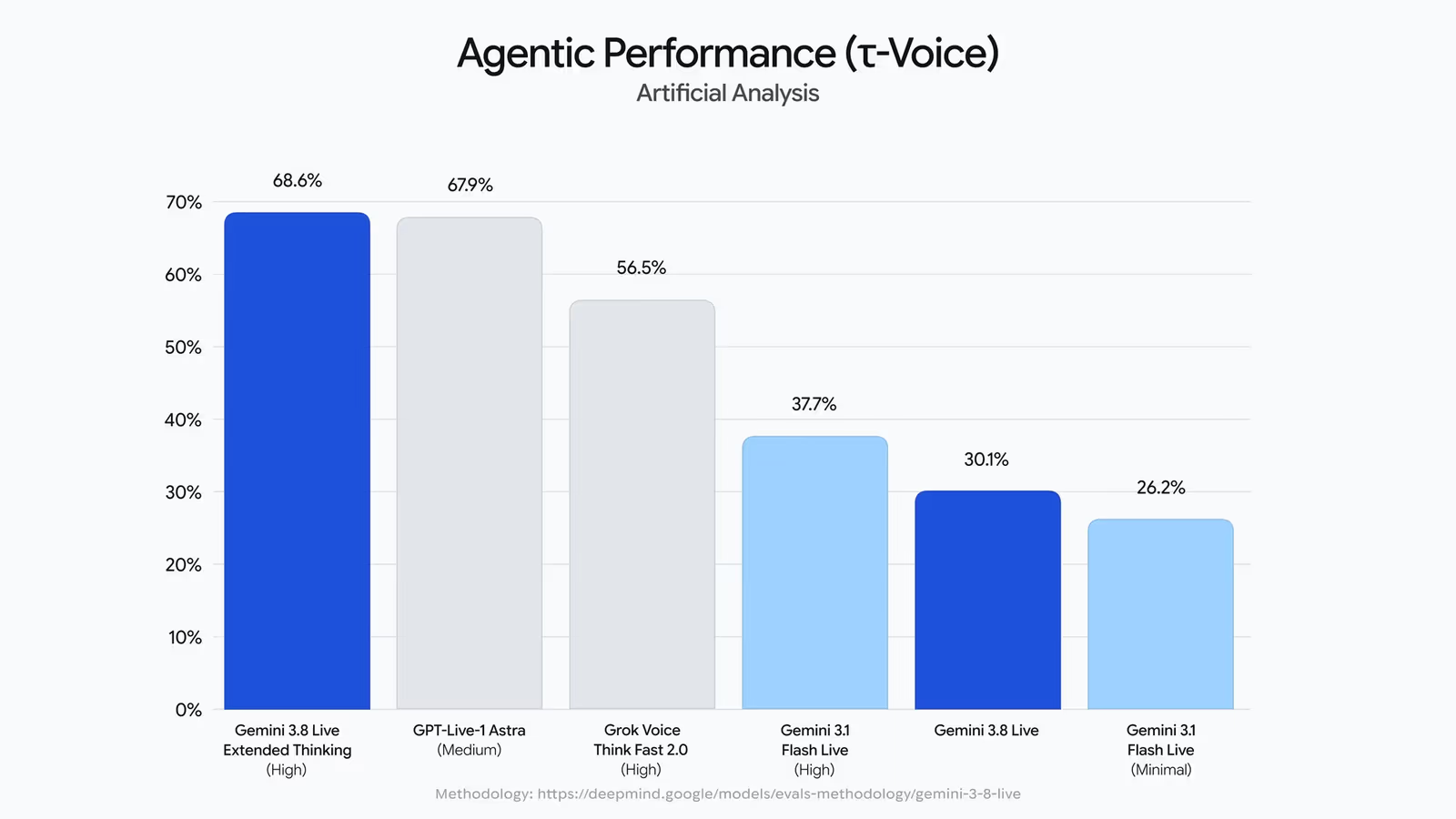
The agentic chart deserves a careful read. On τ-Voice, Extended Thinking scores 68.6%, just ahead of GPT-Live-1 Astra at 67.9%. But the standard Gemini 3.8 Live scores 30.1%, which is below the older Gemini 3.1 Flash Live at high thinking (37.7%). If your agent has to complete multi-step tasks, the default model is not an upgrade on that measure. You need Extended Thinking.
Text-to-speech models
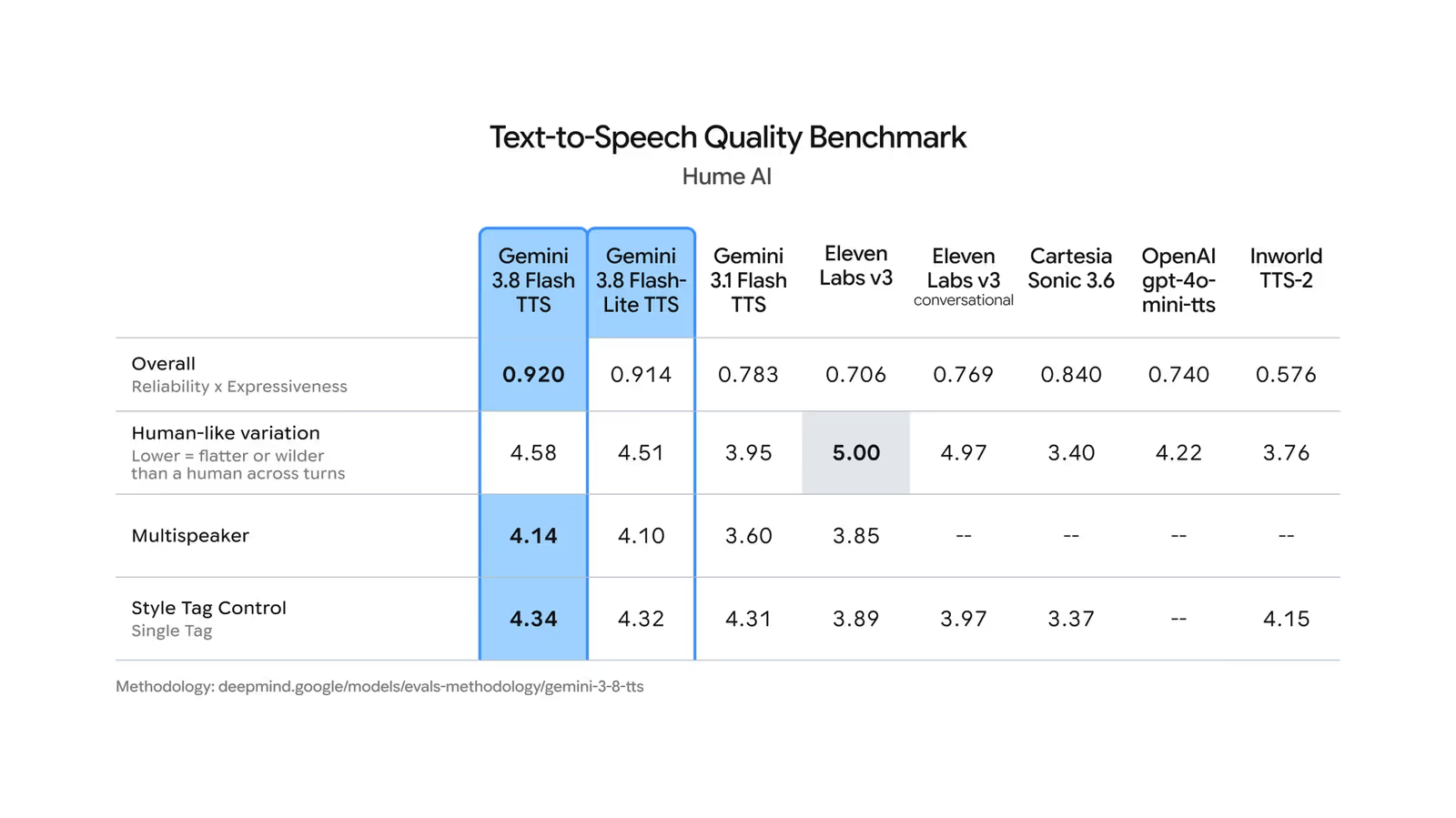
On Hume AI's quality benchmark (shown earlier), Flash TTS scores 0.920 overall and Flash-Lite 0.914, against 0.840 for Cartesia Sonic 3.6 and 0.706 for ElevenLabs v3. The same table shows where the Gemini models do not lead: ElevenLabs v3 has the top score for human-like variation, 5.00 against 4.58.
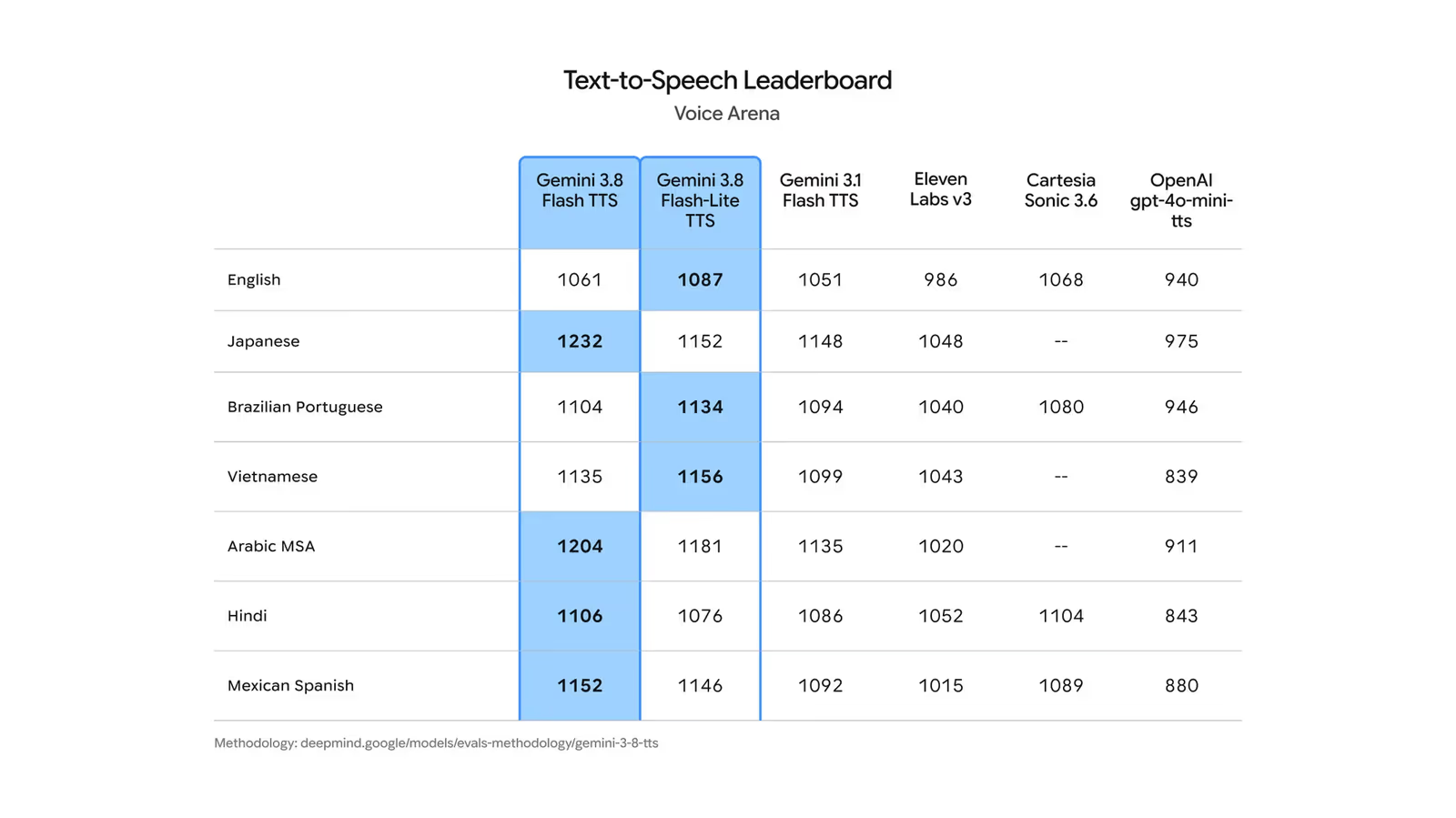
Voice Arena's blind preference scores tell a similar story. Google leads in Japanese, Brazilian Portuguese, Vietnamese, Arabic, Hindi and Mexican Spanish. In English, the cheaper Flash-Lite model tops the table at 1087, and Cartesia Sonic 3.6 (1068) edges out the flagship Flash TTS (1061). In Hindi, Flash TTS leads Cartesia by two points, 1106 to 1104.
Google published no benchmark figures for Gemini 3.5 Transcribe or Gemini 3.5 Live Translate in the pages we read. For Translate, the launch post offers partner feedback only.
Limitations and Inconsistencies
Reading the docs, blog posts and release notes side by side turns up several places where Google's own pages disagree. None is serious, but each is the kind of thing that ends up repeated as fact.
| Topic | One Google page says | Another says | Which to trust |
|---|---|---|---|
| TTS languages | "Over 100 languages" (launch post) | 130 and 101 (model pages) | Model pages; they list each language |
| Voice library size | "2,000+ production-ready voices" (launch post) | "150+" (release notes); "hundreds" (guide) | Unresolved; query the Voices endpoint |
| Live languages | 97 (launch post) | 99 (capabilities guide) | The guide lists 99 by code |
| Transcribe languages | 80+ (release notes, August) | 85+ (model page) | Model page is newer |
| Affective dialogue on 3.8 Live | Listed as a feature (release notes) | "Removed from the API" (model page) | Model page migration notes |
| Extended Thinking levels | Minimal, low, medium, high (release notes) | Low, medium, high; minimal not supported (guides) | The guides |
| Replication sample | "30-second audio sample" (launch post) | 10 to 30 seconds (guide) | The guide |
Beyond the contradictions, these are the practical limits most likely to bite:
- No model does everything. TTS cannot listen, Transcribe cannot answer questions, Translate cannot call tools. A full product usually chains two or three.
- Live sessions are short by default. 15 minutes of audio, or 2 with video, unless you add compression and session resumption.
- Streaming transcription has no speaker labels and caps at 10 minutes per session.
- Two-speaker TTS excludes custom voices.
- Live Translate is still a preview, and Google notes that preview models carry tighter rate limits.
- TTS needs the v1beta API and a recent SDK (google-genai 2.25.0 or @google/genai 2.24.0).
- Everything is watermarked. Google says all generated audio carries SynthID. That is a benefit for provenance, and something to know if you publish the output.
How It Compares
We have not run our own listening tests, so this is a comparison of what is published, not a quality ranking.
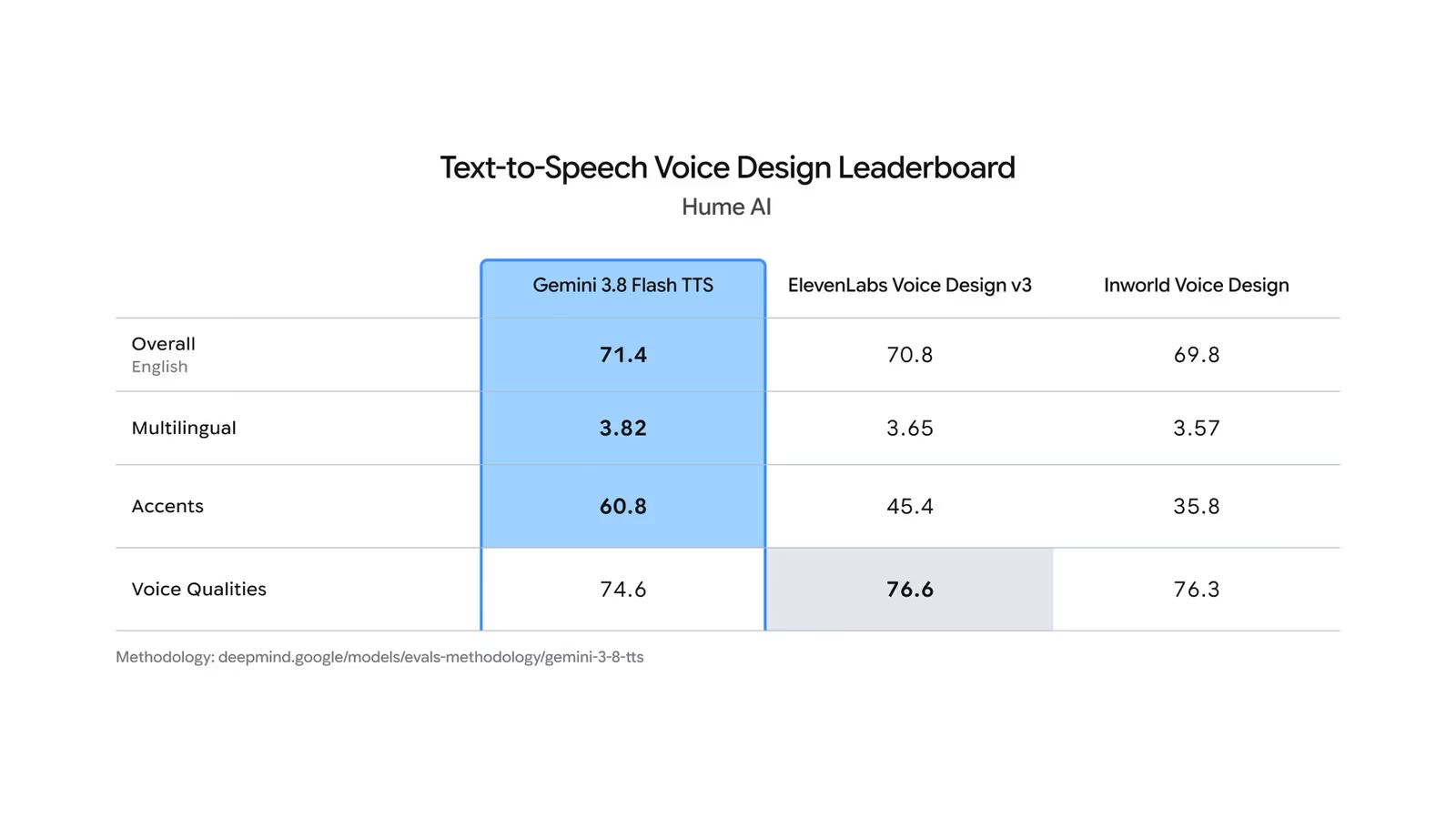
Against ElevenLabs. Google's own tables are the most direct evidence available. Gemini 3.8 Flash TTS leads ElevenLabs v3 on Hume's overall score, multi-speaker score and accent modelling. ElevenLabs leads on human-like variation and voice qualities. ElevenLabs remains a finished creative product with its own editor and marketplace; Google is offering a cheaper, more programmable building block inside AI Studio.
Against OpenAI. The closest match to the Live models is GPT-Live. On the two charts Google published, Extended Thinking and GPT-Live-1 Astra are within about a point of each other, which is too close to call from a vendor chart.
Against open and self-hosted options. Voxtral 3 and Nemotron 3.5 Transcribe can run on your own hardware, which the Gemini audio models cannot. If audio must not leave your infrastructure, Google's line-up is not an option regardless of price.
Against assembling it yourself. Voice-first agent projects such as Hermes Apollo show how much plumbing sits around a voice model. The appeal of Google's set is that speech in, speech out, transcription and translation share one API key, one billing unit and one watermarking scheme. For music, the equivalent comparison is Lyria against Suno, which we cover in our Suno v6 review.
Who Should Use Which Model
| If you want to... | Use | Watch out for |
|---|---|---|
| Narrate articles, courses or audiobooks | 3.8 Flash TTS | About 11 minutes per request; price doubles in January |
| Add read-aloud at volume | 3.8 Flash-Lite TTS with Batch | 101 languages, not 130 |
| Make a two-host audio show | 3.8 Flash TTS, multi-speaker | Two prebuilt voices only |
| Create a consistent brand voice | Voice design or remixing | 200 voices per project; one-year expiry if unused |
| Build a conversational assistant | 3.8 Live | 15-minute default sessions |
| Build an agent that completes tasks by voice | 3.8 Live Extended Thinking | Reasoning adds delay; handle async state |
| Transcribe meetings with speaker labels | 3.5 Transcribe, verbatim | 30-minute chunks; no custom vocabulary with diarisation |
| Add dictation with voice editing | 3.5 Transcribe Live, Smart mode | 10 minutes per session |
| Interpret live calls or events | 3.5 Live Translate | Preview; consent; voice matching can drift |
For content teams, which is the audience the source video speaks to, the realistic uses are narrated versions of existing articles, transcripts of recorded material, and translated audio. Whether audio versions of pages improve search performance is a claim we found no Google documentation for, so we would treat it as an accessibility and reach benefit, not an established ranking factor.
The Bottom Line
The "six audio models" framing is accurate, and the set is more complete than it was six months ago: speech generation, real-time conversation, transcription and translation are all available from one console, all free to try, and all billed on the same 25-tokens-per-second unit. The prices are low enough that an hour of transcription costs about a quarter of a pound and an hour of narration well under a pound.
It is not a single update, though, and it is not finished. Live Translate is still a preview. The standard Live model trails its predecessor on Google's own agentic chart. Two-speaker speech is limited to two stock voices. And the text-to-speech prices that make the headline numbers so attractive double in six weeks. If you are budgeting a project that runs into 2027, cost it at the January rates, and check the model pages, not the launch posts, for the limits that apply to you.
Last updated: 18/11/2026. Prices and specifications as published by Google on 18/11/2026; sterling conversions approximate at $1 = £0.79.
Sources
- Google: Gemini API pricing
- Google: Gemini API release notes
- Google: Gemini API models
- Google: Text-to-speech generation guide
- Google: Gemini 3.8 Flash TTS model page and Flash-Lite TTS model page
- Google: Voice design, Voice replication and Voice remixing guides
- Google: Gemini 3.8 Live model page and Live Extended Thinking model page
- Google: Live API capabilities, session management and thinking guides
- Google: Gemini 3.5 Transcribe model page, audio transcription and live transcription guides
- Google: Gemini 3.5 Live Translate model page and live translation guide
- Google: Gemini API rate limits
- Google, The Keyword: Gemini 3.8 text-to-speech says hello (23/09/2026)
- Google, The Keyword: Introducing Gemini 3.8 Live and 3.8 Live Extended Thinking (15/09/2026)
- Google, The Keyword: Fluid, natural voice translation with Gemini 3.5 Live Translate (09/06/2026)
- Julian Goldie SEO: This Google AI Studio Update is ABSURD!